Daily insights for city builders, delivered every morning at 6 AM ET. I’m Brandon Donnelly — a Toronto-based real estate developer and founder of Globizen. I’ve been writing here since 2013.

Tag: athiscity

  • Streetcars are just a tool

    Earlier this month the Toronto Star published an article talking about the resurgence of streetcars in American cities. According to the Star, 89 cities in the US are currently implementing or at least considering building some form of surface-rail system.

    But the article also goes on to argue that it could be a snobbish fad. Streetcars are new. They’re shiny. And they make yuppies –  who don’t like taking buses – feel better about themselves. But is the ROI really there? Is the economic impact of streetcars as big as people are making it out to be?

    To support this argument, the Star quoted transportation planner Jarrett Walker, who I’ve mentioned here before on Architect This City. But according to a follow-up post that Walker did on his blog, it would appear that he was misrepresented in the article. Here’s a snippet of his response:

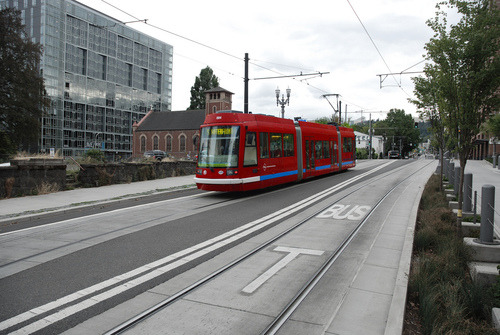
    Here’s the bottom line. Streetcars are just a tool. They can be used in smart ways and in stupid ways. Asking a transit planner for an opinion about a transit technology is like asking a carpenter what his favorite tool is. A good carpenter sees his tools as tools and choses the right one for the task at hand. He doesn’t use his screwdriver to pound nails just because he is a “screwdriver advocate” or “hammer opponent”. Yet the Toronto Star assumes that nobody involved in transit debates is as smart as your average competent carpenter.

    I wanted to share this because I think it’s a great way to approach transportation planning and because I think it gets at a larger issue that we continue to face here in Toronto: We keep politicizing mobility tools. Cyclists have become pinkos. Streetcars are a war on the car. And the list goes on. How about we just look at the problem, and figure out what solution would work best?

    Image: Flickr
  • What should San Francisco do with the Tenderloin?

    image

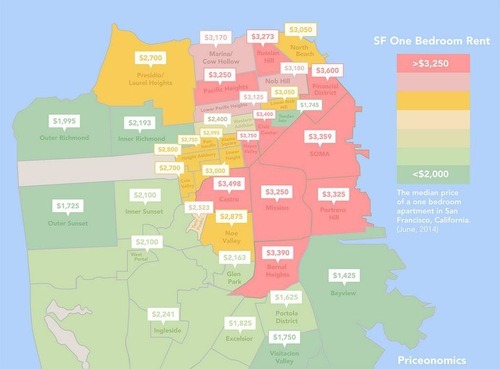
    Recently Priceonomics posted a piece on San Francisco’s “rent explosion.” In it, was the infographic above showing the median rental rate for a 1 bedroom apartment in the city. The most obvious takeaway is that San Francisco is real expensive. In the core of the city, you’re easily looking at $3,000 per month.

    That is with one exception: the Tenderloin (the green area just northwest of SOMA in downtown). The first time I ever visited San Francisco, I actually stayed on the outskirts of this area, which is a neighborhood well known for seediness, homelessness, crime, drug trade, strip clubs, and so on. And it was actually named after a similar neighborhood in New York that was also a center of vice in the late 19th and early 20th centuries.

    But when I saw this diagram, I immediately asked myself: How could it be that the Tenderloin was holding out so well against the forces of gentrification? How is this island of seediness being preserved in the center of downtown? Particularly in a city like San Francisco where there’s a perpetual housing supply shortage and lots of wealth. The Tenderloin has some of the lowest rents in the city.

    So I tweeted the good folks at Priceonomics and they responded with this article. It’s a few pages long, but the reasoning seems to come down to the following: active community groups that fought to keep developers out of the area (and that also own many of the buildings), downzoning, and a high percentage of rooming houses. According to that same article, the Tenderloin contains approximately 100 single room occupancy residential hotels (or SRO’s as they’re called). These were initially built to house the city’s transient and seasonal population after the great fire of 1906.

    So it would appear that there are some significant barriers to entry.

    But at the same time, it generally seems like a bad idea to concentrate poverty, homelessness, drug users, and so on. Interestingly enough, the article talks about how when the Bay Area’s transit system went on strike for a period of time, the supply of drugs actually dried up in the Tenderloin. This underscores how regional the drug business is, but also makes me think that dealers are almost surely benefiting from the clustering of their client base.

    In any event, this is a much larger problem than just a real estate development one. I don’t know what the solution should be, but I’m pretty sure that things are being made worse by concentrating everything in one neighborhood and by rising income inequality in the city. Inequality seems to lead to all kinds of negative externalities and, from my experience, mixed-income neighborhoods perform better than 100% poor ones.

  • A new vision of Yonge Street

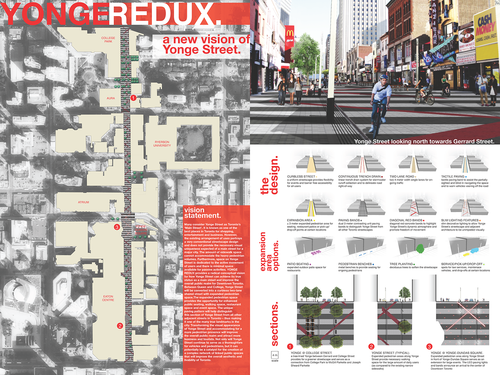
    Back in April I wrote about a competition for young people to reimagine public space in Toronto. It was called NXT City. Well that prize has been awarded and the winner was Richard Valenzona for his vision–called Yonge-Redux–of a new and reimagined Yonge Street. To download the PDF of his entry (the image shown above), click here.

    The proposal encompasses a stretch of Yonge Street that runs from Queen Street in the south, to College Street in the north. It would capture the Toronto Eaton Centre (mall), Yonge-Dundas Square, Ryerson University’s expanded Yonge Street footprint, and the massive mixed-use developments happening in the College Park area (see Aura Tower). To quickly simplify, the proposal is essentially about enhancing the urban experience, prioritizing pedestrians, and reducing the flow of cars to two lanes.

    Overall, I think it’s a wonderful proposal and I’m not surprised it won NXT City. This type of intervention is on so many of our minds. In fact, it’s somewhat surprising that we’ve been as slow as we have to improve our main street. There are so many anchor institutions, such as the Eaton Centre and Ryerson University, that plug into this section of Yonge Street. It makes a lot of sense.

    But as I said in my original post, one of the most exciting things about the NXT City Prize is that it has always been about execution. This is not just an academic exercise–or at least that’s the hope. This exercise is about spurring real change in the city and I genuinely hope that they’re successful in doing so. Because then I can turn around and say: Take that Melbourne 🙂

    Kudos to Richard Valenzona, Mackenzie Keast, as well as everyone else involved in NXT City, for making this initiative a reality and for doing your part to make Toronto even more awesome.

  • #ATHISCITY

    One of the things that makes cities so exciting is the fact that they’re always changing. New restaurants open up. New buildings are built. Old buildings (with no heritage value, of course) are demolished. Bike lanes are added. New infill homes pop up in quiet residential neighborhoods. And the list goes on.

    For years I’ve wanted an app or some sort of product that would allow city builders to keep track of everything that’s going on in their city. In the same way that Foursquare helps you find cool restaurants around you, I would like to know about everything that’s going on, from rezoning applications to construction updates.

    One of the challenges, of course, is that I’m sure more people care about cool new restaurants than about esoteric planning applications. It’s definitely a niche market. But that doesn’t mean there isn’t a thriving group of people who do care. So I’ve decided to introduce an Architect This City hashtag on Twitter: #ATHISCITY.

    I’ll be using it for city building updates and, if some of you join in as well, I think it could become a great way to keep track all of the neat things that are happening in our city, as well as in others around the world.

  • Does the world need a Global Parliament for Mayors?

    Earlier this month a team consisting of Benjamin Barber (who is author of If Mayors Ruled the World: Dysfunctional Nations, Rising Cities), Richard Florida (who is Director of the Martin Prosperity Institute here at the University of Toronto), and Don Tapscott (who is a leading authority on innovation) released a research report advocating for a global network of cities that they’re calling a “Global Parliament for Mayors.”

    Here’s a snippet from the press release:

    “Nation-states work together through multi-lateral agreements and global institutions in an effort to solve global problems. But states have limitations, and their cooperative efforts in our new era of interdependence and globalization are increasingly insufficient and even ineffective and outmoded,” say the three prominent researchers. A Global Parliament of Mayors represents a new type of governance network – one with enormous potential.

    “Our proposed parliament would operate as a global urban network with a vibrant online community that collaborates on key issues 365 days a year,” they say. “Multi-stakeholder governance has come of age and is now fully independent from control by any government, or governmental organizations like the UN.”

    And if you dive into their report, you’ll find the following 5 reasons for why they believe a Global Parliament for Mayors (GPM) makes sense:

    1. Global migration to cities. Most people live in cities, so it makes sense to concentrate problem-solving capabilities there.
    2. Urban predisposition for problem-solving. Cities are entrepreneurial, close to the people and richly connected to a wide variety of stakeholders. They have a history of cooperation and pragmatic problem-solving. 
    3. A need for experimentation with new governance models. Traditional models of state-based global governance have struggled to advance effective solutions to many global problems, so there is an urgent need to experiment with new models. The GPM is the most promising. 
    4. Digital networks. Online collaboration technology makes it possible to operate a largely virtual parliament that would not only be more cost-effective, but more transparent, inclusive and productive.
    5. Digital citizens. There is a large, educated and motivated population of digital citizens that could be tapped to improve urban governance.

    In principle, I agree with the direction. And I feel that way because of the two major shifts outlined above: More people are living in cities (a trend that all urbanists talk about ad nauseam) and digital networks are having a disruptive effect on the way we run companies and live our lives.

    I’ve talked before about how the internet is causing a decentralization of value creation (see Airbnb, YouTube, and so on) and so I think it only makes sense that our governance structures will inevitably go through a similar transformation.

    The governance models that we are living with today were put in place during a time when the world was a different place. At one point, nation-states were the de facto way to effectively organize ourselves on a global stage – probably because there wasn’t any other reasonable alternative.

    But today, we are connected and interdependent in entirely new ways. And so the opportunity in front of us is to create a governance structure that leverages the progress and innovation that’s happening in cities, everywhere.

    If cities are our most important economic unit, then mayors are arguably some of our most important leaders. So it behooves us to figure out how to give them the frameworks and forums to best do their job.