Daily insights for city builders, delivered every morning at 6 AM ET. I’m Brandon Donnelly — a Toronto-based real estate developer and founder of Globizen. I’ve been writing here since 2013.

Tag: athiscity

  • How Energy Recovery Ventilation units work in a condo building

    Lately I’ve been thinking that I don’t talk enough about architecture and about buildings on Architect This City. So today I’m going to step away from transit, driverless cars, and the other topics I’ve been discussing lately, and instead talk about something a bit more technical: mechanical systems and Energy Recovery Ventilation (ERV) units. If you’re thinking about buying or investing in a condo, I think you’ll find it useful.

    Buildings work in many ways just like people do. They breathe in fresh air and they exhale out stale air. And just like you and I, once air has been exhausted out, it needs to be replaced, or made up, with more fresh air. In the world of buildings, this replacement air is called “makeup air.”

    It’s for this reason that you’ll often see no smoking signs directly outside of buildings. It’s because if you happen to be smoking next to a fresh air intake, you’d actually be distributing cigarette smoke throughout the entire building. The same goes for idling trucks and other pollutants.

    The amount of fresh air that needs to be pumped into a building will vary. For some uses – like hospitals and laboratories – the requirement for fresh air can be significantly higher. Sometimes as high as 100%. And that’s because you don’t want a building with toxic smells or lots of sick people to be relying on too much recirculating air.

    You might then be wondering why we don’t rely on 100% fresh air in all buildings. And the reason is that it is incredibly expensive to do so. When you take in fresh air from outside, it needs to be conditioned before it can be distributed. And that takes energy. In the winter when it’s -10 degrees outside (hello Toronto), you need to heat up that air. Whereas recirculating air is already conditioned. So you just, well, recirculate it.

    In most condo buildings, makeup air is supplied by dumping air into the corridors. To check if your condo functions like this, just look for a big vent outside in your hallway. This air then gets sucked into the individual suites by way of slits or openings around your front door.

    So another way to check if your building operates this way is to see if your front door is letting in air from the hallway (or if it’s sealed). There’s nothing necessarily wrong with this approach, but sometimes you might end up pulling in smells from outside of your suite.

    This now brings us to Energy Recovery Ventilation (ERV) units.

    The way an ERV works is very simple. Let’s use our winter example, where it’s -10 outside (and you’re questioning why you live in a place that’s so cold). In this scenario, you’d be pulling in freezing air and exhausting out warm air from your apartment.

    What the ERV does is transfer some of the warmth from the warm exhaust air to the cold intake air. This means the fresh air ends up coming inside your place at a warmer temperature and doesn’t need to be heated up as much. It’s “preconditioned.”

    This saves energy. And it saves in utility costs.

    But the other benefit of these ERV units is that, instead of pulling fresh air (or makeup air) from the corridor, it pulls it directly from outside of your condo suite. In other words, your front door is sealed and each suite is responsible for its own fresh air demands. The overall result is typically better indoor air quality, better energy efficiency, and lower utility costs.

    At both DUKE and Kingston&Co, which are two condo projects that I’m currently working on a TAS, we’re putting an ERV unit into every suite. We think it make sense. But there are always questions around how much purchasers actually care about measures like this. Things like fancy countertops and appliances are usually what sells. Not some hidden mechanical unit that you’ll never see or even know exists.

    But I think details like this matter. What about you?
  • The war on the car

    image

    In today’s post I’d like to focus on the second tweet I embedded in yesterday’s piece about downtown Toronto. Specifically, the fact that almost 75% of downtown residents walk, cycle, or take transit to work, leaving drivers firmly in the minority.

    For me, this then makes me question whether or not we’re optimizing well enough for the majority. However, it’s often not that simple. And that’s because the downtown core is clearly regional in its draw, and the further you move out from the downtown core, the more the modal split flips. In the suburbs, driving is obviously the majority.

    And herein lies the tension and the reason for all this “war on the car” rhetoric: We have a downtown core with completely different mobility preferences than the rest of the region.

    But as Toronto continues to intensify and grow (the population of the Greater Toronto Area is projected to reach almost 9 million by 2036), I truthfully don’t know how we could reasonably expect to (efficiently) move that number of people in private cars. I’ve just never seen it done before.

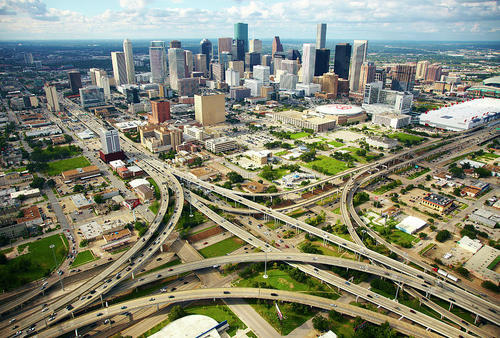
    Some people think that if we simply got rid of all those damn streetcars on our city streets, that we’d be doing a lot to eliminate traffic congestion. But it’s not that simple. The Highway 401 here in the city is already 18-lanes and one of the widest in the world. And yet it’s perpetually clogged. No streetcars there.

    So I look at this tension as a growing pain. Sooner or later I think we’re going to realize that this war should really be a war on inefficiency. How do we move lots of people around big cities while minimizing waste, maximizing economic output, and enhancing quality of life?

    Now that’s a war worth fighting.

    Image: Helibacon

  • Downtown Toronto in numbers

    Last week I tweeted out a Tweetstorm with some of the key facts from this City of Toronto study on the downtown core. Here are two of those tweets:

    //platform.twitter.com/widgets.js

    While I realize that reading city reports is probably not everyone’s idea of fun, it is a good one if you want to understand the massive change that is taking place in Toronto right now and also the importance of the downtown core for this region.

    To put things into perspective, consider that the downtown core (including King West, King East, and the Portlands) is estimated to be responsible for 51% of the entire wealth generated in this city. And yet its physical area is easily less than 10% of the entire city (which is about 630 square kilometers).

    That’s fascinating to me.

  • What are Boomers going to do with their suburban homes?

    The following chart represents births in the United States per 1,000 people. The segment in red demarcates the birth years between 1946 and 1964, which is generally considered to represent the Post-World War II population spike known as the Baby Boom. Besides this jump, we have for the most part been seeing declining birth rates.

    US Birth Rates.svgUS Birth Rates” by Saiarcot895. Licensed under CC0 via Wikimedia Commons.

    Given the magnitude of this population segment, demographers and others love to talk about the impact that this generation has had and will continue to have on society, particularly as many Baby Boomers now start to enter retirement.

    But arguably one of the most significant areas of impact could be the housing market. Today, I stumbled upon an interesting CityLab article from last year talking about “The Great Senior Sell-Off.” And it raises an important question: As Baby Boomers begin to sell off their large single-family homes in the suburbs, will there be enough people to buy them?

    For the most part, the next generation seems to still want a nice detached house in order to raise a family. But that doesn’t necessarily mean that the numbers will match up. Because if you factor in generation size, buying power, and even small shifts in consumer preference (towards, say, urban centers), the equation may not balance.

    If this ends up being the case, I don’t think it’ll impact large, growing cities as much. I mean, most are operating today with severe supply deficits. Instead it’ll probably be the smaller, perhaps already declining cities, that feel it the most. And this will ultimately serve to reinforce the “spiky” world that we’re already seeing today.

    At least that’s my hunch.

  • DSCRBD: Curating interesting minds through short video

    A good friend of mine recently launched a new project called DSCRBD (pronounced ‘described’). The goal is to “curate interesting minds” through short social video clips. Think Humans of New York but only creative types and only short videos.

    I think it’s a great idea. And I was fortunate enough to be one of the first test subjects. It was conducted as an interview between he and I, and we spoke for probably about 45 minutes on the sun deck of my building.

    He then took that entire interview and distilled it down to only a few seconds, extracting what he found most interesting. Perfect for social media consumption.

    image

    Click the image above for my video. What I’m talking about is my approach to architecture, and how I ended up not becoming an architect, but instead becoming a real estate developer.

    I think he’s on to something here and I would love to see it develop further. He’s using the right mediums and format to get the message out in today’s noisy social world. But there’s also no reason that it couldn’t grow to include more content or simply feed to other content, such as what he did with Architect This City.

    If you’re somebody that you think he should profile or know of someone that would be a good fit, drop him a line at hello@dscrbd.com.

  • More thoughts on driverless cars

    image

    If you’re a regular reader of Architect This City, you’ll know that I’m a big supporter of public transit. And that’s because, as far as I can tell, it’s the most efficient way of moving lots of people around a big city.

    But more and more I’ve been thinking about how technology might change, or even disrupt, this school of thought. Which is why when I wrote this post a few days ago, I was careful to say that private cars aren’t the mobility answer. Because in reality, cars likely aren’t going to go away. We’re just going to use them differently.

    Here are the two things I’m thinking about most:

    1. Driverless cars

    I’ve written about driverless cars before in terms of how they might be used as a form of public transit. But I think it’s worth revisiting them for a moment. There are lots of driverless car critics out there and they usually fixate on the fact that a car is still a car, whether or not you happen to be driving it. It still takes up the same amount of space in our cities. Or does it?

    The key thing to keep in mind is that when we’re not longer driving the vehicle, it opens up lots of different possibilities in terms of how they might be used and also how they might be designed. I was watching this fireside chat with the founders of Google the other night and, for them, driverless cars offer the possibility of solving two big problems: traffic and parking.

    We know that parking takes up a lot space in our cities. But that’s really symptomatic of the fact that the utilization rate for most people’s cars is incredibly low. Most of the time a car is sitting parked and idle. But with driverless cars, they’ll be able to drop you off at your destination and then continue on to pick up their next ride–thereby minimizing the need for all that parking.

    This would bring the utilization rate way up for each car, which would also minimize the number of absolute cars that we’d need to have in our cities to move everybody around. Of course, this would mean that we’d be sharing cars. People wouldn’t own cars; they would be an on-demand service.

    2. Networked vehicles

    This brings us to my second point: driverless cars will be networked cars. Again, I’ve written about this before, but I specifically wanted to raise it again because of a new service that Lyft just launched in San Francisco called Lyft Line.

    The way it works is simple. You input where you’re going and Lyft will match you up with others who are going to more or less the same destination. The routes get shared and this brings down the costs to everyday use. It runs on the same principles as the on-demand minibuses I wrote about in Helsinki.

    But if you combine this with driverless cars, you’re starting to get at something incredibly interesting. Now all of sudden you’re getting the door-to-door convenience of private cars with many of the efficiencies of public transit.

    So in my mind, it’s very possible that platforms like Uber, Hailo, and Lyft could became major infrastructure backbones in a world of driverless cars. And if you think about it in this context, then I don’t think the valuations for these companies should seem all that surprising. These are potentially huge innovations.

    In the end, I don’t know how this will all shake out. I don’t think anybody does. I believe that strong public infrastructure (such as subways, light rail, and so on) will still be needed in big cities, but I’m starting to think that mobile apps and driverless cars will also form a big part of how we get around. Probably more so than most people think today.

    Image: Flickr

  • The Globe and Mail: Why Toronto is still a streetcar city

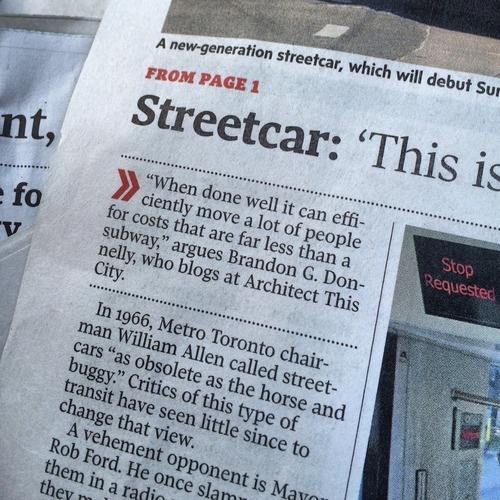
    In anticipation of our new streetcars beginning service this Sunday, the Globe and Mail published an article on Friday called: Why Toronto is still a streetcar city. And I was quoted as saying the following:

    I had no idea that I was going to be cited, but I like the quote that was chosen. The key words are: “when done well.” There are a myriad of different ways in which a city can implement streetcars, and each will have varying degrees of performance.

    So if you’re one of those people who are critical of streetcars, I would encourage you to think about streetcars not just in terms of how they’re implemented today in Toronto, but also in terms of how they could be implemented going forward.

    All streetcars lines are not created equal.

  • Toronto approves 755 storeys of new development

    image

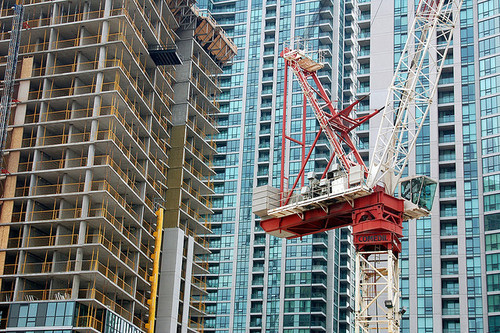
    Earlier this week, Toronto City Council approved the equivalent of 755 storeys of new development, a lot of which will end up in the downtown core. The translates into 6,887 new housing units and roughly 4 million square feet of new commercial space. The Globe and Mail called it the Manhattanization of downtown.

    If you’d like to go through the complete City Council meeting agenda, you can do that here. (I warn you though, it won’t be an exciting read.)

    One notable project that was approved is 50 Bloor Street West, which is a 71-storey mixed-use building in Yorkville adjacent to and on top of Holt Renfrew (It includes a $6 million Section 37 contribution). I mention this one because it’s impressively tall and because it’s a project that I was involved with when I was at Morguard. Watch for Yorkville in the coming years, there’s a lot in the pipeline.

    While I think this is all incredibly exciting, our chief planner, Jennifer Keesmaat, is entirely correct in pointing out that all of this highlights the desperate need for better infrastructure, the most critical of which is a relief subway line that cuts across downtown.

    But to be clear, this isn’t a question of just planning for growth. This is a question of planning for growth and making up for decades of infrastructure disinvestment. That’s the position we’re in today, which means we have a lot of hard work to do. Though I’m confident we’ll get it done.

    The other thing that this level of intensification should highlight for you is that public transit, and other forms of mobility such as biking and car sharing, have to be central to our goals. It’s simply infeasible for everybody to be driving around in a car. We’re currently demonstrating how efficient that ends up being.

    So as Toronto continues to intensify, I think we’ll quickly discover that traffic and private cars aren’t the answer or even the right question to be asking.

    Image: Flickr

  • Personal vs. branded blogging

    As I approach one year of ATC and as people like Lockhart Steele (founder of Curbed and Eater) return to personal blogging, I wanted to share something that’s been on my mind for almost this entire last year. And that is, should ATC just be a personal blog or should there be some greater end goal?

    Right now it’s a bit of a hybrid. It’s hosted at brandondonnelly.com, but along the way I created a somewhat independent Architect This City brand. The most obvious option is to continue to grow ATC and turn it into something like Curbed, This Big City, or Sustainable Cities Collective. In fact, a good friend of mine emailed me a few weeks ago and asked me why I’m not doing that.

    But to do that would require a lot more time and many more posts a day. It would also mean more restrictions on what I can, or should, write about. Personal blogs are, well, personal. Branded blogs typically require a focus. Today I live comfortably in between both of those worlds. I write almost exclusively about city building, but I introduce many personal touches. Architect This City has become my personal brand.

    In many ways, I feel like this tension is a natural one. With the rise of social media and the belief that “everybody is their own media company”, more and more people are finding themselves debating whether or not they should position themselves personally online or create an independent brand.

    At the same time, blogging is evolutionary. It’s a laboratory. And most of the benefits are entirely indirect. Writing helps you get your ideas on “paper” and sort through them publicly. And sometimes that leads to unexpected outcomes. I mean, in the case of Lockhart, he started blogging about his Lower East Side neighborhood and that gave birth to Curbed, which he then sold to Vox Media.

    So as much as I try and plan out where I think blogging everyday could take me, it’s also good to sit back, enjoy the ride, and just see where it takes me.

  • How much should a ride on the Union Pearson Express cost?

    When I was in Chicago a few weekends ago, one of the things we did was take the train from Midway Airport to downtown. We were a large group, but since it was only $2.25 and we figured it would be easier and faster than contending with traffic, we decided to take it.

    Since it was their local transit service (as opposed to a dedicated airport rail line), the train came within a few minutes and it took us about 25 minutes to get to the Loop. It was a great experience. And I would take it again the next time I go to Chicago.

    I mention this because there’s been a lot of debate in Toronto recently about the potential ticket price for the new Union Pearson Express train to the airport. Some are suggesting that it could cost upwards of $30 for a one way ride, which would also take 25 minutes and would leave every 15 minutes.

    The concern is that at this price, the train will only serve the business community and the rich. And indeed, it’s a lot more than the $2.25 I paid when I landed in Chicago earlier this month. But at the same time the Union Pearson Express promises to offer a more refined travel experience than your regular old subway train. So how should it be priced?

    Pricing exercises are really interesting because, as David Fitzpatrick pointed out in a recent tweet, increasing the price of the ticket will lower ridership. And at a certain point, this will cause overall revenues to also decline (the loss in ridership stops being made up by the higher ticket price). So, in theory at least, there exists a magic, profit maximizing number.  

    Of course, profit may not be the only goal. One might also be interested in reducing the number of vehicles on the road, promoting sustainability, and generally providing people with a convenient way to get to and from the city’s biggest airport. And should this be case, then those factors also need to be worked into the pricing model.

    Now, I don’t know what that magic number should be off hand, but I do think we need to be clear on our goals as that decision is made.

    I personally believe that we underprice roads in this city, which is why we have such a supply and demand imbalance (i.e. gridlock). And so if we decide that rail travel should be a premium service, then I don’t think it’ll do much to correct that imbalance.