Daily insights for city builders, delivered every morning at 6 AM ET. I’m Brandon Donnelly — a Toronto-based real estate developer and founder of Globizen. I’ve been writing here since 2013.
A few weeks ago I watched a talk by Keith Rabois called, How to Operate. Keith is a venture capitalist with Khosla Ventures, the former COO of Square, and a member of the PayPal Mafia.
The talk was primarily geared towards startups, but much of what he talked about could be applied to any organization where people are managed. So whether you’re an architect, real estate developer, or governmental organization, I bet you’ll find the lessons relevant.
One in particular that stood out for me was the idea of barrels and ammunition.
For a lot of organizations, the thought is often that by adding more people you’ll be able to increase output. More people = greater velocity. But Keith’s reasoning is that most people are actually ammunition. And just like in war, it doesn’t exclusively matter how much ammunition you have. You can only shoot through the number of barrels you have. Output depends on barrels.
So who exactly are barrels?
Barrels are the kind of people who can take something from idea all the way through to completion, while at the same time taking a group of people along with them. They are, in other words, your leaders.
But, they are difficult to find.
There are fewer barrels than ammunition. And, the culture of the organization itself will impact every person’s ability to be a barrel. Here’s how Keith puts it:
Barrels are very difficult to find. But when you have them, give them lots of equity. Promote them, take them to dinner every week, because they are virtually irreplaceable because they are also very culturally specific. So a barrel at one company may not be a barrel at another company.
That’s something for you to think about as you start your workweek.
This past week was Toronto’s first real snowstorm of the season. It was awesome. I love snow. And part of the reason I love it, is because it means snowboarding season is here. Yes, the “mountains” in Ontario suck, but Quebec and Vermont aren’t too far away and every February there is The Annual.
This year in preparation for the season I decided to splurge on a GoPro camera. We had a lot of fun filming last year in Jackson Hole and, since it looks like we’re going to have close to 10 people at this season’s Annual, I wanted to throw another camera into the mix. Expect another ski and snowboard video sometime in February 2015. We’re heading out to Alberta and British Columbia.
I also ordered this mount for the camera:
But as I was ordering the camera, I started to think about what else I could use it for. And then it hit me: city tours. One of the things I love to do in the summer is ride my bike around the city and explore. I like to find areas I don’t know very well, find new developments I may have missed, and generally just get to know the city more intimately.
Being on a bike is really the perfect way to do this. You don’t cover enough ground walking and with driving you simply miss too much of the city. So what I want to do is strap my GoPro to my handle bars and bring you along for these exploratory bike tours. I think it could be a unique way to show you the city – even if you happen to also be from here.
How does that sound?
It likely won’t happen until the spring, but if you’re interested in joining me, let me know. I think this could be a lot of fun with a group of city geeks.
Harvard Business Review recently published a conversation between Roger Martin – who is the former dean of the Rotman School – and Tim Brown – who is CEO of the global design firm IDEO. The title of the talk is “Capitalism Needs Design Thinking.” But I decided to call this post something else after reading Roger say this:
My friend Dan Pink argued in an HBR piece in 2004 that the MFA is the new MBA. I wrote to Dan to say that if that’s the case we have a problem because America pumps out a mere 1,500 MFAs a year versus 150,000 MBAs. Thirty MFAs per state per year is just a rounding error. This is one of the reasons I was so keen on transforming business education. It’s a huge infrastructure: 27% of all graduate students in America are in an MBA program. If they’re all being taught how to analyze things to death, that’s going to affect how they’ll shape the future of business.
I’m very worried about the fact that in America we’ve now gone 24 years without the median household income rising — it was the same in 2013 as it was in 1989. That’s unprecedented in American history. The longest that’s ever happened before is when it took just under 20 years to recover, after the Great Depression. This long period of stagnation has coincided with the top 1% of the economy doing spectacularly.
And so while it’s easy to point fingers at the tech community and say that it’s to blame for rising income inequality, the reality, I think, is that there are other more fundamental issues that need addressing. Roger and Tim believe that design thinking can help. Here’s another great snippet from the former:
I think the way that government generally works is to think, think, think, think, and then finally create legislation that brings about some change, and then they ignore their legislation and say okay, we’re finished with that. Then people go and figure out how to game that legislation, and the government doesn’t do anything about it. Whereas if they had a design view of it, they’d say when they passed a bill, that’s just the best idea we’ve got now, we have to go see how it works in practice, and then fix it. That’s just not the mentality.
Technology is having a profound impact on the world. And it’s something that is very visible. But part of the challenge is that governments aren’t keeping up. They are almost never out in front.
So when something new comes along, like Airbnb or Uber, the reaction is to just stop it. It doesn’t conform to the rules and regulations currently in place, and so it shouldn’t exist.
But as Roger and Tim point out, maybe we need to look at our rules and regulations as simply part of an iterative process (like designers do). Because if we did that, maybe we’d be better equipped to transfer the benefits of innovation over to society as a whole.
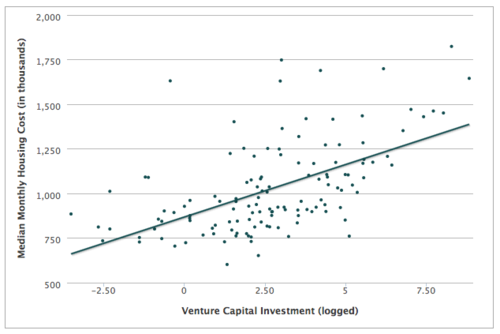
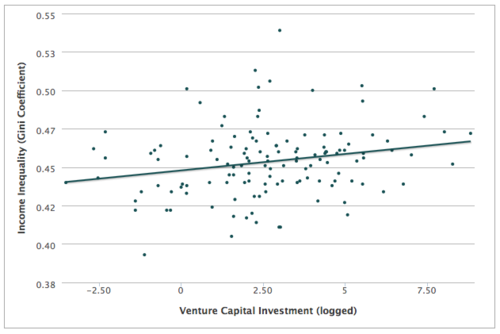
Earlier this week Richard Florida published on article on CityLab talking about the relationship between tech innovation (in cities) and inequality. Specifically, the article deals with the correlation between venture capital investment and a variety of factors, such as monthly housing costs, wage and income inequality, and so on.
The intent of the piece was to address the growing backlash against tech workers – in places like San Francisco – who have become the symbol for the growing gap between the rich and poor.
The strongest correlation appears to exist between venture capital investment and housing costs. As the amount of venture capital goes up, so do housing costs – which probably shouldn’t surprise you. The rich start outbidding the poor for housing. Note: The two outlying dots at the top right, in the graph below, are Silicon Valley and San Francisco.
But when it comes to inequality, the relationship isn’t so clear. For wage inequality, there seems to be a relationship. But for the broader income inequality measure, the relationship is fairly weak. Here’s the graph:
So this is not as black and white as it might seem. Regardless, Florida ends the piece with the following statement (that I think is spot on):
It’s time to stop pointing fingers and get on with the far more important task of harnessing the urban tech revolution to create a new urban middle class and a more inclusive urbanism—one in which many more workers and residents can participate, and one from which many more can benefit.
The answer is not to stop innovating. That would be counterproductive. We should be be encouraging innovation, but at the same time figuring out how best to harness it for society as a whole.
Tomorrow, I’ll touch a bit more on how we might go about doing that. I have a post planned that I think will tie in really nicely to this discussion. So stay tuned.
I’ve made a few changes around here. If you’re reading this post on the actual site (as opposed to via Tumblr, your email subscription, or some other feed) and you’re a regular reader, you might notice that I’ve completely redesigned the look and feel of Architect This City. If you can’t see it and want to take a look, click here.
It’s something that I’ve been meaning to do for awhile now. And it’s because I haven’t been happy with how this blog showed up on mobile devices. It wasn’t responsive. That made ATC less enjoyable to read on your phone and it made it a bit of a pain to leave comments. And since almost 35% of readers are on mobile (and that number is only going to go up), it was time to make a change.
This site now looks more or less the same whether you’re viewing it on your desktop or on your phone. I also made sure to make the font nice and big so it’s an easy read on mobile. I think it’s a big improvement. But I’d love to also get your feedback on the redesign. I hope you like it as well and I hope it leads to more frequent discussions in the comment section 🙂
Yesterday Opendoor.com finally launched their product in Phoenix. If you’re a regular reader of Architect This City, you might remember that back in July of this year I wrote about how they had just raised $10M of funding to make selling your home as easy as a few clicks.
Well, since then, I’ve been following them like a hawk. I had all the founders on Twitter notification (so I got notified every time they tweeted) and I was eagerly anticipating their launch.
Now that they’ve launched, we have a much better idea of how their business model is going to work. I say “better idea” only because there’s still portions of it that are a question mark for me.
In any event, Opendoor basically provides instant liquidity to homeowners. You go on, tell them about your home, and they then make you an offer to buy, which looks like this and lasts for 3 days. The offer they make you is calculated using comparable sales and adjustments based on your home’s unique characteristics.
Upon accepting their offer, they then schedule a home inspection (at their cost) to confirm your home’s condition. Once this is done, you just select your move out date and Opendoor handles the rest. The fee for all this is 5.5%, which the company claims is less than the 6% that realtors typically charge (this would be high for Toronto).
After buying your home, Opendoor plans to turn around and resell it.
What this reminds me of is a “bought deal.” In the world of investment banking, a bought deal is when the bank itself agrees to buy the entire offering of a particular security, as opposed to going out to the market and trying to raise the money. The advantage to the company (offering the securities) is that there’s no financing risk. They know they’re going to get their money. But it usually means the company gets a lower price.
So what I wonder, is if this is what’s going to happen here. Since Opendoor is effectively taking on the selling risk, does that mean their offers will be lower? Or are all their costs built into that 5.5% and that’s truly their core business model? I’m sure some of this will surface in the coming weeks.
I do, however, think they are smart to be focusing on the supply-side of the marketplace and offering virtually perfect liquidity to homeowners. Real estate is a unique asset in that it’s difficult to bring supply to the market. And so if control the supply-side, I think you have a pretty good shot at controlling the market as a whole.
The Economist recently published an essay called, A Planet of Suburbs – The world is becoming ever more suburban, and the better for it. The argument is basically that the “great urbanization” that everyone loves to talk about these days is actually a misnomer. From Chicago to Chennai, it’s not the urban core that’s growing. It’s the suburbs. And so what we’re seeing should actually be called the great suburbanization.
The basis for this argument is that wealth fuels sprawl. As people become richer, they naturally consume more of everything – including space. It’s a natural market outcome.
Take for example, the path of many of Toronto’s ethnic groups. In the first half of the 20th century, College Street was the Little Italy. Then it shifted north and St. Clair Avenue West became the more authentic Little Italy. Today, many Italians now live north of the city in Woodbridge. In fact, last weekend I was on St. Clair West and was disappointed to learn that one of my favorite butchers had closed up shop and “moved to Woodbridge.”
However, there are also many supporters of the exact opposite outcome. From Edward Glaeser to Alan Ehrenhalt, many have argued that we’re in the midst of a “great inversion.” The suburbs are no longer a threat to urban centers. It’s the urban centers who are threatening the suburbs. The suburbs are dead. Long live the city.
So which is it?
Well, The Economist does cite two examples where true urbanization is actually taking place. It’s happening in Tokyo and London. In both cases, it’s the city center that is growing the fastest – not the suburbs. The explanation for Tokyo is its aging population. And the explanation for London is its restrictive greenbelt, which effectively stops the possibility of any further sprawl.
Here in Toronto – where there is also a greenbelt in place – we know that the population of the downtown core is growing at an incredible pace. A recent report by the city – called Comprehensive to the Core – revealed that the downtown core is growing at 4 times the rate of the rest of the city.
But what about the suburbs?
If we look at the province of Ontario’s growth projections, it is indeed the suburbs which are expected to grow the fastest up until 2036. Here is a diagram showing percentage growth rates:
In absolute numbers, the city of Toronto alone is expected to add about 0.66 million people between 2012 and 2036, and the suburbs are expected to add almost 1.9 million.
There are a number of potential explanations for this differential, but I think it’s largely because land is cheaper in the suburbs, it’s easier to add new housing supply, population densities are lower, and we’re talking about very different land areas.
The city of Toronto is 630 square kilometers. If you tack on the suburbs, the Greater Toronto Area is 7,124 square kilometers. That means Toronto makes up less than 9% of the total land area. And yet it is expected to contribute 25% of the region’s population growth.
Still, the suburbs are where the bulk of the population growth is expected to happen over the coming decades.
However, the “great inversion” that authors like Alan Ehrenhalt have been talking about should not really be interpreted as the death of the suburbs. What he’s instead talking about is a socioeconomic or demographic reversal: center cities used to be poor and now they’re becoming rich.
What we are seeing is a reversal in which the words “inner city,” which a generation ago connoted poverty and slums, [are going to mean] the home of wealthier people and people who have a choice about where they live, and the suburbs are going to be the home of immigrants and poorer people. And Census figures show that that’s taking place.
In this context, we are still living through the great urbanization. We’re seeing a shift in consumer preference and a shift in where wealth is choosing to locate. That’s a profound change.
And while we’re obviously still suburbanizing, I don’t agree that we’re better for it. In fact, left unchecked, this demographic inversion could actually prove to be quite damaging to our suburbs.
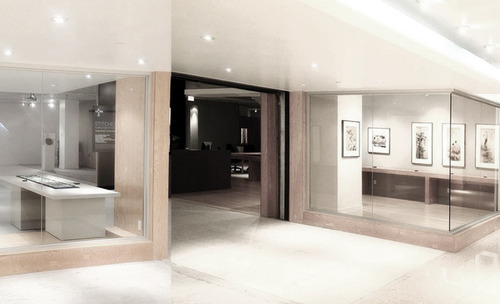
This Tuesday evening at 630pm, WORKSHOP – which is a design studio, gallery, and retail shop located in Yorkville, Toronto – will be hosting a panel discussion titled: What is Smart Now?
On the panel will be a building scientist, a computer scientist, and two architects. The moderator will be Larry Wayne Richards, who is Creative Director of WORKSHOP and the former dean of the Faculty of Architecture, Landscape, and Design at the University of Toronto. He was dean when I was completing my undergraduate degree and is one of my favorite people in the world of Toronto architecture.
Here’s a bit more on the panel:
For more than half a century, visionaries and companies such as Monsanto, Hewlett-Packard, Microsoft, and Samsung have promoted the concept of technologically smart homes with highly integrated, interactive systems. However few of these homes have actually been realized, leaving us to wonder why.
Meanwhile, architects, builders, and home owners have become aware of the advantages of being smart in terms of energy efficiency and sustainability, from using common sense to selectively employing high-tech.
But now, with the digital realm and software advancing rapidly, will sophisticated smart home systems merge with recent advances in high performance materials and energy-efficient construction, making “totally smart” (and affordable) homes commonplace? Will we finally be living in the magical future that was imagined 50 years ago? And what are the implications for architects and architectural education?
And here are the panelists:
PAUL DOWSETT, Architect and Founding Principal, Sustainable TO
SRINIVASAN KESHAV, Professor of Computer Science, University of Waterloo
TED KESIK, Professor of Building Science, University of Toronto
JANNA LEVITT, Founding Partner, LGA Architects, Toronto
LARRY WAYNE RICHARDS (Moderator), Creative Director, WORKSHOP
Given the current “Internet of Things” trend and the fact that software is creeping into so many non-tech fields, such as housing, I think this is a really timely discussion to be having. I also think it’s critical for these kinds of conversations to be cross-disciplinary. There are infinite opportunities in the housing market for people who are able to think in that way.
If you’d like to attend, click here to sign up. It’s free and open to the public. WORKSHOP is located in the lower concourse level of 80 Bloor Street West.
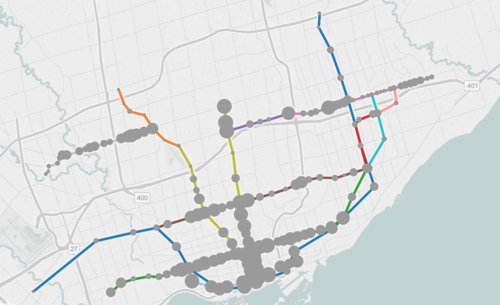
The map shows all existing, planned, and proposed transit lines in the city, and then overlays population densities, commuting patterns, household income, and so on. It’s a super valuable map that I think reveals a lot about how we should be focusing our energies to get Toronto moving.
So what sorts of things does it tell us? I’ll give 2 examples.
If you look at commuting patterns across the Bloor-Danforth subway line, you’ll see that Runnymede station in the west is where people switch over from taking transit to driving. People west of that station tend to drive. Naturally, it also happens to coincide with where population densities start to fall off.
By contrast, if you look at the east side of the city along the Danforth and beyond, the entire stretch more or less relies on transit to get around. Part of this likely has to do with income levels, but it’s also because of the availability of the Gardiner Expressway. There’s no equivalent in the east end. Dylan Reid of Spacing Magazine believes this makes a case for some sort of road pricing along the Gardiner, and I would agree.
As a second example, look at the population densities along the proposed Downtown Relief Line, Finch LRT, and John Tory’s SmartTrack line. Outside of the core, the population densities are relatively low along the proposed SmartTrack line – which is never a good thing for rapid transit.
There’s also no Sherbourne station on the SmartTrack line, which happens to have the highest population density across the entire Relief Line – 22,131 people per square kilometre! That’s more than any other stop along the Yonge-University subway line except for Wellesley station.
I’ve written about this a lot before, but I think we need to do a better job of matching up transit investment with expected customer demand. Too often we let politics get in the way of rationale decision making. Maybe it’s time we did something like set minimum population densities. If you want a subway line in your area, you have to first bring the people.
“We can’t address climate change without thinking about buildings.” -Bryn Davidson, Lanefab (Vancouver)
This is a line from a recent TEDx talk by Bryn Davidson, who is one of the founders of Lanefab out of Vancouver. Lanefab is a design and construction firm specializing in sustainable infill / laneway homes. Unlike Toronto, laneway houses are actually allowed in Vancouver.
If you have any interest in climate change, I would encourage you to watch his talk. It’s less than 20 minutes long and he addresses many of the misconceptions that I think people hold about what it means to build “green”. Click here if you can’t see it below.
While I think it’s great that the green agenda is much more front and center these days, I agree with Bryn in that we’re not yet on a sustainable path forward. For many people, being green means buying a LEED certified home, having a Tesla in the garage, and having a Nest thermostat on your wall. And certainly those things help.
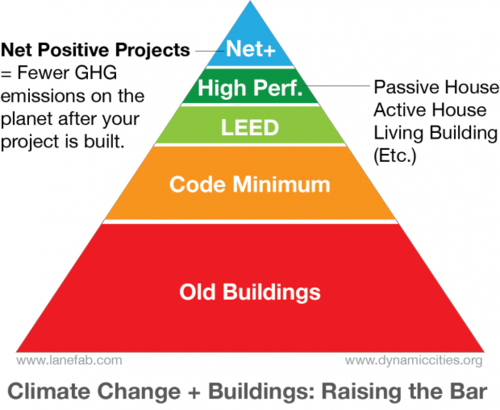
But they’re not the whole story. Instead of just focusing on green and LEED buildings, Byrn argues that we need to take it a step further and start focusing on “Net Positive” buildings. In other words, ask yourself this: Will there be fewer green house gas emissions on the planet after your project is built?
More specifically, he outlines 3 criteria:
How good is your building?
Where is it located?
What does it replace?
The idea behind this framework is that the building itself (i.e. How good is your building?) is only one piece of the story. What also matters is its location and what it happens to be replacing. Is the building in a walkable area? Is it on a greenfield or infill site? Is it replacing an old energy inefficient building? Is it intensifying land use patterns?
All of these things matter when it comes to assessing our greenhouse gas emissions.
Let’s now apply this framework to three different building typologies: mid and high rise condominiums, and laneway houses. In the context of a Net Positive building, they all do quite well. In Toronto, we could certainly do a lot to improve the way many of our condo buildings are built, but they are usually in the right kinds of areas and they are the right kind of building typology.
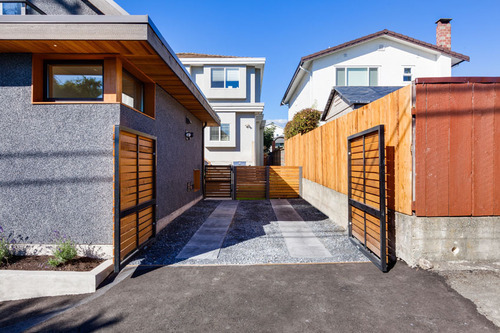
Similarly, laneway houses as a whole are an incredibly sustainable building typology. In fact, I would argue that an energy efficient laneway house is easily one of the most sustainable homes you could build. They’re compact. They’re located on under-utilized and previously developed land. They often replace parking. And they increase population densities in established residential areas, which then makes transit more feasible.
But again, here in Toronto we’re not allowed to build them.
So whether you like it or not, if you’re involved in shaping the built environment, you’re also involved in climate change. This is a job for architects and developers, but also policy makers and communities. Laneway housing is a perfect example of that. Lots of people would build them — if only they could.