Daily insights for city builders, delivered every morning at 6 AM ET. I’m Brandon Donnelly — a Toronto-based real estate developer and founder of Globizen. I’ve been writing here since 2013.

Tag: atc

  • A long history of ‘rail plus property’

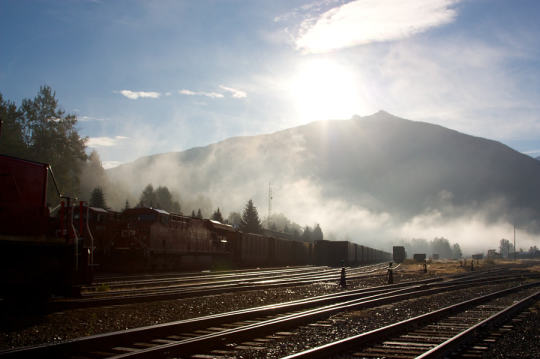
    Photograph morning fog by Familie Pinksterbos on 500px

    morning fog by Familie Pinksterbos on 500px

    Today’s Architect This City post is being brought to you live from the mid-base lodge at Revelstoke Mountain Resort on Mount Mackenzie in British Columbia. 

    It’s currently foggy, rainy, and about 2 degrees celsius — which I’m told is fairly anomalous for this area. It’s unfortunate for my friends on the slopes, but it makes me feel somewhat better about hanging out all day to rest my back and shoulder.

    The town of Revelstoke was founded in the 1880s when the Canadian Pacific Railway connected the area. And traditionally its economy has been closely connected to that rail. However, with amenities like the resort I’m currently sitting in, its economy now increasingly includes tourism.

    One of the most interesting reminders for me on this trip through the Canadian Rockies is how instrumental rail was in unifying and then building this country. But in actuality, it wasn’t just rail. It was rail plus property.

    Within the Canadian Pacific Railway was a division called Canadian Pacific Hotels, which built and operated both urban and rural hotels such as the Banff Springs Hotel and the Chateau Lake Louise (both of which I visited for the first time on this trip). And today, these railway hotels are absolutely some of Canada’s most inspiring landmarks.

    The model at the time was simple. 

    Sir William Cornelius Van Horne — who was president of CPR in 1888 — believed: “If we can’t export the scenery, we’ll import the tourists.” He knew that it was all about moving as many people as possible. And to do that he needed to create accommodations and destinations all along the rail. In other words, rail alone wasn’t going to cut it. It had to be rail plus property.

    This of course is a model that still persists today. Many public transit authorities, such as the MTR in Hong Kong, have been hugely successful by adopting a rail plus property model.

    However as the case study of the Canadian Pacific Railway demonstrates this is not a novel approach. It’s actually a tried a true model. Rail, and infrastructure in general, goes really nicely with property development. 

    So why don’t all transit authorities adopt a rail plus property approach?
  • How unlikely neighborhoods change

    image

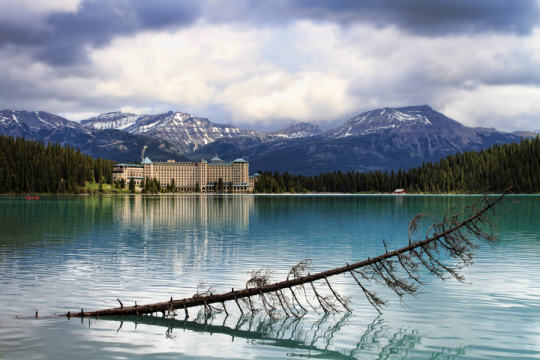
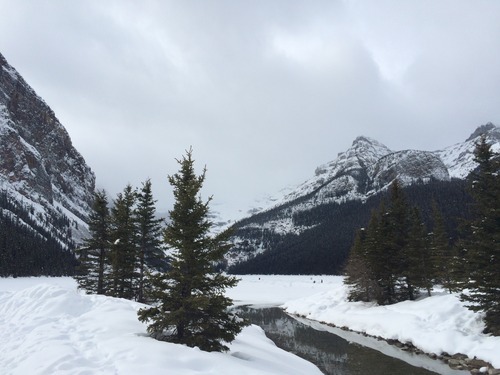
    I’m writing this post from the Lakeview Lounge at the Fairmont Chateau Lake Louise. The view of the (frozen) lake and mountains is absolutely stunning (see above). I can totally see why people move to the Rockies and never leave. Frankly, I’m not sure how I’m going to ever go home 😉

    This Chateau was first built up in the late 19th century by the Canadian Pacific Railway. Developed as a way to encourage ridership and fund railway expansion, its position on the eastern edge of Lake Louise was probably a fairly obvious choice (although only when accompanied by rail). It’s designed to take full advantage of the views of the lake and the mountains.

    Photograph Chateau Lake Louise ~ by Carmen Brown on 500px

    Chateau Lake Louise ~ by Carmen Brown on 500px

    But it’s not always this easy to predict or select where development should happen and will happen next.

    Yesterday I was quoted in a Torontoist article talking about the rise of Dovercourt Village in Toronto – which is a topic I covered here on ATC about a month ago.

    The interesting thing about Dovercourt Village – and specifically Geary Avenue – is that they seem like unlikely places for new investment. Many of the buildings aren’t particularly beautiful. And there’s a rail line and a set of power lines running through the middle of it.

    But if the buzz around Dovercourt Village proves to be true, then it could very well end up as a new yuppy enclave in the city. I’m not going to debate the merits of gentrification today, but I think it’s interesting how change can seemingly emerge out of nowhere.

    If you rewind 10 years to before Ossington Avenue became the hotspot that it is today, many of you would have probably classified it as an unlikely place for gentrification. Located beside the Centre for Addiction and Mental Health (CAMH), the area wasn’t considered desirable at the time. (CAMH has since undergone a lot of change.)

    But oftentimes change can come out of nowhere. It just takes few enterprising pioneers who see something that nobody else does.

  • Banff’s second floor

    image

    I have good news and bad news.

    The bad news is that I took a gnarly spill yesterday afternoon on the mountains. The nose of my snowboard got stuck in deep snow and I fell forward onto my shoulder and then compressed my back. I tore a shoulder ligament and possibly fractured two ribs. So snowboarding season is over for me this year.

    The good news is that I now have more time to relax and enjoy the town of Banff, and then Revelstoke this weekend.

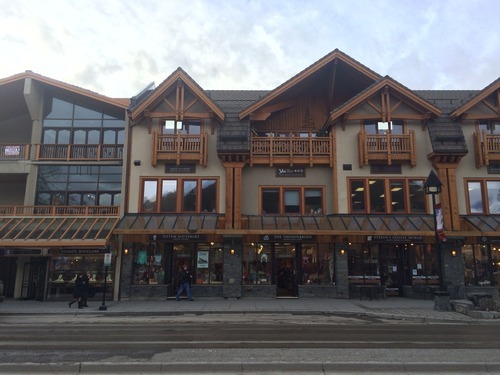
    Banff is a beautiful town. It’s compact, walkable, and surrounded by snow capped mountains. How could you not love it?

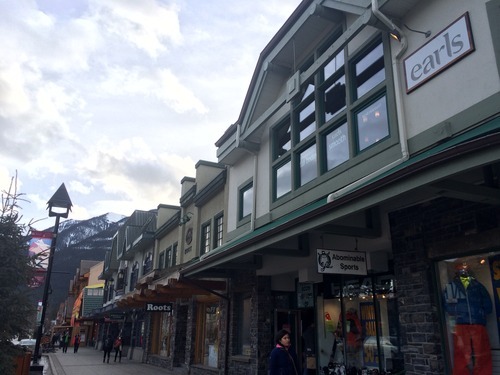
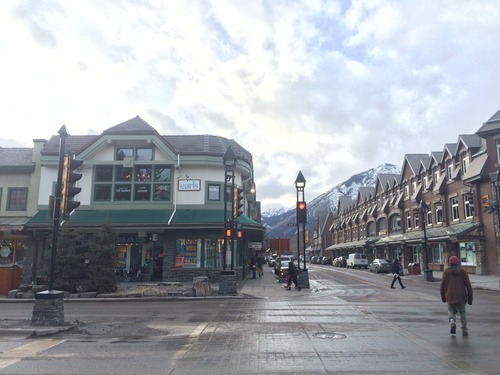
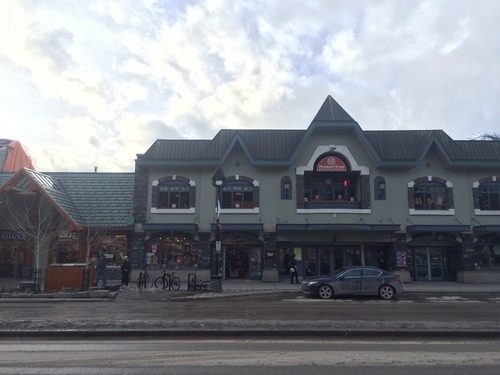
    One of the more subtle things that stands out for me though is the ubiquity of second level retail and restaurants. There’s a lot people in the (North American) real estate industry that will tell you that second floor retail just doesn’t work (you want ground floor). And indeed, it can be hard to pull off. As I’ve said before, getting retail right in general can be difficult.

    But in Banff, many of the bars and restaurants are up top. Here are a few examples (there’s an Earls, Boston Pizza, and a Korean restaurant, respectively):

    image
    image
    image

    So why does it work here?

    Given the town’s small footprint and location within Banff National Park, the market is supply constrained. That’s why Parks Canada imposes a number of restrictions on residency. They’re trying to ensure that the people who actually work in the community can find housing and it all doesn’t become second homes.

    So my gut tells me that in order to get enough retail/commercial space to serve the area and its tourists, they had no choice but to go up. They simply ran out of ground floor space. Because if the town was able to instead sprawl outward, I suspect that’s exactly what it would have done. And then more ground floor space would have been created.

    To be fair, most of the second floor examples I came across were bars and restaurants, which is arguably easier to pull off than straight retail. But it’s still something. 

    If any of you are familiar with real estate and planning in Banff or just have a better hypothesis, I’d love to hear from you in the comment section below.

  • 21 largest venture capital investments in Canada

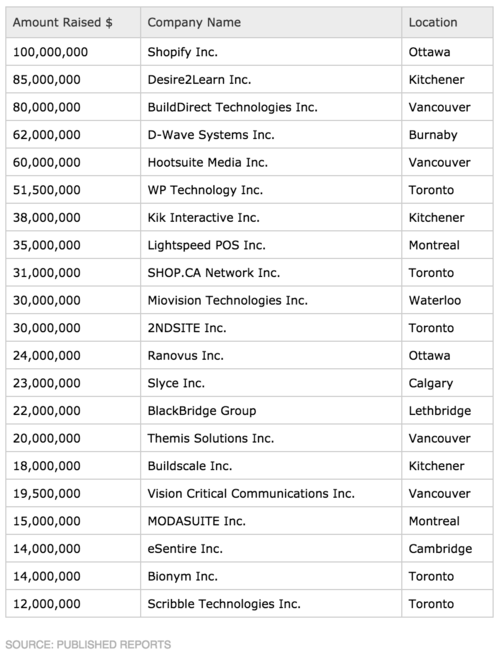
    The Globe and Mail published an interesting article this evening looking at the 21 largest venture capital investments in Canadian tech over the last 18 months. It’s called: Who needs Silicon Valley? Canadian startups scoring bigger deals.

    To put things into perspective, total venture dollars invested in Canada last year (2014) was around $1.9 billion. In the US, that number is estimated to be somewhere around $48 billion. So there’s a big spread here. But the Globe is arguing that there’s a shift towards medium-sized Canadian tech companies raising larger and larger rounds.

    Here are the top 21 largest venture capital investments made in Canada over the last 18 months:

    image

    At the same time, there’s also an attitude change that seems to be taking place. Confidence is growing. Here’s a quote from Mike McDerment of Freshbooks from the same article:

    “Our goal is to be an anchor tenant in Toronto. At Freshbooks, we want to build a global company that really contributes in some meaningful way to the city,” Mr. McDerment said. He touts the local schools and talent pool and downplays the Valley’s head start.

    “The money is shameless – it’ll just go wherever. It wants the opportunities,” Mr. McDerment said. “I don’t see why Toronto can’t beat Silicon Valley.”

    All of this is important because the medium-sized companies of today will hopefully become the large-sized companies of tomorrow. And that’s what you need to build a thriving startup hub. You need big successes. You need those companies going public and generating wealth for their employees and communities.

    Thankfully, that seems to be where we’re headed. The first company on the list above – Shopify – is already preparing for a dual US-Canada IPO.

  • Cities and mountains

    image

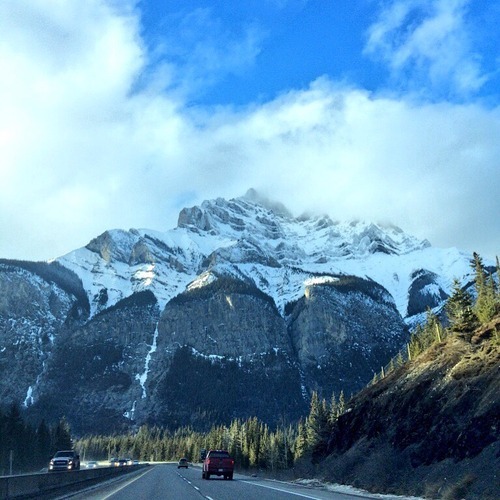
    Having just spent the weekend in Calgary and Banff, I’ve been thinking a lot about importance of picking the right city in which to live. I’m not saying that I don’t love Toronto. Because I do. But I am incredibly envious of cities – like Calgary, Vancouver, and Denver – that have such easy access to incredible mountains.

    The photo at the top of this post was taken on the drive from Calgary to Banff.

    Now, this might not matter to a lot of people, but it does to me. It’s a personal thing. There’s something really nice about landing in a city and seeing people leaving the airport with skis and snowboards in hand. And there’s something really nice about a city where so many people are active, outdoorsy, and fit.

    This, of course, is the topic of Richard Florida’s book, Who’s Your City?: How the Creative Economy Is Making Where You Live the Most Important Decision of Your Life. But it’s still something that I’m not sure many of us give a lot of thought to. Are you living in the right city for you?

    I’ve lived in cities that weren’t right for me and I know that it can have a profound affect on your happiness.

  • Mirvish+Gehry architectural model

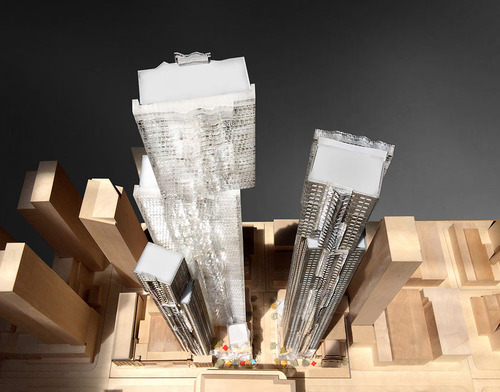
    The developers behind the much talked about Mirvish+Gehry project in Toronto (Projectcore) recently released a video showcasing the architectural model. It’s a great way to see the project from every angle. Click here if you can’t see it below.

    [youtube https://www.youtube.com/watch?v=mka2kVUCyDk]

    I’ve written about this project a number of times before and my view has always been that I’m excited by the project, but that I don’t think we should be demolishing all of the heritage buildings on-site. This latest scheme – with two towers ranging from 82 and 92 storeys – is the result of that compromise.

    What are your thoughts on Mirvish+Gehry? And what do you think the condos will ultimately go to market at? My guess would be somewhere around $1,000 per square foot.

  • 10 days in the mountains

    I’m off this evening to Banff (and then Revelstoke) for a 10 day snowboarding trip. If you’ve been reading Architect This City since this time last year, you’ll know that this is an annual tradition that I started with a group of close friends from grad school. It’s our annual retreat to the mountains and it’s our 6th year doing. I hope we never stop.

    So what happens to ATC?

    Regular scheduled programming will continue as usual. But don’t be surprised if I change things up and make the content a bit more personal on some of the days. I’ve also decided to try out something new and video blog throughout the trip using Snapchat Stories. If you’d like to follow along, my username is donnelly_b. There will also be a more traditional video to follow.

    Finally, if you happen to know Banff and/or Revelstoke well, or happen to be from out west, I’d love to hear from you. It’s always great to get local insights.

    Image: Revelstoke via Flickr

  • Firm Profile: ASH NYC

    A friend of mine recently introduced me to a young real estate company out of New York called ASH NYC (the founders are around 30). 

    But in reality, calling them just a real estate company is an oversimplification. They’re actually a vertically integrated firm that brings interior design, real estate development, property management, hospitality, and a few other disciplines all under one roof. The way they talk about it is in terms of “joining historically compatible disciplines” and “creating both aesthetic and economic value” – which is a pretty neat approach.

    I’ve written a few times before about the future of the architecture profession and so I think it’s really interesting to see yet another example of design being completely integrated with real estate. And I’m certain we’re going to see more of these kinds of hybrid and integrated business models across many other industries.

    In my own career, I’ve been (somewhat similarly) fascinated by the intersection of design, real estate, and technology. And I suspect that many of you also feel like you’re operating in some kind of overlap. Is that true?

    Image: ASH NYC

  • Weird as a competitive advantage

    image

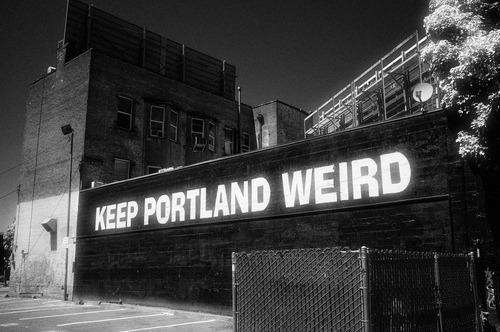
    Joe Cortright of City Observatory recently reposted an article that he wrote back in 2010 called, Keeping it Weird: The Secret to Portland’s Economic Success.

    In it he talks about a “weirdness index” that he developed for CEOs for Cities that measured and ranked 50 American cities across 60 different behavioural indicators. San Francisco and Salt Lake City come out as the weirdest, and Portland ranked 11th out of 50. The most “normal” part of the US was the Midwest. Normal meaning behaviours that are most similar to the national average.

    He then goes on to talk about weird as a competitive advantage. Here are a few snippets:

    When it comes to economic success in today’s economy, the key is to differentiate yourself from your competitors. Harvard Business School’s Michael Porter counsels businesses that “competitive strategy is about being different.” And the late, great urbanist Jane Jacobs told us, “The greatest asset that a city can have is something that’s different from every other place.”


    True entrepreneurship is about deviant behavior: starting a business that makes a product that no one else has thought of or thinks there’s a market for. Entrepreneurs and open-minded, experimental customers go hand-in-hand.


    We shouldn’t do things just to be different, but we should never be dissuaded from trying something simply because it is different or would make us different from other places.

    What this all comes down to is the simple fact that what is weird today, might very well become the norm tomorrow. But you need to be open enough to allow that to happen if you want to be the place that generates those news ideas.

    Could you have imagined that selfies would become as ubiquitous as they have? That would have been pretty hard to predict. It used to be the case that people were afraid to use their real name on the internet. Now we share our entire life online, including our faces.

    Image: Flickr

  • How Uber is driving down the cost of transportation

    A few days ago, Bill Gurley – who is an investor in Uber – wrote a really fascinating blog post called, Uber’s New BHAG (Big Hairy Audacious Goal): UberPool. Bill doesn’t update his blog very often, but when he does it’s incredible stuff.

    I’ve touched on UberPool briefly before. But basically it’s a true “ride sharing” service where people with overlapping routes can easily share the same car – much like people do today informally. The obvious advantage of this is cost. It’s cheaper to share.

    image

    What’s most fascinating about this service though is how it fits into Uber’s larger mission to drive transportation costs down. And there’s a specific reason for that (via Bill Gurley):

    When Uber launched its low-cost UberX offering in the summer of 2012, the company quickly realized that the demand for its transportation services is HIGHLY elastic. As the company achieved lower and lower per-ride price points, the demand for rides increased dramatically. A lower price point delivered a much better value proposition to the consumer, yet still remained a great business decision due to the remarkable increase in demand.

    So what Uber quickly figured out was that if they could increase the utilization rate for drivers (the time actually spent with passengers), they could charge consumers lower prices while at the same time maintaining driver salaries. Prices went down, but volume went up.

    One way to do that is to obviously decrease driver downtime by improving liquidity on the marketplace. But another way is to simply increase the number of passengers being transported at one time. Hence the creation of UberPool.

    But it doesn’t stop there.

    Because of all the transportation data that Uber now has (the company has a data group called the “math department”), they can fairly accurately predict what a price cut will do to their ridership levels. This allows them to “forward invest” their capital in new services – such as UberPool – before they even have the revenue from the anticipated increase in ridership.

    So what does this all mean?

    It means that Uber is going to get cheaper and cheaper and cheaper. Uber is trying to get to what they call “The Perpetual Ride”, which basically means that drivers will always have customers (100% utilization). That’s quite a goal, but it would mean the absolute lowest prices for consumers (barring any other changes to their cost structure). 

    Dirt cheap transportation is a pretty compelling value proposition, which is why I continue to believe that cities should be hard at work trying to figure out how to harness this transportation shift.

    If you’re interested in this topic, I would encourage you to give Bill Gurley’s blog post a read.