Daily insights for city builders, delivered every morning at 6 AM ET. I’m Brandon Donnelly — a Toronto-based real estate developer and founder of Globizen. I’ve been writing here since 2013.

Tag: atc

  • What will driverless electric cars mean for cities?

    Photograph T E S L A by Thomas Juel on 500px

    T E S L A by Thomas Juel on 500px

    Yesterday I posted a video about the career of Elon Musk. And it reminded me of something that’s been on my mind as I think about transportation, cities, and the future.

    Elon’s story for why he founded SolarCity, Tesla, and SpaceX is incredibly compelling. He chose problems and industries that he felt would move humanity forward. He felt that we needed sustainable forms of energy production (SolarCity), sustainable forms of transport (Tesla), and a way for humans to occupy other planets (SpaceX). That’s incredible ambition.

    Today though, I just want to focus on the transportation piece.

    Electric and driverless vehicles, I believe, are a step in the right direction. I honestly believe that at some point in the not too distant future we’re going to look back at that time when people used to drive their own cars and wonder how we ever allowed that to happen.

    But fundamentally, I think there still remains a question of how best to plan our cities. 

    There’s lots of talk today about peak car and the death of the automobile. Certainly within planning and urbanist circles, there’s an almost universal belief that planning (most of) our cities around the car, as opposed to people, was a huge mistake. Multimodal solutions with a public transit backbone are now the way forward.

    But will that always be the case as the notion of the “car” evolves?

    Intuitively, driverless vehicles feels like a massive opportunity to leverage data and better optimize our private transport assets. We know that the utilization rate for most private cars is incredibly low and so there’s lots of room to improve how we use and share private vehicles and how we move people around cities.

    But how big is that opportunity? Does a city filled with driverless electric vehicles and with networks like Uber mean that public transportation now becomes less important? And if so, how much less important?

    I can’t help but feel like private and public transport are on a collision course right now. I suppose that isn’t anything new. But this time around I wonder if private transport won’t figure out a way to achieve similar efficiencies to large scale public transport.
  • Bloomberg Risk Takers: Elon Musk

    Elon Musk is one hell of an entrepreneur. I just finished watching this “Bloomberg Risk Takers” video. 

    [youtube https://www.youtube.com/watch?v=mh45igK4Esw?rel=0&w=560&h=315]

    It’s about 45 minutes long, but well worth it. What’s astounding is both is willingness to go all-in and his commitment to solving big, meaningful problems. Click here if you can’t see the video above.

    Once you’re done watching, you should then read this Quora answer from his first wife talking about what it takes to be that great.

  • Dublin 2007

    image

    In 2007, I spent the summer working in Dublin, Ireland for a boutique real estate consulting firm called Urban Capital. (For those of you who are from Toronto and know the industry, there’s no connection between the Urban Capital in Dublin and the Urban Capital in Toronto.)

    At the time, they were working with a number of government agencies on the development of masterplanned communities, as well as on specific development projects. Real estate was booming and everyone wanted to be a part of it – including the band U2.

    But as you all know, the following year (2008) wasn’t kind to the real estate industry and, in particular, to Ireland. That year the country fell into recession for the first time since the 1980s and became labeled as one of the “PIGS.”

    I really wish I had started this blog by that point because it would be interesting to look back today on my posts from that summer and see how I was thinking about the Dublin real estate market. I remember having many Guinness-fueled discussions about whether the bull market could continue.

    In any event, the Irish economy is coming back.

    This year GDP is expected to grow by 5.4%, which would make it the fastest growing economy in Europe. National debt is also falling. At the end of 2013 it stood at €215 billion or about 123% of GDP. And at the end of 2014 it had fallen to €203 billion or about 109% of GDP. The national debt is expected to fall below 100% of GDP by 2018.

    At the same time, Ireland also got permission to pay off its bailout loans early. That’s a good sign.

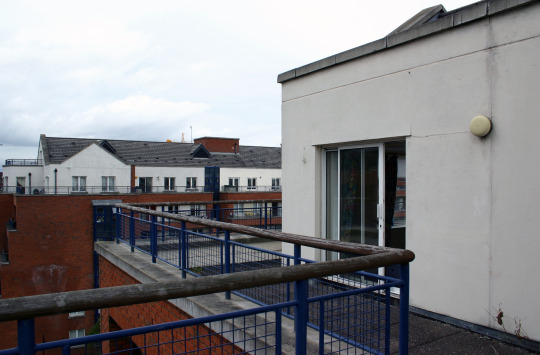
    I’m thinking and reading about all of this today because I was looking through my photo collection this morning and I stumbled upon a folder titled “Dublin 2007.” The photo at the top of this post was the terrace that I had outside of my apartment in the Docklands area. I don’t think I used it once that summer. 

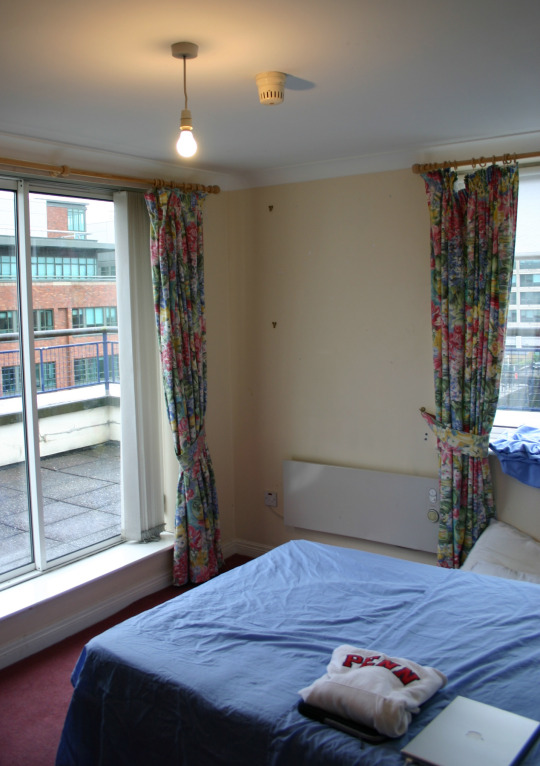
    And here’s a photo of my bedroom. It must have been the curtains that sold me on the apartment.

    image

    I had a great time in Dublin that summer. It’s a fun and young city and I remember being incredibly impressed by the quality of city building that was going on. I’m sure that wasn’t lost in the Great Recession.

  • Where are Millennials going to move when they start having children?

    Photograph Kembangan by Jason Waltman on 500px

    Kembangan by Jason Waltman on 500px

    Earlier this week I attended RealNet’s Q1 2015 market update webinar for the Greater Toronto Area. If you don’t already subscribe to RealNet, you should consider it. They’re one of the best sources for Canadian real estate market information.

    During their webinars, they occasionally run interactive surveys where they ask the audience a question and participants respond using their web browser. On this particular webinar, they asked the following question, which I thought was interesting:

    What is the likely housing moving by Millennials in raising their families?

    A) Move Up – Embrace urban high-rise housing forms

    B) Move Out – Accept extended commutes (including the Greater Golden Horseshoe and Hamilton Area) to find affordable ground oriented housing

    C) Move In – Cohabitate parental homes

    It’s an interesting question because it’s one that I’ve asked myself a number of times. Sure, Millennials are rushing back to cities and living in high density and walkable communities, today, but what are they going to do and where are they going to move when they start having children?

    As a Millennial myself, I know that I’ve always told myself that I want to stay urban for as long as I can (i.e. Move Up). But I’m only one data point. And given the seemingly endless demand for low-rise housing in Toronto, I always felt like I was in the minority. I figured that the majority of people, at least here in this city, still want a ground-related home when it comes time to raise a family.

    Putting aside economics, I still think that may be the case for a lot of home buyers. But the majority of people on this week’s RealNet webinar (which would be almost exclusively folks from the real estate industry) either think that preference is going to change (or already has) or that consumers won’t have a choice due to affordability.

    50% of the people on the call answered A – move up and embrace urban high-rise housing forms. The balance was about 44% for B and 6% for C.

    That’s not the outcome I expected to see. So today I’d like to re-ask this question to the Architect This City Community. Where do you think Millennials are going to move once they start having children? Please let us know in the comment section below.

  • First crowdfunded real estate project opens in D.C.

    Want further evidence that technology and the internet are going to dramatically transform many “non-tech” industries such as real estate? 

    Take a look at 1351 H Street NE in Washington D.C (pictured above). It houses a hybrid retail store and restaurant and is probably the first truly crowdfunded real estate project.

    The project was completed using a platform called Fundrise, which I’ve written about before here on Architect This City. Their vision is to completely democratize real estate investment by removing middlepeople and outdated regulations that restrict who and how people can invest in real estate.

    To accomplish this, the founders of Fundrise went out in 2011 and bought the building located at 1351 H Street NE for $825,000. The goal was for it to act as their proof of concept. 

    They then spent a significant amount of time and money figuring out how to make it legal for small and local investors to participate in the project (as opposed to just accredited investors). It was ultimately done through a “local public offering” filed with the SEC.

    So how does it work?

    In the case of 1351 H Street NE, they first went out to the local community and asked them what they wanted to see. That’s how they ended up with a unique retail store / restaurant. It’s what the community wanted.

    Once this was established, they went out and issued 3,250 shares and crowdfunded $325,000 from 175 local investors. This was for an ownership share in both the building and the future business. The average investment amount was $2,000, but people were able to invest as little as $100.

    This is an incredible accomplishment. It takes real estate investment and development to a local level and really empowers small entrepreneurs to start businesses that may have been previously unfundable by traditional sources.

    I don’t know what you think, but I think this is the beginning of a powerful transformation. Many of the structures that are currently in place were formed at a time when it wouldn’t have been practical to crowdsource ideas and crowdfund money. But now that is very possible. It was just done.

    Image: Maketto 

  • Ace Hotel coming to Toronto’s Fashion District

    https://500px.com/embed.js

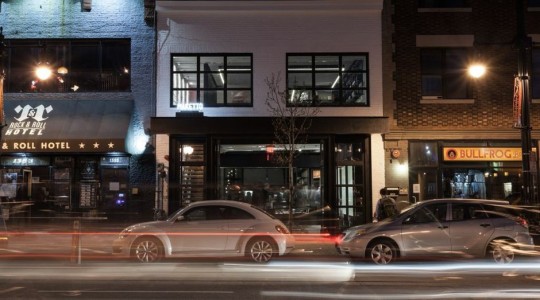
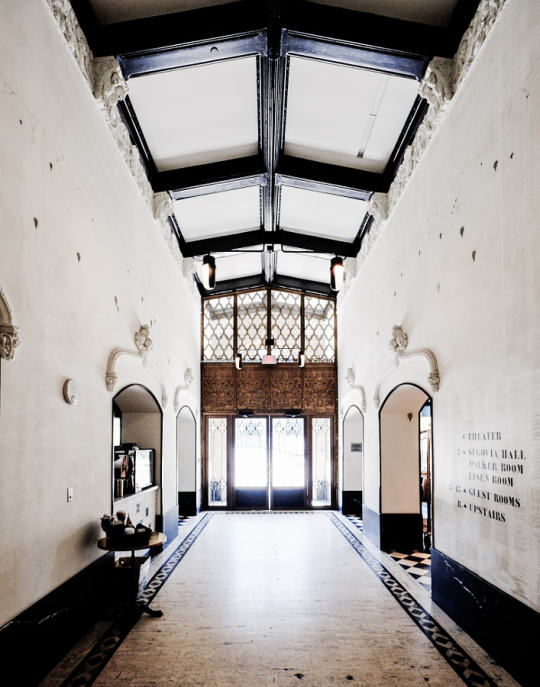
    The word on the street right now is that Ace Hotel will be opening up a location in Toronto’s Fashion District at 51 Camden Street

    Unlike its other outposts around the world, which entailed the renovation of a historic building, this one will be a new build. And according to HotelChatter, Shim-Sutcliffe Architects have been retained for the project.

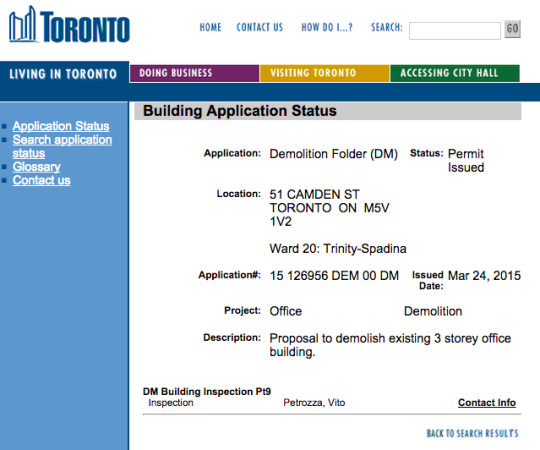
    Already a demolition permit has been issued for the existing 3 storey office building:

    image

    For those of you who may not be familiar with the Ace Hotel brand, the first hotel opened in Portland in 1999 when 3 friends transformed a halfway house into an affordable hotel for creative types. 

    Since then, the hotel has expanded to New York, Los Angeles, Seattle, Palm Springs, as well as many other cities, and has become a kind of cultural institution for the creative class.

    I’m excited that they have (allegedly) picked Toronto for their next property and I’m excited that Shim-Sutcliffe will be (supposedly) designing it.

  • Art and apartments

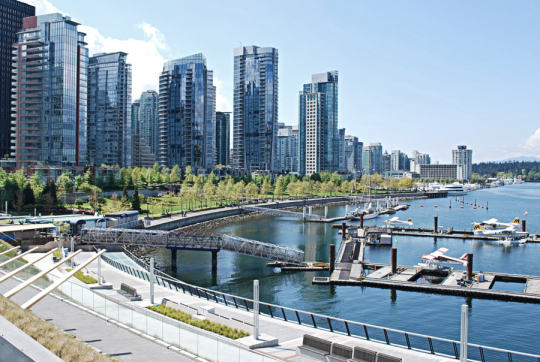
    Photograph Vancouver by Marc M on 500px

    Image Source: Vancouver by Marc M on 500px

    According to a recent Bloomberg article, this is where the rich are putting their money today:

    “The two greatest stores of wealth internationally today is contemporary art….. and I don’t mean that as a joke, I mean that as a serious asset class,” said Fink. “And two, the other store of wealth today is apartments in Manhattan, apartments in Vancouver, in London.”

    In case you wondering, Laurence Fink is the founder and CEO of BlackRock Inc., which today is the largest asset manager in the world. They have over $4.77 trillion in assets under management according to their website. That’s a mind boggling number.

    And if you read the Bloomberg article cited above, you’ll see that this interest in both art and apartments represents a shift away from gold as the de facto safe haven.

    “Historically gold was a great instrument for storing of wealth,” the chairman of BlackRock Inc. said at a conference in Singapore on Tuesday. “Gold has lost its luster and there’s other mechanisms in which you can store wealth that are inflation-adjusted.”

    What’s interesting and probably most relevant to the Architect This City community though is this investment focus on apartments.

    When people talk about a possible housing bubble in Canada they often cite house prices to median household income as a key ratio. The question then becomes: How can house prices be such a high multiple relative to local incomes?

    That’s relevant, but it’s not the entire story for cities like New York, London, and Vancouver. That ratio alone assumes that real estate isn’t a global investment vehicle. And for some people people it is exactly that.

  • Lisbon is the new Berlin

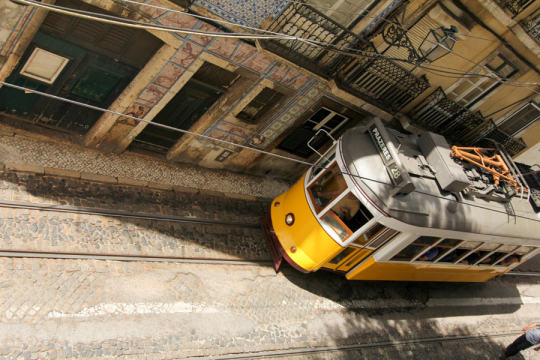
    Photograph Tramway à Lisbonne by yannick le goff on 500px

    Tramway à Lisbonne by yannick le goff on 500px

    This morning I stumbled upon a blog post by a Berlin-based venture capitalist (Ciarán O’Leary) talking about how Lisbon feels like the next Berlin. In other words, it feels like the next great European startup hub.

    Here’s his reasoning:

    • The tech scene is organic – it happened on its own, came out of nowhere. That is much more fun and sustainable than any kind of political or targeted economic strategy.
    • There are a ton of constraints (funding, local talent base, etc.) so entrepreneurs need to hustle to make things happen. Hustle is good.
    • Berlin was an economic void, Portugal had a massive economic crisis and Lisbon sure isn’t letting that crisis go to waste.
    • Entrepreneurship has the real chance to be a center stage act, not a side gig. It’s everywhere.
    • The city is very, very cool. You just want to be here.
    • You can have a great life on a startup salary.
    • Everyone speaks english; everyone is welcoming and open. That matters a lot when you want to attract international talent and funding.

    Of course, he’s not the only one calling Lisbon the next Berlin. The EU also named Lisbon “the most entrepreneurial region in Europe in 2015.” Isn’t it interesting what can grow out of economic crisis? See PIGS.

    I also don’t think it’s a coincidence that Monocle held its first ever Quality of Life Conference in Lisbon. It’s a testament to O’Leary’s point above that, “You just want to be here.”

    And while being “very, very cool” may not seem immediately relevant to creating a robust startup environment, it really is. It may be the most important point. It makes the city a magnet for talent. 

    Just the other day I was trying to explain Berlin to someone and I used a similar lexicon. I said: “It’s an unbelievably cool city. It bleeds hipness. You will love it.”

    If you’re a city, that’s a great thing to be.

  • A Jane’s Walk about the Gardiner Expressway

    image

    This May 2nd at 1:00pm I’m going to be participating and speaking at a Jane’s Walk here in Toronto called, Gardiner Expressway: To be or not to be? 

    The other “walk leaders” include Andrew Hilton, City Councillor Jaye Robinson, Ed Levy, Kyle Baptista, and architect Les Klein (Quadrangle Architects).

    This will be my first time going to a Jane’s Walk, but it’s clearly a topic that I’m interested in. For over a year I have been arguing that we should remove the Gardiner East (the portion east of Jarvis Street).

    This has proved to be a contentious position and topic. One critic said that I only want to remove the Gardiner East so that – as a real estate developer – I can make it harder for people to get into the city, which in turn will force them into buying more condos in the city. 

    That was not my thinking.

    Instead, I view it as an opportunity to truly unlock the eastern portion of Toronto’s waterfront and the Portlands area. Take a look at the Keating Channel (shown above) and tell me whether or not you could imagine a better and more urban kind of waterfront. I get excited when I think of the potential.

    And, if we’re going to do this, I believe now is the time, before the area gets developed. Because once it gets developed around the Gardiner, things will never be quite the same – even if we do eventually remove or bury it.

    Click here for more information on the Jane’s Walk. Please also keep in mind that there will be many other viewpoints expressed at the Walk. This is just mine.

    Image: Gardiner Expressway and Don River, Flickr

  • The 5 objectives of Rejection Therapy

    In the business world – particularly in the startup world these days – there’s a lot of emphasis on the importance of failure. The mantra is: “fail early and fail often.” Because if you’re not failing, then you’re likely not pushing yourself hard enough and getting out of your comfort zone. 

    Some people think we’ve gone too far in our celebration of failure, but I think there’s a lot of value in not being afraid of making mistakes. I try and adopt the same mentality when I snowboard. If I’m not physically falling, then I’m likely not trying things I’ve never done before. (I may have taken that philosophy too far this winter.)

    Here’s a video from Gary Vaynerchuk’s #AskGaryVee show where Jack and Suzy Welch are guests and the first question has to do with this exact topic: the importance of failure.

    Given all of this, I was fascinated to learn about something new this week called Rejection Therapy. I was out for beers with some good friends of mine earlier in the week and one of them – who is an educator here in the city – started telling me the story of Jason Comely.

    Jason was a freelance IT guy from Cambridge, Ontario. His wife had recently left him for someone “better” and he went into a deep slump. Eventually, he realized that he had become terrified of rejection. His wife had rejected him and he never wanted that to ever happen again.

    Initially he withdrew from life. 

    But eventually he decided that he was going to experiment with the exact opposite approach. He decided that he was going to force himself to get rejected by someone every, single, day.

    It didn’t matter how it happened, but he had to get rejected. He would walk up to strangers and ask for a ride home. He would ask for a discount before buying something. The list goes on. 

    Eventually he thought it would be a good idea to start documenting all of his rejections: this is what I did today and this how I got rejected. It became a game for him. When he would get his rejection for the day, he would celebrate it. Then he thought to himself: why not turn this into an actual game that other people could purchase? And that’s what he did.

    He calls it Rejection Therapy and here are the five objectives that he lays out:

    1. To be more aware of how irrational social fears control and restrict our lives
    2. Smash the tyranny of fear and reap the treasures (treasures include wealth, relationships and self-confidence)
    3. Learn from, and even enjoy rejection
    4. To not be attached to outcomes, especially when it involves the free agency of other people
    5. Permit yourself to fail

    Playing Rejection Therapy may not be for everyone. But I think the lessons are universally applicable. There’s value in trying. There’s value in asking. There’s value in making mistakes. And there’s value in not being afraid of someone saying no.