Daily insights for city builders, delivered every morning at 6 AM ET. I’m Brandon Donnelly — a Toronto-based real estate developer and founder of Globizen. I’ve been writing here since 2013.

Tag: atc

  • Photos of the built environment

    image

    One of my absolute favorite things to do is travel to cities, explore, and take lots of pictures. When I’m in a new place, I can’t help but examine everything about the built environment. That’s the architect in me and it’ll never go away.

    When I was in undergrad I had a refurbished digital SLR camera that I used to use. But now I just use my iPhone. As the saying goes: the best camera is the one you have on you.

    Seeing how I was just in Philadelphia, I’ve been posting a lot of new city related photos to my Instagram. And since about 10x more people follow this blog than follow my Instagram, I’m going to plug it here: follow me on Instagram 🙂

  • The global pyramid of wealth

    Every year the London-based property consultancy Knight Frank publishes something called The Wealth Report. And it’s one of those reports that I could go through for hours. 

    It includes a ton of really fascinating stats that speak volumes about where in the world wealth is being created and how it’s moving around. And of course there are a lot of connections between wealth, real estate, and city building.

    Below are 3 diagrams that really stood out for me in the 2015 version. 

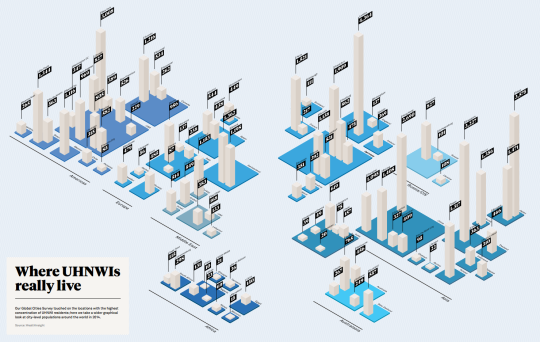
    The first diagram shows which cities have the most Ultra High Net Worth Individuals (UHNWIs). An UHNWI is defined as an individual with assets exceeding US$30 million, but excluding personal assets and property (such as one’s principal residence). Click here to see the full size image (I know the numbers are small).

    image

    Not surprisingly, London (4,364), Tokyo (3,575), Singapore (3,227), New York (3,008), and Hong Kong (2,690) are at the top of the list. But I was a little surprised – albeit happily surprised – to see Toronto (1,216) come in at #2 in North America, beating out Mexico City (1,116), Los Angeles (969), and Chicago (827). 

    The second diagram shows you how many square meters of luxury property (apartment) you can buy for US$1 million in a bunch of different cities around the world. 

    In Monaco (top end), that’ll buy you 17 square meters (183 square feet) and in Cape Town (bottom end), that’ll buy you 208 square meters (2,196 square feet).

    image

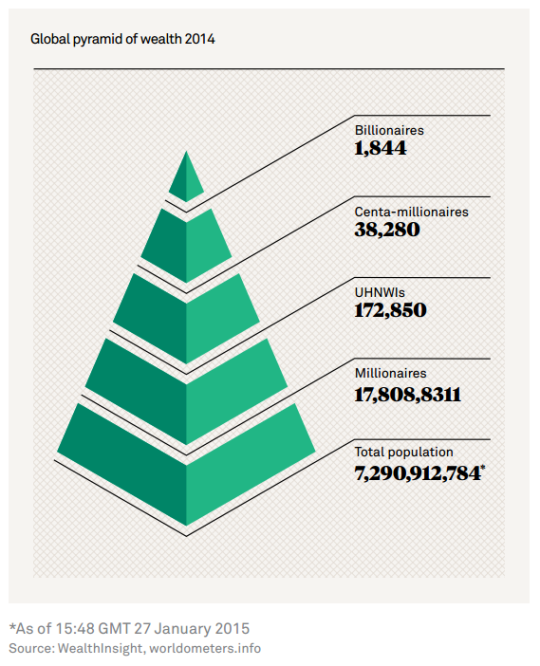
    The third and last diagram is what they call the global pyramid of wealth. It’s a pyramid of everyone in the world and then the number of millionaires, UHNWIs (see above), centa-millionaires, and billionaires. And if you do the math, the top of this pyramid comes nowhere close to 1% of the global population.

    image

    It’s fascinating (and exciting) to see where and how global wealth is concentrating. But it should also make you think about rising income inequality. I know it does for me.

  • Brian Curtner – 1951 – 2015

    image

    The world cannot find a cure for cancer soon enough. Earlier today Quadrangle Architects here in Toronto published the following news release. For those of you not from Toronto, Quadrangle is one of the most important architecture firms in the city.

    It is with great sadness that we share with you that Brian Curtner, our co-founder, colleague and friend, passed away from cancer on August 15, 2015 at the age of 64.

    As an architect, Brian has been widely recognized for exemplary designs that include the award-winning BMW showroom at the foot of the Don Valley Parkway, Corus Entertainment’s state-of-the-art headquarters on Toronto’s waterfront and 130 Bloor Street West in Yorkville – all innovative responses to complex urban challenges. Equally important to his projects was Brian’s unique ability to build long-term working relationships and turn them into friendships that spanned decades.

    Balancing entrepreneurship and commitments to family and friends, Brian was instrumental in creating a highly successful architecture practice, combining business acumen with design excellence, technical expertise and client service which continue to define Quadrangle today.

    Together with his family, we will honour Brian’s life and achievements with a memorial celebration in the near future. We will communicate more details as soon as arrangements have been finalized. In the meantime, Brian’s family welcomes donations to either the Temmy Latner Centre for Palliative Care at Mount Sinai Hospital or Sunnybrook Hospital’s Odette Cancer Centre, in his memory.

    In the coming days, please visit our website for additional information. Details will also be available regarding a website being created in memory of Brian.

    For any inquiries please connect with Elle Fitzpatrick.

    image

    Top image from Quadrangle’s Instagram; bottom image from here.

  • The Philadelphia (real estate) story

    Real estate is a local business. And this weekend in Philadelphia really reminded me of that.

    Here’s what I mean.

    The real estate story in Toronto is condos. We’re buildings lots and lots of condos. When my friend from Chicago recently visited Toronto for the first time, he told me that it feels very similar to Chicago, except that we have modern glass condo towers going up everywhere and they don’t. That’s our story right now.

    Low-rise housing in Toronto is becoming increasingly unaffordable (the average price of a detached home is well north of $1M) and so high-rise condos are now what many people can afford. When young people in Toronto talk about buying their first place, that now usually means a condo.

    But that’s not the story in Philadelphia.

    In Philadelphia, you can buy a 1,600 square foot, 2 storey, 2 bedroom rowhouse in a respectable neighborhood for sub US$400,000. And in speaking with my friends in Philly this weekend, that’s what young people are buying.

    This doesn’t mean that Philadelphia isn’t building new high-rise condos and apartments. It is. Obviously nowhere near as many as Toronto. But it is building. Far more than when I lived there before the Great Recession.

    However, the condo market is typically more upmarket. The target market isn’t so much first time buyers and the mass market; it’s more people who want full floor apartments in Rittenhouse Square. (I’m exaggerating only slightly.)

    Philadelphia is also building more rental towers than condo towers. (Rental has only recently become fashionable again in Toronto.)

    I’m guessing that a lot of this has to do with the fact that Philadelphia draws in a lot of transient students and academics each year. In fact, the most noticeably changed area from when I lived in Philly was University City. That’s the area that houses the University of Pennsylvania and Drexel University.

    So there seems to be strong demand for new rental housing in the city. I’m told vacancies are very low. But when it comes time to buy, young people don’t look to condos like they do in Toronto. They are looking mostly to rowhouses.

    This is interesting to me because it’s the exact opposite of Toronto. In Toronto, low-rise is expensive and so lots more people are buying high-rise. In Philadelphia, high-rise is expensive and so people are buying low-rise.

    I guess that’s why they say real estate is a local business. What works in one city may not work in another.

  • A culture of beer gardens

    It’s great to be back in Philly. I have a real sense of nostalgia around this city.

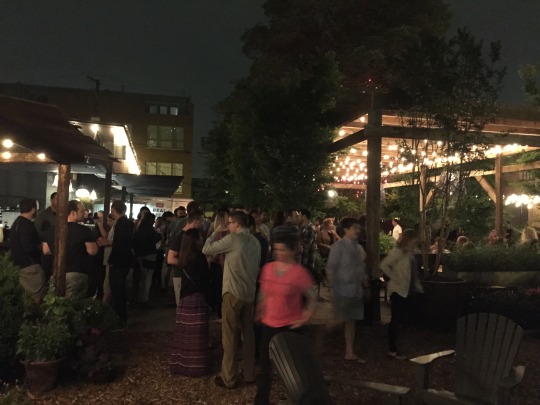
    Last night my friends took me to a popup beer garden on South Street put on by the Pennsylvania Horticultural Society. Before the popup garden, it was just an abandoned lot.

    There seems to be a real culture of beer gardens in Philly, which is something I don’t think we have in Toronto. Why is that?

    Part of the reason, I think, is that there’s a greater spread between desirable and undesirable neighborhoods in Philly than in Toronto. And in the undesirable ones, urbanists have to work really hard to figure out ways to activate them.

    So really these popup beer gardens are a lean urbanist intervention. It’s a way to draw people to an area and create awareness. And I’m told that often these popup gardens end up becoming development sites.

    Because of this, these popup gardens are sometimes controversial within communities. They’re seen as a catalyst and precursor to gentrification. But that’s a whole other debate.

    What I find interesting is this grassroots approach to city building. Great spaces don’t have to be expensive. Sometimes seating, lighting, and beer are all you need to bring people together.

  • 10 reasons to visit Philadelphia right now

    image

    Today’s ATC post – which happens to be a guest post – is coming to you live from on board the UP Express train that runs from Union Station in downtown Toronto to Pearson Airport. (Everywhere should have free wifi.)

    I’m on my way to Philadelphia and I’ve been wanting to try this train since it opened earlier this summer. It feels great to finally ride it. It’s everything I could have hoped for. It even has that new car smell 🙂

    Last month I wrote a post called, 10 reasons to visit Toronto right now. It was in honor of my good friend Alex Feldman’s visit. Well now it’s my turn to visit Philadelphia and he has decided to return the favor and do a Philly version of that same post. 

    Alex is to Philadelphia what I am to Toronto. He grew up in Philly. He was educated in Philly (we went to Penn together). And he’s super passionate about the future of Philly. And I think that’s how everyone should be about their city.

    So I hope you enjoy his list of 10 reasons to visit Philadelphia right now. It’s basically my to-do list for this weekend.

    ———————————————

    10. World Heritage City: Philadelphia is on track to become the first World Heritage City in the United States. This UNESCO designation will underscore the city’s historic importance as the birthplace of American Democracy as well as the historic urban fabric which gives the city it’s walkable, urbane character.

    9. Shopping: Philadelphia has come a long way as a shopping destination. Conde Nast Traveler recently ranked the city as number 2 out of the best shopping destinations in the world. 3rd Street in Old City has become a hotbed for independent boutiques while Rittenhouse Square has attracted new chains such as Uniqlo, Theory, and Vince. More is on the way with a complete re-make of the Gallery shopping mall slated to start soon and the new East Market complex under construction. 

    8. The Pope is Coming:  In case you haven’t heard, Pope Francis will make his first visit to the United States – with a 3 day visit to Philadelphia in late September. The visit will coincide with the World Meeting of Families gathering. A crazy number of visitors (2 million?) are expected to descend on the city – causing Philadelphians to panic, complain, and attempt to rent their houses for ridiculous amounts of money. But this important visit will help raise the profile of the city on the international stage.

    7. Building Boom: There is probably more development happening in Philadelphia right now then any other time in recent history. The skyline is growing with additions by Norman Foster, Cesar Pelli , and Kohn Pedersen Fox. New apartment buildings, condos, and rowhouses are under construction across the city (rental vacancy rates are less than 2%). In addition the Barnes Foundation and the new Singh Center for Nanotechnology mark impressive additions to the city’s architectural landscape.

    6. Public Spaces: Philly’s public realm has seen massive investment over the last several years. A complete remake of the landscape outside of City Hall has become the new Dilworth Park. The designers of NYC’s highline have added two public spaces to the city (Race Street Pier and the new Central Green in the Navy Yard). And Schulkill Banks recently added a new boardwalk which the New York Times raved about when they ranked Philly as the number 3 city to visit in 2015. More is on the way with the first phase of the Reading Viaduct Rail Park expected to start soon.

    5. Waterfront: Philadelphia’s Delaware River waterfront has long been cut off from the city by interstate 95. Things have started to change recently, with new trails and pier parks recently added to the working waterfront. Even Penn’s Landing, the city’s much maligned waterfront attraction is seeing improvements – including the tremendously popular Spruce Street Harbor Park – a pop-up park featuring floating beer barges, shipping container food stands, and tons of hammocks.

    4. Food: Philly is one of the best food cities in the United States. So much is happening right now in the city’s dining scene, it’s hard to keep track of the latest restaurant openings. Neighborhoods such as Fishtown and East Passyunk have emerged as hot dining districts with BYOB chef driven restaurants. More can be gleaned from the Washington Post which recently summarized the dining scene better than I can.

    3. Pop-up Gardens: One of the best reasons to visit Philly in the summer is the opening of the Pennsylvania Horticultural Society Pop-Up gardens. The wildly popular beer gardens, began several years ago as an initiative to remake underused or vacant lots into useful public spaces. This summer, 2 gardens – one on 15th and South and one at 9th and Wharton have been transformed into vibrant spaces for eating, drinking, and hanging out.

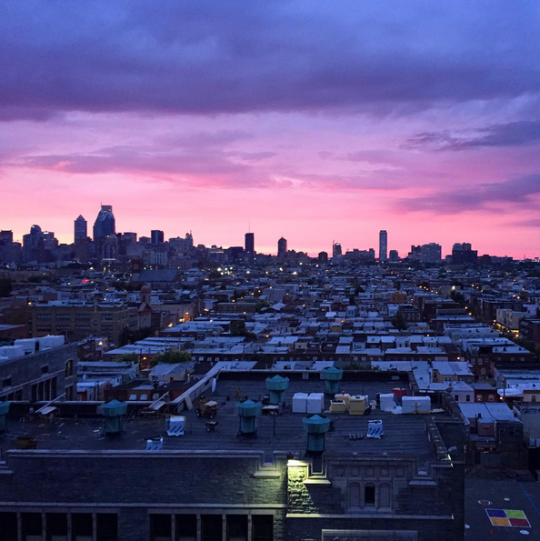
    2. Le Bok Fin: Speaking of temporary uses, the most recent addition to Philly’s pop-up (or iterative placemaking) scene is a rooftop bar called Le Bok Fin. Situated on the 8th floor of an old vocational high school in South Philly (and named after the school’s restaurant – which in turn is a play on one of Philly’s most famous French restaurants). This is the first iteration of development at what is planned to become an amazing new center for creatives inside the old school – being led by Lindsey Scannapieco and her team at Scout LTD. Check out Le Bok Fin for incredible views of the city skyline (especially at sunset).

    1. Bike Share: While a little late to the party, Philly recently launched it’s own bike share program – which is proving to be a huge success. Dubbed Indego, the new bike share is easy to use, has 60 stations, more than 600 bikes and is becoming one of the best ways to hop around town. Check one out and go explore Philly!

    Image: Alex Feldman

  • Taller and skinnier

    Tall buildings will sway in the wind. And when they get taller and skinnier, the swaying becomes more pronounced.

    In seismically active cities, such as Tokyo and Taipei, “tuned mass dampeners” are often used near the top of tall buildings to offset the swaying caused by an earthquake.

    But tuned mass dampeners are also found in cities like New York, so that developers can build even taller and skinnier.

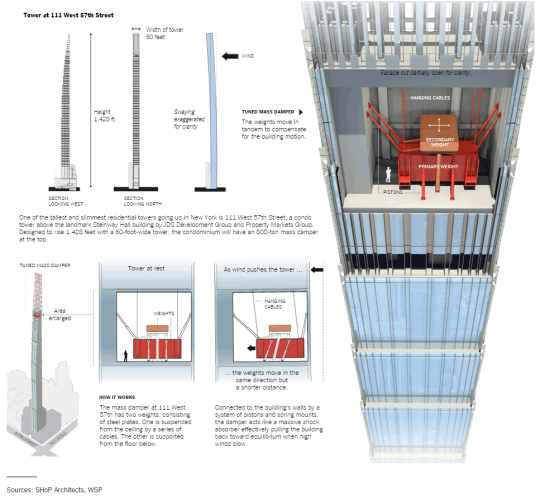
    Below is a diagram from the New York Times showing what one looks like and how it works. The example tower is 111 West 57th Street.

    Basically the masses are tuned to oscillate at a different frequency than the rest of the tower. So when the wind blows and the tower is moving one way, the weights are moving in the opposite direction and forcing the tower back towards some sort of equilibrium. 

    Neat. Structures was one of my favorite classes in architecture school.

  • The impact of laneway housing in Vancouver

    In 2009, Vancouver created policy and legalized laneway homes. (If you’re not up on laneway housing, click here. I’ve written too much about this topic.)

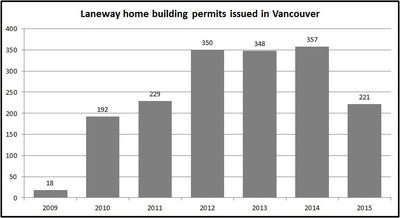
    Since then, the number of laneway homes built in Vancouver has steadily increased to the point where roughly 350 new homes are built every year. 

    Here’s a chart I found showing the number of laneway home building permits issued in Vancouver since 2009 (the year to date number for 2015 is up to and including June):

    image

    This is pretty interesting in its own right.

    But as soon as I saw this chart I started wondering how these numbers fit into the overall new home construction landscape. So I decided to dig up the City of Vancouver’s Statement of Building Permits Issued for June 2015.

    As the chart above shows, the number of laneway dwelling units built (well, permits issued) was 221 as of June 2015. But what’s really fascinating is that this numbers exceeds the number of building permits issued for single family dwellings, which was only 192!

    Also super interesting is the significant spread in building permit value. 

    For single family dwellings, the total value was $156,086,861 (or $812,952 per dwelling unit). On the other hand, for laneway dwellings the total value was $36,478,785 (or $165,062 per unit).

    Now to be fair, if you add single family dwellings with a secondary suite into the mix, you get a total count of 608 new dwelling units (as of June 2015). But at 221 new units, laneway dwellings still make up a meaningful portion of the new construction market.

    So while laneway houses might seem fringe for Toronto and other cities right now, they’re really not that fringe. In fact the numbers above start to show that they can be a viable source of new and relatively affordable single family housing.

    Eventually other cities will realize this too.

  • Making alpha-bets

    GBike by Mohamed Yahya on 500px.com

    https://500px.com/embed.js

    On Monday, Google broke the internet when it announced that it was reorganizing itself into a holding company structure called Alphabet.

    That means that Google, Inc. will now become a subsidiary, along with many other companies, of Alphabet Inc. and all shares of Google will automatically convert into the same number of shares in Alphabet.

    This is huge, but also something that was likely inevitable given the passions of the founders. Apparently Larry Page has been thinking about this move for years.

    As it stands pre-Alphabet, Google (with its main internet products) is basically a cash cow funding all of Google’s other experiments. But this muddied the waters and made it difficult for investors to clearly see how much the main internet products were making and how much the founders were spending on self-driving cars, delivery drones (Project Wing), and other new ideas.

    Now everything will be separate.

    But what’s really exciting about the reorganization is that it sets the stage for Alphabet/Google – which is arguably already one of the most important companies in the world – to become even more impactful in a wide variety of industries and disciplines, some/many not traditionally associated with tech. Each wholly owned subsidiary will have their own CEO and the founders rightly believe, I think, that this overall structure will afford them more “management scale.”

    Within Google will remain search, advertising, maps, YouTube, and the Android mobile operating system. But already Alphabet is the parent company of the following other businesses:

    • Calico, an anti-aging life extension company
    • Sidewalk, a smart cities company whose mission is to improve life in cities
    • Nest, an “internet of things” company that makes connected devices for your home
    • Fiber, a company that offers super fast internet
    • Google Ventures (venture capital) & Google Capital (private equity)
    • Google X, which is the lab developing self-driving cars and delivery drones (Project Wing)

    If you can’t tell, I’m bullish on all of this. The approach really resonates with me and I can’t wait to see what Alphabet becomes. If you’d like to read the full and official blog post announcement, click here

    Cheers to trying new things and making big bets.

  • 1 bedroom condo for sale

    image

    I’m hijacking Architect This City today to help my mother out and try something new.

    She is looking to sell her 1 bedroom condo in the Radiocity Condominiums, located at 285 Mutual Street in Toronto. It’s called Radiocity, not because the developers thought New York was cool (my pet peeve), but because the site used to be the headquarters of the Canadian Broadcasting Corporation (CBC) way back when.

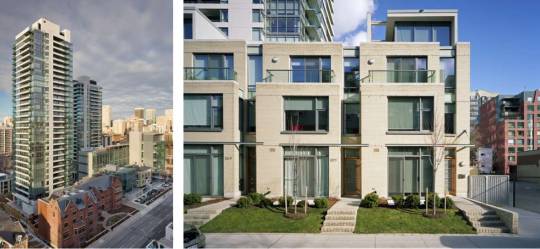
    The 2-tower complex is located north of Carlton Street, between Church Street and Jarvis Street, and is adjacent to Canada’s National Ballet School (designed by KPMB Architects). It’s close to College Park and Yonge & College.

    It was completed/registered in 2005 and won a number of design awards, including one from the Royal Architectural Institute of Canada. Notable about the design is the way it integrates townhouses at the base, a public courtyard (with public art) between both towers, and the Ballet School. (A deal struck with the developer and the CBC allowed the school to buy their portion of the land for $1). 

    The buildings were developed by Context Development and designed by architectsAlliance, which is actually the same developer-architect duo behind the building I currently live and own in. I’m clearly a big fan.

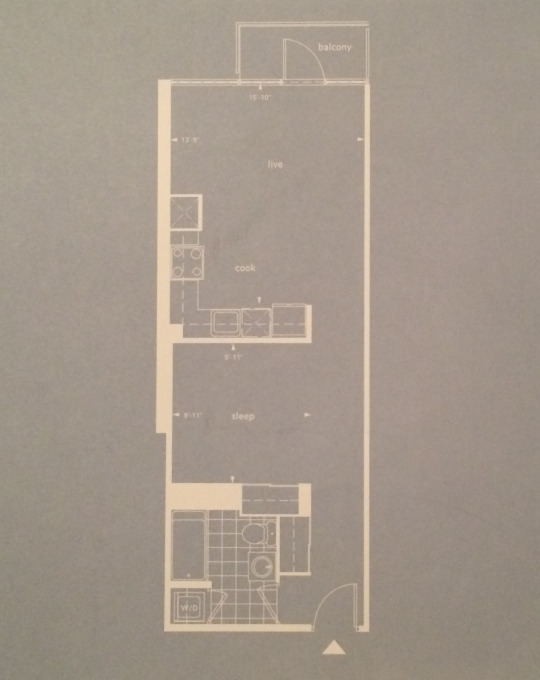
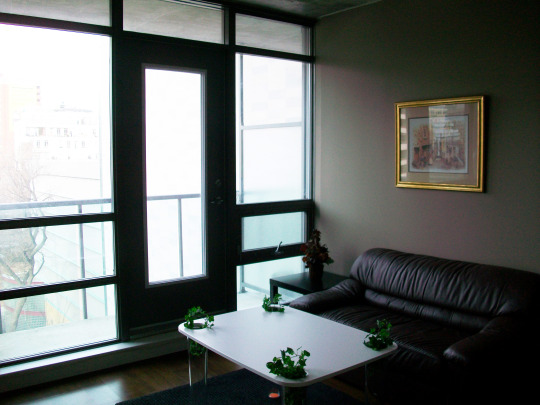
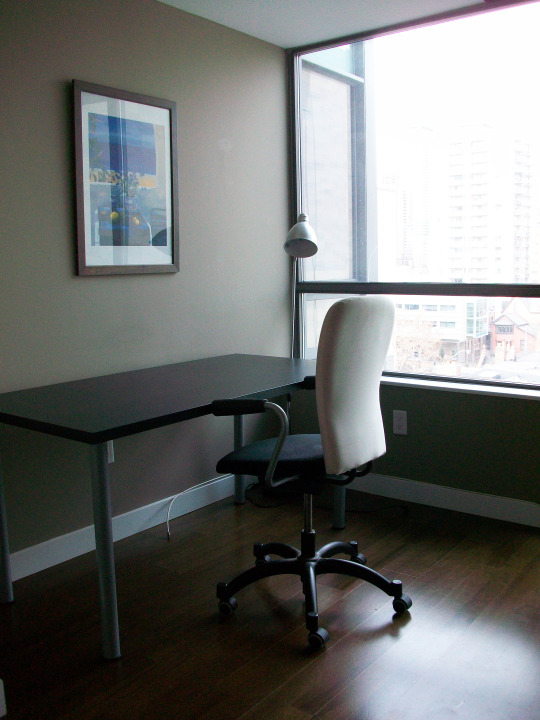
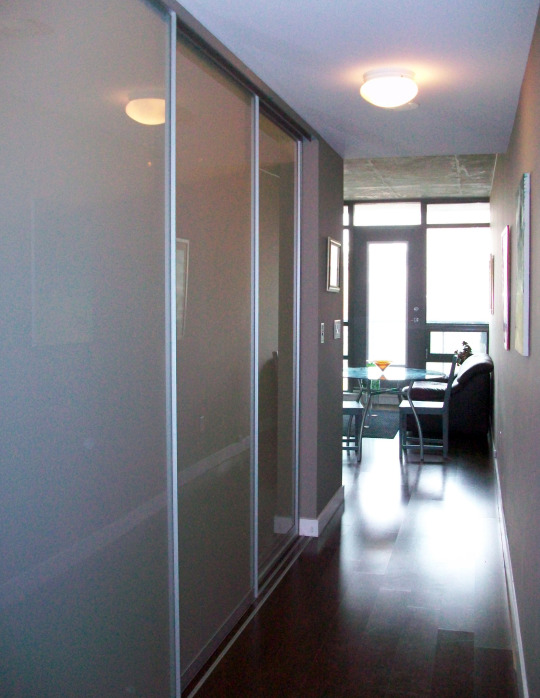
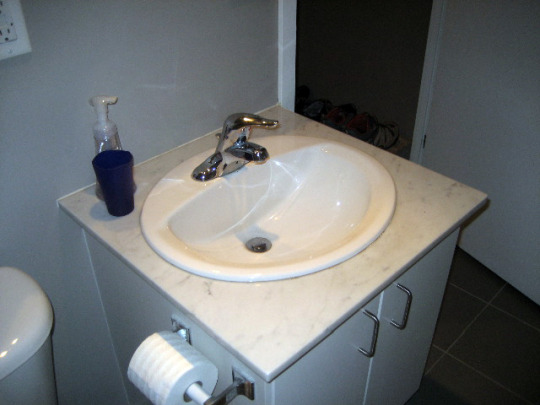
    The suite is about 560 square feet. It has 9’ exposed concrete ceilings. It has one full bathroom (tub), with a stacked washer and dryer. The bedroom is about 10’ x 10’ and is setback from the outside windows and enclosed with 3 x translucent sliding doors from C-Living. (I had them installed myself and they’re much better quality than the sliding doors you’ll find in most new builds.) The kitchen and living area is open concept, and there’s a north facing balcony that overlooks a quiet private courtyard. You basically get a view of trees, greenery, and the city. The suite is located on the 7th floor.

    Here’s the floor plan:

    image

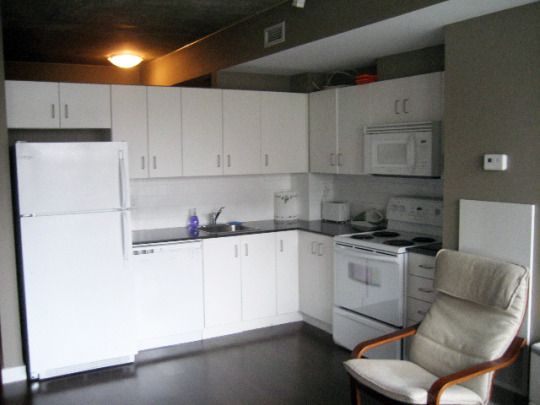
    And here are a few photos. They are all the right proportions and haven’t been stretched to make the space look bigger 🙂

    imageimageimageimageimage

    The building has 24-hour concierge, visitor parking, and 3 floors of amenities. The amenities include a gym, aerobics room, party room, saunas, media room, boardroom, multiple lounges, 2 x guest suites, a party room, and a billiard room. 

    College subway station is a 7 minute walk (600m).

    image

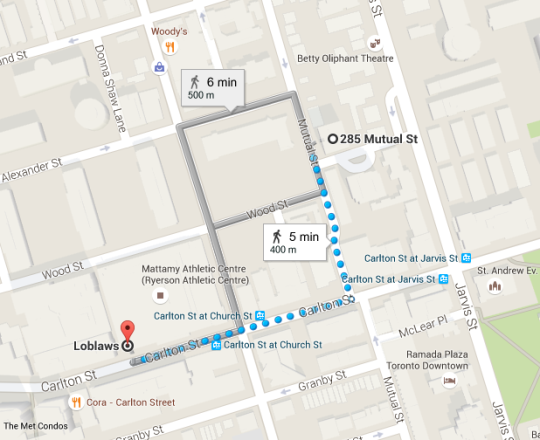
    The Loblaws grocery store at Maple Leaf Gardens (which is awesome and also includes an LCBO) is a 5 minute walk (400m). Though I’m fairly certain you could do it in 4 minutes.

    image

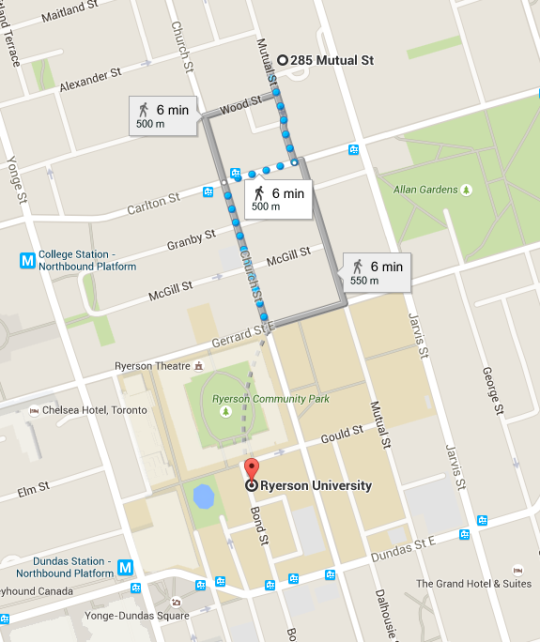
    And you’re a 6 minute walk to Ryerson University (500m).

    image

    The asking price is C$349,900. The maintenance fee is $426.64 per month and the property taxes are $2,039.19 per year.

    It’s a private sale, but she is willing to cooperate with buyer’s agents (2.5% commission). It’s currently furnished, but you can have it either way you want (unfurnished or furnished).

    If you have any questions or would like to book a viewing, please send her or me an email. If you’re an agent just looking for a listing, please don’t. Thanks for reading. Regularly scheduled programming will resume tomorrow.

    Image at the top of this post is from architectsAlliance.