
Daily insights for city builders, delivered every morning at 6 AM ET. I’m Brandon Donnelly — a Toronto-based real estate developer and founder of Globizen. I’ve been writing here since 2013.

Tag: architect as developer

  • The development value chain

    When I was in graduate school, my plan was to create a vertically integrated design and development company. I loved designing things and wanted to remain close to those sorts of details, but I had already decided that I wasn’t going to be an architect in the traditional sense and that I was going to be a developer. And so my objective was to figure out a way to combine everything under one roof. How could we be designers, but also be the entrepreneurs that make buildings happen?

    In some ways, Mackay Laneway House is a manifestation of that model. Through a partnership with Gabriel Fain Architects, we (Globizen Studio) have been heavily involved on the design side. Gabriel did all of the drawings and the overall architecture, but we weighed in (more than your typical client), selected most of the FF&E, and even designed things like the kitchen (with Scavolini) and the exterior signage. I wouldn’t call it true vertical integration, but we did start to blur the lines between architect/designer and developer.

    One of the interesting things about this approach is that it begins to create some consistency and a bit of a branded product. The hope is that when Mackay Laneway House is fully complete, it will read as a Globizen project, which is not that dissimilar from what David Wex of Urban Capital was talking about in this recent podcast. Their projects are a specific kind of product. They generally repeat it, and if that’s not what you’re interested in, then you don’t buy an Urban Capital home.

    But this also raises an important question: what is the role of architects and architecture in the case of buildings as very specific products? (This is something that we have discussed before on the blog.) Is the job of the architect to create an interesting exterior shell that then gets populated on the inside by a specific product offering? Or is it even worse, is architecture sometimes just an “empty vessel” that gets interior design and a brand slapped onto it? In some cases and with some projects, it does feel this way.

    I am a firm believer in the value of architecture and design. An “empty vessel” is not architecture. It is, well, an empty vessel. And that is not what I aim for in any of the projects that I’m involved in. Creativity, function, thoughtfulness and, yes, beauty, are all important. At the same time, I think this is a valuable debate. These sorts of questions are helpful in dissecting the architecture/development value chain. And so I would be interested in hearing your thoughts in the comment section below.
  • Mr. Robinson — Architect as Developer

    I first learned about the work of Jonathan Segal back when I was in architecture school. And he was somebody I immediately admired. 

    At the time, I was struggling to figure out where I wanted to position myself between architecture and real estate development, and he was somebody who had seemingly figured it all out: he simply merged the two.

    For those of you who are unfamiliar with Jonathan Segal, he has made a name for himself by being a pioneer of the “Architect as Developer” business model. That is, he acts as both the architect and the developer/client.

    This business model isn’t going to suit everyone, but I suspect that we’ll see more of it in the future.

    Of course, it doesn’t just have to be an architect acting as a developer. It could also be an architect and a developer joining forces or some other permutation. Whatever the case may be, design and innovation are central to business today and that’s why I think this model will only become more relevant.

    Below is a short 3 ½ minute video about Segal’s latest project, called Mr. Robinson. It is located in San Diego. If you can’t see the video below, click here.

    [vimeo 155403927 w=500 h=211]

    If you’d like to see the typical floor plans or rent one of the apartments (they start at $2,400/month), click here.

    Now I’d be curious to hear your thoughts. Do you like the project?

  • 3 architects operating as developers

    image

    A reader recently shared with me an interesting article from Crain’s New York (2013) profiling three “architects as developers.” The three firms are DDG Partners (which I’ve mentioned before here on ATC), FLAnk, and Alloy.

    I’ve written a lot about these emerging business models and I continue to think that we’re going to see more of them in the coming years.  As evidence for that claim, I thought it was really interesting to read in the article that Vishaan Chakrabarti – who is director of the real estate program at Columbia University – made specific mention that there’s growing interest among his students to wear multiple hats. In other words, they don’t want to be just an architect or just a developer. They want do it all.

    In a lot of cases, these firms are made up of partners who have those diverse skill sets. There’s only so much that one person can do. But that doesn’t negate the fact that vertically integrated companies are being formed that handle everything from design and construction to property management and development.

    And if an increasing number of students today are interested and thinking about those models, then I think it’s a pretty safe bet that many of them will get out into the workforce and eventually create those companies in the future.

    Ultimately, I think that’s a great thing for cities. Developers tend to have a bad reputation for thinking only about money. But when you bring design and other disciplines in-house, you create tensions in the process. And tension can be a great thing for innovation and creativity.

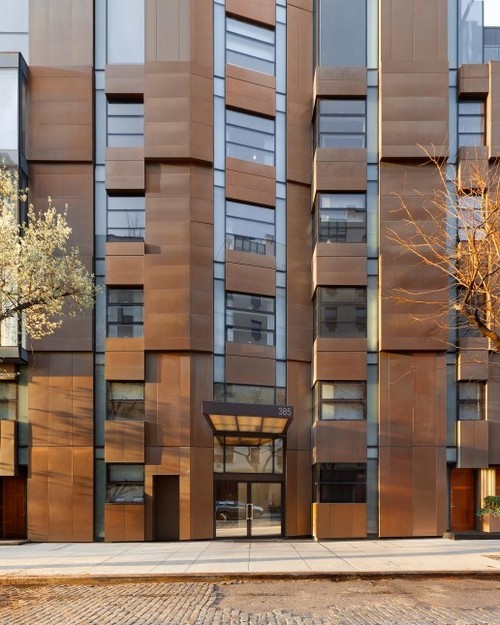
    Image: 385 West 12th by Flank

  • A new model for the architecture profession

    Last week I provided a few suggestions for how architects might be able to transition over to real estate development. And I ended by saying that I loved architecture school, but that it could use a few more business and entrepreneurship classes. Today, I’d liked to expand on that idea.

    When I was doing my Master of Architecture at Penn, I spent a lot of time thinking about hybrid models for the architecture profession. I was trying to figure out a way to reconcile my love of design with my desire to be more of a building entrepreneur.

    I was interested in what Jonathan Segal was doing down in San Diego with his “architect as developer” approach. And I was really taken by a lecture that Joshua Prince-Ramus (formerly of OMA, now REX) gave where he talked about how architects have marginalized themselves (away from being the master builder) by shying away from liability.

    Out of all the models, conflating architecture and development seems to me like a real possibility. I believe that good developers understand good design and that good architects understand what’s good for the market. So why not merge the two?

    We know that the architecture profession is facing significant challenges; fewer and fewer architecture school grads are getting licensed and actually become a bona fide architect. Some think this calls for licensure reform, but I’m also interested in revisiting the model in its entirety.

    Imagine if every architecture school taught students how to design a building and then go out and actually get it leased up and built. Is this too much to ask of one discipline?

    I can see firms naturally splitting up roles between those who prefer the design side and those who prefer the selling and business side, but is there any reason why the same firm couldn’t be handling both?