Daily insights for city builders, delivered every morning at 6 AM ET. I’m Brandon Donnelly — a Toronto-based real estate developer and founder of Globizen. I’ve been writing here since 2013.
I was out for lunch with a colleague of mine yesterday afternoon and he said to me: “Brandon, I’m really surprised that you’re so interested in technology. It just seems so different compared to real estate and architecture.”
And I’ve certainly heard that exact same comment from a number of people before. But I don’t see it that way and here are a few reasons why.
The common thread for me between architecture, real estate development, and technology is that in all of these cases it is about imagining the way things could be in the future and then creating it. It’s about change. It’s about growth. It’s about creation. And I consider myself a builder in practically every sense of the word.
At the same time, each of these disciplines is about creating engaging spaces for people. Architects and real estate developers do it in the physical world, but many technology products strive to do exactly the same thing in the online world.
In fact, a couple of years ago I was fascinated to learn that Facebook has and continues to draw inspiration from many of the same books and philosophies that architects, planners, and developers rely on when it comes to creating engaging communities. The medium might be different, but it’s still about people.
Finally, as I’ve said many times before here on Architect This City, I think that the distinction between tech and non-tech companies and industries is quickly evaporating. Is Airbnb a tech company or a hospitality company? Is Uber a tech company or a taxi company? Pretty soon we’ll be saying that about many other industries.
Maybe it’s because I’ve always been interested in wading through the overlaps between disciplines, but this is just the way I see it.
This afternoon I saw on Twitter that Toronto Police are now starting to crackdown on UberX drivers in the city. The investigation is called “Project Snowball” and they have already charged at least 11 people. The fines are anywhere from $200 to $20,000.
I get that Uber is a highly disruptive company. I’ve written about it many times before. But at the end of the day, this is not just about Uber. This is about a larger shift in the economy.
The buzz term is “sharing economy.” But one of the ways I like to think about it is like so: Facebook doesn’t produce any of its own content, and yet you could define it as a media company. Airbnb doesn’t own any rooms, and yet it is disrupting hotels. Uber doesn’t own any cars or plates, and yet it is disrupting the taxi industry.
What’s happening is that the internet and mobile phones are allowing for peer-to-peer connectivity and more decentralized forms of marketplace supply.
What does that mean?
It means that instead of having a fleet of cars or a centralized hotel building, anyone with an extra car or an extra room (and an internet connection) can plug themselves into the market. And that represents an entirely different cost structure for businesses.
It’s worth noting that prior to Uber, Travis Kalanick founded a peer-to-peer music sharing company called Scour (1998). Its closest equivalent would have been Napster. Remember Napster? This is not a new trend.
That said, I still think we’re at the early stages of this shift. I predict that many other industries will see disruptors similar to Airbnb and Uber. And so when I look at it in this context, I have a hard time believing that fining UberX drivers is the most enlightened way forward.
I believe we should instead be taking a leadership position and trying to figure out how to adapt our rules and regulations to this changing economy. Toronto is not alone in this battle. But we could certainly be the one to lead the way out.
One of the most interesting talks that I attended while I was in graduate school at Penn was by John Maeda.
John operates at the intersection of design, technology, and business, and I find his work fascinating. He’s probably best described as a graphic designer, visual artist, computer scientist, academic, and author. And when I heard him speak in 2008, he was also President of the Rhode Island School of Design.
More recently though, John has entered the world of venture capital by becoming a “Design Partner” at Kleiner Perkins Caufield & Byers (KPCB) in Silicon Valley. But what’s really interesting about this move is that when he joined KPCB in January 2014, he was the first designer to arrive on Silicon Valley’s legendary Sand Hill Road. No other VC firm had a designer in-house.
So that’s changing. As of this month (March 2015), there are now 6 other designers on Sand Hill Road. The venture capital community has seemingly woken up to the value of great design.
John Maeda has branded this shift, #DesignInTech. And he recently gave a presentation on the topic at SXSW. It’s a great read, particularly if you’re somebody who cares about design. Click here if you can’t see it below.
Last week I wrote (yet another) post about Uber where I argued that leading cities will be the ones that engage with the sharing/rental economy (as opposed to try and outright ban it) and that Uber is going to continue to impact current beliefs around vehicle ownership.
As to be expected, some people agreed with me and some people didn’t:
But I also discovered following that post that there are groups, and hopefully cities, who are working to adapt to the changing realities brought about by disruptive innovation.
One of those groups is The National League of Cities – which I truthfully don’t know that much about. But they have created something called “The Sharing Economy Advisory Network.”
“Cities across the country have been struggling to respond to the rapid emergence of the Sharing Economy,” said Clarence Anthony, National League of Cities executive director. He continued, “Cities are looking for ways to update and improve their current regulatory framework to ensure that regulations like safety and health protect residents, while at the same time supporting the growth of new businesses. It is imperative for cities to learn how this industry operates and discover ways to engage in order to support these new modes of doing business and to create jobs.”
It sounds like the right kind of initiative and I wish them lots of success. I hope it’s effective and I hope that Toronto will look at how it too can properly manage these economic changes. This is going to take both the private and public sectors working together.
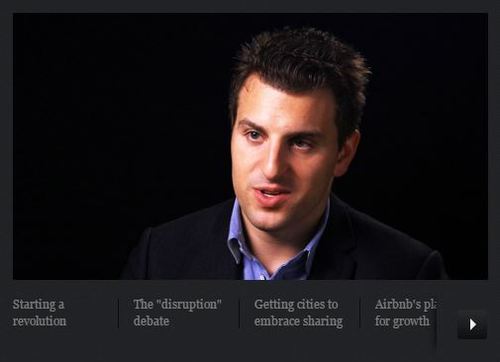
McKinsey recently put out a great interview with one of the founders of Airbnb, Brian Chesky, talking about the relationship between his company and cities. I thought it was fascinating. Click here to watch the video.
If you don’t feel like doing that, I’ve also pasted the interview transcript below and bolded some of the really interesting takeaways. Let us all know what you think in the comment section below.
It’s a currency of trust, and that used to live only with a business. Only businesses could be trusted, or people in your local community. Now, that trust has been democratized—any person can act like a brand.
Airbnb is a way that you can, when you’re traveling, book a home anywhere around the world. And by anywhere, I mean 34,000 cities in 190 countries. That’s every country but North Korea, Iran, Syria, and Cuba.
The reason we started was I was living with my roommate, Joe, in San Francisco, and I couldn’t afford to make rent. That weekend, the International Design Conference was coming to San Francisco. All the hotels were sold out. Joe had three air beds. We pulled the air beds out of the closet, we inflated them, and we called it the “Air Bed and Breakfast.”
The reason it’s grown so fast is, unlike traditional businesses, we don’t have to pour concrete. The infrastructure and the investment was already made by cities a generation ago. And so all of a sudden, all you needed was the Internet.
The ‘disruption’ debate
I never really loved the word “disruption,” because it suggests that maybe it’s the kid in a class who was disruptive, who probably didn’t add a lot to class. I think that we have a lot to add to society.
Over time, cities have gotten so big that the sense of community has gotten lost. And I think once you know everyone, that community can reemerge. And as far as our relationship with cities, we can’t succeed without a city. Or we can’t really thrive without a city. We don’t want to thrive in spite of a city. And I think if we work together, it’s going to be amazing. I think the people win. And I think if we don’t work together or if we fight, the loser isn’t really us or the city—it’s the people in that city.
Getting cities to embrace sharing
Fundamentally, the idea of the sharing economy is going to be great for cities. It means that people all over a city, in 60 seconds, can become microentrepreneurs. And they can be empowered. And they can make an income. Now, this is amazing, but it’s also complicated because there are laws that were written many decades ago—sometimes a century ago—that said, “There are laws for people and there are laws for business.” What happens when a person becomes a business? Suddenly these laws feel a little bit outdated. They’re really 20th-century laws, and we’re in a 21st-century economy.
It’s probably going to be a fair amount of work to revise some of the laws and rethink the way cities and platforms work together, but I think that work is worth it. Because what cities don’t have to do is invest billions of dollars in infrastructure to create jobs. Whereas historically, to create opportunities, cities would need massive projects and investments, these jobs only require the Internet. Now what they need to do is navigate the legal framework, which is typically outdated. We want to work with the cities. We’re not telling them that their laws are terrible. The world continues to change. Laws must continue to adapt for that world.
We want to help cities understand what our world looks like so they can modernize the laws to make sense. We’re not against regulation. We want to be regulated because to regulate us would be to recognize us.
Airbnb’s plans for growth
We want travelers to be able to book homes anywhere. Anywhere includes Asia. Asia’s a nascent market for us. Number two, we’re also looking at other use cases. Airbnb started as a way for travelers to find a budget way to vacation in a city. But now we’re starting to see people who aren’t on a budget. They want a much more high-end experience. And the third is that at the end of the day, if you’re traveling to Tokyo, you’re not traveling to Tokyo to stay in a home or a hotel. You’re traveling to Tokyo—if you’re on vacation—because you want to have an experience. And we’d love to do more to make that experience special and memorable.
The future of sharing: Your free time
I don’t think people would view the jobs created in the sharing economy as jobs. I don’t even know if they get counted as jobs when the White House has a new jobs report. They are jobs. As far as I can tell, people are working, they’re making income, and they depend on that income. Half of our hosts depend on it to pay the rent or mortgage. Maybe it’s a new kind of job. Maybe it’s like a 21st-century job. Tom Friedman talks about how in the future people may not have jobs. They’ll have income streams.
I believe that the sharing economy broadly can probably provide tens of millions of jobs or income streams for people all over the world. This is going to have a pretty big effect on the economy, mostly a good one.
The sharing economy started by democratizing and creating access to probably two of the biggest assets people have: their homes and then their cars. But I think the whole idea of ownership is changing. When my parents were young, owning things was a privilege, and there was a sense of romance to owning a house, owning a car.
Today’s generation sees that ownership also as a burden. People still want to show off, but in the future I think what they’re going to want to show off is their Instagram feed, their photos, the places they’ve gone, the experiences they’ve had. That has become the new bling. It’s not the car you have; it’s the places you go and the experiences you have. I think in the future, people will own whatever they want responsibility for. And I think what they’re going to want responsibility for the most is their reputation, their friendships, their relationships, and the experiences they’ve had.
So I think the biggest revolution will be in the biggest asset of all. The biggest asset is not a house. It’s not a car. It’s people’s time. People’s time may start with just gigs: waiting in line for you, delivering something for you. Over time, I think it’s going to move upmarket. And eventually, menial tasks become real trades, and real trades become art forms.
Somebody may say, “I cook a great brunch. I wonder if people would enjoy having brunch at my house?” And you could be able to book a brunch at someone’s house, instead of at a restaurant. That person isn’t trying to create a restaurant, they’re just allowing someone to have brunch. They build a reputation. One day, that person can be a Michelin-rated chef in their house.
I’m convinced that city building – like probably every other industry – is going to get a lot more data driven. Yesterday I wrote about how driverless cars are collecting exact replicas of our cities as a result of the 3D scanning that they do. And today I learned about an interesting new startup called Placemeter.
Basically it works like this: If you have a window (at home, at the office, or wherever) that faces onto a lively street, Placemeter will pay you to setup a smartphone in that window as a “meter.” The going rate is up to $50 per month and they’ll even provide you with the necessary suction cups.
Through video, your phone will then start collecting anonymous data about that street’s activity levels: the number of people, cars, and so on. Below is a video of what that output looks like. Notice that it’s even collecting the number of people that go into each of the stores. Click here if you can’t see the video below.
To make money, Placemeter plans to sell (or is already selling) this data. And their goal is to “make your city better” by specifically improving the way that pedestrian spaces are designed. There are of course lots of other use cases for data like this (such as seeing how busy that bar is across town), but their primary goal appears to be around city building. At least that’s the case right now.
Not surprisingly, there are concerns about privacy. But I’m sure they’ll be able to work around that. All of the data they collect is anonymous and they don’t save any of the footage that they receive from the meters. Their system just extracts the relevant data points and then automatically deletes the video.
What’s also interesting to me about this startup, though, is that it’s yet another example of decentralized value creation. Just like Airbnb empowered anyone with a spare room to run their own bed and breakfast and YouTube empowered anyone with some talent (or a funny cat) to create engaging content, Placemeter is allowing anyone with a window and a view to connect and contribute to a network of urban sensors.
And it works because the marginal cost of adding a new meter to their network is relatively low. Especially if you compare it to what it might cost for a municipality to setup and manage a similar – albeit centralized – system. It’s a totally different cost structure. So when we talk about smart cities and data driven city building, we’re really talking about networks and an environment of decentralized inputs.
It’s a pattern that keeps coming up as a result of the internet. If you start watching for it, I’m sure you’ll see it.
Jevon MacDonald of StartupNorth published an interesting article today called, You are supposed to break the rules. It talks about entrepreneurship and how great companies are built by disregarding the way things are done today.
And I think it’s for that reason that many stupid sounding ideas (think Airbnb and its initial idea of offering air mattresses) actually turn out to be great ideas. In reality, they weren’t stupid ideas. They just contravened the norm, and that made them sound stupid. It made people feel uncomfortable. And as humans, we tend to have a bias towards things that reinforce our existing view of the world.
In any case, Jevon talks about some of the “big rules” that are being broken today. His list includes:
But really he’s talking about Uber, Tesla, and Airbnb. They are the startups breaking those rules. However, that’s old news for most of us. What’s more interesting are the following two takeaways.
The first is his prediction that startups are going to start running into more and more regulatory hurdles. In other words, we’re going to see more, not less, litigation. And I think he’s right. As technology starts to creep into other industries (like it has with the taxi industry, the car industry, and the hospitality industry), we’ll probably see a lot of incumbents fighting to hold on.
The second interesting takeaway for me was that out of his list of “big rules”, the real estate industry (i.e. the MLS) is the only one that doesn’t have a formidable disruptor attached to it. Which makes me wonder: Is something like Opendoor.com inevitable?
I’ve been following Airbnb pretty much since the beginning. The company has always fascinated me because I saw it as being less about technology and more about travel, hospitality, community and, in my view, real estate.
An office building is just a set of spaces that get rented out on long term leases. A hotel building is just a set of spaces that get rented out on short term leases (one night at a time). And Airbnb spaces are simply extra or “found spaces” – such as an extra bedroom – that could never really be rented out at any sort of scale before. But then Airbnb came along, built a community around it, and empowered everybody to make money off that found, extra space. I think that’s pretty neat.
What’s interesting about this new expression is that it’s a perfect example of Simon Sinek’s belief that people don’t buy what you do, they buy why you do it. And in this case, Airbnb’s why is community, trust, belonging, and a sense of place. Talk about emotive.
In both the above video and in CEO Brian Chesky’s blog post today, reference is made to our cities and towns, and the fact that as they continue to get larger, we’re also becoming increasingly more disconnected. Things have gotten impersonal. But Airbnb is bringing back that sense of belonging.
On a less emotive level, what it also does is set Airbnb up for expansion.
Chesky has said before that the company wants to own the entire travel experience – from the moment you leave your home to the moment you return. So presumably a big impetus behind the rebrand was to develop something that could become ubiquitous across a number of different products and services. Which is why it makes perfect sense that they would encourage people to design their own versions of the logo.
So while the rebrand has received a lot of criticism today – some people say it looks like a vagina – I wouldn’t discount it just yet. There are bigger plans in store.
What’s immediately interesting to think about is how recent the modern workplace really is:
The information worker is a relatively new concept. Peter Drucker coined the term in the 50s. By then companies had already developed new ways of housing information workers. The very first information workers were accountants hunched over “Bob Crachit” desks in the back rooms of factories. Booming railroad companies demanded more organization and created offices within the new skyscrapers along the Chicago skyline. With these new offices came stacks of paper and folios, and cabinets in which to file them. Then, the Mad Men wrought an era of typewriters and mahogany corner offices. Next, Bell Labs invented the suburban office park, moving offices from the city as part of post-war suburbanization and in the 70s, Herman Miller crafted the now-ubiquitous cubicle, which was called the “Action Office” when it launched. Oh, the irony.
It’s also interesting to think about how quickly things seem to be changing. Up until quite recently, everybody seemed to be singing the virtues of the open office plan. However, today, more and more companies are shying away from that kind of space planning:
In 2011, the organizational psychologist Matthew Davis reviewed more than a hundred studies about office environments. He found that, though open offices often fostered a symbolic sense of organizational mission, making employees feel like part of a more laid-back, innovative enterprise, they were damaging to the workers’ attention spans, productivity, creative thinking, and satisfaction. Compared with standard offices, employees experienced more uncontrolled interactions, higher levels of stress, and lower levels of concentration and motivation. When David Craig surveyed some thirty-eight thousand workers, he found that interruptions by colleagues were detrimental to productivity, and that the more senior the employee, the worse she fared.
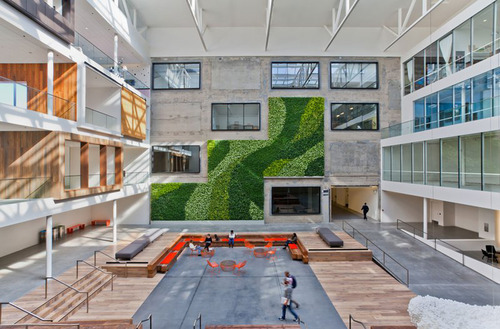
Today, the most radical changes are appearing in startup offices around the world and are being driven by a desire to have spaces that embody their unique corporate cultures. This means everything from cool brick-and-beam architecture to bike racks in the office to flexible rooms and spaces that encourage mobility throughout the day. And to further reinforce these cultures, companies are creating positions like Chief Culture Officer and Chief Vibe Officer.
But as I’ve said before on ATC, the other big shift is simply location and the return to cities. More and more startups, for example, are choosing San Francisco over Silicon Valley and it’s because the city is where young people want to live. It’s increasingly where the talent is. This has already brought about many changes in workplace design, but it likely bring about many more.
Though it’s sometimes common to downplay “this for that” startups (that is, derivative startups that try and borrow a model and use it in another market), Storefront–which can be described as Airbnb for retail spaces–has just raised a $7.3 million Series A round.
Storefront is a marketplace for short term retail space (think pop-up shops). People with space simply create a listing and decide how much they would like to charge per day, per week or per month. In doing so, Storefront “helps all sorts of brands, sellers, and merchants to create their first brick and mortar retail experience.”
What I find interesting about Storefront, and other startups like Airbnb, is that they’re really rewriting the way real estate marketplaces work. Instead of large retail landlords (Storefront) and multinational hotel operators (Airbnb), technology is allowing individuals to now participate in these marketplaces. Supply is being decentralized and anyone with extra space can participate.
You could argue that these sorts of informal and short term rentals are nothing new, but I don’t think there’s ever been the possibility of scaling up like there is today. I mean, just look at how much attention Airbnb has been getting in New York. These startups are having an impact on the way the larger market functions.
Change is coming. And I think we’ll see a lot more of it in the real estate space.