Daily insights for city builders, delivered every morning at 6 AM ET. I’m Brandon Donnelly — a Toronto-based real estate developer and founder of Globizen. I’ve been writing here since 2013.

Tag: airbnb

  • Airbnb-ing your way to homeownership

    I just discovered an interesting new Seattle-based startup called Loftium

    The way it works is that they provide down payment assistance (up to $50,000) to prospective homeowners as long as they commit to renting out one of the home’s bedrooms on Airbnb for 12 to 36 months. Loftium is positioning it as a way to help first time buyers get onto the property ladder.

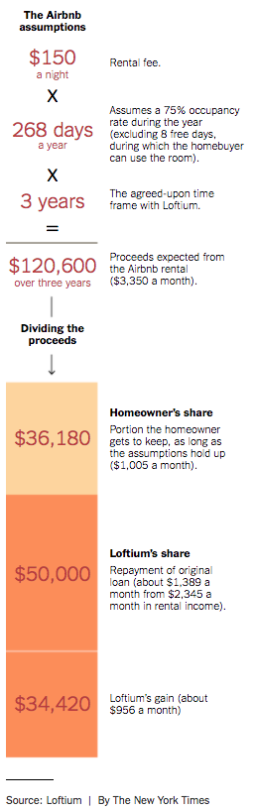
    Here’s an example of how the math might work (taken from the New York Times):

    The details certainly matter a great deal here but, high level, the homeowner gets $50k upfront, ~$1k per month in shared Airbnb revenue, and the opportunity to buy a home. You just have to be committed to being a host.

    And from Loftium’s perspective, they put out $50k at the outset and get back just over $28k a year for 3 years. Assuming these assumptions are correct, that’s a pretty good IRR. 

    However, if the home doesn’t generate enough Airbnb income during the agreed upon term, Loftium is on the hook because the homeowner doesn’t owe anything after the “services contract” expires.

    Think this will fly? Would you use it?

  • Watery hummus and Airbnb rentals

    I’m on an American Airlines flight right now reading the New Yorker. I’m thankful that I brought a few back issues with me because it’s distracting me from the semi-deplorable conditions found in the rear of the plane.

    The TV in front of me is broken and they have run out of everything that could be considered edible. Instead of the humble wrap I wanted, I was offered a soggy box of vegetable crackers and hummus. The hummus came in a small toothpaste-like tube that squirted out some kind of watery substance. Not yet sure what it is because I stopped eating it. Thankfully the lady behind me managed to smuggle on a cheeseburger and a basket of onion rings. So I’ve been subsisting on her fumes for the last hour.

    In any event, onion rings and watery hummus are not actually what I want to talk about today. Last week’s New Yorker has an essay in it all about the gig economy. One of the sub-stories is about a woman named Caitlin Connors (real name?) who rents a 3 bedroom duplex with a friend in Williamsburg, Brooklyn.

    Her and her roommate’s goal is to rent out their place on Airbnb for at least a week each month. Often during this week they’ll take off traveling somewhere (net net they seem to come out ahead this way), but sometimes they’ll just decamp and stay with friends in the city.

    One of their criteria when they were initially looking to rent a place was that it had to be “Airbnb-able.” That’s partially what drew them to Williamsburg. They knew that tourists would see the area as trendy and want to stay there. So far that investment thesis has proven true, as their plan allows them to cover their $4,000 per month rent.

    The reason I mention all of this — the gig economy, not cheeseburgers — is because I recently attended a panel discussion about the current state of purpose-built rentals in Toronto. At the end of the discussion, somebody in the audience asked about how they’re dealing with Airbnb and each of the panelists responded in exactly the same way. Essentially: we closely monitor our buildings and crack down on it the best we can.

    My view about these sorts of things — Airbnb, Uber, and so on — is that they’re not going away so we should try and figure out how to accommodate and work with them. But how exactly should that play out?

    Do you get rid of the 6 month minimum lease term that is commonly applied to condo buildings in this city and let people do whatever the hell they want? Do you create rules, so that guests can, for instance, rent a room in a place but not rent an entire apartment? Or do developers need to start creating dedicated Airbnb floors and buildings? (It’s already happening in some cities.)

    I believe that there are ways to manage the negative externalities potentially associated with short-term rentals. But I would love to get all of your temperatures on this. Are you a firm yes or no to Airbnb in multi-family buildings, or are you a qualified yes with the right rules and regulations in place? Would you have an issue sharing a wall with an Airbnb suite? 

    Let’s talk it out in the comments. 

  • Merry Christmas

    Merry Christmas everyone! And, thank you all for reading this past year.

    I just checked into an Airbnb in Mont-Tremblant, Québec and will be spending the next few days here with family and friends. I’ve also brought along some of my favorite wines (see above) and, obviously, my snowboard.

    Hopefully that wherever you are and whatever you’re doing, that you’re with family and/or friends. I know that this time of year can be lonely for some people when things quiet down. So hopefully you have good people to spend it with.

  • What could a connected lockbox mean for the residential real estate business?

    image

    I just discovered an interesting Dallas-based startup this morning called TOOR. They were on Shark Tank and haven’t yet launched their product, but it’s essentially a connected lockbox. Lockboxes are a mainstay of the residential real estate industry (they hold the keys so that co-operating agents can show a property) and they are becoming even more common nowadays because of Airbnb rentals.

    What caught my attention about TOOR is the app that goes along with the lockbox that also allows people to search for homes. Once you’ve found a home you can even find an agent for an escorted tour. I’m not clear on the exact workflow, but I am thinking that if you buy this connected lockbox you then have the opportunity to put your home up for sale on their platform.

    This is interesting because the app will also verify user identities and scan people’s IDs, so it helps to solve the security problem that agents today now solve. I could imagine the app storing my credit card so that if I go into a home unescorted and I do something mischievous, it then charges me. It also makes it really easy to just drive around and pop into homes by instantly scheduling appointments.

    In any event, I may have the exact user flows a bit wrong, but it’s fascinating to think about how something as simple as a connected lockbox could start to chip away at the status quo.

  • Airbnb’s 5 point plan

    New York State Governor Andrew Cuomo recently signed a bill that will levy heavy fines (up to $7,500) on Airbnb hosts who do not abide by local housing regulations.

    Hours after, Airbnb filed a federal lawsuit claiming “irreparable harm.”

    However, they also proposed a 5 point plan that they hope will make home-sharing work in New York City and then serve as a framework for new legislation.

    Here are Airbnb’s 5 points (summarized by me):

    1. One host, one home: Just like it sounds, this would limit people to renting a single home within the five boroughs.
    2. Require registration: State would require short-term rental hosts to register. Airbnb would be authorized to register people on behalf of the state.
    3. Make home-sharing work for all: Landlords would be able to set specific rules for short-term rentals in their buildings and then secure a portion of the revenue for maintenance and so on. (I would imagine that the same could be done by condo corporations.)
    4. Good neighbor rules: Platforms would be required to have dedicated 24/7 hotlines should any neighbor complaints arise as a result of home-sharing.
    5. Taxes to support affordable housing: Airbnb would collect and remit additional taxes on behalf of hosts, which could then be used for things such as affordable housing.

    It’s interesting to think about Airbnb’s evolution. It started out as air mattress rentals on the floor and nobody thought it would ever work as a business. Now it’s a huge business and governments everywhere are trying to figure out an appropriate response. Hopefully a suitable middle ground will be found.

    How do you feel about Airbnb’s proposed 5 point plan? With this framework, would you be comfortable with Airbnb in your building? I know that many of you are also hosts (some of you do it for a living), so I would be curious to hear your thoughts.

  • Sonder — intimate neighborhoods, consistent quality

    Airbnb has been a game changer. I know many people who have made Airbnb their full-time career or who “stay for free” when they travel because they Airbnb their home. Airbnb likes to focus on the “community” rather than on the business possibilities, but regardless, it unlocked space in a new way.

    Here’s another take on decentralized vacation rentals: Montreal-based Sonder. Similar to Airbnb, you submit your property to their platform. But unlike Airbnb, they take care of everything from reservations and guest communication to operations and housekeeping. It’s a completely hands-off approach for owners.

    The value proposition to guests is that they get a more consistent experience, but with all the “local color” of a traditional vacation rental. And for owners, they get to maximize revenue without having to be as hands-on as with an Airbnb. (Presumably Sonder’s take is greater.) In many ways, it’s like a decentralized hotel chain. Same supply source as Airbnb, but they are now unifying the customer experience.

    It’s fascinating to watch this software/internet layer developing on top of real estate. It’s giving me all sorts of ideas.

  • How should cities manage their own awesomeness?

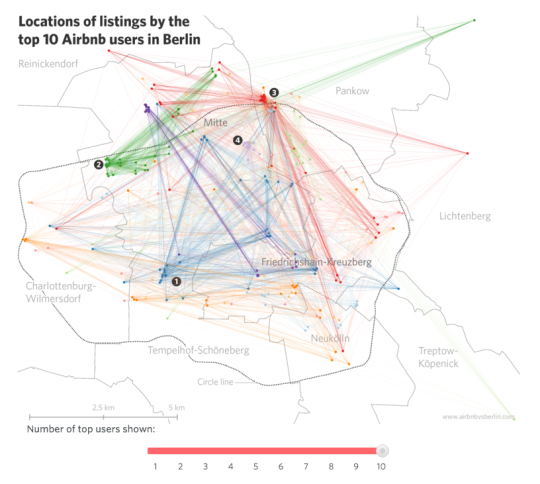
    Conor Maguire introduced me to an interesting site today called Airbnb vs. Berlin. The site does a deep dive into Berlin’s Airbnb market with the hope of answering the question: Is Airbnb contributing to a shortage in affordable housing?

    The site is very well done. It’s filled with lots of great market stats and diagrams such as this one here: 
    Of course, the impetus for a site like this is that cities all around the world, from San Francisco to Berlin, are grappling with rising home prices. If you happen to live in a successful, growing city, that’s probably what is happening.

    But when this happens, we seem to want to look for something or someone to blame. In San Francisco it’s the tech workers. They’re the ones driving up homes prices. In Vancouver, it’s the foreign Chinese buyers. And in Berlin, it’s those Airbnb users who are just out to make a profit. In all of these cases, we like to tell ourselves that if we could just get rid of “X”, everything would be much better. 

    But I think sometimes we forget that this is also the result of doing many things right.

    If Berlin wasn’t a brilliantly cool place to visit, then tourists wouldn’t come. And if tourists didn’t come, then Berlin wouldn’t have, by far, the largest Airbnb market in Germany. If Vancouver wasn’t one of the most enjoyable places in the world to live, you wouldn’t have the same attention from overseas buyers looking to snatch up properties. 

    So in a way, we should be asking ourselves: How do we, as a city, manage our own awesomeness?

    The other thing that Airbnb vs. Berlin reminded me of is the viewpoint that profits are some dirty little secret. I hear it all the time in the real estate development business. People will say: “That developer is just out to make money.” Of course she/he is! They operate a business. And like all for-profit businesses, one of the objectives – it may not be the only one – is to make money.

    I say all this not as a direct response to the website. They remained fairly neutral in their analysis. Instead, I raise it as an alternate viewpoint in the seemingly universal battle against “X.”

    In case you’re wondering about Berlin’s Airbnb market, the site estimates that there are roughly 11,701 Airbnb listings in the city out of a total of about 1.9 million flats. Of these listings, it is estimated that somewhere around 30% are by “professional users” who are only out to make a profit and are not participating in the “sharing economy” in its purest sense. That equates to about 0.18% of all Berlin flats.

    Based on this number, I’d say that Berlin’s cool factor probably has a lot more to do with the city’s rising rents than do the profit seeking Airbnb users.

  • Peer-to-peer solar startup

    Airbnb is a platform that connects people who have extra space with people who need space. It’s a peer-to-peer hospitality company.

    Yeloha, which is a startup I just discovered today, is a peer-to-peer solar company based out of Boston. 

    In the same vein as Airbnb, it connect people who have extra roof space (that’s suitable for solar collection) with people who want to buy solar energy (but may not have a solar friendly roof).

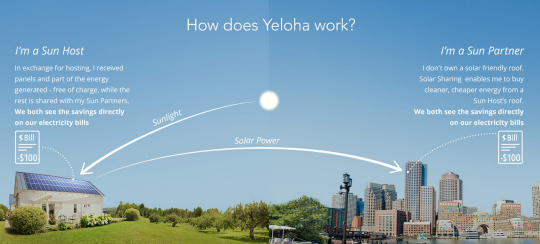
    Here’s an image from their website that explains how it works:

    image

    Basically, if you have a solar friendly roof, Yeloha will come and install solar panels on top of your place for free. You get to keep some of the energy that’s generated (about 1/3 apparently) which becomes a credit to your electricity bill. You are then known as a “Sun Host.”

    The remaining energy gets fed back into the grid and, if you don’t have a solar friendly roof, you can purchase this excess energy, which also results in a credit to your electricity bill. The solar electricity is less expensive than the regular grid electricity. In this case, you are known as a “Sun Partner.”

    I think this is a pretty neat idea. Neither party has to pay anything upfront. Both parties save money. And the result is more solar through a distributed and virtual net metering setup.

  • Enabling innovation by lowering the barriers to entry

    Yesterday afternoon Sam Altman of Y Combinator published a blog post talking about a new YC Fellowship program for even earlier stage companies. 

    For those of you who aren’t familiar with Y Combinator, they are a super successful funding platform for early stage startups. They are located in Mountain View, California.

    What’s unique about their approach is that they invest a relatively small amount of money ($120,000 for 7% of your company) in a relatively large number of companies. Their most recent cohort was around 85 companies and they do that twice a year.

    The rationale behind this approach is that it can be incredibly hard to predict which people and ideas will produce the next great company. Oftentimes the best ideas appear really shitty at first. (Here’s a post by one of the cofounders of Airbnb talking about the company’s early rejections.)

    So instead of putting all of their eggs in one basket, YC invests smaller amounts in more companies.

    But beyond this being beneficial to them, it’s also a model that I think helps to reduce the barriers to people starting a company. It gives more people the chance to prove that their company has the potential to be something great. 

    And that’s precisely what makes this new YC Fellow program/experiment so interesting to me.

    Instead of $120,000, YC fellows will receive $12,000 and they won’t have to move to the Bay Area (although it’ll be encouraged). They’ll still get mentorship and advice like the regular YC program, but it’ll be a kind of light version. 

    Though this is almost certainly just the beginning. Here’s how Sam ended his announcement post:

    “Someday if it works, we’d love to fund 1,000 companies per year like this.”

    Now all of a sudden that’s some scale.

    What’s exciting about this is that I believe our cities have the potential to be far more innovative than they are today. Every city is trying to be the next Silicon Valley, but every city is not the next Silicon Valley.

    I saw a great tweet the other day that went something like this (I wish I could remember who the author was):

    “Entrepreneurs aren’t risk takers. They’re just rich kids with big safety nets.”

    It’s a bit of a tongue-in-cheek generalization. But to unlock the full potential of our cities, we should be figuring out how to get everyone participating and building their ideas, not just those with a head start. 

    I think there are a lot of people around the world who could be doing great things, but they just haven’t been able to take that first step for one reason or another.

    Hopefully organizations like Y Combinator will be able to help them take it.

  • The evolving gig economy

    This morning venture capitalist Fred Wilson wrote a post on his blog talking about the gig economy and Hillary Clinton’s economic speech last night. 

    Here’s a snippet from Clinton’s talk:

    Meanwhile, many Americans are making extra money renting out a small room, designing websites, selling products they design themselves at home, or even driving their own car. This on-demand, or so-called gig economy is creating exciting economies and unleashing innovation.

    But it is also raising hard questions about work-place protections and what a good job will look like in the future.

    So, all of these trends are real and none, none is going away. But they do not determine our destiny. The choices we make as a nation matter. And the choices we make in the years ahead will set the stage for what American life in the middle class and our economy will be like in this century.

    The headlines this morning are making it seem like Hillary Clinton is taking direct aim at companies like Uber. But the transcript suggests that she’s being far more balanced than that: these new companies are creating exciting opportunities, and they are not going away, but there are still things to figure out.

    That’s basically how I feel.

    Take, for example, Airbnb. I think Airbnb is a great idea and company. A lot of my friends use it both as consumers and as suppliers of space.

    But for many (most?) condos in Toronto, owners are strictly prohibited from renting out their units on leases that are less than six months. It’s a direct ban on short-term leasing and it’s written into the Condo Corporation’s Declaration.

    And there’s good reason for that. Who wants to buy a condo only to find out that next door is being operated as a nightly hotel? Most people would even prefer that their neighbor is an owner rather than a renter.

    That doesn’t mean I believe Airbnb should not exist. I think we’ll likely end up getting more transparent about how buildings (and portion of buildings) are operating, as opposed to it being a shadow economy. And that could help.

    If you have any ideas for how companies like Airbnb might be better integrated into urban life, I would love to hear from you in the comment section below.