Daily insights for city builders, delivered every morning at 6 AM ET. I’m Brandon Donnelly — a Toronto-based real estate developer and founder of Globizen. I’ve been writing here since 2013.

Tag: affordable housing

  • Landed is helping teachers buy homes

    The average salary of a teacher in the United States was approximately $61,730 last year. This can make homeownership in high cost areas a challenge.

    Here is a chart from Curbed:

    Landed is trying to solve this problem by offering downpayment assistance to “essential professionals” — starting first with teachers — so that they can buy homes in and near the communities that they serve.

    The way it works is pretty simple.

    They’ll contribute up to half of a traditional 20% downpayment — so 10% of the value of the home — in exchange for a 25% share in any future gains, or losses.

    Put differently, for every 1% that Landed contributes, it takes 2.5% of any future appreciation (or depreciation). However, on an equity basis, they are actually putting up 50% of the required cash (in the maximum scenario) in order to get 25% of any future gains.

    There’s no monthly payment associated with Landed’s money, but it does need to be repaid at the end of 30 years or when the homeowner exits the agreement, whichever comes first. Homeowners are free to repay Landed at any time should they decide to sell the property or they just want to pay them out.

    Landed pitches the service as another version of “the bank of mom and dad.” And for many prospective homeowners, I am sure that it makes all the difference in the world.

    At first glance, it would seem that each homeowner also benefits from a kind of positive leverage. They only put up 50% of the required equity, but they get to enjoy 75% of the potential gains. However, each homeowner is also responsible for 100% of the carrying costs.

    I ran a couple of quick return scenarios, assuming a $500,000 purchase price and a 10 year hold, in order to test whether Landed or the homeowner would receive a higher IRR once the property gets sold.

    I didn’t carry any transaction costs, but I did factor in principal recapture, as well as utilities, insurance, and maintenance.

    My rough numbers suggest that it depends on the annual rate of appreciation. If appreciation stays close to the rate of inflation, it could tip in favor of Landed because they don’t put out any money after t = 0.

    But at higher rates of appreciation, the homeowner starts to benefit from the favorable 75/25 split at the end of the hold period.

    Either way, Landed is providing a service to people who may not otherwise be able to afford to buy a home. That has value. Here’s some more information on how it works, in case you’re interested.

  • The American Institute of Architects’ 2019 Housing Awards

    The American Institute of Architects just presented its 2019 Housing Awards. 12 housing projects were recognized across four categories.

    Some of the projects I have written about before — such as the Tiny Tower in North Philadelphia. But most of the projects haven’t been covered on this blog. One of my favorites, among the winners, is the Oak Park Housing project in Sacramento by Johnsen Schamling Architects.

    I like that the massing is simple and that it’s a dense — 6 unit — urban infill project in an area of Sacramento that has been struggling with disinvestment for many decades. According to the architect, it is one of the first residential projects in the neighborhood since the Oak Park Riots of 1969.

    Three of the homes front onto the main street. And the other three front onto and are accessed from a rear alley. Each home is just over 1,500 square feet. The project also had “an ambitiously limited construction budget“, so let’s call it an example of good design not having to necessarily cost a lot of money.

    I’m guessing their land costs were reasonable.

    Photo: John J. Macaulay

  • Laneway suites all across the city

    As of August 2018, the City of Toronto has allowed laneway suites (accessory dwelling units) to be built as-of-right in the Toronto and East York area of the city (subject to meeting some criteria).

    This was a tremendous step forward for the city. And I know a number of people who are currently taking advantage of these new planning permissions.

    Toronto is now looking at expanding these permissions across the entire city and they have just started their community engagement phase. The first public meeting took place today and the next three will be taking place over the course of this month. Click here for the when and where.

    This is a natural extension of the policies that have already been put in place around laneway suites and I’m excited to see this moving forward.

    For those of you who already own property in Toronto & East York and are considering building a laneway suite, there are two programs that you should be aware of.

    The first one allows eligible property owners to defer development charges on the new secondary dwelling unit for up to 20 years. This is meaningful. And the second is a $50k forgivable loan if you make the laneway suite an affordable rental for at least 15 years. (The cap is the City of Toronto Average Market Rent.)

    I still remember what happened when I tried to build a laneway house almost 10 years ago. I was told, by the city, that a house cannot be built behind another house. I knew that would change. Now look at how far we’ve come.

    Image: Lanescape

  • Toronto to market 11 city-owned sites for new affordable rental housing

    At the end of last month, Toronto City Council adopted the “Housing Now” action plan. The first phase of the plan involves the public marketing of 11 city-owned sites for the purpose of finding non-profit and private sector partners to help redevelop the lands with new mixed-income housing. It is expected that these lands could accommodate about 10,000 homes.

    Here is the list of sites:

    As part of the offering, around 2/3 of the built units will need to be rental (the above chart shows more), and of these rental units, 50% will need to be affordable with rents set to 80% of Toronto’s average market rents. All of this should translate into approximately 3,700 new affordable homes. (Mayor Tory’s plan is to build 40,000 affordable rental homes by 2030.)

    The City wants to ultimately retain ownership of these lands, and so the sites will be offered up through long-term land leases. It looks like they’ll be for 99 years. The City will also be forgiving a number of fees and levies for the 3,700 affordable homes. They are pegging the PV (present value) of these development incentives at just over $280 million:

    Making use of surplus public land to increase the supply of affordable housing certainly makes a lot of sense. But there’s a cost burden associated with these affordable units, which is why discussions around inclusionary zoning often come back to offsetting measures. Who is going to pay for these subsidies?

    The above “financial incentives” — which in this case are simply foregone revenue — speak to this cost burden.

    Tables: City of Toronto

  • How London became the center of the world

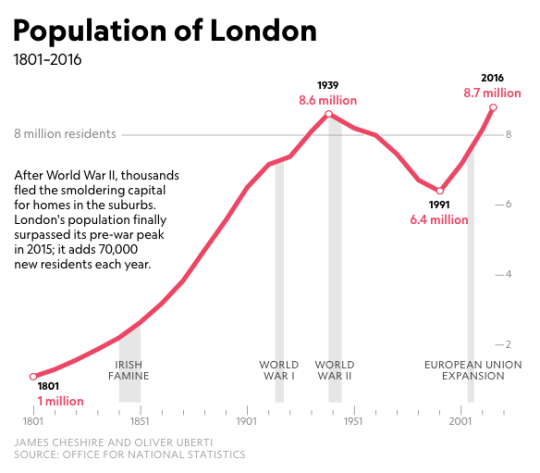
    Some of you may want to debate the “center of the world” title (New York may be more deserving), but Laura Parker of National Geographic recently published a great essay describing the tremendous growth that London has seen over the last 30 years thanks to in part the deregulation of the financial services industry. Here is an excerpt:

    As the manufacturing industry splintered, the docks of what was once the world’s largest port fell victim to shipping modernization and closed. The death in 1965 of Winston Churchill, the great prime minister, marked “the last time that London would be the capital of the world,” the Observer noted. Population continued a downward slide, bottoming out at 6.7 million in 1988. By then London’s fortunes had changed with deregulation of the financial services industry, known as the Big Bang, along with the shift to electronic trading, which enabled London to rival Tokyo and New York. A new financial district rose on the ruins of the West India Docks on the Isle of Dogs, a marshy nub that juts into the Thames. Canary Wharf, as the district is called, became London’s first modern large-scale regeneration project.

    According to National Geographic, London’s population grew by about 1.2 million between 2006 and 2016. That’s a pretty incredible number and is why the city estimates that they need about 66,000 new housing units a year just to keep up the growth. Like many supply constrained big cities, they’re not meeting that target.

    For the full essay, click here. It comes packaged with some incredible photographs by Luca Locatelli.

  • Rendering of block 8

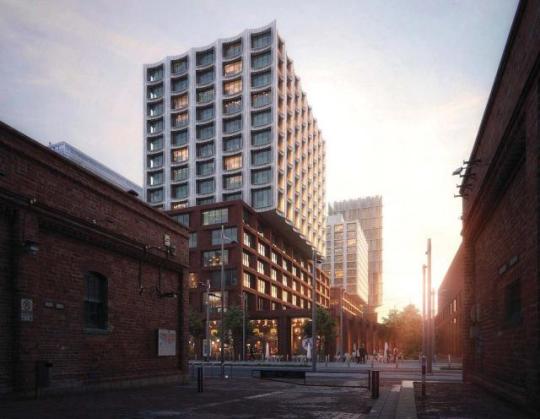
    I really like what has been put forward for Block 8 in the newly developing West Don Lands neighborhood of Toronto. Here is a rendering looking east from the Distillery District toward the proposed westernmost tower:

    image

    It feels like an extension of the Distillery District, which was clearly the intent. The materiality also reminds me of Junction House. Red brick at the base to fit within its context, and a more modern material palette on the upper floors. 

    I also like how, in this instance, the building steps out on its south side, as opposed to in. It’s something different. Not every building has to look like a wedding cake, right?

    The architecture is by COBE Architects and architectsAlliance. The developers are Dream, Kilmer Group, and Tricon. And the plan is for 756 rental apartments, of which 225 will be affordable and integrated throughout the 3 towers. 

    For more information, check out Urban Toronto.

  • First-year building project

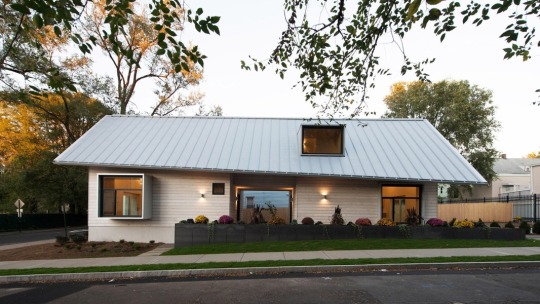
    Each year, first-year graduate students at the Yale School of Architecture are tasked with designing and then physically building a new single-family house in an economically depressed neighborhood. Sometimes, like this year, the house may have multiple dwelling units.

    I have always thought that this is a great exercise both from a pedagogical standpoint and from a positive impact standpoint. Young architecture students get to experience designing and building something from scratch, and lower-income families get a new house. I toured one of the completed houses in New Haven back in, I think, 2005. 

    This building project, which was started in 1967, is fairly unique among architecture schools, though others have replicated the model. When I was living in the US, I spent a few weekends working on homes for Rebuilding Together Philadelphia. But the scope was fairly limited. It was nothing like this.

    I think more schools should do this. And I also wonder if there aren’t permutations of this model that could live outside of the university context.

    Image: Yale

  • How Singapore fixed its housing problem

    There are a number of affordable housing plans being thrown around in Toronto right now given that we have a municipal election coming up this fall. 

    From what I have read, the plans are largely centered around surplus and/or available public land and possibly some subsidies. 

    These subsidies are very important because the money has to come from somewhere. This is often overlooked.

    In light of these debates, I thought I would share a short Bloomberg video that my friend Evgeny shared with me this morning all the way from Tokyo.

    The video is about how Singapore fixed its housing problem. If you can’t see it embedded below, click here.

    [youtube https://www.youtube.com/watch?v=2cjPgNBNeLU?rel=0&w=560&h=315]

    It strikes me as being very Singaporean.

  • Economies of scale in the car and housing industries

    Over the weekend I watched this interview discussion between Elon Musk and Marques Brownlee. If it doesn’t show up below, you can find the video here.

    [youtube https://www.youtube.com/watch?v=MevKTPN4ozw&w=560&h=315]

    Elon figures that if Tesla works really hard they could probably come out with a USD 25,000 car in about three years. The key to that affordability is twofold: (1) design & technology improvements and (2) scale. 

    So part of the answer is just time. As design and engineering iterations continue to take place, the components will become better and cheaper, just as they have for things like cell phones. Elon estimates that we’re in the 30th iteration of the cell phone today.

    But the second factor is simply volume. And that got me thinking about housing production and the similar importance of scale and density. We do a lot to limit volume, despite saying we want more affordable housing.

  • Planning staff reports

    A bunch of people have asked me lately about what they should do if they want to get smarter on land use planning and on the entitlement process for development projects. It was specific to Toronto, but I don’t think my answer is specific to only this city.

    I took a few planning classes in graduate school when I was in the US. But I was more focused on architecture and real estate, and so I did not leave school an expert by any means.

    I learned about the failures of euclidian zoning and about things like the Low-Income Housing Tax Credit, which always seemed like a sensible supply-side tool to get the private sector to invest in affordable housing.

    But what I have found most useful is to just read planning staff reports. These are the responses to actual development proposals and they show you how staff interpret the policies that are in place and how staff apply them to real buildings.

    I may be in the minority in that I actually find these reports interesting. But regardless, they are a great crash course in planning and development approvals and they can help you manage your entitlement risk.