Daily insights for city builders, delivered every morning at 6 AM ET. I’m Brandon Donnelly — a Toronto-based real estate developer and founder of Globizen. I’ve been writing here since 2013.
This is an aerial photo of the construction site at One Delisle:
Currently, we are on hold and waiting to pour a number of columns on the ground floor because the city has not yet issued our above-grade building permit. And the reason the city has not issued our above-grade building permit is because we have not yet conveyed our parkland dedication land to the city. Frustratingly though, we have been ready to convey this land for over a year! We simply need the city to allow us to give them this free land. To date, we have meticulously documented at least 3-pages of follow-ups and back-and-forth emails as we try our best to do this.
I’ve been doing this long enough that this isn’t surprising or unusual. But it remains deeply maddening. Younger people on the team can’t believe that this is par for the course. On top of this, the city continues to charge interest on the fees that are payable upon issuance of the first above-grade building permit. The result is an insane dynamic where the city can delay things as long as it wants and then charge us, and all other developers, interest on its own delays! I mean, is it any wonder that housing keeps getting more expensive in this city?
During the last mayoral election, some candidates were quick to promise that, if elected, the city itself would start building affordable housing. This, I’m sure, sounded good to most. Toronto needs more affordable homes. But for all of us involved in the building of buildings, it was frankly impossible to imagine. If the city takes this long to accept free land from developers, how could it possibly build anything?
Resonance Consultancy, which is a placemaking firm that we have spoken about before on the blog, is working on a new America’s Best Cities report. And as part of this, they’ve been surveying Americans about which cities they would most like to live in and visit. The result is a list of the most “desirable” US cities that looks like this:
New York
Miami
Los Angeles
Las Vegas
San Diego
Chicago
Seattle
San Francisco
Houston
Denver
The long and the short of it seems to be that people generally want to live in the places where they like to travel. But what’s interesting is that if you look at the US cities that have actually grown the most in absolute numbers over the last few years (specifically April 2020 to July 2023), the list transforms into this:
Dallas (+462,639)
Houston (+360,649)
Phoenix (+219,008)
Atlanta (+200,414)
Austin (+189,896)
Tampa (+167,672)
San Antonio (+145,884)
Charlotte (+144,767)
Orlando (+144,542)
Jacksonville (+107,396)
The only city that shows up on both is Houston.
What this suggests is that cities very much have brands. And when you ask people where they’d ideally like to live, they think of the sexiest ones. Places like New York, Miami, Los Angeles, and so on. But it when it comes to actually moving somewhere and paying for a home, there are clearly other realities to consider — the most important of which is probably affordability.
I was out for drinks recently with a friend of mine who is a developer in California and she mentioned a few things to me that I thought were really interesting.
First, she talked about how virtually nothing gets built in the Bay Area “as of right.” And so the market is hugely supply constrained. She said, you’re lucky if you can get your entitlements in 2 years. It’s starting to take longer. I immediately said: “That’s Toronto.”
Second, we talked about Proposition 13, which was timely given this recent post. One of the consequences of Prop 13, beyond helping golf clubs survive, is that longtime homeowners seem to be highly incentivized not to move.
Their property taxes are so below market that it can be more cost effective for them to stay put as opposed to downsize – even if they have too much house. This means far less turnover in the housing market.
Third, there really does seem to be a feeling in the Bay Area that it’s at a breaking point in terms of affordability. When a successful software engineer making $200,000 a year can’t afford housing, people naturally start to look to other cities.
We hear this refrain all the time in the media, but because I’m not active in that market, it was far more impactful hearing it from a friend.
The survey measured the affordability of “middle-income” housing in Australia, Canada, China (Hong Kong), Ireland, Japan, New Zealand, Singapore, the United Kingdom, and the United States.
It is based on a “median multiple” approach, which tries to normalize house prices across the world by looking at median house prices over median household incomes.
The above list probably won’t surprise you, as well as the report’s focus on land supply. But I did want to call attention to the following remark:
My own housing research focused on this difference: Why did Germany (and similarly Switzerland) provide housing stability where much of the Anglosphere did not?
In a nutshell, the answer to this question has a lot to do with the way councils are funded. In jurisdictions where local decision-makers stand to gain from new development, they will be much more eager to make it happen.
The topic of incentives is not something that is often focused on when we talk about land supply. But it’s a really interesting point. Because the reality is that, in many cases, the incentives probably work in the opposite direction to the one described above.
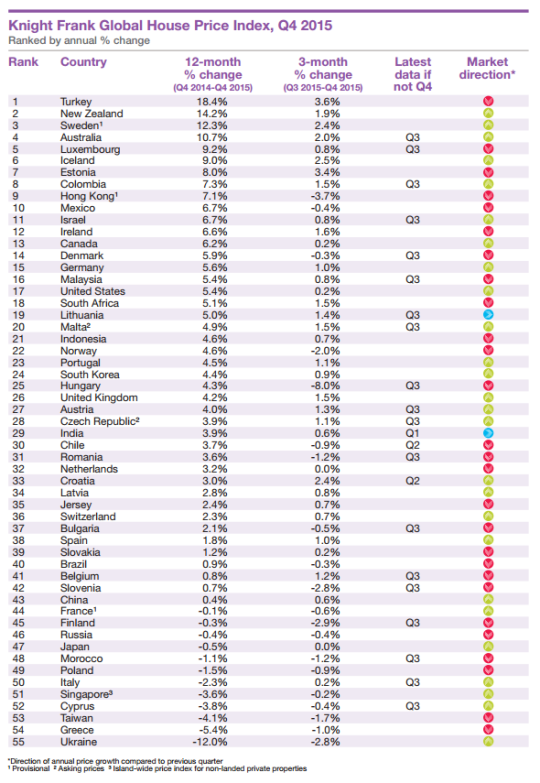
Seeing how we’ve started looking at data from last year, I thought it would be interesting to look at global home prices as of Q4 2015. Here’s a chart from Knight Frank, which they refer to as their Global House Price Index:
At the top of the list is Turkey, with an 18.4% increase from Q4 2014 to Q4 2015. (Supposedly this is because it has recently become easier for foreigners to buy property in the country.) Canada is 13th with a 6.2% increase (during this same time period) and the United States is 17th at 5.4%.
This is obviously a high level analysis. There are lots of regional and local variations within each country. For instance in Canada right now, Calgary is a very different place than, say, Vancouver or Toronto.
Nonetheless, it’s still valuable to see the relative performance of each country and see what their (Knight Frank’s) prediction is for 2016:
“Our outlook for 2016 is muted. We expect the index’s overall rate of growth to be weaker in 2016 than 2015. The global economy is experiencing a potentially dangerous cocktail of low oil prices, a strong [US] dollar and a continued slowdown in China.”
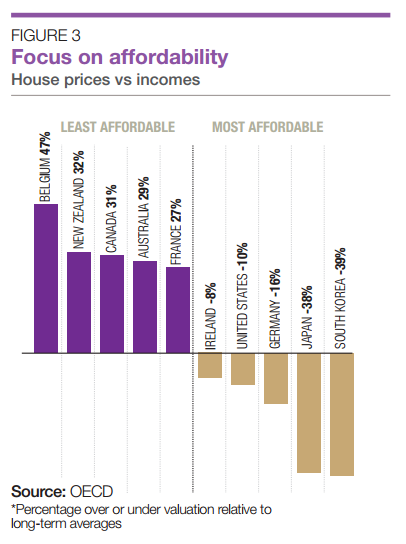
It’s also interesting to see how the countries rank in terms of affordability:
Once again, Canada ranks as being one of the least affordable countries in terms of home prices.
The key concept here – which is critical to understanding urban real estate economics – is that home values are essentially made up of two things: the land and the improvements (i.e. the building).
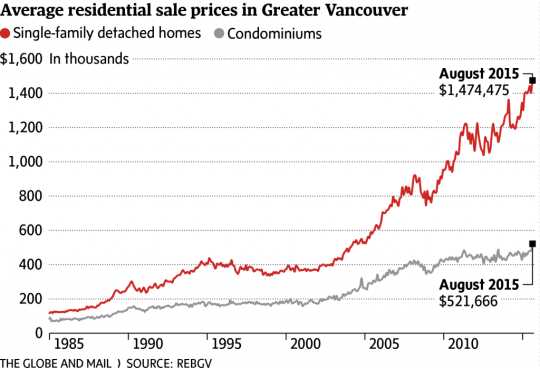
When home prices rapidly appreciate, as has been the case in cities like Vancouver (see below) and Toronto, it’s not the building, but the land that’s really driving the price up.
And as you can see from the chart below (which Daniel shared in his post), it is possible for multifamily housing to be less expensive than single family housing.
So why was someone arguing that multifamily housing is more expensive?
Well if you look at just construction costs, then this is generally true. Single family housing is typically wood frame construction, whereas multifamily housing is usually reinforced concrete or some other material that allows you to build up. In these latter cases, the price per square foot to build is going to be higher.
But Daniel’s argument is that when you build multifamily housing, you also begin to amortize the cost of the land over more housing units. So you begin to use land more efficiently and that offsets the higher construction costs.
However, two thoughts come to mind.
First, the value of a piece of land is entirely dependent on what you can build on it. And the more you can build on it, the more the land is worth. So as densities increase, so do land prices.
Second, a big part of why condominiums are so much more affordable is that they’re smaller. In 2014, the average condo size in Metro Vancouver was estimated to be 840 square feet. I couldn’t find the average size of a detached house in the city, but let’s assume for a second that it’s 2,500 sf.
If that were the case, then a detached house, despite being more expensive overall, would still be cheaper on a per square foot basis. You would be paying less for every square foot of livable space. True that doesn’t make the house more affordable, but I think it’s a bit unfair to compare apples (small condo) to oranges (large house).
So what I would really like to see is a graph of all-in low-rise and high-rise per square foot prices over time and for various cities. Because I would be curious to see at what point – if ever – they intersect.
Laneway housing is becoming an incredibly popular topic here in Toronto. Lots of people seem to be interested in building, or least living in a compact ground-related laneway dwelling.
A big part of this, I think, has to do with affordability (or the perception of affordability). A lot of people want to live in a central urban neighborhood, but it has simply gotten both expensive and difficult to secure low-rise housing. Here’s an example of a young couple in Toronto who went door-to-door in their desperation to find a house.
I believe that laneway housing has the potential to be a more affordable low-rise housing solution in this city, as well as in many other cities around the world who have a similar urban condition. But today, at least here, it’s not that way.
Since the City of Toronto does not officially support laneway housing, it would be an uphill to get one approved and you need to be willing to put a significant amount of money at-risk in order to try. It’s unfortunate, but that’s the reality today.
I’m certain that will change. But it will take a bit more pioneering. The Laneway Project, which I advise, is working to change the way Toronto thinks about its laneways and I know that there are many other small entrepreneurs working on doing the same.
One of the first things that will need to happen is that we’re going to need to name our laneways. Some of them are already named, but many of them are not. And while this may not seem like a big deal, it is. For laneway housing to become a reality, they will need to have addresses and we will need to think of our laneways as legitimate streets.
Recently The Laneway Project published a how-to guide called: How to Name Your Laneway. So if you’re interested in laneways and laneway housing here in Toronto, I would encourage you to give it a read and then try and get your local laneway named.
The headline immediately caught my attention because conventional economic wisdom would suggest that supply constraints – whether natural or artificially created – generally have a negative effect on housing affordability.
To be clear though, I support Ontario’s greenbelt. I think an urban growth boundary is the right thing to have if we want to build sustainable, walkable, and transit-oriented communities. But I’m also not blind to some of the potential (negative) externalities.
However, Keesmaat’s article got me wondering just how prevalent those externalities might be and to what extent our greenbelt is actually impacting housing affordability in Toronto. In her article she cites a recent report by the Pembina Institute that very clearly argues the following:
“There is no shortage of land throughout the GTA [Greater Toronto Area] to build single-family homes for decades to come, but this land is predominantly located far from the City of Toronto and other established centres of employment in the GTA.”
More specifically, the report found that of all the land available for development in the region (within our growth boundary), 81% of it is projected to still be unused by 2031. This got me thinking: it’s not that there isn’t land still available in the region; it’s that there isn’t land in the areas where demand is the greatest.
Put differently, young families aren’t clamoring for single family homes in High Park and Leslieville because the greenbelt has restricted their ability to find new housing. They’re doing so because they want to live in neighborhoods like High Park and Leslieville.
If you dive into the data, the report shows that in 2004 the average price of a detached home in Toronto was about $117,000 more than the rest of the Greater Toronto Area. As of 2013, that spread had grown to about $200,000. And indeed the data shows that it’s the core of the city where home prices seem to be appreciating the fastest.
So when it comes to housing affordability and supply, the greenbelt may actually be a red herring. Releasing it would not increase the supply of housing in areas where demand is already high, which is probably why this same report also found that – with or without an urban growth boundary – most Canadian cities are seeing similar increases in home prices.
So what should we be doing?
I think we should do two things: (1) focus on accommodating more growth in the areas that people already want to live in, and (2) figure out ways to transform the less desirable areas into more desirable ones. This second one will be the hardest, because it’s likely going to mean changing car dependent areas into transit-oriented ones, which is no easy task.
The good news though is that we are already doing these things. There’s more that I would like to see happen, but we’re headed in the right direction.
If your city has a greenbelt or you have experience with greenfield development in the Toronto region, I’d love to hear your thoughts in the comments. This is an area of development that I’ve never really been involved with.
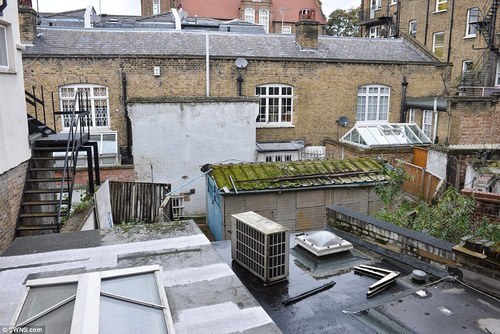
The garage shown above (with the pseudo green roof) is located in the Chelsea neighborhood of London. It measures about 11’ x 7’ and it – along with the site it sits on – is about to go up for auction.
It’s expected to go for more than £550,000 according to the DailyMail UK, which would make it the most expensive garage ever sold in the UK. The site area is 535 square foot – about the size of an average 1 bedroom condo in Toronto.
Below is an aerial view of the site. It basically looks to be residual land.
But as awkward as this site might appear, the expected value is being driven by the fact that planning permissions were granted to turn it into this:
It’s a 2 bedroom house that feels a lot like a laneway house. It certainly fits the description of “a house behind a house”, which is often how laneway housing gets described here in Toronto.
I wanted to share it because it supports my belief that, sooner or later, Toronto will come around to laneway housing. As property prices rise and affordability continues to erode, people will – quite justifiably – start looking in all sorts of new places for a decent urban home.
Many thanks to my friend Adrian for sending me the link.
The tech community has been receiving a lot of backslash in San Francisco as of late. And Peter Shih’s infamous 10 things I hate about San Francisco post certainly didn’t help. But I think there’s a bigger issue than just rich tech people driving up the price of real estate.
I was reading Quartz this morning and I think they nailed it:
“But the blame shouldn’t go to the tech companies or their employees moving to San Francisco, however despicable some might be. Blame San Francisco for being pleasant, and its policymakers for being foolish: When a lot of people are moving to your city—San Francisco the city gained 50,000 new residents between 2000 and 2012, including some 25,000 between 2010-2012 and likely more since—home prices are going to increase unless you build a lot more housing.”
If San Francisco, the city, gained 25,000 people between 2010-2012, let’s say that the city gained roughly 8,300 people per year. I just divided by 3. However, if you look at the rate of new housing supply, you get a 10-year average of 2,350 housing units a year (from the Quartz article) and an even lower amount according to Atlantic Cities.
Regardless, what you end up with is a pretty simple phenomenon: More people are moving to the city than new housing is being provided and that’s driving up the price of real estate. In fact, San Francisco allegedly only created 269 housing units in 2011! That’s the equivalent of only one fairly typical Toronto condo building going up (and we have hundreds under construction). No wonder there’s upward pressure on prices.
So rather than just blame the tech community for the city’s housing problems, I think there needs to be a broader look at housing policy. If you really want to help affordability, here’s one simple solution: start building.