Daily insights for city builders, delivered every morning at 6 AM ET. I’m Brandon Donnelly — a Toronto-based real estate developer and founder of Globizen. I’ve been writing here since 2013.

Search results for: “night mayor”

  • The value of lifestyle in attracting human capital

    When I was in Revelstoke, BC last year I met a number of people who had made the move out there from Toronto. When I asked if they missed living in a big city, pretty much everyone gave me the same answer: “No, I love it here.”

    This past week when I was in Park City, Utah, I similarly met a number of people who had made the move from New York and other large cities. And when I asked them the same question, I heard statements like: “I used to live in New York, but then I got a life and moved out here." 

    In these two examples, the obvious draw is the mountains. But it’s not like everyone just moved and became a ski bum. In fact, Inc Magazine recently published an article talking about Park City’s robust startup scene. People are figuring out how to combine hard work with the lifestyle they want.

    What I find interesting about this is that it runs counter to the trend of young people preferring big cities. Here’s a quote from NPR:

    “But affordable real estate and waterfront views don’t have millennials biting. They continue "a multigenerational pattern of young adults preferring more expensive urban areas over lower-cost rural ones because the lifestyles and opportunities in such places make the extra burden of cost worth it,” says Robert Lang, professor of urban growth and population dynamics at the University of Nevada, Las Vegas.”

    However, some small towns clearly have a unique lifestyle advantage: mountains. And that seems to be a strong enough draw that some people are simply figuring out how to create the economic opportunities for themselves.

    For me, this is yet another reminder that if you’re trying to attract the best human capital to your city or town, you need to think about lifestyle. And since young adults aged 18-34 are far more likely to move around than any other generation, you should also be thinking specifically about what this generation wants.

    Here’s a chart from CityLab that shows how precipitously migration falls off (in the U.S.) once people finish school and get settled in a job:

    image

    Obviously, not every town or small city is blessed with mountains. But there are many lifestyle advantages that can be created. It’s for this reason that I keep talking about nightlife and Toronto’s laughable 2AM last call. Those are lifestyle things and we can do better.

  • What is an urbanist?

    Cities are in vogue. And that has brought about buzzwords like urbanism, tactical urbanism, urbanist, and the list goes. But what exactly does it mean to be an urbanist?

    If you look it up in the dictionary, you’ll likely get something along the lines of: someone who is a specialist in city planning. But I bet that there are many people out there who would self-identity as being an urbanist, but who would also not consider themselves specialists in the field.

    The term has evolved to imply other things.

    To this end, Scott Bonjukian (over at The Urbanist) recently wrote a good piece called, Why I call myself an urbanist. And in it he offered up this definition from the former mayor of Seattle, Michael McGinn:

    “At the core, urbanists want more people living in cities, so they support more urban housing of all types. They prioritize walking, biking and transit, and support a high quality shared public realm. Parks, nightlife, theaters, transit and taxis can replace backyards, TV rooms and private cars. That way we can live well with less stuff, sprawl and pollution.

    I’ll go a little further, and say urbanists prefer bottom up, granular, and seemingly chaotic innovation to top-down planning and mega-projects. Think the “Main Street” of neighborhoods with food trucks and lots of little stores, as opposed to tax-subsidized big box stores with legally required massive parking lots. Bike lanes, crosswalks and plazas instead of public garages and new highways.

    Urbanists believe that mixing people and ideas creates wealth in a city. Why else would people choose to live so close to each other? Cities, therefore, should be open to people of every background, ethnicity, race and class to maximize the potential from our human capital.”

    Scott added that most urbanists are probably also environmentalists on some level, and I can certainly see where he’s coming from with that. Regardless, I think the above definition is pretty apt.

    But if you unpack some of the points, this definition raises some interesting questions. For instance, take the first line around supporting housing of all types. 

    This could mean that even if you lived in an inner city transit-served single family neighborhood, but you didn’t support alternate housing types such as duplexes, triplexes, accessory dwelling units and/or laneway houses, then you might not be a true urbanist. You would rather homogeneity over a “chaotic” mix of housing types. And I can certainly think of inner city neighborhoods in Toronto that have fought against “monstrous” duplexes. 

    So I would be curious to hear your thoughts on the above definition of urbanist. Do you agree or disagree? Is there anything you would add or take away? Are you an urbanist? Let us know in the comment section below.

  • A year in review — 2015 on Architect This City

    Thanks to this blog, it’s pretty easy for me to go back and look at what I was doing and thinking throughout the year. That’s one of the benefits of writing a daily blog/journal. And as is usually the case, 2015 was a year of ups and downs.

    For my annual ski and snowboard trip with the guys, we went to Banff (Alberta) and Revelstoke (BC). But we got stuck with unseasonably warm weather in the west (the opposite of what’s happening this winter) and I got injured on day 3. That put me in the emergency room and knocked me out of snowboarding for the rest of the season – as well as from the gym for a number of months.

    Shortly after that I also got struck with some family health issues. That was pretty scary for a good solid month, but in the end, everything seems to have worked out. What a relief.

    Towards the end of March, I did a brand partnership between Architect This City and Porter Escapes, which brought me to Quebec City for a weekend. That was a lot of fun and gave me the opportunity to be a real flâneur in one of the most interesting cities in Canada.

    In April, I left my real estate development job at TAS and shortly after I joined CAPREIT (TSE: CAR.UN) to help build out their (real estate) development platform. Previously their/our focus had just been on acquiring existing rental assets. But now it is time to build.

    Later this month I also participated in the Toronto filming of a documentary called Waterfront Cities of the World. That was a lot of fun. But come to think of it, I don’t think I ever watched the final video.

    In May, I started lobbying hard for the removal/replacement of the eastern portion of the Gardiner Expressway East here in Toronto. If you’ve been reading this blog since the summer, I am sure you remember this period. With the help of a colleague of mine, I even started a petition that ended up getting presented at City Council.

    But in June, Toronto City Council voted to demolish and then rebuild the elevated expressway along our waterfront. I am still surprised by that. What a shame.

    In July, we (CAPREIT) announced our first joint venture development project. A mixed-use project – 506 rental apartments on top of about 160,000 square feet of retail – in Toronto’s Liberty Village. 

    In August, I went back to Philly to relive my Penn days. I do that every couple of years just to make sure that Bob and Barbara’s is still offering up “The Special.” The Special is a can of PBR and a shot of Jim Bean for $3. It’s famous in Philly, but it always sounds like a far better idea the night before, as opposed to the morning after.

    In this same month I also hit the 2 year mark here on Architect This City. That’s 2 years of getting up every single day and staring at a blank blog post screen and thinking of something insightful to say. 

    The following month on September 11 (I’ll never forget this date), I got laser eye surgery. More specifically, I got custom wavefront LASIK. And today it’s pretty hard to imagine that I used to have to reach for my coke bottle glasses as soon as I woke up every morning.

    Later in September, I also gave a talk at my alma mater, the Rotman School of Management, to a delegation of about 70 urbanists from Portland. It was an honor to be invited alongside rockstars such as Richard Florida and Jennifer Keesmaat.

    In October, I featured a guest post from the former mayor of Toronto, John Sewell. I don’t often do guest posts on my blog, but John had just published a new book and I thought it would be a good way to change things up here. John and I aren’t necessarily on the same page with many urban issues, but we did agree on the Gardiner East.

    For the remainder of October, it was basically just the Jays.

    In November, I spoke at a Product Hunt event focused on real estate + tech. It was incredibly encouraging to see so many entrepreneurs here in Toronto focused on the intersection of real estate and tech. There are lots of opportunities in this space and I am sure that there are many success stories in the making right now. Toronto is the perfect place for real estate + tech innovation.

    And finally, in December, I crossed something off my bucket list and attended Art Basel Miami Beach. I have wanted to go for well over a decade; pretty much since I started studying art history in undergrad. I don’t know what took me so long.

    Oh, I also announced that I was writing a book on becoming a real estate developer

    What a year. I can’t wait for 2016. 

    What do you have on your to-do list for next year?

  • Fabricating a new urbanism

    image

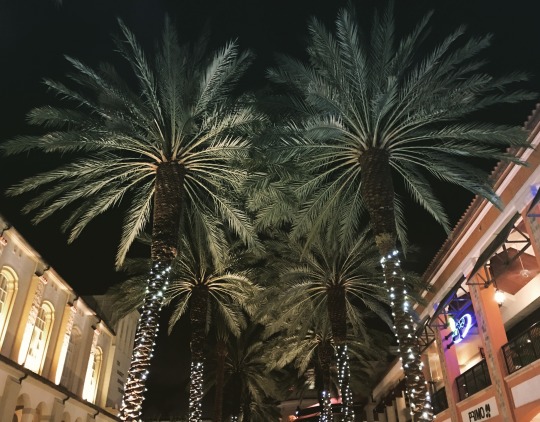
    Last night I was in CityPlace, West Palm Beach. Completed in 2000, CityPlace is a quintessential example of New Urbanism. (For those of you from Toronto, this is a different kind of a CityPlace.)

    In case you’re unfamiliar with this movement, here’s a snippet from The Charter of New Urbanism (via Wikipedia):

    “We advocate the restructuring of public policy and development practices to support the following principles: neighborhoods should be diverse in use and population; communities should be designed for the pedestrian and transit as well as the car; cities and towns should be shaped by physically defined and universally accessible public spaces and community institutions; urban places should be framed by architecture and landscape design that celebrate local history, climate, ecology, and building practice.”

    At a high level, New Urbanism makes a lot of sense. American cities were sprawling uncontrollably and so advocates had decided that something had to change. The Congress for New Urbanism was founded in 1993.

    But the New Urbanism movement has had its share of critics. Here’s how Witold Rybczynski – professor at the University of Pennsylvania – talked about it on his blog:

    “What are the important ideas that have affected American cities in the last 20 years? The development of waterfronts. The renaissance in constructing urban parks. The move of genXers and retirees into downtowns. High-rise urban living and Vancouverism. The popularity of urban bicycling and bike-rental programs. Ditto for Zipcars. Urban farmers markets and community gardens. Urban charter schools. The dramatic expansion in attendance of urban cultural institutions, especially art museums. Urban tourism. Downtown trophy buildings. The emergence of influential big-city mayors. Have any of these been the result of the new urbanism movement?”

    Frankly, I have never been a big follower of New Urbanism. It has always felt artificial to me. But I recognize the immense challenge in transforming car-oriented cities and communities into walkable ones. It’s one of the greatest challenges in city building. You’re asking people to change their habits.

    If any of you are experts on New Urbanism (because I am certainly not), I would love to hear from you in the comment section below.

  • Interview with Brad Keast of Osmington

    image

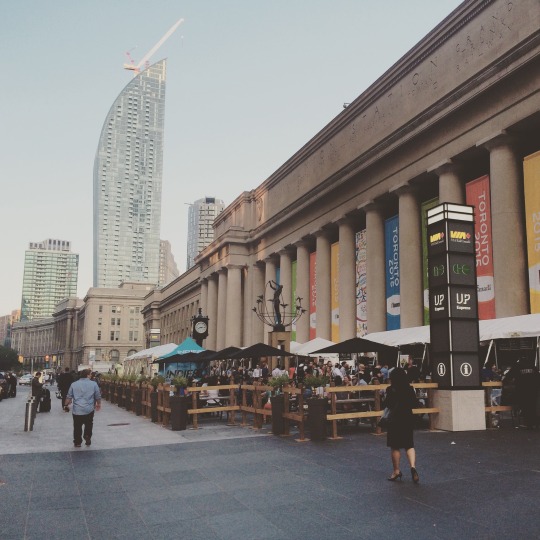
    Given yesterday’s post about Times Square in New York, the timing is perfect to talk about the revitalization of Union Station here in Toronto, its new public spaces, and the programming that’s now happening in and around the station.

    Perhaps the most noticeable is something called Front Street Foods @ Union Summer, which is an outdoor food market set up along Front Street. It’s on this summer from July 6th to September 27th, 2015. 

    However, Front Street Foods is only one part – the food part – of a larger events and programming strategy known as Union Summer. I recently had a quick chat with Brad Keast of Osmington, who is involved in a lot of what’s happening right now at Union Station.

    I found it interesting to learn about how organic the process was. And I thought you all might find it interesting as well.

    ————————————–

    Tell us a little bit about you and your company’s involvement with Union Station. 

    I’ve been with Osmington for over 4 years now and Union Station is a major focus of my waking life. 

    The company won a public RFP with the City of Toronto in 2009 to be the City’s retail partner in the redevelopment. What this means is that while the City owns the building and is doing base building construction, we are overseeing all the retail, advertising, and special events and programming. We are finding all the tenants, doing a bit of overshell work and then turning it over for fit-up.  

    We think the real special part of the project comes in through the special events and programming. We really want to make the station a destination in itself and you’re starting to see that with some of the programming we’ve done this year, be it a contemporary art event like Villa Toronto or something more community-focused like Union Summer – the current animation of the area in front of the station.

    How did the idea for Union Summer come about? 

    This really was a collaborative internal effort. We started by thinking ‘hey, let’s put a bunch of tables and chairs on the new plaza in front of the station and see what happens.’ Then we added in the idea of food. We knew it had to be accessible but didn’t want traditional food trucks, rather something less mobile but still not permanent. 

    That’s when we reached out to Toronto Market Company and they started rounding up the vendors. Then we layered on entertainment – daily music be it live or DJs, as well as a movie night with the Toronto International Film Festival (TIFF). We even have some kids programming on the weekends. Then we worked with the Farmers’ Market being displaced from Nathan Phillips Square due to Pan Am this year to have them here on Wednesdays.

    What was involved in making Union Summer a reality? What was the biggest surprise and/or hurdle that needed to be overcome? 

    There was a tremendous amount of coordination needed. First we weren’t sure when the construction was even going to be finished, all that was certain was it would be before Pan Am started. 

    Then the infrastructure required for the event itself was an exercise in creativity – power, water, and grey water disposal in particular. There was a lot of meetings with City officials for things like building permits, fire code, council approval to apply for a liquor permit, and health and food safety measures. Operationally things like loading in, coordinating with the installation of the Pan Am banners between the columns, interim furniture when our original order didn’t make it onto a ship in Antwerp, and then the first week was so busy that some vendors started losing staff because they were burnt out. 

    Like all things with this project we have to be mindful that this is an operating train station. In fact it’s the busiest building in the country with over 250,000 people per day passing through so we can’t impede those operations. We’ve done our best and have learned some lessons along the way and the reception has been overwhelming. 

    One of the best things about having that many entrepreneurs in close proximity is that some vendors have been pairing up to try experiments. Frozen custard-stuffed churro?

    Toronto is getting much better at designing and programming its public spaces. Given your experience with Union Summer, is there something the city could and should be doing to encourage more of these kinds of urban activations?

    Well, first of all, our contacts at the City, in particular Denise Gendron and Scott Barrett in Real Estate Services have been incredibly supportive of our efforts and we couldn’t have done it without them. If I could make one recommendation it would be to build in the supportive infrastructure for services. Of course that’s only beneficial if there is someone to take charge of the space and program it appropriately. It’s not a part time job.

    What’s next for Union Station?

    Right now the focus is on getting the first retailers open on GO’s new York Concourse. On the programming side we will host art for Nuit Blanche (October 3rd, 2015). That promises to be exciting. And then opening November 30th, 2015 is the Holiday Market. It was a huge success last year so we’re bringing it back for 3 weeks this time.

  • A petition to Toronto City Council to remove the Gardiner Expressway East

    image

    “If the decision ultimately of the council is to support the hybrid I think frankly it’ll be a major step backwards and you’re going to miss a once in a lifetime opportunity, and I’ll be very frank, we’ll be the laughingstock of the world.” 

    -Paul Bedford, former chief planner of Toronto

    As many of you I’m sure know, I have been a vocal and passionate supporter of removing the eastern portion of the elevated Gardiner Expressway in downtown Toronto. I have written about it so many times that a lot of you are probably sick of hearing about it.

    I’m sorry if that’s the case. But it’s a hot and important topic in Toronto right now. We’re just over 3 weeks away from City Council finally making a decision. That is scheduled to happen on June 9th and/or 10th. 

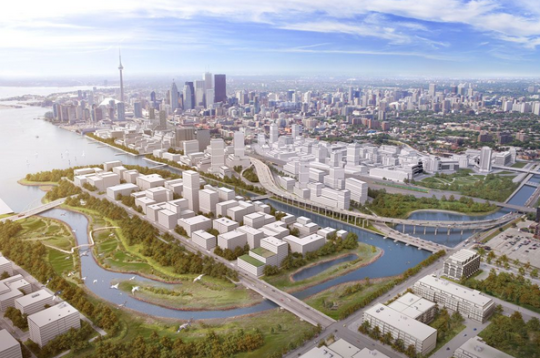
    For the most part though, I was pretty confident that we would ultimately make what many of us believe is the right decision. But then this past week Mayor John Tory went public in his support for the “hybrid” option, which is basically to rebuild the elevated expressway in a slightly different configuration. And that really upset me.

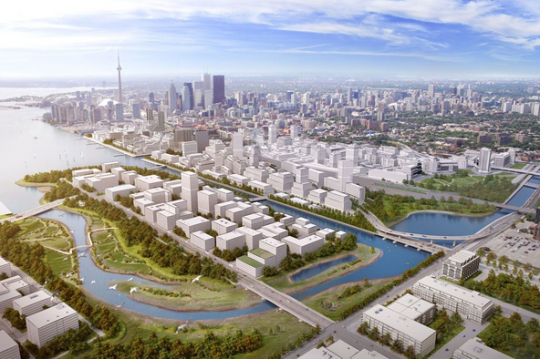
    Here’s what that looks like (versus the remove option shown at the top of this post):

    image

    Have we learned nothing from our past city building mistakes?

    Since that announcement, I went on Twitter every night this week to check out the discussions that were happening around #GardinerEast. And every night it got me so worked up that I then had trouble falling asleep. I have since stopped reading about the Gardiner East before bed.

    But rather than just get frustrated, my friend (a fellow city builder named Stephen Job) and I decided to do something about it and create a petition using Change.org.

    It is a petition that we will ultimately be sending to Toronto’s entire City Council prior to their June 9 meeting and we hope that you will consider signing it and sharing it with your network – regardless of whether or not you happen to live in Toronto. (Although it’ll certainly help if you’re a taxpayer and voter in the City of Toronto.)

    We just finished getting it up and you can check it out and sign it by clicking here.

    Images: Toronto Star

  • How Toronto voted

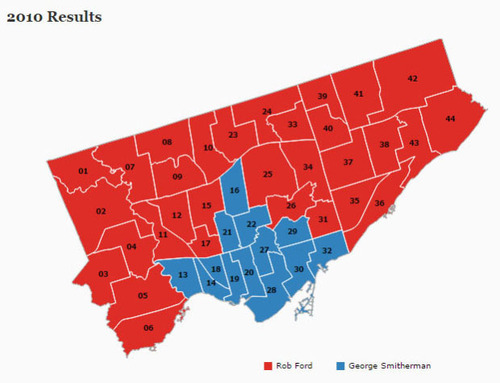
    In 2010, Toronto voted for its new mayor, Rob Ford, like so:

    image

    It was basically the core of the city (old Toronto) versus all of the boroughs. And it was perfect ammunition for anyone who believed that Toronto’s amalgamation was a mistake. (I personally don’t think it was.)

    Yesterday, Toronto did better.

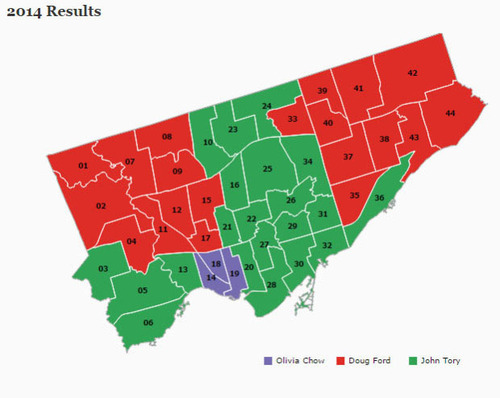
    While we’re still a divided city — with Etobicoke and Scarborough largely remaining loyal to Ford Nation — we’re not quite as divided as we were 4 years ago:

    image

    However, there is one thing that Torontonians did largely agree on last night: the next mayor should be white and male. And this got the Guardian Cities out of the UK asking why one of the most multicultural cities on the planet (apparently we’re third behind Luxembourg City and Dubai), continues to elect middle-aged white guys.

    Now, I’m not a fan of the article. And I take offence to the way Toronto is portrayed. But it did get me thinking. And I thought it would be interesting to see how some of Toronto’s demographic data overlays on top of these election maps.

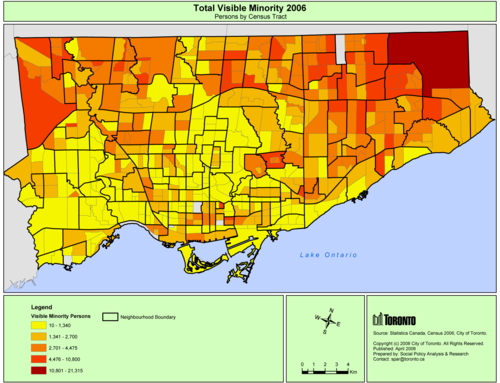
    Looking at 2006 census data (2011 isn’t available in map form yet), here is a map showing the total number of visible minorities broken down by census tract. The darker the red the more visible minorities.

    image

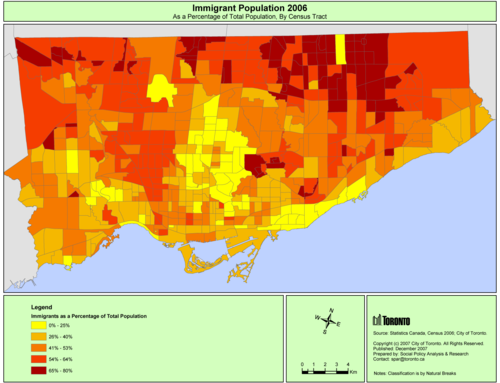
    And here is a map showing immigrants as a percentage of the population. Again, the darker the red, the higher the percentage.

    image

    What should be apparent from these maps is that Ford Nation is actually, in some ways, immigrant and visible minority nation. In the above map, the darkest red areas indicate that immigrants represent anywhere from 65-80% of the population. That’s a significant number.

    So why didn’t this group vote for the Hong Kong-born Olivia Chow? It’s because she wasn’t telling them the right story. Rob and Doug Ford, on the other hand, were.

  • Why I like Porter and the island airport

    I’m going to New York City tonight. I’ll be flying Porter from the island airport. And I’ll probably walk there.

    I’m a big fan of Porter and, while I’ve noticed some minor slippage over the last few years, it’s still one of the best flying experiences in the city.

    But the island airport has always been a contentious subject. Stopping a bridge to the island was a fundamental part of our last mayor’s original election campaign.

    Today the contentiousness is around expanding the airport so that it flies further using “jets.” Primarily people appear concerned about noise and that the runway will need to be expanded out and into Lake Ontario to a certain extent.

    As someone who lives along the waterfront, I really don’t share the same concerns.

    For one, the “whisper jets” are supposed to produce the same amount of noise as the current fleet, which don’t bother me in the least. I hear yappy dogs barking more than I hear planes.

    Secondly, I think the island airport is fantastic from an economic development standpoint. If we were in Europe, Toronto would have high speed rail connections to New York City, Montreal, and other cities.

    But it’s not Europe and we don’t have those rail lines. What we do have though is short haul flights from the island which, similarly, allow people to leave the city from downtown.

    This may not seem like a big deal, but an extra hour can mean the difference been making and missing a morning meeting or whether your trip needs to be overnight or not.

    If you’re against the expansion, I’d love to hear your thoughts in the comment section below. Debate is important.

  • “I can’t recall many instances when I was mayor where an issue was so crucial that my staff had to awaken me in the middle of the night,” he told me. “I hired very competent managers who knew I expected them to work hard. They knew they couldn’t be afraid to make a decision. Sometimes the decisions were right, and sometimes there should have been a different approach. The important thing is that the decision was made.” 

    Richard Daley, former Mayor of NYC