Daily insights for city builders, delivered every morning at 6 AM ET. I’m Brandon Donnelly — a Toronto-based real estate developer and founder of Globizen. I’ve been writing here since 2013.
The Coalition Against New-Home Taxes (or CANT) is a group of home builders, led by Matt Young of Republic Developments, who are asking all levels of government in Canada to lower the taxes on new homes. In some cities, these taxes — which include everything from development charges to HST — can account for up to 30% of the cost of a new home. This is bad for housing affordability and runs counter to our publicly stated goals. So to drive this point home, the group created a cheeky game called Taxopoly: The Unwinnable Game of Canadian Homeownership. (Credit to Blackjet for the idea and design.) I don’t think that the average buyer understands what kind of taxes are being levied on new homes, and so kudos to CANT for being a loud advocate for positive change. To learn more, sign their pledge, and/or email your representative, here’s their website.
I had a call with a developer in Paris earlier this week and it was interesting to hear him talk about the new home market over there. It sounded a lot like Toronto. Higher interest rates cooled demand. Individual investors largely disappeared. And now developers are having to rethink their strategies and floor plans (including suite sizes).
But in his view, this isn’t necessarily a bad thing. It now means that you actually have to be a reasonably good developer in order to have a chance at succeeding. You have to design thoughtful floor plans and build great housing. It’s a return to fundamentals, and I would argue that the same thing is happening here in Toronto.
My other noteworthy takeaway was around social housing. All new developments in the Île-de-France region are subject to inclusionary zoning. I believe the requirement is 30% of the suites. These suites are then purchased by social housing operators, and it is one of the ways that new supply is created in the market.
We talk a lot about IZ on this blog, but what’s interesting about this approach is that it becomes a forward sale for the developer. Meaning, it helps to de-risk projects. Before doing anything, you know you’ve sold 30% of your inventory, and somehow the numbers all work. European social housing math is baffling to me.
I am now wondering if this creates some kind of incentive to keep development costs in check. Because if social housing operators are expected to buy 30% of all new homes, then they too are going to want them to be as cost effective as possible. I’m speculating though; I don’t know that this is the case.
If you’re a developer or real estate person in Paris, please get in touch. I’d love to learn more about your market and trade notes.
This is a longstanding joke / criticism among nerds:
Namely, it is the fact that the charging port for Apple’s Magic Mouse is on its bottom, meaning, when it’s being charged, you can’t use it. This would be annoying if you ignored the low battery warnings and let it die in the middle of working on something critically important. And so lots of people think it’s a ridiculous design. But is it? Here’s an excerpt from a recent post by John Gruber of Daring Fireball:
Yes, with the charging port on the mouse’s belly, you cannot use it while it charges. There are obvious downsides to that. But those positing the Magic Mouse as absurd act as though Apple doesn’t know this. Of course Apple knows this. Apple obviously just sees this as a trade-off worth making. Apple wants the mouse to be visually symmetric, and they want the top surface to slope all the way down to the desk or table top it rests upon. You can’t achieve that with an exposed port.
This is an argument that feels right. Apple is not the kind of company that makes arbitrary design decisions. And the deliberate decision they have made is that a more perfect design is more important than solving for the few instances where a user was negligent and forgot to charge their mouse. Gruber goes on to say, the “charging port placement is an opinionated design, not an absurd design.”
But this then raises another question: Is opinionated design the right approach?
For well over a century, one of the maxims of good design has been that form should follow function. In other words, the shape and design of an object should relate to its intended use. And so, in this instance, if “function” involves using the mouse while it’s being charged then maybe, by this criteria, it isn’t a good design. Then again, it is a wireless mouse. Maybe Apple doesn’t want you to use it while it’s charging.
Let’s consider another design object that you touch with your hand: Walter Gropius’ famous door handle.
Originally designed in 1922, the simple design consisted of a square bar and a cylinder. And its job was to communicate to you that, in order to use it, you should grab the cylindrical part, and not anywhere else. So on this level, the design was responding to its intended use, to our hands. Grab here. But is this truly an example of form following function? It’s debatable.
Architect and professor Witold Rybczynski, who I would say generally isn’t a fan of modernism, has argued that it’s not. His critique of the overall Bauhaus movement — of which Gropius was the founder — was that it was actually a design school dedicated to “form follows predetermined aesthetics rather than form follows function.”
In some ways, he’s right. You can tell when something came out of the Bauhaus, just as you can tell when something is from Apple. There’s a particular aesthetic and stubbornness to maintaining it. That’s why the Magic Mouse can’t be charged while in use and why Apple, equally famously, clung to the simplicity of a single-button mouse. Two just didn’t look as nice.
But I see this as an honorable quality. Having an opinion is better than not having one. And there are lots of objects out there without one.
The City of Burnaby recently passed an amendment to its inclusionary rental requirements. It has now been removed from the southeast portion of the city, which, according to Burnaby Now, has one of the lowest median incomes in the city.
The analysis explored the impacts of increasing the density of developments in the Edmonds Town Centre area to try and improve revenues. However, the results showed that at current values, additional density is not able to offset the costs of providing the non-market housing, and that the equity needed to pursue large developments became prohibitive. As such, it is recommended that inclusionary rental requirements apply city-wide, with a delayed effective date for the Southeast Burnaby CMHC rental zone (the “SE Burnaby CMHC Zone”), until such time that inclusionary rental requirements become financially viable.
What’s noteworthy about this amendment is that it acknowledges the real costs associated with non-market housing and shows how important high market rents are to subsidizing them. There’s no such thing as no-cost affordable housing. In the end, somebody always has to pay.
This, it turns out, is an important question, because there’s a strong correlation between trust in government and overall prosperity (the above chart is via NZZ). The extreme examples of distrust are somewhat intuitive. If, for example, you don’t believe that your government will uphold property rights, why would you ever want to risk investing in property?
Trust is central to both stability and development. If citizens have trust in their system, they will be more likely to push for growth-promoting reforms. Moreover, they will be more confident that politicians will actually implement such reforms, and that sacrifices made today will pay off in the future. If this trust is lost, democracies become unstable, and autocratic tendencies are more likely to prevail.However, trust is also important for the transition from an autocracy geared solely toward the extraction of resources and wealth into a progressive democracy. A politically dominant class that governs autocratically will make concessions voluntarily and refrain from repression only if it trusts that it too will benefit from the institutional changes over the long term, and that it will not later be deprived of all opportunities.
All of this forms part of the work of economists Daron Acemoglu, Simon Johnson and James A. Robinson, who were awarded the Nobel Prize in Economics earlier this year. Their research explains why wealth is so unevenly distributed across the world. It’s a problem of institutions. But it’s also highly relevant to countries that are already rich.
Distrust is on the rise in countries like the UK (57%), France, (51%), Germany (49%), and Italy (47%). The outliers among OECD countries are places like Luxembourg and Switzerland. Only 25% of Swiss people express distrust in the government. That’s a good thing for overall prosperity and it shows in their GDP. So how can we be more like the Swiss?
Radical transparency when it comes to decision making and more of a direct democracy (versus a representative democracy) are two places to start, according to the research. People, it seems, trust their government more when they themselves make more of the decisions.
Today I went for a bike ride on the Niagara Peninsula.
We started at Project Bench, went to the Jordan Village (where the street was having its grand re-opening), stopped in at RPM Bakehouse for an obligatory apple sticky bun (the line was out the door and we got the last one), and then did a big loop that took us along the Welland Canal and through Port Dalhousie.
Here’s the map:
It was a great ride, and it might be one of my last long rides for the season. It’s just about time to pull out the snowboard. But for now, I’m going to put tiger balm on my knees and go to bed early. See you tomorrow.
As counterintuitive as it may sound, one way you could try and improve traffic congestion is to discourage people from riding their bikes and instead encourage them to drive more. That’s what’s happening in Toronto right now. Another way is to dramatically restrict car usage. And starting this Monday, that’s what Paris will be doing with its new limited traffic zone (zone à trafic limité) in the center of the city:
This new ZTL is approximately 5 square kilometers. About 100,000 people live within its boundaries, and it is estimated that somewhere between 350,000 to 500,000 vehicles enter it each day. But according to the city, it is estimated that only around 30% of these trips are absolutely necessary (because of a lack of alternatives, for example). The purpose of the ZTL is to reduce the unnecessary ones.
The way it will work is that drivers will no longer be allowed to drive through this zone. You’ll only be able to enter if you plan on stopping for a legitimate reason. It’s not yet clear what this exact list of approved reasons will be, but the general idea is that if you want to drive in for dinner or to attend a meeting, that’s fine. What you can’t do, though, is just drive around in a souped-up Honda Civic blasting Taylor Swift.
The next 6 months are planned to be a period of education. Drivers exiting the zone are just going to be told that there’s this new ZTL and that they better have stopped somewhere. But eventually there will be a 135 euro fine and eventually drivers will be expected to furnish some sort of supporting evidence for their stop, such as a restaurant receipt. There’s also talk of adding automatic cameras.
Of course, this creates a lot of gray areas. What about if you’re just going over to a friend’s place for dinner? Will they then need to write you a note saying that you went over for some homemade bouillabaisse? Yeah, I don’t know the answer to this. But you have to admit that this is a bold city-building move, and a far more effective way of improving traffic flows.
Unlike removing bike lanes, this plan will actually work.
Yesterday, the City of Toronto announced that it would be “unlocking” 7,000 new rental homes — including 1,400 deeply affordable homes — by doing two key things:
Waiving development charges on rentals
Providing a 15% reduction on property taxes
And by their estimates, the value of these benefits would be roughly $58k per new rental home:
Great news, right?
But wait, there’s a catch. If you read the details, you’ll see that in order for a project to be approved under this program, there is also a requirement to deliver at least 20% of the homes as affordable rentals.
So let’s look at what this could mean.
Here is a chart comparing a market rental suite at $3,000 per month to a more affordable one at $1,500 per month:
Market
Affordable
Variance
Face Rent
$3,000
$1,500
($1,500)
Suite Size
$600
600
0
PSF Rent
$5.00
$2.50
($3)
Annual PSF Rent
$60
$30
($30)
NOI Margin
70%
70%
$0
Annual Net Rent
$42
$21
($21)
Cap Rate
4.50%
4.50%
$0
PSF Value
$933
$467
($467)
Per Unit Impact
($280,000)
20% of Units
($56,000)
Both are assumed to be 600 square feet. In the case of the market suite, the per square foot (PSF) value is estimated at $933 psf, and the affordable suite is estimated at $467 psf. This represents a halving of the value (which makes sense because I halved the rents).
On a per unit basis (again, we’re assuming 600 sf), this is a loss in value of about $280k. But since only 20% of the units would need to be “affordable”, I multiplied this number by 0.2. The result is a per unit loss of approximately $56k.
What this means is that we’re basically doing a whole bunch of stuff to get right back to the same place. Like, hey, we’re not building enough rental housing and we’re certainly not building enough affordable housing — because the development margins are so dangerously thin — so here’s a credit of $58k per unit. But at the same time, here’s a bill for $56k per unit.
What’s the point, besides making it sound like we’re doing something to create more housing? This program will do absolutely nothing to spur the creation of new rental housing.
Bullpen Consulting just released its Q3-2024 high-rise land report for the Greater Toronto Area. Here’s a figure showing average high-density land prices (on a per buildable square foot) by quarter since 2018:
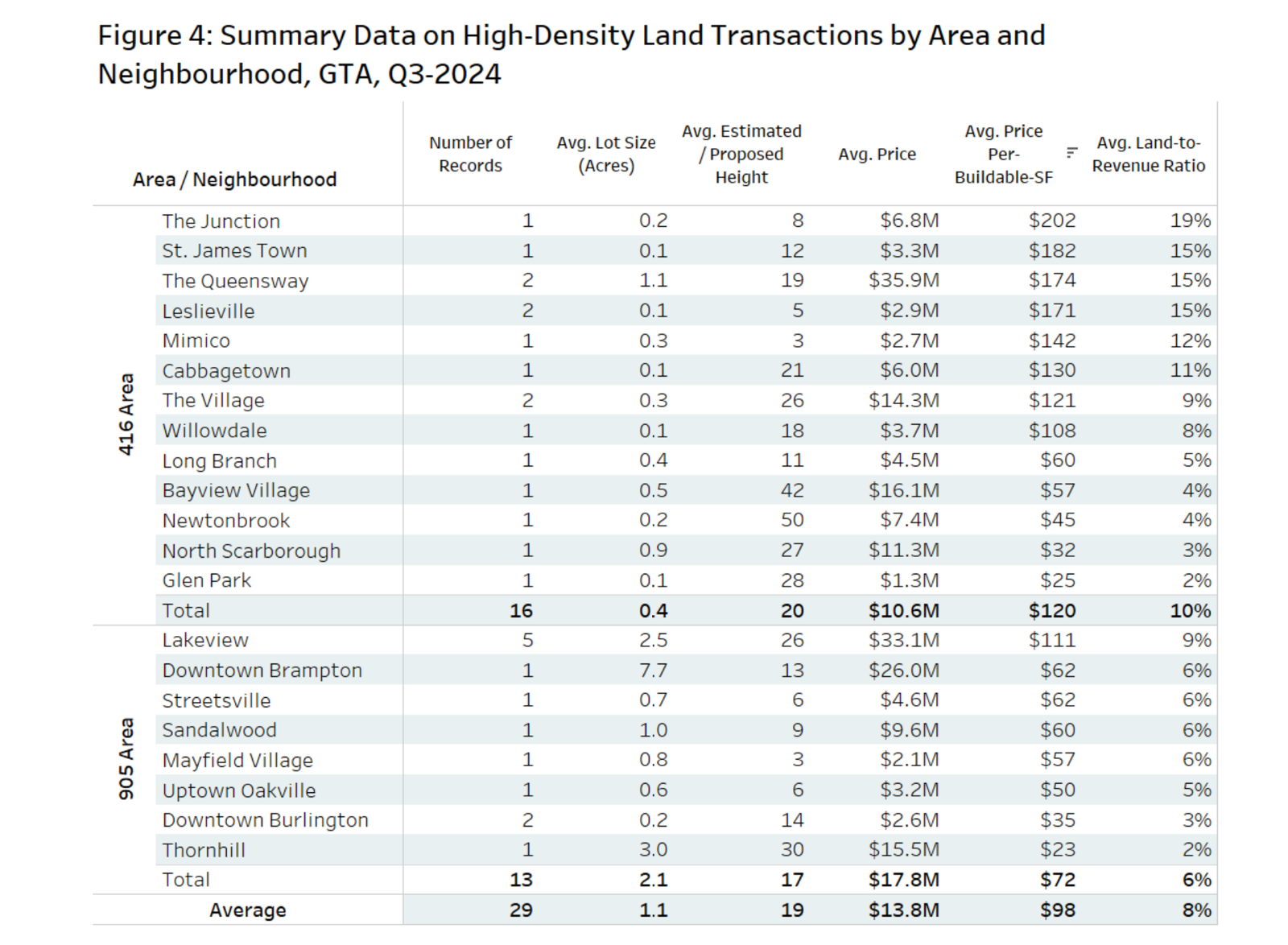
Here’s their summary data broken out by Toronto versus the Greater Toronto Area:
And here’s a list of all the land transactions last quarter:
At the highest level, the average high-density land trade last quarter across the GTA was at around $98 per buildable square foot. This is down 13% from $112 pbsf in Q3-2023. And going back to the first chart in this post, there also seems to be a longer-term decline in high-density land prices.
But as Bullpen rightly points out in their report, there are limits to what can be gleaned from data like this. And that’s because land transactions can be structured in countless ways. Did the vendor provide cheap financing? Was there a delayed close? Are there any unique site conditions that could be impacting value? The list goes on.
So even though prices and transaction volumes are down (which is what one would totally expect right now), it still doesn’t feel like this data accurately reflects what’s going on in the market today. I think the reality is worse.
The train from Paris to Marseille takes just over 3 hours:
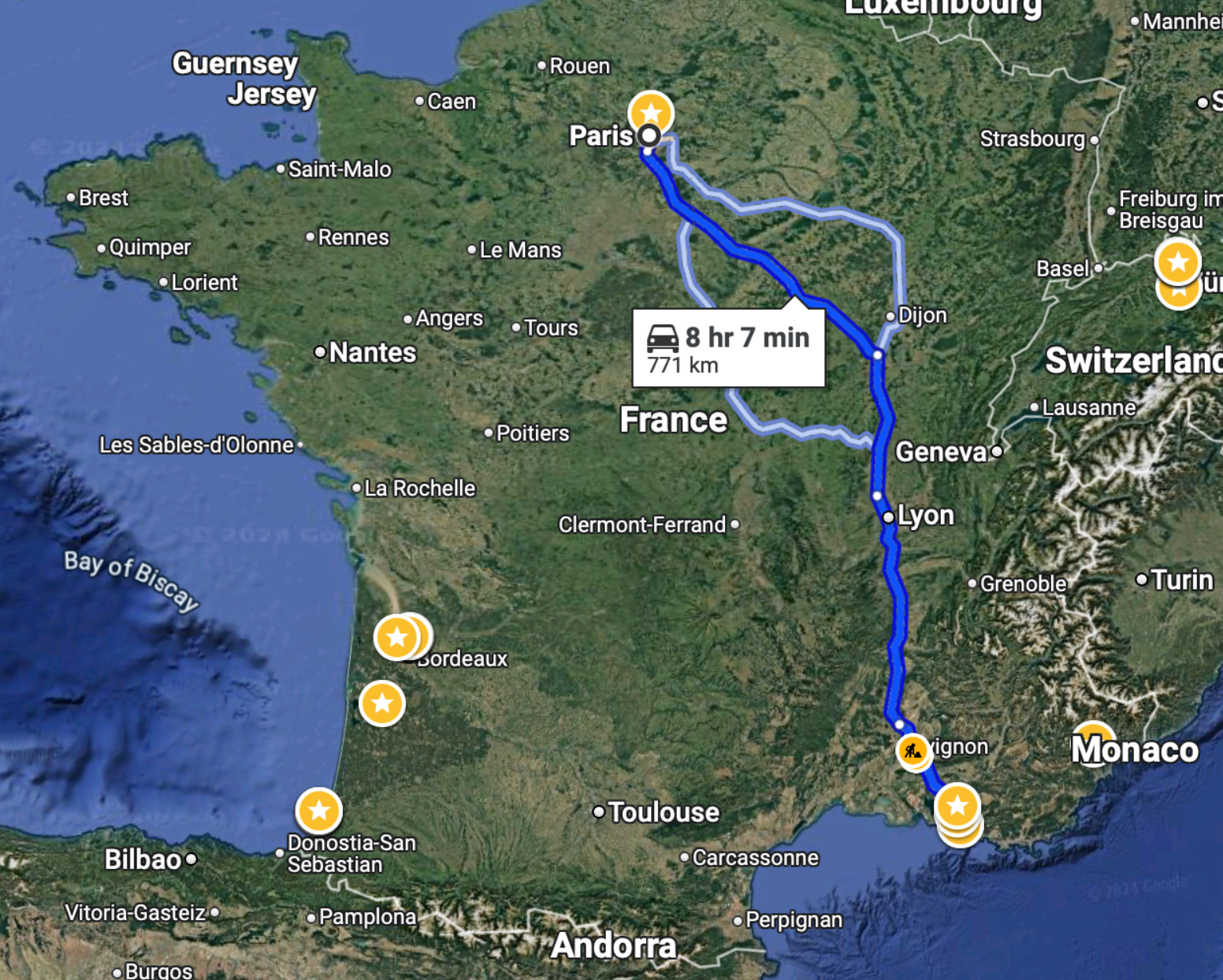
To drive this same distance, it would take just over 8 hours:
So unless you had a very specific reason, I don’t know why you’d ever want to drive this route. I certainly hate long drives and would avoid this at all costs.
On a related note, the Canadian government announced this week that it will actually be moving forward with a high-speed train linking Québec City to Toronto, stopping in Peterborough, Ottawa, Montréal, Trois-Rivières, and Laval. And unlike previous announcements, it will actually go pretty fast — upwards of 300 km/h, which is comparable to what the TGV does on the above route.
There are three consortia currently competing for this contract, but apparently the federal government has already chosen a winning bidder. An announcement is expected next month. At the same time, the project office owns all of the bids, and so there’s a chance that elements from each of them could be used in the final project.
According to official messaging, the design alone is expected to take some 4 to 5 years, which is an eternity and way too long. But at least we seem to be moving forward. This rail link is a no brainer. It will compress the geography of an importantly bilingual corridor with nearly 20 million people — about half the population of Canada! It’s our megalopolis.
Now we just need to move forward with urgency and with an unwavering commitment to creating the best high-speed rail service in the world. Let’s not accept mediocrity. And let’s not cancel it once we’ve already sunk millions into it. That would be a terrible outcome for such an obviously important nation-building project.