Daily insights for city builders, delivered every morning at 6 AM ET. I’m Brandon Donnelly — a Toronto-based real estate developer and founder of Globizen. I’ve been writing here since 2013.

  • Cities are now consumer products

    June 14, 2026 · View original


    We keep hearing that wealthy people increasingly want to live in cities like Miami. The weather is warm and taxes are lower. But it’s important to keep in mind that this is part of a larger trend. In 2024, it was estimated that approximately 128,000 millionaires would relocate abroad. Last year, the number was more than 140,000. And this year, the number is expected to top 165,000. According to Henley & Partners, this represents “the largest voluntary transfer of private capital in modern history.”

    People and their capital are now more mobile than ever. And the result is that from Miami to Milan, something interesting has happened: cities have become consumer products that compete based on what they can offer their customers. Up until this year, Dubai seemed to have the strongest offering for millionaires, but we’ll see how the Iran war impacts that going forward. As another example, the US remains a magnet for talent and capital, but:

    > …the biggest shift is in America—home to more than a third of the world’s people worth $30m or more, according to Knight Frank, a property firm. “The US has gone from a blip to the primary market,” says Ronald Klasko, a lawyer in Philadelphia. > > He says that most clients are interested in moving to Europe, because they are concerned about America’s political direction, want an alternative residency or want to be able to travel without an American passport.

    Anecdotally, I can also say that I was speaking with a luxury real estate agent in Toronto last week and she told me that her biggest client segment by far right now is wealthy Canadians who have been living in the US for many years or even decades and have now decided to move back home. Take that for what it’s worth.

    Of course, treating cities as transactional consumer products as opposed to deeply rooted places has its drawbacks. Global wealth migration can detach real estate values from the local economy and create banal districts for people with weak local connections. But I don’t think these two things need to be mutually exclusive. Cities can and should be both global and local.

    The reality today is that cities cannot take their tax bases for granted. Talent and capital are more mobile than ever before. If they don’t like your product, they’ll shop around for another one.


    Cover photo by Avi Werde on Unsplash

    Capital flight chart from The Economist

  • Congestion pricing solves traffic, but what about road safety?

    June 13, 2026 · View original


    Okay, so, we know that New York’s congestion pricing in lower Manhattan is doing exactly what it’s supposed to do. It has reduced traffic congestion and average drive times, improved air quality, increased public transit ridership, and continues to generate lots of money for the city.

    Because of this, a majority of New Yorkers now say they want congestion pricing to continue, despite many vehemently objecting to it before its enactment. It is, in fact, a car-friendly policy. It makes driving faster and easier by reducing congestion.

    But here’s another way to look at its effects. A recent study by the Columbia University Mailman School of Public Health (in partnership with the Yale School of Public Health) found that, at the highest level, the program is also helping road safety. Car crashes have declined since the program began.

    But this is for overall crashes. Interestingly enough, the results are less obvious when looking specifically at injury and fatal crashes. One possible explanation for this is that congestion pricing is, you know, working. Cars are able to drive faster! And since I would imagine that vehicle speed is correlated with injury severity, this makes sense.

    So, congestion pricing won’t solve all of your city-building problems. It will, however, solve a great number of them. Which city will be bold enough to step up next?


    Cover photo by Stian Skevig on Unsplash

  • A new global landmark in Toronto

    June 12, 2026 · View original


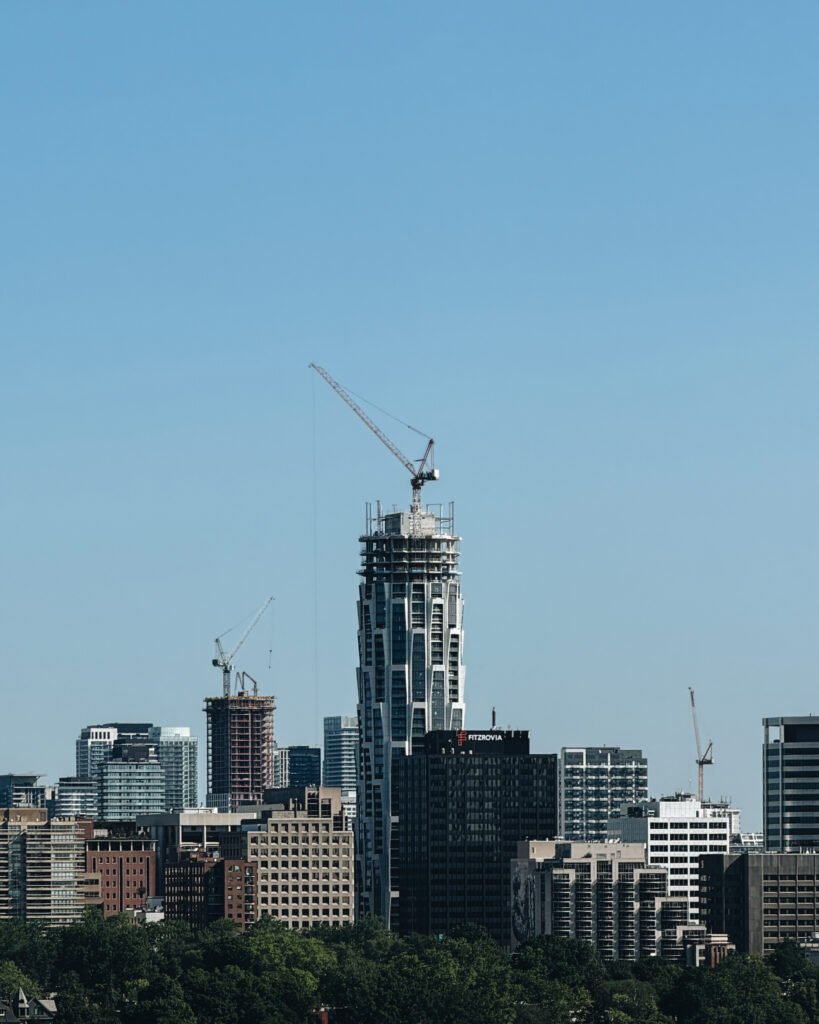
    Now that One Delisle is nearing its final height, the team hired Jacob Côté Photography to go out and capture some progress photos of the site. If you’d like to take a look, they’re posted over on Globizen’s blog journal. My absolute favourite is the twilight-hour shot with the light blue sky and view toward downtown and the lake. It’s the kind of shot that reminds me why I love Toronto.

    In other news, the structural backup wall is now underway along the Yonge Street retail frontage. This structure will allow for the reinstatement of the Art Deco facade that was dismantled, catalogued, and stored off-site since the start of construction. Following this, the remainder of the ground floor will be clad in curtain wall (pictured below).

    The structural steel for the top of the building, or what we internally call the “architectural crown,” was also recently delivered to site. This structure will frame a two-storey volume at the top of the building, conceal the mechanical penthouse, and serve as the building’s last important architectural move. Watch for it this summer.

    Lastly, we welcomed a select number of brokers to site this week to tour our recently completed model suites. If you have clients you’d like to bring to site or if you yourself are interested, I would encourage you to reach out to the team to book a private site tour. Email [sales@onedelisle.com](mailto:sales@onedelisle.com) or phone 416-551-4520.

  • Where “luxury” home sales are rising and falling

    June 11, 2026 · View original


    Aziz Sunderji of Home Economics has come up with an interesting way of measuring luxury home sales. He starts by identifying the top-decile price in 2019 for a collection of metro areas (i.e., the top 10% of all home sales in a given market).

    This means that if the top 10% of homes in a city sold for $1 million or more, then $1 million is the threshold for a home to be considered “luxury.”

    But to prevent general market inflation from skewing things over time, he then adjusts this luxury threshold according to how the entire market performed. For instance, if average home prices have increased by 30% since 2019, then the luxury threshold also increases by 30%. In our example, it is now $1.3 million.

    Now what?

    By definition, in 2019, exactly 10% of sales in a given market were deemed to be luxury. But because the luxury threshold moves in tandem with the general market, Aziz is then able to see if the luxury segment grew or shrank in a particular market.

    If, for example, only 4% of home sales are now above the new trended luxury benchmark, well then this indicates a shift toward affordability, as opposed to luxury. To be considered luxury today, a home’s value has to have grown faster than the average home in that market.

    The result is the above chart, which shows three luxury outliers, and two in particular: San Jose and Miami. This illustrates that so-called “K-shaped” economy.


    Cover photo by Charlie Lederer on Unsplash

    Charts from [Home Economics](Aziz%20Sunderji%20of%20Home%20Economics%20has%20come%20up%20with%20an%20interesting%20way%20of%20measuring%20luxury%20home%20sales.%20He%20starts%20by%20identifying%20the%20top-decile%20price%20in%202019%20for%20a%20collection%20of%20metro%20areas%20(i.e.,%20the%20top%2010%%20of%20all%20home%20sales%20in%20a%20given%20market).%20%20%20This%20means%20that%20if%20the%20top%2010%%20of%20homes%20in%20a%20city%20sold%20for%20$1%20million%20or%20more,%20then%20$1%20million%20is%20the%20threshold%20for%20a%20home%20to%20be%20considered%20″luxury.”%20%20%20But%20to%20prevent%20general%20market%20inflation%20from%20skewing%20things%20over%20time,%20he%20then%20adjusts%20this%20luxury%20threshold%20according%20to%20how%20the%20entire%20market%20performed.%20For%20instance,%20if%20average%20home%20prices%20increased%20by%2030%%20since%202019,%20then%20the%20luxury%20threshold%20also%20increases%20by%2030%.%20In%20our%20example,%20it%20would%20now%20be%20$1.3%20million.%20%20%20Now%20what?%20%20%20By%20definition,%20in%202019,%20exactly%2010%%20of%20sales%20in%20a%20given%20market%20were%20deemed%20to%20be%20luxury.%20But%20because%20the%20luxury%20threshold%20moves%20in%20tandem%20with%20the%20general%20market,%20Aziz%20is%20then%20able%20to%20see%20if%20the%20luxury%20segment%20grew%20or%20shrank%20in%20a%20particular%20market.%20%20%20If,%20for%20example,%20only%204%%20of%20home%20sales%20are%20now%20above%20the%20new%20trended%20luxury%20benchmark,%20well%20then%20this%20indicates%20a%20shift%20toward%20affordability,%20as%20opposed%20to%20luxury.%20To%20be%20considered%20luxury%20today,%20a%20home’s%20value%20has%20to%20grow%20faster%20than%20the%20average%20home%20in%20that%20market.%20%20The%20result%20is%20the%20above%20chart,%20which%20shows%20three%20luxury%20outliers,%20and%20two%20in%20particular:%20San%20Jose%20and%20Miami.%20This%20illustrates%20that%20so-called%20″K-shaped”%20economy.)

  • The richest person in Utah wants to buy the largest ski resort in the US

    June 10, 2026 · View original


    The richest person in Utah is a man named Matthew Prince. Prince, who grew up in Park City and was once a ski instructor at Park City Mountain Resort, is the co-founder of a tech company called Cloudflare. I’m assuming his riches came from the tech company and not from being a ski instructor. But he still seems to like skiing because he’s been mounting a highly public and aggressive campaign to buy the resort from Vail.

    There is a narrative in the ski and snowboard community that Vail has destroyed the industry through poor management, expensive lift tickets, homogeneity, and just an overall loss of what the vibe used to be. The market may also agree with this narrative because Vail’s stock price is down nearly 60% over the last five years.

    So Prince’s message to Vail is “you’re a bad capital allocator” and his pitch to the Park City community is one that sounds really nice. It’s basically a community-first rescue mission. He has promised zero personal profit of any kind (he apparently has enough money), pledged to reinvest 100% of the resort’s profits into infrastructure upgrades and employee compensation, and floated ambitious ideas to build a massive gondola network connecting Main Street Park City to some of the neighbouring canyons (which would be totally awesome).

    Vail’s response continues to be that the resort is absolutely not for sale. But Prince is trying to encourage them to adopt a more asset-light model, where they control the brand and the Epic Pass, and local billionaires like Prince run the physical properties.

    To provide a bit of real estate context here, Vail owns the mountain infrastructure, the snowmaking equipment, and the overall business operations, but much of the resort sits on land owned by Toronto-based Talisker. My understanding is that the land lease gives Vail all the practical indications of ownership for a very long time, but I thought I would explain this nuance given that we like to talk about real estate specifics on this blog.

    I have no idea where this public pursuit will go, and I know nothing about Prince’s values as an individual, but the story is certainly compelling. There’s something to be said for a rich local wanting to buy a resort just for the love of skiing.


    Cover photo by Patrick T’Kindt on Unsplash

  • The great American elevator tragedy

    June 9, 2026 · View original


    And we’re back!

    It has been said that the definition of a habit is that you don’t feel normal until you do it, and that’s certainly how I’ve been feeling over the last few days without writing this blog. I’ve been unusually preoccupied. At the end of the day, you don’t write a daily blog for 13 years without being someone who enjoys routine and consistency. I’m assuming I’ve written over 4,600 posts at this point.

    Anyway, I just listened to this podcast by Malcolm Gladwell.

    It starts with Malcolm proudly declaring himself a YIMBY. This is a recent thing for him, and so he goes on to say that he has “all the zeal of the recently converted.” Then comes Stephen Smith, Executive Director of the Center for Building in North America, and they talk about the great American elevator tragedy.

    It has been well documented that elevators in Canada and the US generally cost many multiples more than elevators in other developed countries. The result is that we tend to have fewer elevators per capita. Only certain projects and building types can afford and/or physically accommodate them. In the words of Malcolm, aiming for perfection comes with costs — fewer elevators and more expensive housing.

    If you’re interested in this topic, the Center for Building in North America has an extensive report titled Elevators that you can download here. But even if you aren’t particularly interested in the trials and tribulations of elevators, all of this is an important reminder that the challenges facing new housing are fundamentally multifaceted.

    If we want to unlock as much housing as possible and make it as affordable as possible, it’s not just a question of zoning. It’s also a question of utilities, environmental regulations, levies, construction methods, building codes and, yes, elevators.


    Cover photo by Bagzhan Sadvakassov on Unsplash

  • Vivienne Maria Donnelly

    June 4, 2026 · View original


    Welcome Vivienne Maria Donnelly.

    You arrived June 3, 2026 at 1:42 AM in downtown Toronto.

    Right now, both you and mom are resting comfortably.

    We’ve known you for less than 24 hours and we are already completely in love.

    You’ve unlocked a new part of our hearts.

    And one day, when you’re old enough to understand, I’ll send you this blog post.

    <3

  • For the rich, climate risk in Florida doesn’t matter

    June 3, 2026 · View original


    I was recently debating with a friend about climate risk in Florida. He is less concerned about climate risk than I am and part of his argument was, “Why would the world’s elite move to Florida only to get pushed out by sea-level rise in the near future?”

    My view is that we shouldn’t necessarily view the migration of high-net-worth individuals to the state as clear confirmation that they all believe everything will be fine (though I’m sure some or many do). Instead, I see it as rational consumer and economic behavior.

    If you’re a wealthy individual and have the means to be highly mobile, Florida offers two obvious benefits: warm winters and lower taxes (including little to no risk of something like a California wealth tax).

    Let’s look at some numbers.

    If you had a $100 million capital gain from your private placement in SpaceX and you switched your tax residency from New York City to Miami, you would save 14.776% in state (10.9%) and city (3.876%) taxes, equaling about $14.8 million at t = 0 (definitely not tax advice!).

    You could then use these tax savings to buy a waterfront home and get this benefit for all future income streams. In addition, you would get the benefit of warm winters going forward and the optionality of bottle service at LIV whenever you want to see David Guetta. I’m personally not an EDM fan. I prefer house and techno, but to each their own.

    So in a total doomsday scenario, if the market started pricing in climate risk and your $14.8M waterfront property went to $0 at t = 10 years, it would still be a rational lifestyle and economic decision. And if the value destruction happened at t = 25 years, it would matter even less. It’s probably outside of the forecasting period.

    For wealthy people, the value of their personal residence generally makes up a much smaller percentage of their net worth compared to that of the middle class. And my assumption is that the wealthy are making self-serving economic decisions and/or they really want to live in Florida for lifestyle reasons.

    The greater concern is for less-wealthy people for whom an erosion in principal residence value would have a more meaningful impact on their financial health. At a certain point, the tax benefits and lifestyle benefits may not outweigh the climate risks, assuming you believe this is a risk in the foreseeable future.


    Cover photo by Alex Guillaume on Unsplash

  • Berkshire Hathaway’s plan to create a combined housing platform

    June 2, 2026 · View original


    Over the weekend, Berkshire Hathaway announced that it has come to an agreement to buy Arizona-based homebuilder Taylor Morrison for US$6.8 billion in cash. The agreed-upon price is $72.50 per share, representing a 24% premium over the company’s closing stock price on the prior Friday. Once the transaction closes, Taylor Morrison will be delisted from the New York Stock Exchange and become a privately held company within the Berkshire Hathaway conglomerate.

    Now, the press release only says so much, but I did find the canned quotes interesting. Greg Abel of Berkshire said that the company wants to “unify our site-built homebuilding operations into a combined platform.” And Sheryl Palmer, CEO of Taylor, said the acquisition “will allow us to scale the Taylor Morrison platform in ways that would not be possible as a standalone company.”

    Berkshire has a long history in housing. It also owns a manufactured home company (i.e. not site-built), and various companies that make up the housing supply chain: bricks, paint, insulation, roofing, sales, and more. So it’ll be interesting to see what they are able to achieve by way of a “combined platform.” It has elements of both vertical and horizontal integration.

    The other interesting thing about this announcement is that it also seems to signal the following: Abel wants Berkshire to be more of an active manager (finding those “synergies” across its subsidiary companies), and he likely feels the housing market is at or near the bottom of the cycle (despite current inflation risks). Regardless, the US has a structural housing deficit and so homebuilding is probably a good business to be in for the long term.


    Cover photo by Josh Olalde on Unsplash

  • Summer nostalgia: 60 kilometres, 25 years, and one pending baby

    June 1, 2026 · View original


    I hope you all had a great weekend.

    Yesterday was the annual Bike for Brain Health ride in Toronto. It was an absolutely beautiful morning (much warmer than last year) and I rode 60 km. I’m sorry, I didn’t have it in me to do the 90 km circuit. I’ll try to be more committed next year.

    The good news is that Bianca didn’t go into labour while I was on the DVP and so I didn’t need to show up at the hospital in full spandex. While clearly suboptimal, I feel like that would have made for a useful story to embarrass our daughter with in the future.

    It’s starting to feel a lot like summer in the city and with that comes the feeling of nostalgia. There’s something obviously magical about this time of year, and this past weekend was particularly nostalgic for me because on Friday I also had my 25-year high school reunion.

    Unnecessary details: I went to two different high schools and this reunion was for the first one, which was also my elementary school. It was nice of them to invite me.

    Seeing friends that, in some cases, I hadn’t seen in over 25 years reminded me that you can’t replace the people that you grew up with. High school is a high-definition time.

    Among many other things, it’s when you’re figuring out which clique you belong to, what music defines you, what it means to nervously ask a girl out on a date (and have her say no), and what it’s like to have your heart broken.

    My unproven theory (rigorously developed over the weekend) is that you will always share a unique bond with the friends that you had during this period of personal development. I mean, they were there during the really awkward years.

    We also had small class sizes and everyone knew everyone. I’m sure that helped. I’m still close with a number of people from high school and from elementary school, but this weekend reminded me that I should make even more of an effort.

    I’d also like to be a better cyclist, but let’s not get ahead of ourselves here. Something tells me that I’m going to have less rather than more free time going forward. And I can’t wait.

    Regularly scheduled city-building programming will resume tomorrow.