Daily insights for city builders, delivered every morning at 6 AM ET. I’m Brandon Donnelly — a Toronto-based real estate developer and founder of Globizen. I’ve been writing here since 2013.

  • French classes and the work of Georges Eugène Haussmann

    April 6, 2025 · View original


    Some of you might remember that I grew up going to a French school here in Toronto. My mom had rightly decided that I should be able to speak both of Canada’s official languages. But truthfully, I never really loved it as a kid. I started midway through elementary school and so I always felt a little insecure about my French abilities. Which is partially why in the fall of 2023, I decided to enroll in night classes at Alliance Française. I’ve been doing it ever since and I can feel my French getting markedly better. There’s also something deeply nostalgic about being in a French class.

    Generally speaking, the classes are pretty relaxed (sometimes we learn grammar and sometimes we just talk about delicious cheeses), but at the end of last year I decided to register for the DELF exam. DELF stands for Diplôme d’études en langue française and it’s a diploma for non-native speakers of French offered by France’s Ministry of Education. It’s offered at various proficiency levels and I registered for level B2, which France describes in the following way:
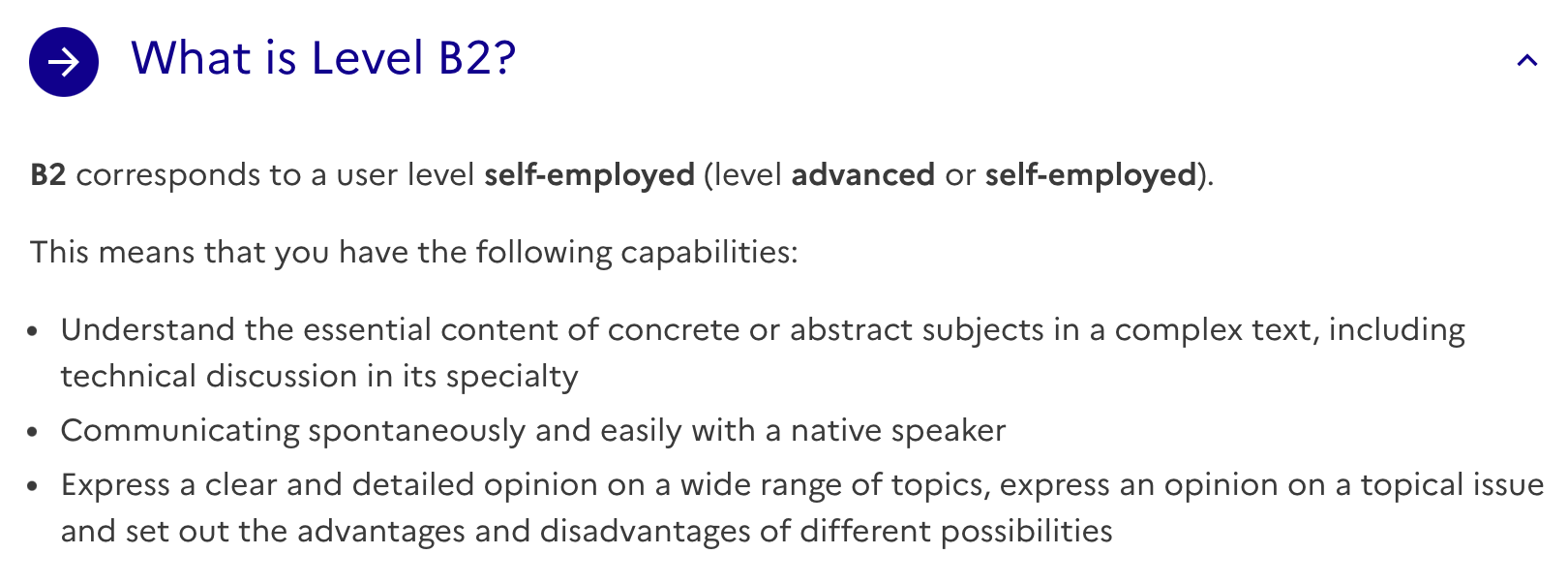
    One of the reasons why I registered for this particular level is that it will soon become the minimum level of language proficiency required to become a French citizen. Currently you need the equivalent of B1, but starting January 1, 2026, I understand it will jump up to B2. I, of course, don’t know if I will ever need this, move to France, and/or seek to become a citizen, but it became a goal. I told myself that I wanted the diploma that proves one’s French is good enough to be an actual citizen. I guess it was a way to conquer my childhood insecurities.

    So I’m happy to report that I ended up taking the exam in early March and that last week I received my passing grade. I scored just under 90%. (My weakest section was the handwritten essay.) After I got the news, I came home to the below book sitting on the kitchen counter with a bow and thoughtful handwritten note from Bianca — in French I would add — congratulating me on achieving this goal. One of the first things I said was, “wait, when did you buy this? How did you get it so quickly?” And she responded with, “I ordered it a long time ago, because I knew you’d pass.”

    The book is called Paris Haussmann and it’s a comprehensive look at Haussmann’s 19th century plans for the city. It covers every scale, from the city’s boulevards (morphological scale) down to individual floor plans for each building type (typological scale). It’s a truly extraordinary book and it’s also highly relevant to one of the things that Globizen is focused on right now, which is the building of infill housing on Toronto’s major streets. The urban context isn’t exactly the same, of course, but there’s a lot to be learned from this human-scaled building type. So even if you aren’t trying to overcome some childhood insecurity related to the French, I highly recommend you check out this book.

    Cover photo via Pavillon de l’arsenal

  • Why aren’t Japanese toilets more popular?

    April 5, 2025 · View original


    Things have been pretty serious around here lately. We’ve been talking a lot about isolationist tariffs that make zero economic sense and that have been blatantly miscalculated, and so let’s switch gears and talk about something a little more fun: toilets.

    If any of you remember my post from earlier this year called “Takeaways from Japan,” you might remember this:

    > Our toilets are in the stone ages. You’re not going to get yourself clean with just paper. You need a comfortable warm seat and highly adjustable jets of water. I never fully appreciated this need before the trip, but now I’m a true believer. It’s time for a new toilet.

    Well, I meant it when I said it:

    This week, I finally got around to installing a new TOTO WASHLET seat on my existing toilet. My bathroom may now look a little more geriatric, but it’s a fantastic quality of life upgrade that more people, outside of Japan, should adopt. So why don’t they?

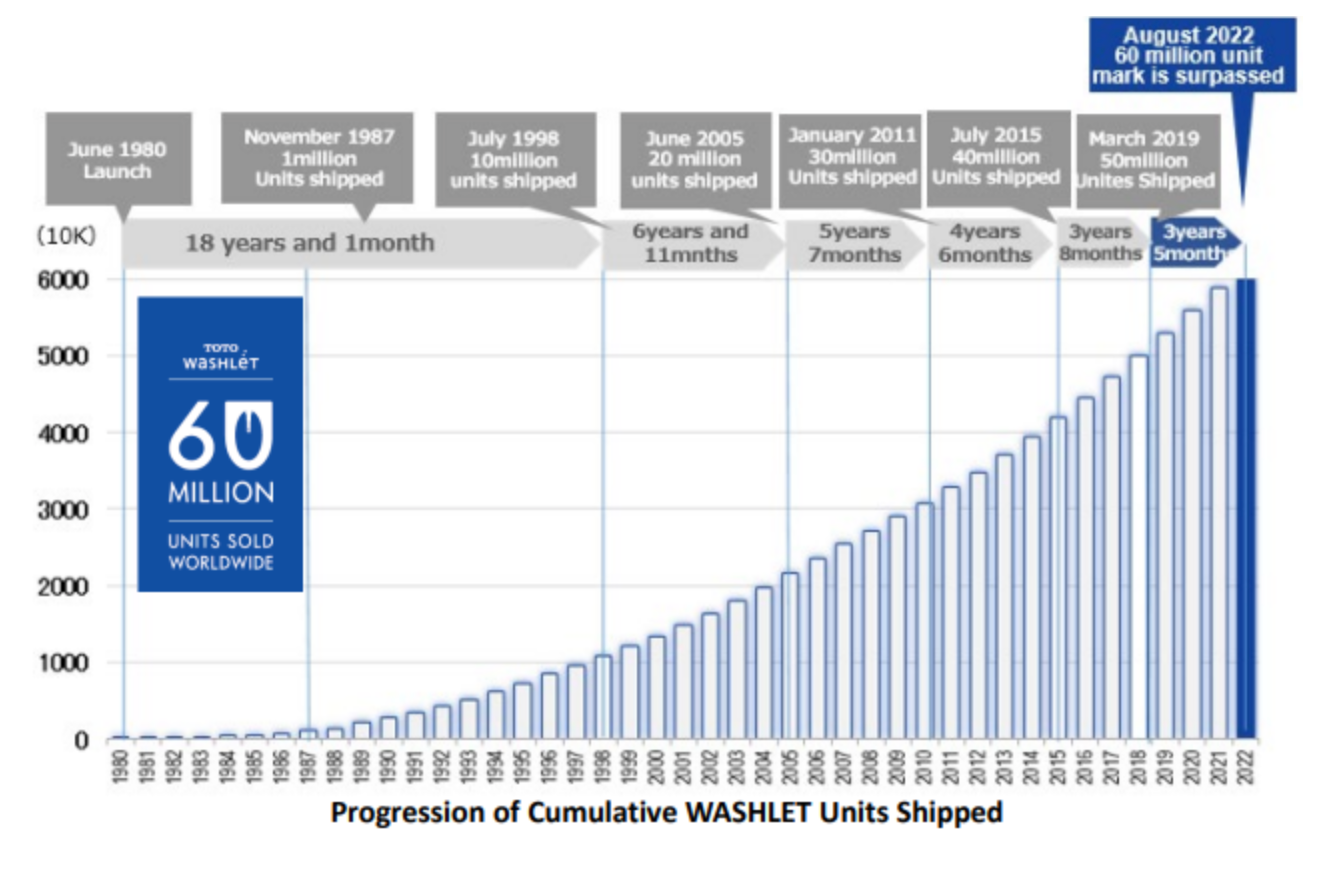
    The TOTO WASHLET seat was first created in 1980. And since then (and up until 2022), the company has reported selling more than 60 million units, with the majority of them being sold in Japan. As of 2021, it was believed that over 80% of Japanese households were equipped with some sort of heated bidet toilet.

    Market penetration is much lower in the West. In the US, ChatGPT think it’s less than 5%. And based on anecdotal evidence, this does not seem far off. I almost never see them in public places (though The Butcher Chef here in Toronto has one) and I rarely see them in people’s homes.

    My gut is that it’s a combination of a lack of awareness and people thinking it’s weird and/or unhygienic. I mean, is that wand clean? But if you travel to Japan, you will have an aha moment. So maybe TOTO needs to figure out a way to export this moment to the rest of the world through, oh I don’t know, some sort of public toilet program.

    Note: This post is not sponsored by TOTO. But I really wish it were, because then maybe I would have gotten my seat for free.

  • This is how long it will take the world to fully replace the US export market

    April 4, 2025 · View original


    We all know what happened this week:

    > Donald Trump’s decision on April 2 2025 to enact sweeping “reciprocal” tariffs on US trade partners will go down as one of the greatest acts of self-harm in American economic history. They will wreak untold damage on households, businesses and financial markets across the world, upending a global economic order that America benefited from and helped to create.

    We also know it was based on highly questionable math:

    > His “reciprocal” levies amount to a back-of-the-envelope calculation. They take trade partners’ US trade deficit in goods as a share of imports from that country, and then divide it by two. This is not a calibrated attempt to equalise tariff and non-tariff barriers facing US exporters, perceived or otherwise. It is, however, a reckless repudiation of all trade agreements the US has signed, as well as a deeply flawed plan to attract foreign manufacturing investment.

    So what happens next?

    Assuming this behavior persists, the US will continue to isolate itself from global trade, and the rest of the world will pivot and quickly move to trade more freely among themselves. This maybe isn’t as problematic as some might think. Today, the US represents about 13.5% of global goods imports, which is down from almost 20% in 2000. And the biggest drivers of global growth are now China and the Euro area.

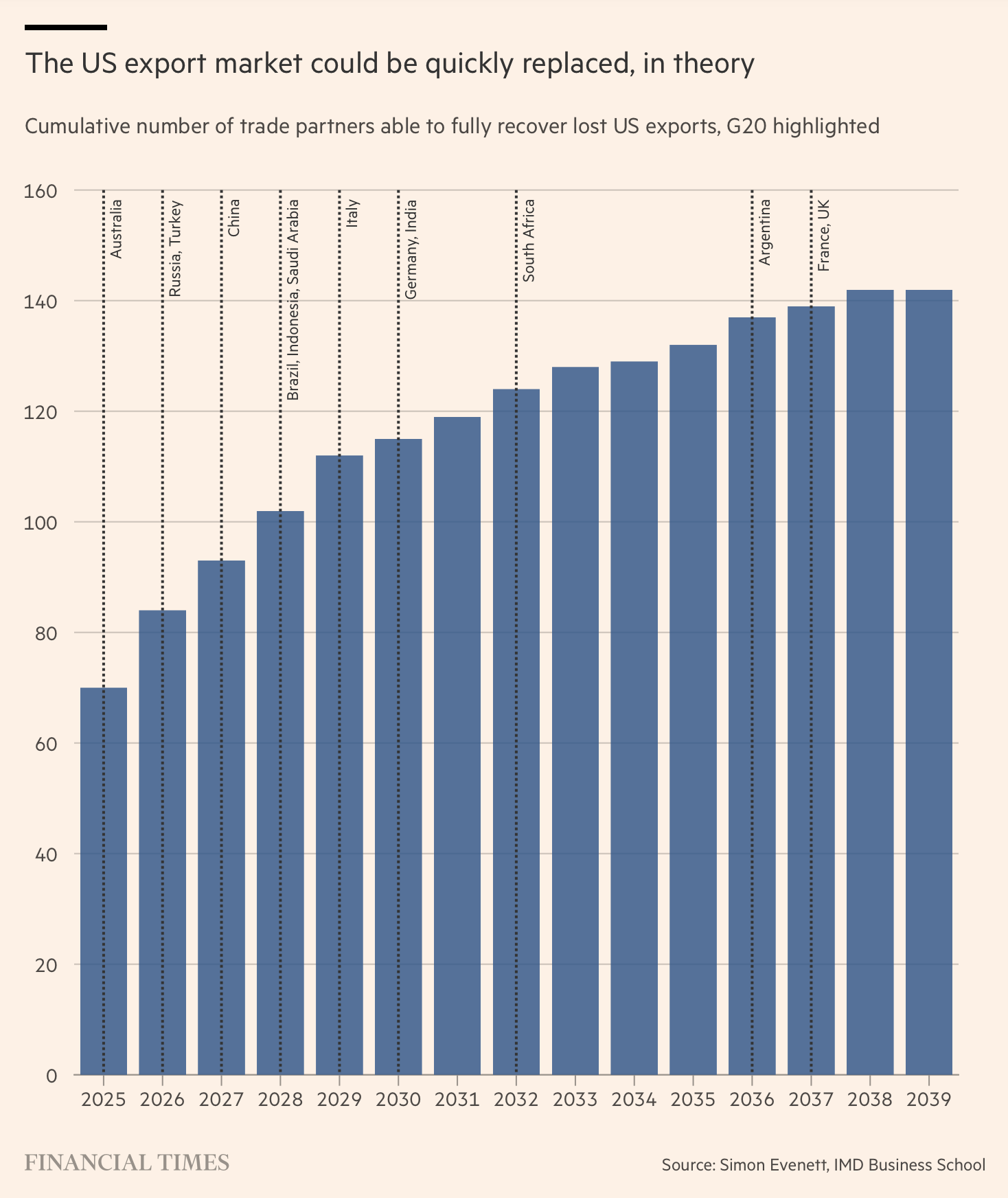
    To that end, here’s a fascinating study from IMD Business School that looked at how long it will take for various trading partners to completely wean themselves off of the US. And to do this, they looked at non-US import growth for the 10-year period from 2012 to 2022, and then extrapolated. This is what they learned:

    What this chart says is that by the end of this year, some 70 US trading partners could, in theory, replace the loss of the US export market so long as non-US growth continues as it did in the past. And by 2039, the number jumps to over 140 trading parties. 2039 is obviously a long ways away, but I think it’s noteworthy that year one in this specific chart already starts with 70.

    Importantly, Canada does not fall within this initial bucket. Based on the study, we are in the danger zone. That is, exports to the US make up more than 10% of our GDP and it will take more than 10 years for full export recovery. But again, this is based on historic non-US growth. So all this means is that the status quo cannot continue; we need to dramatically increase this growth rate and do it as quickly as possible.

    I hope our leaders recognize the urgency of this, because nothing can be taken for granted when it comes to the US right now. We need to be hyper focused on full trade recovery as soon as possible. Canada needs to be open for business to the world.

    Cover photo by Ben Wicks on Unsplash

  • Housing is expensive in Ontario

    April 3, 2025 · View original


    The Missing Middle Initiative, which is a research group housed at the University of Ottawa’s Institute for the Environment, just published this detailed report on Southern Ontario’s housing affordability crisis.

    As we know, things are not good: In 2005, 21 of 26 single-family house markets in Southern Ontario could have been classified as either affordable or deeply affordable for middle-class families, and none were unattainable.

    Today, none of these markets can be considered affordable or deeply affordable, and 11 of them are now unattainable. In every single one of these markets, buyers should expect to pay 25% or more of their pre-tax income on mortgage payments.

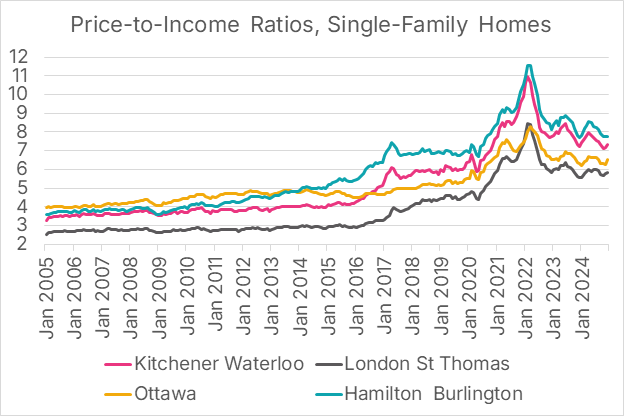
    Below is one of their charts showing the price-to-income ratios for single-family houses in various markets since 2005. Outside of the Greater Toronto Area, the turning point toward worsening affordability was generally in 2016, and the peak was in 2022.

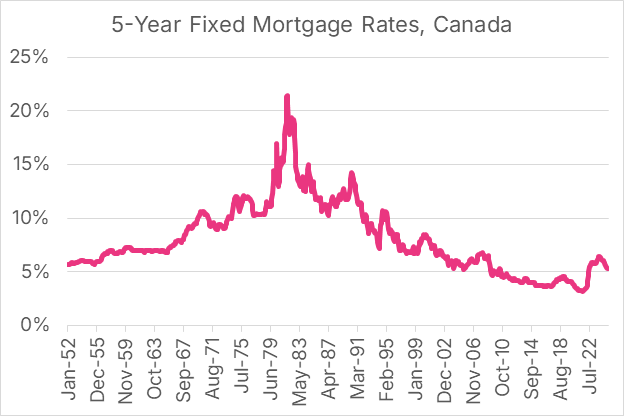
    Here’s some historical context. Canadians who had mortgages in the late 70s and early 80s often like to talk about how crippling rates were back then. But interestingly enough, monthly payments — relative to wages — are actually worse today than they were during this high-rate period (according to the report).

    This is partly because home prices were a lot lower back then and so high rates didn’t have the same impact to mortgage payments. Instead, the two worst periods of time for affordability (payments relative to wages) were during the late 80s housing boom and then during/after the recent pandemic.

    Following the real estate crash of the early 90s, monthly payments relative to wages declined along with home prices. And they didn’t return to the same levels seen during the preceding boom until 2022 — some thirty years later.

    The same thing is happening right now. This reset is naturally improving affordability. But it really should be viewed as an opportunity to course correct before the next cycle begins. MMI’s report does a good job explaining that housing is objectively less affordable today than it was for prior generations.

    Charts from the Missing Middle Initiative; cover photo by Victor Ballesteros on Unsplash

  • What housing type have you lived in the most throughout your life?

    April 2, 2025 · View original


    I started thinking about this the other night. For the first 18 years of my life, in other words, up until I moved away to university, I lived for the most part in a detached single-family house in the suburbs of Toronto. But since then, I have almost exclusively lived in apartments/condominiums ranging from converted houses to high-rise buildings.

    This was true when I was at the University of Toronto and it was true when I lived in Philadelphia for grad school. In my first year of grad school I lived in a converted house in a questionable area of West Philly. In my second year I lived in a high-rise brutalist building. And in my third year I lived in a small three level walk-up apartment above a pet store and a really great deli. This perhaps not surprising given I was a student.

    But since moving back to Toronto, the same has been true. I initially invested and lived in a single-family house, but then decided I preferred living in a condominium and so I have done that ever since. Maybe this changes with kids or maybe it doesn’t. But it’s interesting to think about the housing types we have chosen or were handed. Location and other factors certainly play a role.

    What housing type have you lived in the most throughout your life? Let us know in the comment section below.

    Cover photo by Michal GADEK on Unsplash

  • Do governments make good developers?

    April 1, 2025 · View original


    The Liberals just announced that, if elected, they will form a new entity called Building Canada Homes (BCH) which will, “get the federal government back in the business of building homes.” Broadly speaking, this new entity is proposed to have three key functions: it will build affordable housing at scale (including on public land), it will help to “catalyze” the private sector, and it will provide financing to affordable housing developers. There’s a lot that is interesting in the policy teaser, but let’s focus on function number one today: Do governments make good developers?

    The outlined intent is that BCH will “act as a developer to build affordable housing” and “partner with builders for the construction phase of projects.” So it sounds like they will not be constructors. The language they use also suggests that BCH will be an acquirer of land. Sometimes it will develop on already-owned public land, but in other cases it will go out and buy new land, sometimes offering it back to the market via land leases.

    Acquiring new land will be challenge number one. As we have talked about many times before on this blog, land should be the residual claimant in a development pro forma. Meaning the value of land depends on what you can build on it. So if BCH is looking to build affordable housing and the rest of the market is looking to build some higher-and-better use, it will be very difficult for them to complete in the market. This is the same reason why, historically speaking, the City of Toronto has struggled to acquire new parkland with the funds it collects from developers. It can’t compete.

    On the flip side, it’s very possible that in a downmarket, like the one we’re in right now, BCH might be the only real buyer of development land. Affordable housing requires subsidies and if the subsidies BCH has access to result in both feasible projects and higher residual land values, well then they’ll be able to win sites. But it will depend on the market conditions at the time. It also raises an important question: What is the right level of subsidy for the affordable housing that BCH intends to develop itself?

    The second challenge is going to be execution. Development is a risky endeavor, but most of the time the private sector accepts these risks because they believe they will be compensated accordingly. And once they have taken on these risks, they become highly motivated to deliver for their investors and partners. Will the federal government be equally motivated? Perhaps. There are, of course, lots of examples of public housing developers in other parts of the world. But is it the most effective way to deliver new affordable housing? An alternative approach would be motivating the private sector to participate.

    Getting the federal government “back in the business of building homes” may sound promising, but there’s reason to be skeptical. There will be lots of details to figure out if it’s actually going to be efficient and effective.

    Cover photo by Eduardo Alvarado on Unsplash

  • Season finale

    March 31, 2025 · View original


    Neat B and I were in Park City this past weekend for our last runs of the season. (Now it’s time to pull out the impossibly tight spandex for road biking!) This is a trip we do often, but given the current geopolitical situation, we weren’t exactly sure what to expect. But I will say that we were pleasantly surprised. When we picked up our rental car at SLC, the attendant, who was from Texas, immediately said that he was trying to figure out how to become the next Canadian province. He then proceeded to inquire about the quality of our brisket in a way that made it sound like a firm prerequisite. And virtually everyone we met on the mountain was extremely apologetic once they learned we were Canadians from Toronto. Frankly, they came across embarrassed, and they made it clear that they do not approve of what their government is doing right now. This made us happy to hear.

    I still love you, Park City.

    Cover photo by Alex Moliski on Unsplash

  • Some thoughts on work-life balance

    March 30, 2025 · View original


    Sahil Bloom tweeted this out a few days ago:

    > Tweet: The single greatest challenge for any ambitious person is eliminating the guilt associated with free time and rest.

    And it really resonated with me. I’m sure it does with a lot of you as well. I’m guilty of feeling this guilt. Because by definition, if you have a strong desire to do or to achieve something, then you’re going to want to spend a lot time working toward it. And any time not spent working toward it, can feel like an unnecessary slowdown or delay.

    But it’s easy to let time melt away when you’re in this headspace and I’m trying to be better at not letting this happen. For one thing, there are diminishing returns to work. We all need free time and rest. It makes us better at everything else we do in life.

    It’s also really easy to fill our lives with unnecessary bullshit. The same thing happens in our homes when we’re not paying attention: we end up collecting unnecessary stuff. So as Paul Graham argues in this 2016 essay called “Life Is Short”, it’s important to “relentlessly prune bullshit.” Focus on the things that matter, and don’t wait.

    When you’re ambitious, I think it’s easy to become focused on the future. I’ve been told I do this too much. Achieving something usually requires hard work and determination, and that likely means it won’t happen today; it’ll happen at some point in the future. So it can be easy to discount the present. But nobody knows how much healthy future we all have.

    These are all things that I’m trying to be better at and so I’m writing them down here as a reminder. How do you manage your work-life balance?

    Cover photo by Christopher Gower on Unsplash

  • Sundance Film Festival is moving from Park City to Boulder

    March 29, 2025 · View original


    YouTube video

    This past Thursday, the Sundance Institute announced that it will be moving the Sundance Film Festival from Park City to Boulder starting in 2027. This is sad. Sundance has been based in Park City since 1981 and it’s the largest independent film festival in the US. Last year (2024), it is estimated that it created 1,730 jobs for residents, contributed $132 million in GDP to Utah, and produced about $13.8 million in state and local tax revenue.

    Here’s what Park City Mayor Nann Worel had to say following the announcement:

    > “For over 40 years Park City wasn’t just the host of the festival, we were its home. We helped shape the identity of Sundance with our unique energy, our colorful people, our undeniable spirit,” Worel said. “The world came here for film, yes, but they stayed for something more. They stayed for the feeling this town gave them. So, yes, I’m disappointed. Deeply. I know many of you are, too.” > > “To our community: We are not defined by one event. Our creative spirit is deeper than any single festival. And while Sundance may be leaving, Park City isn’t going anywhere,” Worel said.

    As I understand it, Utah offered to nearly double the amount of funding that they provide to the arts festival. But that clearly wasn’t enough. There’s also speculation that the festival left because it had overgrown Park City and/or because Colorado is viewed as being more liberal. There are people in Utah who do not approve of some of the content shown at said festival. I have no idea as to the actual reasons. But I do think it’s a real loss for Utah.

    Cover photo by Spencer Davis on Unsplash

  • New York’s congestion pricing is doing what it’s supposed to do

    March 28, 2025 · View original


    New York City was supposed to terminate its congestion pricing program last Friday because, well, Trump told them to. But they didn’t do it and so harsh words were exchanged and then the deadline was extended for another 30 days. (This sounds oddly familiar.) Who knows what happens next month, but we are able to accurately quantify the benefits of nearly 3 months of congestion pricing.

    Firstly, it’s generating a lot of money. In the first two months of operation, congestion pricing has already brought in over $100 million in new revenue for the city. This is important because it’s money that can be used for transit and other infrastructure improvements.

    Equally important is the fact that this money was generated by creating measurable value for drivers. For all of the river crossings that lead into the CBD, average weekday travel times this past January are lower compared to January 2024. And in some cases, they’re lower by a lot. The Holland Tunnel, for example, saw travel times drop by 48%.

    Lastly, it’s encouraging more people to take public transit. Here’s a chart from Sam Deutsch over at Better Cities showing the increases in ridership since the program was implemented:

    The MTA as a whole is now averaging about 448,000 more public transit riders per day. And to put this number into perspective, Sam reminds us that Washington DC has the second most-used public transit system in the US and that it sees an average of about 304,000 total riders per day (January 2024 figure). So in other words, New York’s congestion pricing bump alone was nearly 1.5x DC’s entire ridership base.

    Some critics will argue that NYC’s subway is dangerous and that this program unfairly pushes people toward it. But crime data suggests otherwise. New York’s subway also saw over a billion rides in 2024! So I don’t know how you argue that less people should be taking it. It’s pretty clear that this is what moves the city. Imagine if the above went the opposite way and 448,000 more people started driving to work.

    Some people may not like it, but the reality is that congestion pricing is doing exactly what it’s intended to do: reduce traffic congestion, make money, and encourage more sustainable forms of urban mobility.

    Cover photo by Wells Baum on Unsplash