Daily insights for city builders, delivered every morning at 6 AM ET. I’m Brandon Donnelly — a Toronto-based real estate developer and founder of Globizen. I’ve been writing here since 2013.
Earlier this week I wrote a post about a new build home under construction at 37 Canerouth Drive in the west end of Toronto. As part of that post, I asked people what they thought the home would be valued at when it was completed. There were just under 10 responses (many thanks!) and I thought it was really fascinating to see the ranges.
A lot of you responded in the comment section of the post, but a bunch of the other estimates came in via Facebook, Twitter, and email. It isn’t a huge data set, but I’ve nonetheless consolidated the ones I could remember I received:
If you average these estimates, you come to a value of $3.3M. However, the clear outlier is the $8.5M. So let’s take that one out and see how the number changes. If you do that, you then get an average estimate of $2.5M. A pretty big swing.
Now, I don’t know offhand how accurate that number really is, but I’m fascinated by this idea of “the crowd” determining value. Particularly for markets such as housing where supply can be completely heterogeneous and there isn’t a lot of transaction volume to refer back to (compared to other types of markets).
Because my strong belief is that under the right circumstances and with enough data points, this number could end up being hugely accurate. And, it could also be more forward looking since it’s capturing current market sentiment as opposed to being based on historical transaction prices.
If you have any thoughts on this, I’d love to hear from you 🙂
I’m always on the lookout for great websites and communities dedicated to cities. And today, thanks to a friend of mine, I found a new one called City Observatory. It’s my new favorite site for city geeks.
I’m looking forward to digging into more of their articles, but I did already take a look at the first report they published, which is called: “The Young and Restless and the Nation’s Cities”. Click here to download the PDF.
What the report talks about is a demographic group that they refer to as “Young and Restless”, and which they define as being 25-34 years old and having a 4-year degree. And they focus on this group because they see it as critical to driving local economic development.
They’re the next generation who are going to start those companies and drive growth and innovation. And since the data shows that as people age, they become less willing to relocate (which intuitively makes sense), cities today are quickly realizing that they need to capture this group of smart people while they’re still restless (i.e. mobile).
So if this is important, which cities (in the US) are winning right now? Here are the top 10 cities via City Observatory:
Washington D.C. 8.1%
San Francisco 7.6%
Boston/Cambridge 7.6%
San Jose 7.5%
Denver 7.5%
Austin 7.0%
New York 6.6%
Minneapolis 6.6%
Raleigh 6.5%
Seattle 6.1%
The percentage represents the portion of the population that’s 25-34 years old and has a 4-year degree. I’ve just listed the cities here, but in reality they reference the entire metro areas.
Do any of the cities on this list surprise you? None are surprises for me. It’s more or less what I would have expected to see, except maybe for the absence of Chicago (it’s 12th according to this ranking).
In addition to technology, the conversation touches on a bunch of different topics such as why it’s beneficial to be an optimist and why change can be difficult for people to accept.
But they also hit on a number of broader economic shifts, such as the replacement of labor by machines, and the rise and decline of industrial production in the US. Here’s a snippet on that latter point:
You’ve described the middle class of the 20th century as a myth.
There are two middle classes. There’s the historical middle class—which is the bourgeoisie—starting in the, like, 1600s. This was the businesspeople and the traders, the merchants, the butcher, the baker, the general-store manager, the guy who was going off to China to go get silk and bring it back. Businesspeople.
But in the 1940s something really significant happened, which is we bombed the rest of the industrialized world. And so the industrial base of Germany was obliterated. Japan was reduced to rubble. The rest of Continental Europe was bombed. England was bombed. The industrial base of the world was bombed. The one major industrial country that wasn’t bombed was the United States. So the United States became the monopoly producer of industrial goods.
The army bombed the American middle class into existence?
It was an accident of history. We had a window of opportunity which we took full advantage of. We had this window from basically 1945 to 1966, 1968, in which we were basically running unopposed. In that window, all kinds of wonderful things happened. One of the things that happened was the rise of this new idea of the middle class, which there was no historical precedent for, which was college-level wages for high-school-level education. As long as there’s no competition, it’s all well and good. The minute the Japanese show up, the minute the Germans show up, it just all falls apart.
Click here for the full conversation. It’s an interesting read.
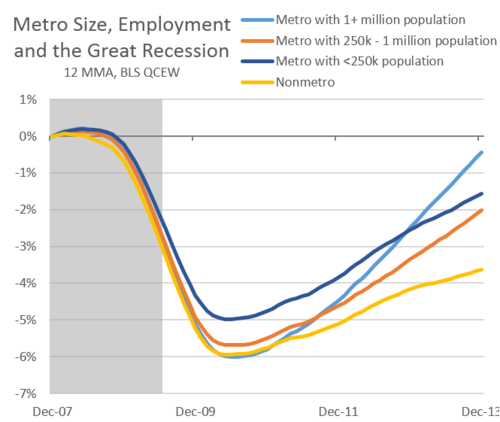
Josh Lehner of the Oregon Office of Economic Analysis published a study earlier this summer where he looked at employment growth according to city size across the US.
What he found since the Great Recession of 2008-2010 is that larger metros – with populations greater than 1 million people – have rebounded the fastest. They are shown in the light blue line below:
According to Josh:
This is at least partially due to the fact that all those good economic things — agglomeration effects, knowledge spillovers, clustering, etc — happen in certain locations, which are usually bigger cities.
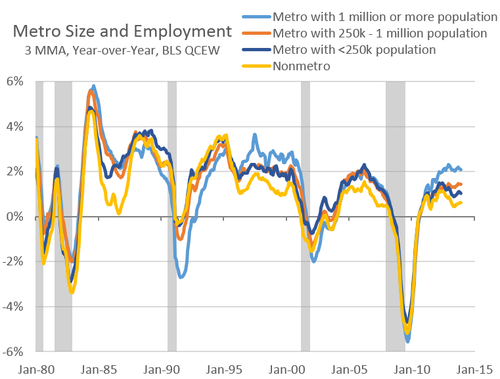
However, if you go back to the 1980s, you find that this trend isn’t consistent. Large metros outperformed in the late 90s. But they were more or less on par with smaller metros during the housing boom of the early 2000s and actually under performed in the early 90s recession.
One possible explanation for this – which Josh proposes – is that the recent housing boom acted as a sort of equalizer for smaller metros. It created stronger population growth outside of the bigger cities.
I buy that.
But then does that mean that going forward big cities will continue to outperform? Is this going to be more or less the new norm? Intuitively, I would think yes.
You can find Josh’s blog post, here. Richard Florida also wrote one for CityLab, here.
Poll: How much do you think this home is or will be worth? Respond in the comment section below. I’ll be giving away one free ATC t-shirt. (Comments)
A few weeks ago a good friend of mine – who is a builder – called me up and told me that I had to come and see a house under construction in Etobicoke (west end of Toronto). He told me that the owner was doing everything from geothermal to a car elevator, and that he was doing it all, not with the intent of ever being able to sell it, but because he just wanted to build something really cool.
I thought: Amazing. I need to see this.
So this past Saturday afternoon, I drove out to 37 Canerouth Drive in Etobicoke to take a look. Situated near Centennial Park, the house is at the end of an unassuming cul-de-sac filled with post-war bungalows that you could probably pickup for anywhere between $800,000 to $1M, fully renovated. This house, on the other hand, has had many multiples of that sunk into it.
But before I get into the house, let me start from the beginning.
The owner actually used to live next door on Canerouth Drive. He lived in a nice, newly renovated bungalow, but he wanted something else. Something cooler. Something he could create from scratch. Being a car collector, one of the driving forces behind a new build was to create a place for all his cars. At one point he had around 7 or 8 of them. So he had decided that it was time to do a knock-down and start again.
But before he could demolish his house, his neighbors – whose bungalow hadn’t been renovated, but which had a slightly bigger and better lot – said to him: “You’ve got to be crazy. Your place is fully renovated.”
Somehow that comment led to the two neighbors actually switching houses. (I think this is fascinating, because I wonder how many of these types of transactions would be possible under the right circumstances.) The neighbors got a newly renovated house, and he got a better lot to build his dream home. It was a huge win for the neighbors, but it also meant one less neighbor to oppose him at the Committee of Adjustment when he went in for his variances.
The biggest variance was apparently density. The house is almost 6,000 square feet. It has somewhere around 4 bedrooms, but also includes a few studio and study areas, a spa area, 2 walk-in closets the size of the bedroom in my condo, and even a “meditation hallway”. The master bedroom and main living areas are all on one floor so that as the couple ages the home remains functional. (There’s also an elevator just in case.)
Being at the end of a cul-de-sac, the lot is pie shaped and the architecture of the house mimics it. The front is concave and the rear is convex – opening up the main living areas and master bedroom to the ravine at the back (see above photo). The owner was absolutely firm in his belief that these curves were central to the architecture. Without them, the house simply wasn’t worth doing, he said.
The initial intent was to build a completely passive solar house, but he found that it was extremely difficult to do so within the confines of our building code. Still, the house contains a significant amount of thermal mass, which is one of the principles of passive solar design. The home uses precast hollow core slabs with 3" of poured concrete on top and in-floor radiant heating and cooling. All of the floors will be polished concrete – love it.
Here’s the main stairwell (check out the support stringers):
Here’s the view from the kitchen looking towards the living room and out to the backyard (the far wall will be outfitted with custom millwork for his pottery collection):
Here’s a shot of the through-fireplace that will connect the living room area to the main stairwell area shown above:
And here’s the meditation hallway:
The most over the top part of the house though, is probably the underground parking garage. This shouldn’t come as a surprise to you given that he’s passionate about cars and it was one of the main reasons he wanted a new house in the first place. At the front of the house (shown in the first image above) is a single car garage, which conceals a parking elevator he sourced from the US.
It looks like this from the basement:
And it leads into this below grade parking area:
There’s enough room for all of his cars and it’ll be fully equipped so that he can work and tinker on them.
But what stood out to me most from my visit – more so than the scale of this project or all the fancy bells and whistles – was his attention to detail and his passion for design. Here is a guy who is worrying about baseboard details and the design of the space down to the centimeter.
Here’s his door detail:
In fact, he gave me a number of examples where a couple of inches here and there were having a profound impact on the experience of the space and he forced the trades to change it. He even spoke about how the 3" concrete floor topping had changed his experience of the outside (for the better). These are subtleties that most people don’t even notice, or care about.
But he sure does.
Of course, in some ways, this is the difference between building for yourself and building strictly for profit. When it’s a passion project, you do things that you love, but that other people will tell you don’t make economic sense. But sometime it’s good to be crazy. I mean, what do those other people know?
So today, I thought we would play a little game on ATC where you try and guess what you think this home will be worth upon completion? Take a guess. There’s no wrong answer here. I’ll also randomly select somebody from the comments to receive a free ATC t-shirt.
I have a rough idea of the costs in my head, but I’d like to see what you come up with on your own first. I’ll also be forwarding this post to the owner, so make sure you respond in the comment section below as opposed to via email or on social media. I’m sure he’d love to see your numbers 🙂
To add one last piece to this story, I discovered midway through our tour that the owner of this house used to be my family’s veterinarian before he retired sometime in the mid 2000s. What a small world. He was an excellent veterinarian (my mom told me to tell him that), but that clearly wasn’t his only passion.
I’m a big fan of wine. But in particular, I like and I support Ontario wines. And last night I was in Niagara-on-the-Lake for the Stratus Vineyards annual harvest party. It happens every year and, as the name suggests, it kind of marks the end of the growing season for the vineyard. I say kind of because not all varietals have been harvested by this time.
At one point during the evening, I was speaking with the winemaker, J-L (Jean-Laurent) Groux, who is a native of the Loire Valley in France and first learned how to make wine in Burgundy and Bordeaux. And I asked him: why Niagara? Why did you bring your talent to Niagara? (When he came, Niagara would have had a great reputation for crappy wines.)
He first responded by saying that he had been traveling around the world to different wine regions, and Niagara just so happened to be where he was when he ran out of money. But he went on to say that he saw Niagara as a place of opportunity. It was a region on the rise and he knew that he would have the creative freedom to experiment and do whatever he wanted.
And that just wasn’t the case in France where tradition dictated. Good for Niagara.
But as he was telling me all of this, I couldn’t help but think that it’s the classic business story of incumbents and disruptors. I’m not saying that French winemaking will get disrupted. I’m just saying that in a world of established wineries, corporations and other groups, it would seem impossible for them to be threatened in any way by upstarts. They, the incumbents, have more money, more people, and more resources all around.
But what they sometimes lose along the way, is the will to try new things.
This morning I stumbled upon an interesting documentary (via The Urbanophile) about two New York skyscrapers that were built in the 1930s as telecommunications buildings: the Western Union Building and the AT&T Long Lines Building. It’s fascinating to see how they have evolved along with technological change. Click here if you can’t see the video below. It’s only 8 minutes long.
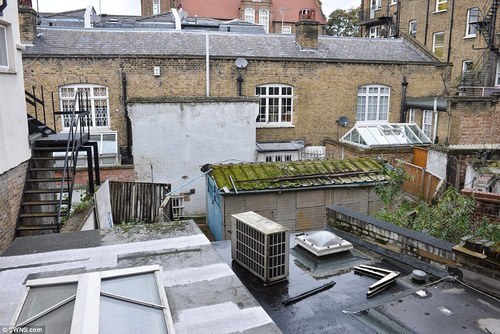
The garage shown above (with the pseudo green roof) is located in the Chelsea neighborhood of London. It measures about 11’ x 7’ and it – along with the site it sits on – is about to go up for auction.
It’s expected to go for more than £550,000 according to the DailyMail UK, which would make it the most expensive garage ever sold in the UK. The site area is 535 square foot – about the size of an average 1 bedroom condo in Toronto.
Below is an aerial view of the site. It basically looks to be residual land.
But as awkward as this site might appear, the expected value is being driven by the fact that planning permissions were granted to turn it into this:
It’s a 2 bedroom house that feels a lot like a laneway house. It certainly fits the description of “a house behind a house”, which is often how laneway housing gets described here in Toronto.
I wanted to share it because it supports my belief that, sooner or later, Toronto will come around to laneway housing. As property prices rise and affordability continues to erode, people will – quite justifiably – start looking in all sorts of new places for a decent urban home.
Many thanks to my friend Adrian for sending me the link.
Roger Martin – who is the former dean of the Rotman School of Management and one of my favorite business thinkers – recently published a post on the Harvard Business Review blog called: The Dark Side of Efficient Markets.
In it, he makes an interesting distinction between what he calls use-driven markets and expectations-driven markets, the latter of which is assumed to be the more efficient one:
In the natural evolution of markets, as markets become more efficient, they turn from being use-driven to expectations-driven — like equities, real estate, or derivatives based on both.
The example he starts off with is that of corn. In its simplest form, this market is about farmers growing corn, taking it to a local market, and then selling it to real humans who will then go home and eat it for dinner. Simple. And this is what he means by a use-driven market.
But as markets grow and evolve, you have middle agents or market makers that insert themselves between buyers and sellers, suppliers and consumers. They help create greater marketplace liquidity and generally help buyers and sellers find each other and transact.
However, as this happens, Roger argues that the game eventually shifts from being use-driven to expectations-driven. Now people buy, not necessarily to consume, but to invest, resell, and generally speculate on future values. In other words, they stop buying the corn to eat it. And instead buy it (or sell it) because of what they think it might be worth at some point in the future.
Now, his argument is that even though this latter stage is considered to be more “efficient”, there’s a dark side to it: increased price volatility. When people are buying, not because they need something, but because of future expectations, it can lead to big price swings. And that’s because the market is now being driven by fear and greed, as opposed to utility. Interesting.
But I want to talk about something a bit different today. I agree with him, but I want to look at it from a different angle.
What I’m instead curious about after reading his article are the following:
Are these non-use-driven markets really that “efficient”?
Is this a natural market evolution only because we had no other choice and no other distribution options?
And how does the internet change this natural evolution?
Efficient markets are supposed to be based on perfect information. Buyers and sellers know the same things, prices accurately reflect intrinsic value, and all that other good stuff. But while this may be more true in some markets – such as perhaps the stock market – I would argue that it’s far from the truth in others.
The real estate market in my view is actually an imperfect market. There’s lots of missing information and there’s overall poor transparency. And I’m sure this also leads to big distortions in the market. So I find it difficult to classify the real estate market as an efficient one – though it may still have a dark side.
I also don’t think you can talk about markets, today, without talking about the internet. One of the most interesting things for me is how it’s completely rewriting distribution between buyers and sellers, producers and consumer.
In the old days, we needed middle actors because it wasn’t cost effective to distribute on your own. If I wanted to write about cities every day, I would have had to get picked up by some newspaper or publication. But today (for better or for worse), I and anybody else can self-publish for basically no cost. The same goes for videos on YouTube, short-term spaces on Airbnb, and so on.
Now, I’m not exactly sure how the changes taking place in marketplaces will ultimately play out in the financial markets, but I do think there’s room for our markets – the simple act of people buying and selling stuff – to get a lot more “efficient”. And as that happens, maybe the dark side won’t be as dark anymore.
If you’ve been reading Architect This City since last winter, you might know that every year I go on one big snowboard trip with a group of guys I went to grad school with at Penn. Last year we went to Jackson Hole and Vail, and this year the plan is to go to Banff and Revelstoke.
We start planning it by the fall and so already we’ve been trying to sort out the details for this winter’s trip. But as we finalize the plans, one thing I’ve noticed is how I’ve automatically been trying to minimize the amount of driving that we’ll need to do. In fact, in a perfect world, we wouldn’t have to rent a car at all.
Now, small mountain towns aren’t usually the best for public transit, but there are often ways to get around that. When we were in Jackson, we took the public bus to get to the mountain every day, as did most people who lived or stayed in town.
This winter, the plan is to fly into Calgary and stay in Banff for the first leg of the trip. So I’ve been trying to figure out if there’s a train that can get us from Calgary to Banff and which hotels offer shuttle buses to the mountains. Because I’d rather not drive, and I know many of my friends feel the same way. It’s an added cost and it gets in the way of après ski.
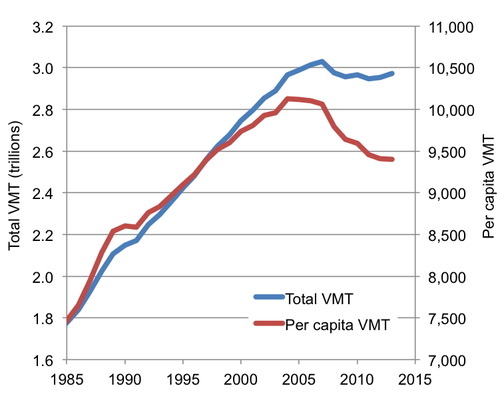
What’s interesting about this, is that not only do I try and minimize the amount of driving I do here in Toronto, but I do it when I travel as well. And if you’ve been following the macro trends, you might know that many other people feel the same way. That’s why total Vehicle Miles Traveled in the US has been in falling since about the mid-2000s:
People are falling out of love with driving, and many believe that this shift is permanent. Here’s a recent report from the US PIRG Education Fund talking about just that:
I also think this shift is permanent – until maybe the nature of driving changes and cars start driving themselves. But at that point, it won’t be called driving anymore and there will probably be many other changes. So on this rainy Wednesday morning, my big bold prediction is that future generations will no longer drive.