Daily insights for city builders, delivered every morning at 6 AM ET. I’m Brandon Donnelly — a Toronto-based real estate developer and founder of Globizen. I’ve been writing here since 2013.

  • Site: Volume 6

    image

    Urban Capital just released Volume 6 of its annual publication called Site. (Sadly, I missed the party.)

    The cover, shown above, is a photo of Shayne Dark’s 90 foot public art installation at Tableau Condominiums. The piece is called NOVA and it’s located at the southeast corner of Peter Street and Richmond Street West in downtown Toronto. If you haven’t yet seen it, I would encourage you to go by. I love the scale that the art and architecture have brought to this stretch of Richmond.

    You can pick up a free copy of Site from any Urban Capital sales office. But in case you don’t end up doing that, I thought I would post a copy of the article I wrote for it. It’s called “Too Much of a Good Thing” and it’s a discussion about urban regeneration vs. gentrification.

    Some of you may also appreciate the Condo Development 101 feature that Urban Capital has been publishing alongside Site. The “how to” in this issue is on financing a development project.

    ———————————————————

    Too Much of a Good Thing

    Urban Capital is an urban regenerator. From its start in Toronto’s King-Spadina district in the late 1990s to Ottawa and Montreal in the early 2000s and Halifax, Winnipeg and Saskatoon today, it has tried to be at the vanguard of urban change. But there’s a flip side of this – “gentrification”, where people get displaced. When does too much of a good thing – regeneration – become a bad thing – gentrification? Brandon Donnelly looks for the answer, and asks what can be done to offset the negative impacts of urban regeneration.

    The 1960s through to the 1980s were not kind to many cities in North America, Europe and the UK. The economy was going through a process of industrial restructuring. Racial tensions were high, particularly in the US. And the lure of the suburb proved irresistible to an auto-oriented generation who saw cities as blighted and dangerous.

    In 1967, Detroit saw one of the most destructive riots in the history of the United States. It lasted five days and resulted in 43 deaths and the destruction of over 2,000 buildings. From 1960 to 1980 the city lost nearly 30% of its population – a decline that continued into the 21st century and has only recently been reversed.

    On October 16, 1975, New York City was less than 24 hours from declaring bankruptcy, as $350 million of debt was about to come due. The economic fallout from deindustrialization had hit the city hard and crime had risen dramatically. By the end of the decade the city would lose nearly a million people and then see the start of what became known as the “crack epidemic.” People avoided “the city” – the city being Manhattan. It was simply too dangerous.

    Cities, it would seem, were dying.

    Yet despite this dire urban backdrop, concerns over gentrification were not non-existent. New York neighbourhoods such as the South Houston Industrial District (today’s SoHo) and the Lower East Side were embroiled in fights over highways, displacement, and gentrification throughout the 1960s, 70s, and 80s.

    Indeed, the term “gentrification” can be traced back to 1964, when it was coined by the German-born British sociologist Ruth Glass. She described it as a rapid process where modest mews, cottages, and previously subdivided Victorian houses were upgraded to elegant and expensive houses – ultimately upsetting the whole social order of the district.

    Baron Haussmann – the original gentrifier

    Even before the term had been coined, “gentrification” as an urban phenomenon had long entered the mind of city dwellers. From the 1850s to the 1870s, during Baron Haussmann’s complete destruction of working-class medieval Paris, the French poet Charles Baudelaire wrote about the estrangement he felt with this newer and richer Paris. This was 19th century gentrification at work.

    But is gentrification always a bad thing? As Detroit bled people in the post-war years, would anyone have opposed a new “luxury” condo tower, assuming it could have been built? Should Haussmann and Emperor Napoléon III have left Paris the way it was? The generation that was displaced wasn’t all that thrilled, but today Paris is one of the most admired and visited cities in the world. So was it worth it?

    De-gentrification is not a great alternative

    Another way to look at gentrification is that it by definition requires capital investment. To renovate and regenerate a neighbourhood is to invest money and make new things. Therefore, the opposite of gentrification – let’s call it de-gentrification – would be disinvestment. This is where capital investments are not made. Things are left to age, because let’s keep in mind that all built form depreciates over time. Nothing is static.

    Most people would probably agree that disinvestment is not an optimal outcome for communities. And you don’t have to look hard to find examples of it. In 1970, the United States had 1,100 urban Census tracts that could be classified as “high poverty.” By 2010, 40 years later, that number had climbed to 3,165. This is disinvestment. This is the lack of gentrification, which doesn’t always get talked about.

    Developers such as Urban Capital have positioned themselves as urban regenerators. What started with a late 1990s boutique loft project – Camden Lofts – in Toronto’s hollowed out Fashion District has grown into a firm philosophy around investing in and regenerating neglected urban areas. In 2013 the company completed the first phase of its four-phase River City development. It was the first building in Toronto’s emerging West Don Lands district, previously a derelict area completely outside the consciousness of Torontonians.

    Earlier, with its East Market development in 2001, Urban Capital kick started what ultimately grew into quite a condo boom in Ottawa. East Market was at the scruffy end of the city’s Byward Market, a one-acre empty parking lot adjacent to a Salvation Army hostel. It was the first major condominium development proposed in the city’s central district in over ten years.

    And today, with the completion of its Glasshouse development in Winnipeg, Urban Capital is delivering 200 new residential units in a downtown bereft of permanent residents.

    Wake up and smell the gentrification

    But at what point does urban regeneration become unwanted gentrification?

    In 2012, on the heels of its successful East Market and then Mondrian developments, Urban Capital returned to Ottawa to launch an infill project in an area of that city that they felt represented an urban void between the downtown core and the trendy Glebe neighbourhood. Their objective was to re-energize a stretch of blocks that, at the time, was characterized by a mostly surface parking lots.

    However, instead of being welcomed as an urban regenerator, as it had been with East Market and other projects, the company was seen as an intruder coming in to build luxury condos for the wealthy. An anti-gentrification campaign quickly emerged with flyers screaming: “Wake Up and Smell the Gentrification!” The gist of their strongly rhetorical message: Don’t get pushed out by the rich developers.

    Of course, this is not unique to Urban Capital in Ottawa. Gentrification battles and fears of displacement dominate headlines around the world. In many ways it is symptomatic of a larger socioeconomic shift: income inequality is rising and the middle class is being squeezed out. The results of this now play out on our streets with every new condo development and hipster coffee shop.

    Good at the beginning; not so good later

    Perhaps the main difference between welcome regeneration and unwanted gentrification is that the revitalization of neglected urban areas – the “welcome regeneration” – often does not directly impact that many people. There’s nobody there to oppose change at the beginning. Things are just getting starting.

    For instance, no one lived in Toronto’s Fashion District in the 1990s, and most people did not believe that this de-industrialized part of the city would one day be transformed into the thriving mixed-use community that it is today. So urban regeneration was not only not opposed, it was actively encouraged.

    But as communities mature and people begin to fear that additional investment will translate into displacement and/or a reduction (or even change) in their quality of life, NIMBYism takes root. Urban Capital has projects from the Maritimes to the Prairies, and partner David Wex describes the evolution this way: “I’m usually pretty popular at the start of a city’s upswing, and then disdained (at best) later on.”

    It would seem that cities only have two states: they’re either on the brink of death or they’re being gentrified and over-developed by nasty developers.

    Inclusive Urbanism

    It is short-sighted to think that as cities and neighbourhoods cross the chasm from under-the-radar regeneration to unwanted gentrification, simply stopping change will preserve the status quo. Instead, we must find the right balance between growth and preservation. And we need to get better at creating inclusive urbanism.

    Earlier this year, at the 24th Annual Congress for the New Urbanism in Detroit, Carol Coletta of the Kresge Foundation’s American Cities practice delivered a keynote speech where she spoke about the transforming city and the battles of gentrification. She urged everyone to consider the value of mixed-income communities, and gentrification – without displacement. She ended by saying: “Equity does not sit in opposition to a thriving, appealing city. It is central to it.”

    Since the very beginning, people have moved to cities in search of social interaction and wealth creation. So it strikes me that the concern may not necessarily be that neighbourhoods could be becoming wealthier (gentrified), but rather that the investments being made and the benefits being created are not being broadly shared. And that some people are not only being left out, but are in fact getting pushed out.

    So what should we do?

    First, we shouldn’t assume that this is entirely a design, real estate and city planning problem. Exponential technological growth has caused rapid structural changes in our economy, manifesting itself in an economic “decoupling”. This has been well documented. A 2012 study by Andrew McAfee, a research scientist at MIT, found that while U.S. productivity and GDP have continued to grow since the early 1980s, median household income has in fact decreased. This is the hollowing out of the middle class that is driving the populism – in Europe as well as the U.S. – that we are seeing today. Sadly, this is not a problem that architects and real estate developers, alone, can solve.

    Second, we – meaning everyone involved in the built environment – need to do more to create inclusive urbanism. This means mixed-income and mixed-use communities that minimize displacement and ensure that residents are well connected to jobs, education, and other services. Already, cities such as Toronto have by-laws in place to preserve affordable and mid-range rental housing in the face of new development. Residential rents are also controlled, with maximum annual rent increases set by the government. You could call these anti-displacement policies.

    Third, there has been much debate about the connection between new housing supply and affordability. On one side you have Harvard economist Edward Glaeser, who touts the affordability success of cities such as Houston, a sprawling metropolis with few land use controls. And on the other you have people like urbanist Richard Florida, who have become frustrated with this proposed solution to inclusivity.

    It is unlikely that supply alone will solve the urban affordability crisis, but there is a clear connection. Heavily supply constrained cities – Vancouver because of its hemmed-in geography, and Toronto (arguably) because of its greenbelt – have seen prices increase faster than more elastic markets. That’s because the rich will always outbid the poor for housing – particularly when supply is fixed. So stopping new supply does not guarantee that displacement will not happen. In fact, it may even exacerbate it. Without new supply, the wealthy will simply look to gentrify the existing housing stock.

    Vital cities evolve.

    As counterintuitive as some of this may seem at first, investment in cities is a sign of vitality. Every construction crane or sidewalk repair is money being spent to maintain and, hopefully, improve the environment in which we live. When cities and neighbourhoods fall into neglect, we seem to be able to recognize the value of change. That’s when we invite urban regeneration. That’s when we want to see that crane up in the sky. But at some point there’s a feeling – and it’s not a new feeling, as evidenced by the “Haussmannization” of Paris – that it’s simply too much of a good thing. Enough is enough.

    Not all development is good development, but we must find a balance. Cites are incredibly powerful and resilient organisms. They welcome us in. They allow us to live our lives with our families and friends. And they empower us to generate wealth. But in order for them to do that best, they need to be allowed to adjust, evolve, and grow.

    Rather than try and stop urban change, a more productive set of questions would be: Are we using this opportunity to improve the built environment and create inclusive urbanism? And how can we ensure that the benefits will be more broadly shared? These are the great challenges facing our cities today. And if we don’t address these issues head-on, the gentrification battles will only get nastier.
  • Supply down. Prices up. Unit sizes up.

    This morning BILD released its November new home data for the Greater Toronto Area. 

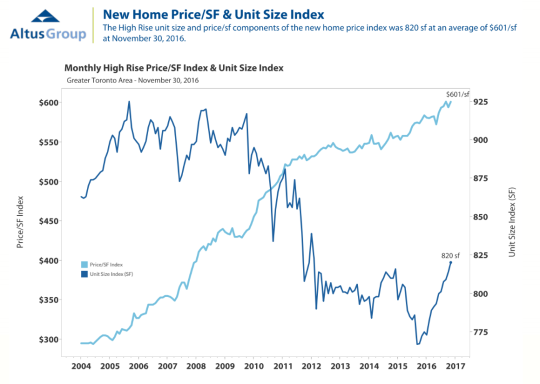
    The story is one we’ve been hearing for a while. Supply is trending downward. It’s becoming harder to build. And prices are up. The average new detached house in this region is now C$1,230,961 and the average new condo is now C$493,137 (~$601 psf). Overall, average pricing is up 20% for low-rise houses and up 10% for condos, compared to this time last year.

    One of the things that I find interesting about the data is how unit sizes have recently started trending upward on the high-rise (condo) side. Below is a chart from Altus Group that shows what I’m talking about. Look at the increase from the middle of 2015 to today. The average is now 820 sf, compared to what looks to be around 770 sf at its lowest point.

    image

    Now, there are a number of possible explanations for this. One is that boomers are starting to sell their houses and move into condos in larger numbers, and 500 sf just don’t do. The market is starting to cater to them. Another possible explanation is that low-rise pricing has become so out of reach for many people and families, that they are now looking to condos to fill that need.

    I see both scenarios playing out in new projects today. But this second scenario, in particular, is one that I’ve been thinking about for a few years now. It’s less obvious than the boomer play. But I think of it as the market maturing. I like seeing families living right in the city and I am sure we will see more of that in the future.

  • New York and Toronto population densities compared

    Today I came across this Reddit talking about how few census tracts there are in the United States with a population density greater than 150,000 people per square mile. 

    Basically, there’s a bunch in New York, one in San Francisco (Tenderloin), and one in Chicago that doesn’t really count because it’s an unusually small tract. Most other American cities don’t even come close.

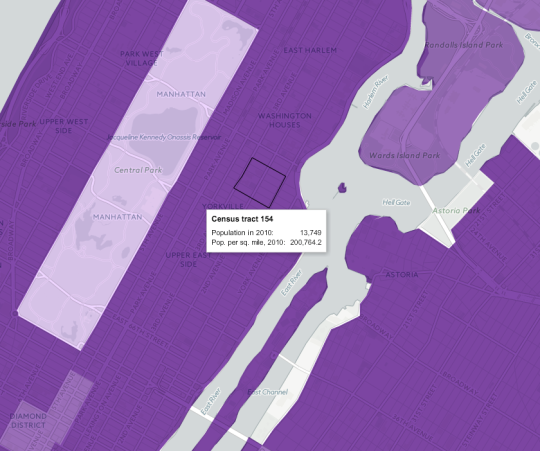
    Looking at this New York Times mapping of the 2010 US census data, it turns out there are neighborhoods in NYC that go well beyond 150,000 people per square mile. Here’s one census tract (#154) at just over 200,000 ppsm:

    If you convert 200,764 into the globally accepted standard for measuring distances and areas, you get approximately 77,515 people per square kilometer. Pretty dense.

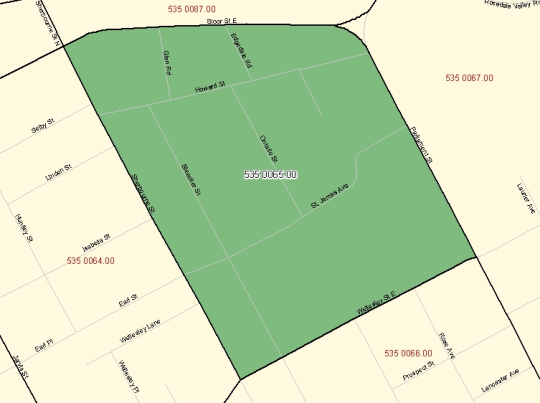
    As a comparison, I thought I would see how this number stacks up against what is commonly referred to as the densest neighborhood in Canada: St. James Town

    If you pull up that geographic code in the 2011 Canadian census data (#5350065.00 in case you’re that nerdy), you’ll see a map boundary that looks like this:

    And you’ll also find a 2011 population density of approximately 60,915 people per square kilometer. Also pretty dense – though the population did decline from 2006.

    Now obviously St. Jamestown is only one example. The rest of the city is, by and large, far less dense. But maybe when our 2016 census data gets released next year, we’ll find that we’ve become even denser. I suspect we will.

  • Yardhouse for sale

    The London-based architecture firm, Assemble, has recently put their old studio space up for sale at

    £150,000 (building only). It’s called the Yardhouse.

    Completed in 2014, the 250 square meter building was designed and constructed by the firm using modest and, in some cases, prefabricated materials. Total construction costs were £291/m².

    The building has since been disassembled and put into storage until a buyer comes along, which tells you a lot about how it was built in the first place.

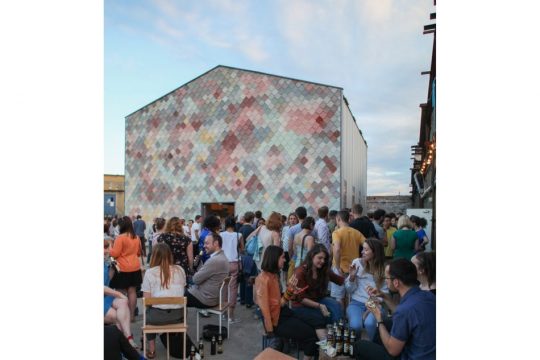
    But what’s great about the building is that, despite its modest roots, it was highly celebrated. The front facade is clad in colorful concrete tiles, which supposedly made it one of the most Instagrammed buildings in London.

    Here’s a photo of what that looked like when the building was still put together:

    image

    The front faced a “public yard” – hence all of the people in the photo and why it seems appropriate to call it a Yardhouse.

    According to The Modern House (they have the listing), the building is already under offer. So if you were in the market for a Yardhouse clad in multicolored concrete tiles, you may be too late.

    But perhaps you’ll draw some inspiration for your next project.

    Image: The Modern House

  • Are you challenging yourself personally?

    I’m not a huge believer in new year’s resolutions, as I much prefer the idea of continuous goal setting and improvement. But I like Mark Zuckerberg’s tradition of pursuing one “personal challenge” every year. One year it was to learn Mandarin. And this year it was to build a personal artificial intelligence tool. If you’re interested in AI, you can learn about the experience and his takeaways in this post.

    I am definitely interested in AI, but right now I’m actually thinking about his approach to personal challenges. This is a time of year when many of us are looking back at what we accomplished over the last 12 months and thinking about what we would like to accomplish in the next 12 months, as well as beyond. I know that I was doing some of that this past weekend. 

    I managed to check off many/most of the items on my 2016 list, but full disclosure: some of them are getting punted to 2017. I also modified certain items. I originally wanted BARED (Becoming A Real Estate Developer) to be a book, but instead it transformed into a new blog series. My most recent BARED post can be found, here.

    However, as I look back at all of the lists I’ve been making, I realize that virtually all of the goals are work related. They’re about completing this, growing that, and so on. That’s obviously important, but what about personal growth? Sure, one could argue that learning Mandarin is actually a prudent business move, but Zuckerberg claims to have been motivated more by personal reasons. And that’s great.

    So I’m revisiting my lists and thinking about ways in which I can challenge myself to grow not just as a professional, but also as a person. Right away, photography comes to mind as an obvious personal challenge, but I’d like to give it a bit more thought. If Mark Zuckerberg can find the time, then there’s no reason that you and I can’t as well.

    Do you have your own set of lists that you keep?

  • Detroit tests new QLINE streetcar

    Detroit has started testing its new streetcars on Woodward Avenue. Quicken Loans bought the naming rights to the line, so it’s now officially called the QLINE. If you’re British, this name probably won’t instil feelings of rapidity.

    Here’s a recent tweet from M1-Rail (click here if it doesn’t show up below):

    //platform.twitter.com/widgets.js

    Note how the train is running curbside.

    There’s lots of debate about the economic benefits of streetcar/LRT over other transit solutions such as BRT. But if you’re a regular reader of this blog, you’ll probably know that I am a supporter of light rail.

    In the case of Detroit, I also think there’s symbolic importance to bringing back light rail to the core of the city. The last Detroit streetcar was shut down in 1956.

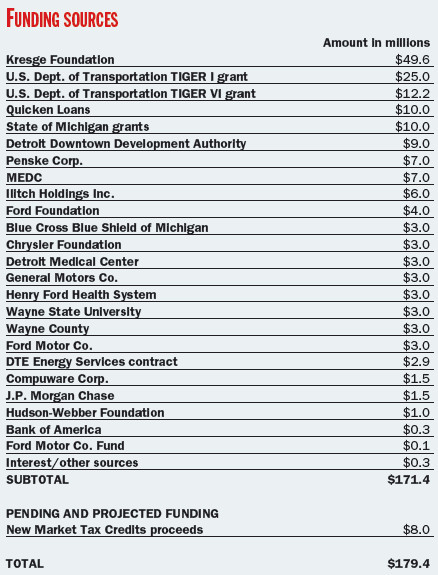
    It’s also worth mentioning how the streetcar line was funded. Below is a breakdown of funding sources dated 2014.

    image

    There may have been some changes since then, but it’s positive to see the public and private sectors come together, alongside a large infusion of philanthropic money (The Kresge Foundation).

    Many of the companies on the above list sponsored individual stations. The cost to do so was $3 million, which is why you see that number show up a few times. Compuware and JP Morgan Chase shared a station at $1.5 million each.

    Is this a transit funding model worth replicating?

  • A 50′s gas station in Berlin

    I have written about the Berlin-based publication Freunde von Freunden (FvF) before. I love the content that they put out – particularly their interviews. They’re personal and genuine. Pretty much the opposite of traditional marketing, though you could call some of it content marketing.

    One series that they do – called Home Stories – is done in collaboration with Siemens Home Appliances. What they do is explore innovative urban living solutions through the lenses of global city inhabitants. 

    There’s everyone from a marketing consultant who built a house boat to an architect who converted an old lingerie factory into an “antivilla” along the water.

    Below is a video of Juerg Judin explaining how and why he decided to convert an old 50′s gas station in Berlin into a home and gallery. Click here if you can’t see the video below.

    [youtube https://www.youtube.com/watch?v=lPsbOT2dG9A?rel=0&w=560&h=315]

    In this case, he bought the gas station in 2005. But he first saw the for sale sign in 1992. And that was a good seven years after it was originally listed. So this property had been sitting for a while

    It’s hard to imagine a central property like this sitting for so long in a place like Toronto. But I think it’s partly opportunities such as these that have made Berlin the city that it is today. New ideas require old buildings.

  • U.S. street grids compared

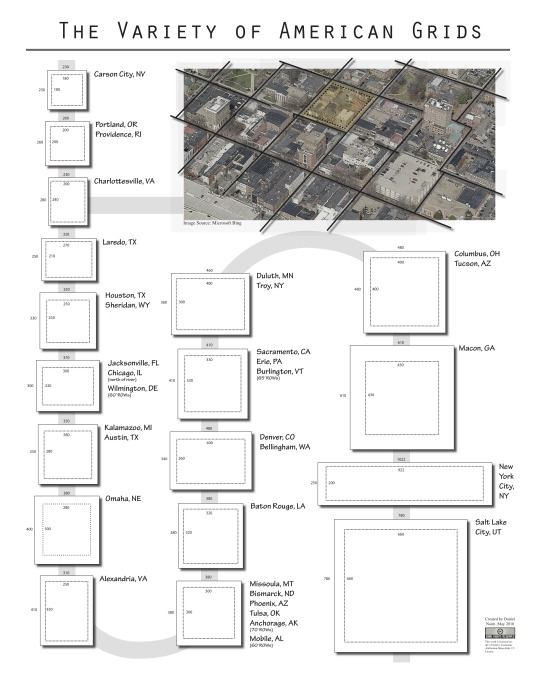
    I like this comparison of street grids that Daniel Nairn prepared back in 2010:

    There’s huge variation here. On the one end you have cities like Carson City, Portland, and Providence, which have small blocks (180′ x 180′ and 200′ x 200′). And on the other end you have cities like Salt Lake City, which have massive blocks (660′ x 660′). 

    This variation creates very different experiences for both pedestrians and drivers. It is widely understood that small blocks are better for walking, which is perhaps why Salt Lake City is known as a driving city. (I just learned that they have “crosswalk flags” to help pedestrians safely cross the street. What does that tell you?)

    In the case of New York – with its irregular rectangular blocks – it is arguably one of the reasons why the avenues (short side of the rectangle) have such a different feel than the streets (long side of the rectangle). Walking north-south is more enjoyable than walking east-west.

    All of this is even more interesting in the context of the point I made in this post: once these urban grids get laid out, they’re pretty sticky. That has far reaching implications.

  • Coastal dilettantes and venture capital

    Chamath Palihapitiya – founder and CEO of a VC firm called Social Capital – recently penned an op-ed in The Information called: “The Sunk Cost Fallacy and the Future of Silicon Valley.”

    Chamath is one of the most outspoken voices in Silicon Valley and is openly critical about the way the industry generally functions today. Here are two excerpts from his op-ed piece:

    “Chronic diseases like obesity, diabetes and heart disease are ravaging much of the U.S. and the world. Automation is eliminating the jobs of millions of well-meaning, law-abiding men and women. Weather patterns are increasingly unpredictable, disrupting water and food supplies and displacing millions of people. But despite this trail of breadcrumbs of big problems and big markets, we still find it difficult to fund potentially big solutions. Instead, we keep doubling down on the easy things.”  

    “Easy short-term growth is now so highly valued in Silicon Valley that we often overlook technical innovation, sustainable long-term growth and meaningful progress in markets that matter. Every week adds to the corpus of press releases from companies with quick, fleeting growth overcapitalized beyond rationalization. And after too many years of this, Silicon Valley is now typecast as a monoculture of coastal dilettantes who float from one meaningless endeavor to another, tone deaf to real problems.”

    Social Capital was founded in response to these criticisms. Their mission is to improve society by using technology to solve big problems – problems like the ones mentioned above.

    Another firm with a similar mission is Obvious Ventures. They call what they do #worldpositive investing. Their goal is to only fund companies that deliver social and environmental benefits along with every dollar earned.

    It’s interesting to think about how capital gets allocated and whether or not it will result in meaningful benefits to the world. Because this is not just about venture capital. You could substitute venture capital for many other asset classes and ask similar questions.

  • Kanju (and the future of cities)

    There is so much interest in cities right now and I think that is absolutely wonderful. Earlier today my friend Derek shared a video with me on Twitter called, The Future of Cities. It’s by YouTuber Oscar Boyson, who I recognize from some of Casey Neistat’s videos, but whose own videos I have never watched before.

    I highly recommend you watch this video. It’s just over 18 minutes. If you can’t see the video below, click here.

    [youtube https://www.youtube.com/watch?v=xOOWk5yCMMs?rel=0&w=560&h=315]

    It’s well-executed, a joy to watch, and packed full of information and ideas. There are soundbites from lots of well known urbanists (both living and dead). And I also love how Oscar crowdsourced ideas and content from cities all around the world.

    The title of this blog post will make sense once you’ve watched the video.