Daily insights for city builders, delivered every morning at 6 AM ET. I’m Brandon Donnelly — a Toronto-based real estate developer and founder of Globizen. I’ve been writing here since 2013.

  • Technology and the city

    Embedded at the bottom of this post is a great rapid-fire talk by Edward Glaeser about technology and the city. 

    Technology has always been a fundamental driver of change within our cities and I like how Glaeser starts by referring to these forces as either centripetal and centrifugal. The car was an example of the latter. It spread us out.

    At the same time, Glaeser points out that the car was really the first time that urban mobility patterns shifted from hub-and-spoke to point-to-point. Transit systems rely on hubs and some walking, which in a world of cars has led to something we call the last mile problem.

    Also worth noting is the fact that Glaeser is terrified about what autonomous vehicles will do to our cities. His point is that the fundamental law of highway traffic has shown that vehicle miles traveled increases basically 1:1 with highway miles built.

    So if all of a sudden AVs are able to decrease the cost of mobility, provide capacity benefits, and increase rider enjoyment (because you’re no longer a driver), vehicle miles traveled are going to go through the roof. This makes a strong case for some form of road pricing.

    But it also means that unlike traditional cars, which were a centrifugal force, AVs could in fact turn out to be a force that further centralizes us within dense urban centers.

    When you listen to Glaeser’s talk, you will quickly understand why so much attention (this blog included) is being paid to autonomous vehicles. They are one of – if not the – next great technology bound to reshape our cities.

    If you can’t see the video below, click here.

    [youtube https://www.youtube.com/watch?v=lbGwhWbuhfg?rel=0&w=560&h=315]
  • 5 decades of condo development in Toronto

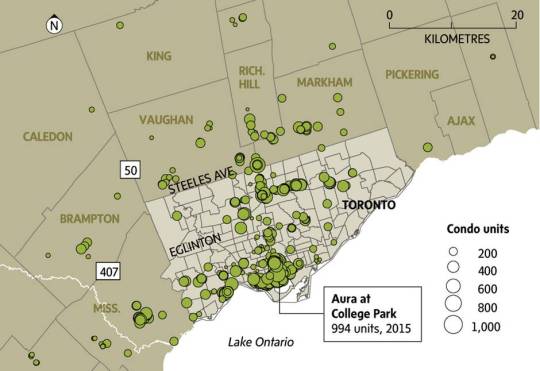
    Jeff Gray and John Sopinski just published a terrific set of maps in the Globe and Mail outlining 5 decades of condo growth in Toronto.

    Ontario first introduced the Condominium Act in 1968. The first condo project was supposedly built by Bert Winberg – founder of Rockport Group – between 1968-1969. He saw what developers were doing in California and Florida and he brought it to Toronto.

    Since then, here is what condo supply has looked like across the Greater Toronto Area:

    • 1970s – 11,697 units
    • 1980s – 30,881 units
    • 1990s – 49,503 units
    • 2000s – 103,683 units
    • 2010s – 109,497 units (up to September 2016)

    And here’s the map for the 2010s:

    We are now a condo city. For the full set of maps, click through here.

  • Instagram Stories has more active users than all of Snapchat

    Instagram has a company chart that shows: Days to Reach the Next 100 Million Users. It is only the chart where they want to see it decline. The first 100 million users took 28 months. And the last took only 4 months. Instagram now has 700 million active users.

    Instagram is also saying that they have 200 million people using their Stories feature – you know, the feature they blatantly stole from Snapchat. This would mean that more people are using Instagram Stories than Snapchat has daily users (~158 million).

    Anecdotally, I can tell you that I’ve almost completely stopped using Snapchat. (Snapchat battery usage over the last 7 days = <1%.) I still prefer Snapchat’s direct messaging functionality, but not enough to continue using the platform. Instagram now provides basically the same functionality – plus my photos – in a single app. 

    But more importantly, Instagram’s network and my network are bigger there. And network effects are clearly the most important thing. In fact, by directly copying Snapchat, Instagram (Facebook) made sure that this competition was only about network size and not about features. Monopoly power.

    In real estate, if you own a property in a great location, your position is pretty defensible. (Though you may not be completely immune.) But in tech, that is clearly not the case. Someone might copy everything you’ve done and beat you at your own game.

    As someone who used to be very bullish on Snapchat, I am now wondering if I need to remove my Snapchat handle from the header of my blog emails. I mean, I’m not there very often anymore. But maybe, just maybe, Snapchat will find a way to compete outside of network effects at a game that Instagram/Facebook can’t play.

    How would you or are you placing your bets?

  • HOT, HOT HOUSES

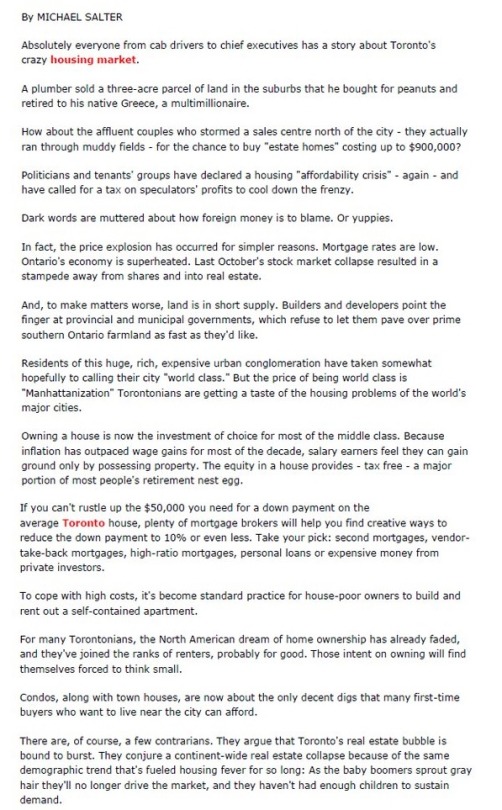
    Below is a piece by Michael Salter from the Globe and Mail. It’s all about Toronto’s HOT, HOT housing market. Michael’s message: Here are the real reasons why home prices are skyrocketing and why they are going to remain high.

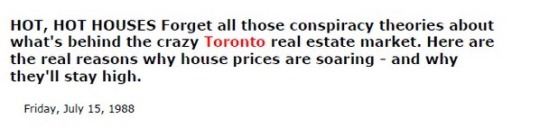
    Did you find yourself agreeing with this article or did you notice that something was off? If you noticed something, it may be because this article was originally published on Friday, July 15, 1988. And by that time, the North American dream of home ownership had already died in Toronto.

    Here’s the header I cut out from above:

    Thank you to Tamsin McMahon for tweeting this out last weekend.

  • Envelope Beta

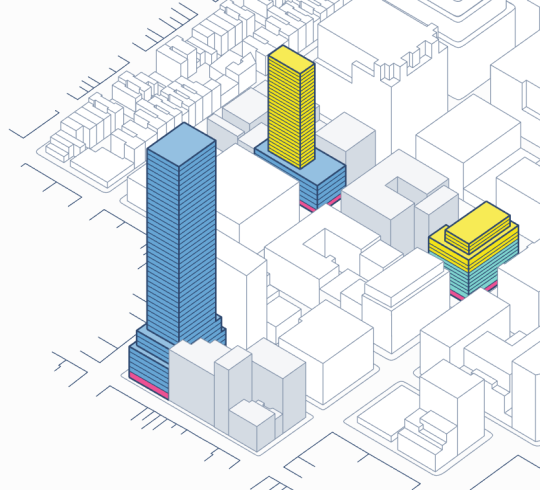
    My friend Bruce of getrefm.com (real estate financial modeling) just introduced me to a new real estate startup called Envelope. Basically it’s 3D mapping software that allows you to quickly visualize the zoning envelope for a particular site. It’s similar to what Flux.io was initially trying to do.

    Now, I think this is very cool, but my first reaction was: What if the zoning is out of date? What if approvals/entitlements are done a site-specific basis? This isn’t the case in every city, but I’ve heard some people in Toronto argue that this city basically has no zoning code. (We can debate that one in the comments, I’m sure.)

    That being said, there are still many design guidelines in this city that shape built form and I could see a tool like this being incredibly useful. They’re still in private beta but I would like to try it out. Hopefully they’ll see this blog post and let me have an early peek.

    Image: envelope.city

  • E20_Private Residence

    The private residence below is located on a quiet street in the village of Pliezhausen – about 30 km south of Stuttgart. Designed by Steimle Architekten, the house is 376 square meters and sits on a 658 square meter property. Its insulated concrete shell is 50 cm thick. All photos by Brigida González.

  • How urban density dictates how we vote

    “It’s remarkable that even as the internet disperses information and enables us to form online communities across great distances, our politics are still highly correlated with physical environments. Who we are is largely defined by where we are. For architects and urban designers, this is an important reminder that space is and always has been political, from the days of the valley section to the postmodern stage of Trump.”

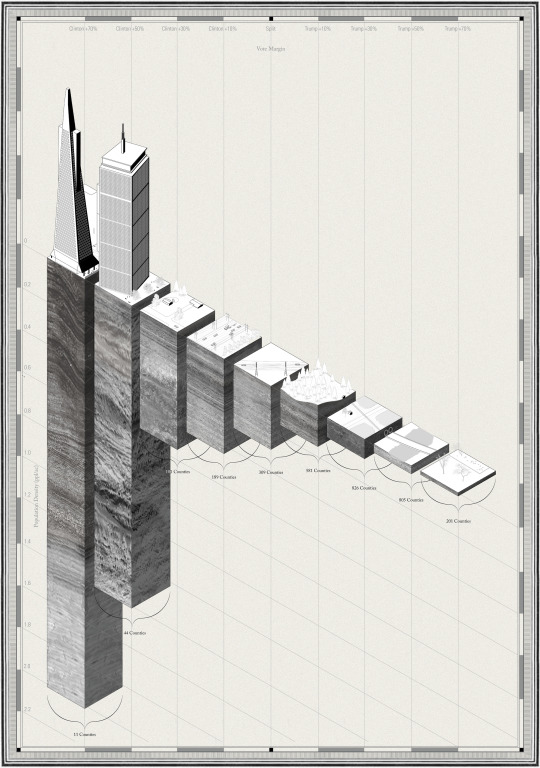
    The above excerpt is from a Places Journal article by Neeraj Bhatia called, Environment as Politics. The premise of the article is that residential population densities have long shaped political outcomes and that that was certainly the case in the 2016 U.S. presidential election.

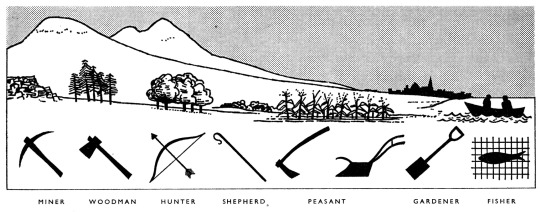
    But before we get into the work and drawings of Places Journal, let’s first talk about one of the inspirations mentioned in the article. In 1909, the pioneering town planner Patrick Geddes drew the following “Valley Section”:

    The point of this section drawing is to make clear the relationship between humans and their environment. In this case, it speaks to occupation. The physical geography of where you lived determined what you did: fish, hunt, mine, and so on.

    For those of us now living in cities, these “natural occupations” may not seem all that relevant. But that same human-environment relationship remains.

    In the 2016 election, 49 of the 50 highest density counties voted for Hillary Clinton. And 48 of the 50 lowest density counties voted for Donald Trump. It turns out that how close you live to your neighbor had/has a tremendous impact on your political views and the way you vote(d).

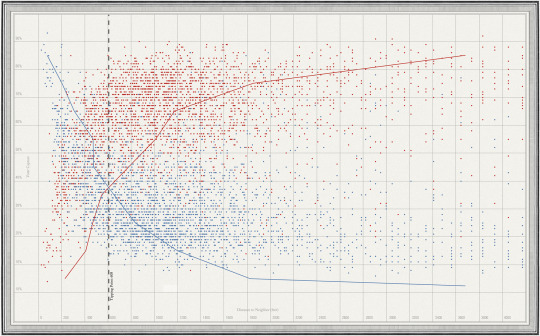
    Below is a chart from Places Journal that plots the 2016 election results for all U.S. counties:

    On the y-axis is “vote capture” by Democrats and on the x-axis is “Distance to Neighbor (feet).” What you see here is a dramatic drop off in liberal voting as distance to neighbor increases. And the tipping point appears to about 608 feet.

    Part of the explanation for this is that living in close proximity to others change how we feel about others. It can reduce fear and prejudice. In other words, it makes us more open. And as Bhatia points out in his article, one could argue that this last U.S. election was in fact a “clash over the openness of society.”

    We often talk on this blog about how space impacts our lives. As Jan Gehl once said: we shape cities and then cities shape us. Today we are reminded that space is also highly political.

    In my case, the distance to my neighbors is likely about 8-10 inches. Sometimes I can hear somebody sneeze. But most of the time I don’t hear anything at all. It’s usually pretty quiet around here. Whether I acknowledge it or not, this distance is shaping me and how I see the world.

  • Fake architect charged on 58 counts

    I had to read the following announcement a few times just to make sure it was legitimate. 

    A few days ago, attorney general Eric T. Scheiderman (New York State), announced that as a result of “Operation Vandelay Industries”, he was indicting an alleged fake architect named Paul Newman on 58 counts of larceny, forgery, fraud, and unlicensed practice of architecture. 

    And yes, the Seinfeld reference was entirely deliberate. Can you believe the guy’s name is Paul Newman? For over 7 years, Newman had been pretending he was an architect and had stamped drawings for over 100 buildings in Albany, Rensselaer, and Saratoga Counties.

    For those of you who weren’t Seinfeld fans (I assume there are some), George Costanza liked to pretend he was an architect, among many other things. He would also sometimes go by the name of Art Vandelay – an “importer/exporter” who ran a company called Vandelay Industries. Hence the operation name above.

    In any event, a funny announcement, but a not so funny reality for the hundreds of clients and building industry professionals that believed Paul Newman was indeed an architect. 

    Moral of the story: It’s one thing to pretend you’re an architect to meet women. It’s another thing to pretend that you actually have the professional ability to stamp building drawings.

  • The post-Wall techno music of Berlin

    image

    I’ve written about Berlin many times before on this blog. It’s such a fascinating case study for me because of its history, its urban development patterns, and its famous techno scene.

    Last month, Nick Paumgarten wrote a piece in the New Yorker, called Berlin Nights, where he dives into the city’s club culture and its reputation as the cradle of techno music. 

    But in doing that, he is necessarily forced to talk about the once divided city and its unique “post-Wall” condition. When the Wall came down, the East became – as a result of its under-utilized built form – a breeding ground for the pent up energy and creativity of the West.

    Here is an excerpt that speaks to the importance of those empty spaces and sparsely populated neighborhoods:

    The post-Wall abundance of derelict building and excess housing was decisive. “Empty spaces allowed there to be a club culture,” Robert Henke said. “With no empty space, you get a closed-at-2 a.m., restrictive-alcohol culture.” At first, the reclamation seemed slapdash, improvisational, anarchic, as squatters took over buildings and neighborhoods and set off a period of cultural ferment. But the powers that be had been dreaming up developments for years before the Wall came down, and now—amid a boom in real-estate speculation and investment (everyone spoke of the Swedes)—empty space, and the sense of wildness that comes with it, has become harder to come by. “Flats are getting more expensive,” Hegemann said. “But we still have many free spaces. This is the secret for why Berlin is still alive.”

    And here is the story of one such building:

    Some empty spaces have completed their life cycles. One afternoon, I visited the old Reichsbahnbunker, a five-story fortress of reinforced concrete built by the Nazis in 1942 as an air-raid shelter. The Soviets turned it into a jail for P.O.W.s. Then it was used to store bananas and other tropical fruit. It was abandoned. In the nineties, it became an infamous techno night club, the Bunker. No ventilation, no fire exits. The government eventually shut it down. In 2003, an advertising executive and his wife bought the building and converted it into a museum to house their collection of contemporary art. They also built a glass-and-steel penthouse on the roof, to house themselves. Now the collection is open to the public, by appointment only. I joined a tour one afternoon. The guide, a young art student with a sweet monotone, took us into a cell-like space featuring giant manipulated photographs of the night sky, by Thomas Ruff, and explained that it had been the original dark room of Berlin. “It was very extreme,” she said. “It was hot, damp, loud, and dark. It was said to be the hardest club in the world. I’m sure you can imagine the things.” She gave a coy smile.

    If you’re interested in cities and/or electronic music, the essay is well worth a read.

  • 16 new housing measures

    The big news today in Toronto real estate is that the province of Ontario introduced 16 new measures intended to rein in the housing market. 

    Some of the most notable measures, which many of you will have seen in the headlines, include a 15% tax on home purchases by non-residents and expanded rent control for buildings completed after 1991. Previously it only applied to older buildings. The maximum annual rent increase for existing tenants will now be capped at the rate of inflation, up to a maximum of 2.5%.

    Here’s some more information from the Globe and Mail and CBC.

    I’ve had a few people ask me to blog / comment on the above, but I haven’t yet had time to do a deep dive into the details. I would like to do that first rather than provide a knee-jerk reaction. In the meantime, I would love to hear your thoughts in the comment section below.