Daily insights for city builders, delivered every morning at 6 AM ET. I’m Brandon Donnelly — a Toronto-based real estate developer and founder of Globizen. I’ve been writing here since 2013.

  • Skip-stop

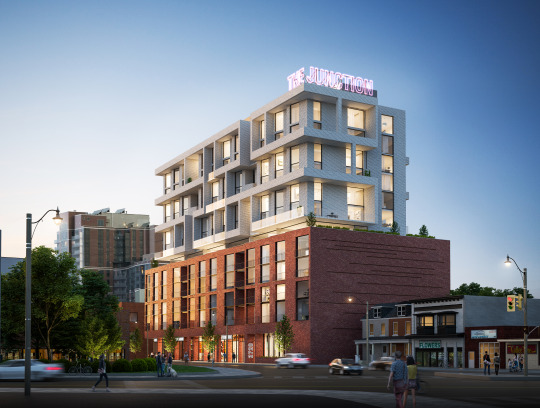
    After Junction House was announced, an interesting discussion emerged on Twitter around 2 storey suite designs.

    There are, of course, many examples of multi-level apartments in the city. There’s 75 Portland by CORE Architects. There’s District Lofts and Mozo by architectsAlliance. And there’s Village by the Grange (pointed out during the discussion), which has a number of 2 and even 3 storey suites.

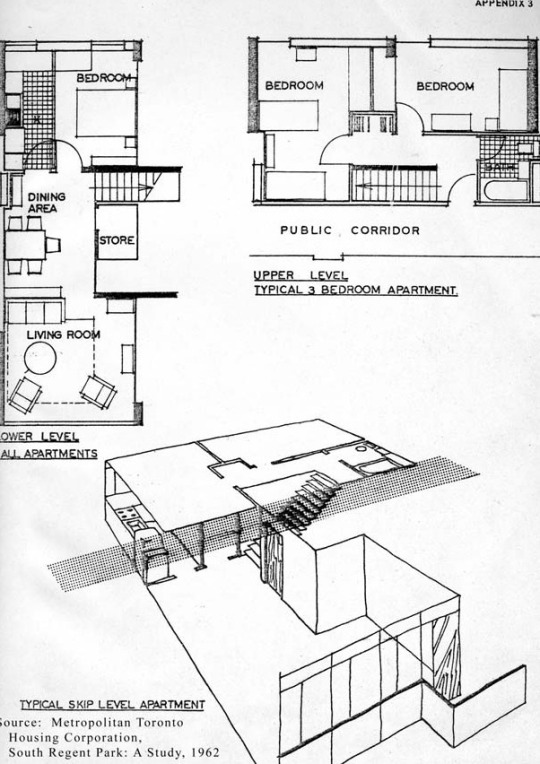
    Another example that was raised by Gil Meslin is 14 Blevins Place. Now demolished, Blevins Place was designed in 1955 and completed in 1957 as part of the Regent Park South urban renewal project. It was designed by the British-born Toronto architect Peter Dickinson and by Page + Steele.

    In 2005, prior to its demolition, the building was identified as a listed heritage building, but it was never elevated to a designated heritage building.

    Perhaps most notable about the building are its “skip-stop corridors” and its 2 storey suites. See below images taken from this Heritage Impact Assessment by ERA Architects.

    imageimage

    The reality is that modern architecture has had a long history of employing multi-level units and skip-stop corridors. Le Corbusier and Oscar Neimeyer were said to be experimenting with them as far back as the 1930s.

    But I think most would agree that Toronto is a very different city today compared to what it was in the 1950s. Some still believe that no child should grow up in an apartment, but I disagree with that belief system. I lived in an apartment as a kid and somehow I survived.

  • International and domestic migration in the US

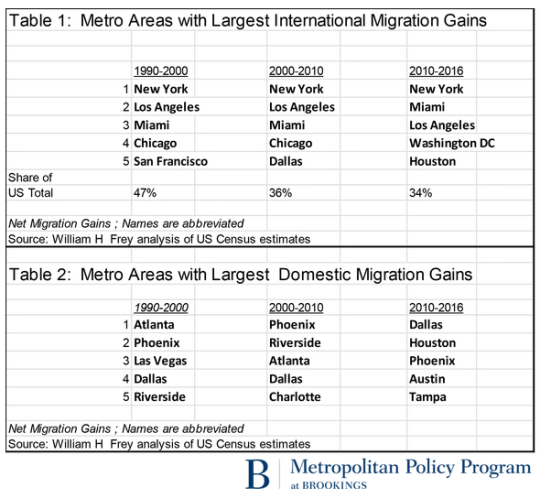
    In response to President Trump’s proposed immigration bill, Brookings recently analyzed census data from earlier this year to demonstrate the importance of immigration for growth within much of the United States. 

    I’d like to share three tables from their analysis.

    The first two look at international migration grains and domestic migration gains over the last 3 decades (the last decade isn’t quite a decade).

    Here you can see that New York, Los Angeles, and Miami (all port cities) have dominated international migration to the US since 1990. But at the same time, international migration has become less geographically concentrated. From 1990-2000 the top 5 cities received almost half of all immigrants moving to the US. More recently, that number has dropped to 34%.

    Domestic migration is different in that it’s a zero sum game. When one US city gains, another US city loses. Here there is a very clear migration trend toward cities in the southwest – arguably because of weather, job growth, cheaper housing, and probably a bunch of other factors.

    If we look at actual international and domestic migration numbers over the last 6 years, the 12 largest metropolitan areas look like this:

    The key takeaways here are that 8 of these cities are losing people to domestic migration and only 7 of these cities have a positive net migration number – meaning their population is actually growing.

    What is clear is that the international migration column is a pretty important one if you believe that growth is valuable. 

    If you’re Dallas, Houston or Atlanta, maybe you care a little less about that column. But for most of the other cities, international migration is either the only way you’re growing (look at Miami go) or keeping your population losses in check (see Philadelphia).

  • Don’t fall off the “humor cliff”

    Some of the most successful people I have ever met in business are also some of the funniest people I have ever met. This, of course, isn’t universally true. But I don’t think it’s pure coincidence. These are people you want to be around and do business with. 

    There’s lots of research out there to suggest that humor is an incredible way to build relationships and strengthen workplace cultures. Joel Stein recently penned an article about this at Stanford Business called Humor Is Serious Business. Naturally the article itself is also funny. Here is an excerpt:

    “The reason humor works as a bridge (just go with it) is that laughter sparks the release of oxytocin, a hormone that facilitates social bonding, increases trust, and quickens self-disclosure. This is key in a workplace since all the other ways to release oxytocin are no longer permitted by Human Resources. In a 2015 study, psychologists Alan Gray, Brian Parkinson, and Robin Dunbar had participants watch either a funny or neutral video clip before engaging in a self-disclosure exercise with a stranger: People who watched the funny clip revealed 30% more personal information relative to those who watched the neutral clip.”

    The article goes on to talk about how humor at the negotiating table can lead to increased concessions and how, if you’re in a senior position and you make fun of yourself, people tend to assume you’re highly confident in your abilities. It also humanizes you.

    One of the interesting things about this topic is that, according to research by Stanford professor Jennifer Aaker and lecturer Naomi Bagdonas, most of us fall off a “humor cliff” when we enter the workforce. That’s roughly the moment where we start laughing less and finding stuff less funny.

    We shouldn’t let that happen and I’m going to make a concerted effort. Not just because of business, but because laughter is good for you.

  • Introducing Junction House

    image

    Earlier this week I posted this teaser photo on social (full photo above) and said to stay tuned for a big announcement. Well, that announcement is here and you can read all about it over on the Globizen blog. Please let me know what you think in the comment section below.

  • Just put up a sign

    Back before the 2008 financial crisis, I did a short stint working for a real estate developer in Dublin, Ireland. 

    Most of our projects were in Ireland, but our consultant teams were sometimes from all over.

    One day we were having a meeting with our architect from Germany and we started talking about a particular project’s green space.

    But this wasn’t the sort of green space that was supposed to be actively used. It was a green space that, I guess, you were just supposed to look at and admire for its greenness. 

    So one of my Irish colleagues asked, while referencing the proposed design: “How are we going to keep people off the grass?”

    Our German friends didn’t immediately appreciate the concern and responded with: “What do you mean?”

    Irish: “How will we stop people from walking and hanging out on the grass?”

    German with serious face: “Oh. We will put up a sign.”

    At that point, every Irish person in the room just started laughing and more or less said: “Yeah, that’ll never work.”

    Cultural differences can be subtle.

  • Value creation gap

    Here is a good follow-up to yesterday’s post about Ian Schrager and Edition Hotels. It’s a short post by Seth Godin that I’m going to reblog here in full:

    The gulf between “risky” and “feels risky” is huge. And it’s getting bigger.

    It turns out that value creation lives in this gap. The things that most people won’t do (because it feels risky) that are in fact not risky at all.

    If your compass for forward motion involves avoiding things that feel risky, it pays to get significantly better informed about what actually is risky.

    I like this distinction, a lot.

    I’m traveling for work right now, which is why you may be noticing shorter than usual posts. But stay tuned because I’ll be making a big announcement later this week on the blog.

  • Editions of Edition

    A few weeks ago Surface Magazine interviewed Ian Schrager. If you don’t know who Ian Schrager is, you should look him up. He started Studio 54 in New York (along with Steve Rubell) and is largely credited with inventing the boutique hotel genre. His latest project is Edition Hotels, which launched in London in 2013 and in Miami in 2014.

    What I found particularly interesting about the interview are the “serious snafus” that Edition experienced at the outset. There was a project in Waikiki and a project in Istanbul. Both failed. Here’s a guy who invented the genre and had partnered up with Marriott to pioneer a new brand. And it wasn’t until Edition London that they were able hit their stride.

    I say all of this not to poke fun at their failures. Nobody should do that. Poke fun at not trying instead. My point is the exact opposite. To create something new and amazing, such as Edition, you often have to subject yourself to a few scrapes and bruises along the way.

  • Power to the people

    Bloomberg columnist Barry Ritholtz recently interviewed Richard Barton about his startup companies. Barton founded Expedia while he was an executive at Microsoft (Gates and Ballmer era) and then went on to cofound Zillow (real estate site) and Glassdoor (jobs site). 

    I’ve been following the work of Barton for many years now because I admire the common thread among his startups: They’re about bringing transparency to industries where transparency is lacking. I used to try and dissect his thinking when I was working on my own real estate/tech startup.

    I believe there’s still a lot of room for transparency in the real estate space, but that doesn’t negate the work that Barton has done. He’s all about using technology to bring “power to the people.” That’s a good thing.

    Click here to listen to the podcast.

  • The best party in town!

    Friend: Ever go to Jilly’s?

    Me: No, actually.

    Friend: Same.

    Me: What about you? [Addressed to random guy in elevator]

    Random guy in elevator: I’m from Portland. I don’t know what you’re talking about.

    I went to check out the new Broadview Hotel last night in Riverdale, Toronto. (Riverside if we’re being pedantic.)

    Originally built in 1891 and most recently a boarding house with strip club at grade (Jilly’s – the best party in town!), the building was acquired in 2014 by developer Streetcar and turned into a “58-room boutique hotel and charismatic gathering spot.” The soft opening was July 27, 2017.

    Official website here. Lots of interior photos here.

    Besides the pink neon above the lobby bar (which is obviously great), I really like what they did in the stairwells. Credit to Supermilk Studio. Here’s a photo I snapped last night while trying to find the WC:

    Each floor is painted with murals that pay tribute to the building’s history, from the early days of Dingman’s Hall to its most recent iteration as Jilly’s.

    Interestingly enough, the building originally served as an important social hub for the community, though it did not initially house a hotel. On the ground floor was a bank (see, there’s a long tradition of this) and above it were offices and grand meeting halls.

    It wasn’t until the original developer sold the building that it was converted to a hotel and granted a liquor license. It’s worth noting that this conversion is said to have faced stiff community opposition. A hotel that serves alcohol to people? Not in my 1906 backyard.

    With the reopening of the new Broadview Hotel this summer, you could argue that east of the Don River is once again regaining its grand gathering spot. And the feeling I got when I stepped foot inside the hotel last night was that it was time. The demand was latent and, yes, condos wouldn’t have cut it.

    At the same time, this is obviously bigger than the east side. There are many who don’t know this building’s infamous history. Jilly’s? What’s that? Time to go for a walk in the stairwells.

  • Laneway house support map

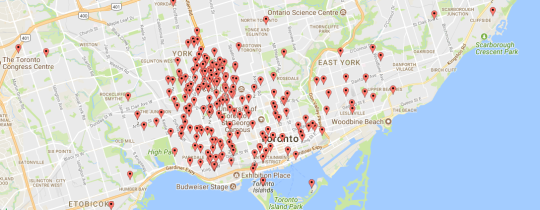
    I posted the following image to Twitter this morning:

    It’s a map of some of the people who support my proposed laneway house (in midtown Toronto) and have signed their name at lanewaylove.com.

    To me, this is an incredible demonstration of the kind of broad-based support that exists in this city today for laneway housing/suites.

    I met with some of my neighbors last week to discuss the proposal and one of them said to me: “I can tell that you’re genuinely passionate about this idea.” 

    My response: “You’re absolutely right. I am. This is not just about my singular project or the money. This is about something much bigger for the city.”

    Clearly, many others see that as well. 

    I know that there’s been a lot of laneway talk on the blog over the past few weeks and months. It’s been on my mind as I prepare for my project’s hearing next month.

    For those of you who have no interest in laneway housing/accessory dwelling units, rest assured that the laneway content should subside (a little) after the summer.