Daily insights for city builders, delivered every morning at 6 AM ET. I’m Brandon Donnelly — a Toronto-based real estate developer and founder of Globizen. I’ve been writing here since 2013.

  • 2017 year in review

    I just finished going through my list of 2017 goals. I didn’t accomplish everything I wanted to, but I did manage to check off a number of professional and personal goals.

    Some of the remaining goals have been pushed to 2018. But there are also items that I have since realized aren’t worth pursuing and so I have dropped them from the list.

    All that said, it was a great year. Here is a rapid-fire summary of 2017 told through posts from this blog.

    Thanks for reading. Onward my friends.

  • Waste and efficiency

    Here are a couple of cut-up snippets from a recent post by Seth Godin titled: “Waste and the new luxury.”

    Luxury goods are built on a foundation of waste.

    The front lawn is a luxury good, a sign that you don’t need to graze your cows on every square inch, and that you’re willing to waste the lawn.

    There’s a new luxury that’s occurring, though, one that’s based on efficiency.

    A luxury that’s based on investing in renewables, in resources that might be seen as endless, in smart design, in the satisfaction of knowing that others are benefitting, not paying, for the experience or the object you’re buying.

    Waste vs. efficiency.

    (Above is a photo I took this week in Dundas Square.)

  • Merry Christmas

    I took the above photo on Christmas Eve in Toronto’s Distillery District (one of my favorite neighborhoods in the city). It was before the snow had really started falling. We got a white Christmas this year – the best.

    This is one of the first photos with my new Fujinon 23mm f/2 (35mm equivalent) lens. I have come to realize that if I’m not photographing people, 35mm is the right focal length to have on my camera for the types of photos I seem to gravitate toward.

    And now back to eating. Merry Christmas everyone. If you’re reading this post in your inbox and it feels late, then: Happy Boxing Day 🙂

  • The most expensive housing market in the world

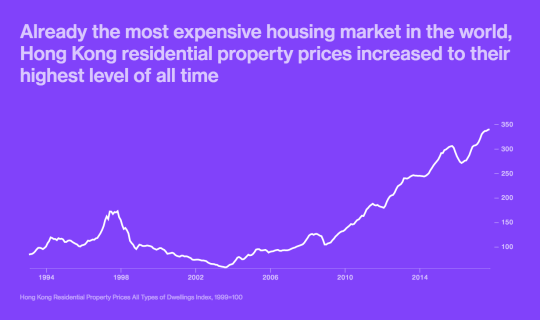
    It’s that time of year again. Time to get contemplative about the last year. Bloomberg recently posted this: 2017 – The Year in Money. Below is a capture from the real estate section.

    Here you can see the run up to the 1997 Asian financial crisis and also the Hong Kong “handover”. Initially, I thought the uncertainty of the handover would have reduced demand, but I guess there were other factors.

    According to the book Hong Kong 20 Years after the Handover, the property and stock markets at the time were being fuelled by high inflation and low interest rates. This made real interest rates negative and created a strong incentive to borrow and invest.

    I love seeing longer range indices because it helps to put things into perspective. If you started your career in real estate in Hong Kong around 2003-2004, you might think that prices generally always go up. 

    But consider how long it may have taken to get back to where you were if you had instead bought at the peak of 1997-1998.

  • The impact of inclusionary zoning on development feasibility

    image

    After my recent post on inclusionary zoning in Ontario, I was asked to provide my comments on the draft regulation and on how inclusionary zoning could and will impact development feasibility. So I will endeavor to do that today.

    It’s important to first understand the costs and inputs that go into a development pro forma and how overall project feasibility is determined. For simplicity, let’s breakdown the costs as follows:

    – Land

    – Soft Costs

    – Financing Costs

    – Municipal Fees/Charges

    – Hard Costs

    All of these costs buckets are significant. For a project to be feasible, you obviously need the revenues of the project to be greater than the above costs. There also needs to be a remaining profit margin that is commensurate with the risk profile of the project and that meets your investor’s return expectations. Most developers rely on outside equity and debt to finance their projects.

    One of the misconceptions that I often hear is that people seem to think that the profit margin on projects is so great that developers could simply build affordable housing (or do many other things) if they weren’t so greedy. The reality is that development happens on the margin. It’s not easy to find sites and projects that make any sort of financial sense. More often than not they don’t.

    The other reality is that in a growing market all of the above costs are also continually increasing. If revenue (i.e. rents and condo prices) is also growing, as has been the case here in Toronto for many many years, then developers can generally absorb reasonable increases and continue building. But if revenue stops growing, grows at a slower pace or, worse, shrinks, then feasibility could disappear and development would stop.

    Now let’s talk specifically about inclusionary zoning. IZ is typically an incentivized or mandated requirement to provide a certain number of below-market housing units as part of new developments. Affordable housing is important. That’s why a number of cities already have inclusionary zoning policies – though it remains a fairly controversial tool.

    From a development feasibility standpoint, a mandatory inclusionary zoning requirement represents a decrease in revenue. There’s now a percentage of the units that can no longer be rented or sold at market prices. And so to maintain the project’s feasibility – because remember development happens on the margin – something has got to change.

    There are a few options.

    Option One: You could simply try and pay less for the land. As we have talked about many times on this blog, land is supposed to be the residual claimant. Work backwards from revenues and your other costs to determine what can be paid for the land. The problem with this option is that land prices tend to be sticky.

    Many or most landowners don’t give a shit about your development pro forma. They often have a number in mind and if you try and tell them that development charges just went up and you can’t pay as much for their land, they’ll simply sit on it and wait for someone else – even if that means waiting for the market to catch up (i.e. waiting for rents to go up).

    Option Two: Charge more for the remaining market units. If the market is sufficiently robust, perhaps this is an option. This is one of the reasons why inclusionary zoning often produces more units in markets where there’s already strong demand for new housing.

    But it’s also one of the reasons why IZ is controversial. You’re asking the other renters/buyers in the project to effectively subsidize the below market units. And there is research out there (previously posted on this blog) suggesting that in some instances IZ policies have created additional upward pressure on market rents and home prices.

    Option Three: Incentives are provided by the municipality to offset some or all of the additional burden placed on the project. This could come in the form of a density bonus, financial contribution, a waiving of other municipal charges/fees, and so on.

    Though I have questions about the details, this is something that was proposed in Ontario’s draft regulation (albeit not to the extent that the industry wanted). Now you know why I said and why I believe that these offsets are important to the industry and to overall housing affordability.

    My hope with this post was to provide the developer’s perspective, but also take a very matter of fact approach to inclusionary zoning. Most people recognize the importance of affordable and accessible housing. The question is how best to execute.

    Photo by Toa Heftiba on Unsplash

  • Notes from the retail apocalypse

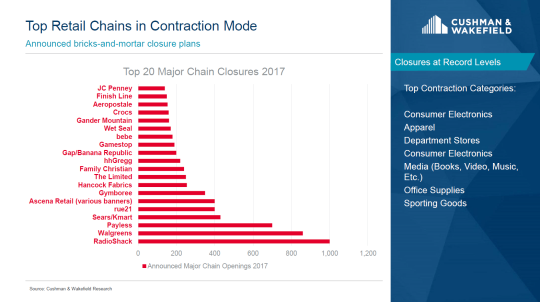
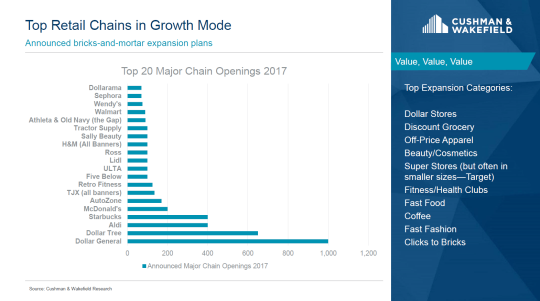
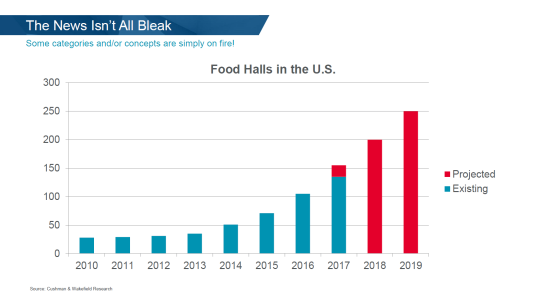
    A friend of mine was in Scottsdale last month for an ICSC conference where Garrick H. Brown (VP of Retail Research for the Americas at Cushman & Wakefield) delivered this retail presentation. 

    My friend flipped it to me this week and below are a couple of slides that stood out as I scanned through it.

    image

    Apparently over the last five years, a new dollar store has opened every four hours in the US. That’s how quickly this category is growing. A race to the bottom.

    image

    Food halls are hot and not just in the US. Check out: “5 huge food halls opening soon in Toronto”.

    image

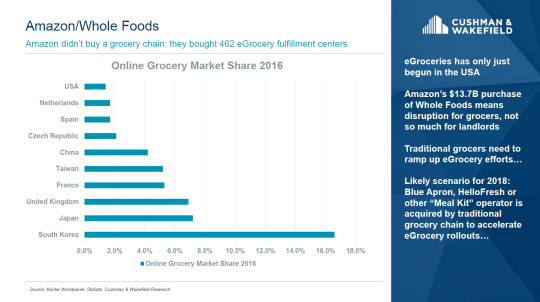
    This is similar to a chart I posted a few weeks ago that pegged online grocery shopping in South Korea at closer to 20%. I’m still fascinated by this market share number and want to better understand what’s driving it.

    image

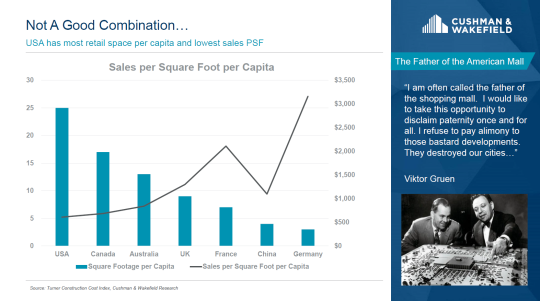
    This is an interesting chart that shows the relationship between retail square footage per capita and sales per square foot per capita. The US has lots of retail space per capita but low sales. Now look at Germany.

    image

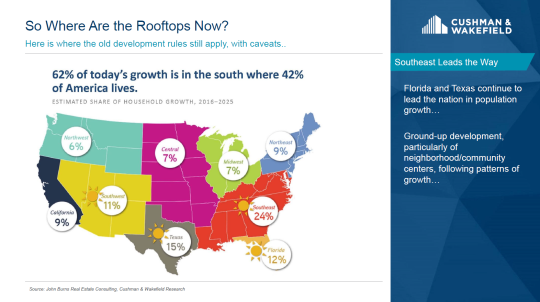
    Finally, this is a chart that shows where household growth is expected to happen from 2016 to 2025. It follows a very clear historical trend of Americans moving from cold places to warmer/hot places.

    image

    For the full presentation, click here.

  • Great things that happened on transit

    Elon Musk’s apparent distaste for public transit and random strangers prompted a Twitter battle last week. Though for the record, Musk later clarified that he loves trains, most subways and London buses.

    Transit planner Jarrett Walker retorted that Elon’s views are the “essence of elite projection”. What’s good for Elon Musk may not, in fact, be good for the broader society. Elon responded by calling him an idiot.

    All of this prompted Brent Toderian – city planner and former chief planner of Vancouver – to initiate the hashtag: #GreatThingsThatHappenedOnTransit. It then took off and the transit stories started pouring in.

    Not surprisingly, this has been getting a lot of attention. It’s Elon Musk after all. But billionaire celebrities aside, it does serve as a good example of the two sides of this debate.

    Some people seem to think that I am anti-car. I can see why some people might think that, but I am not anti-car. I love nice cars. And I love nice trains. What I value first and foremost is the city. 

    The kind of city you can build on the backbone of transit is very different than the kind of city that gets built around the car. And as a rule of thumb, I prefer the former over the latter.

    But this is not to say that the public transit model is perfect. It’s far from perfect for many reasons. And it can get even more imperfect when we don’t pair it with the right land use policies.

    Deploying heavy rail through low density areas – that are by design inhospitable to car-less humans – will not magically flip the modal split. Public transport alone cannot solve that problem.

    At the same time, if you’re a regular reader of this blog you’ll know that I am enamoured by the possibilities of autonomous electric vehicles. I am not assuming that the “car” of tomorrow will look and perform anything like the car of today.

    Mobility is such an exciting space right now.

  • Inclusionary zoning is coming to Ontario

    On Monday the province of Ontario posted a draft regulation intended to establish a framework for inclusionary zoning. It builds on a bill that passed last year allowing municipalities – should they choose – to require affordable housing in new developments and redevelopments.

    Below are some, but not all, of the things that are being considered in the draft regulation. Some of these items were recommendations made by the development industry through the Ontario Home Builders’ Association (OHBA) and the Building Industry and Land Development Association (BILD).

    – The total number of affordable units or gross floor area dedicated to affordable housing units would not exceed 5% of the total units or 5% of the total gross floor area (excluding common areas). This number increase to 10% in high density transit station areas.

    – The affordable period would be a minimum of 20 years but no greater than 30 years.

    – There may be opportunities to provide the inclusionary zoning units off-site.

    – The policies would only apply to developments / redevelopments with 20 or more units.

    – The affordable component could not be used to determine community benefits under Section 37. Section 37 would also not apply if the proposed development (with IZ) is in a location where a development / community planning permit is used.

    – Municipalities would be required to offer incentives to help offset the IZ cost burden, but only if the development is not subject to a development / community planning permit. The incentives could include a waiver or reduction in application fees, parkland dedication fees, development charges, and so on. These offsets are very important to the industry and the affordability of the market rate units. But interestingly enough, increases in height and/or density are not being contemplated as a possible incentive or financial contribution.

    – The financial contribution would be based on the following formula: (A – B) x 0.4. A is the total sum of the average market price for all of the affordable housing units and B is the total sum of the affordable price for all of the IZ housing units. In other words, the intent is that municipalities would be required to offset 40% of the costs associated with providing the affordable units.

    Click here for the rest of the draft regulation. The OHBA also published this media release following the draft. They like the “partnership model” but were advocating for a 50/50 public/private cost share on all government-mandated units.

    If you’re looking for more reading on inclusionary zoning, check here, here, and here.

    Photo by Omair Khan on Unsplash

  • The Christmas slowdown

    It has been a busy year end. No slowdown whatsoever on my end as I make my way through the last week of the year in the office. Because I love what I do so much (I’m grateful for that), I have a habit of getting completely absorbed in my work. That’s a good thing, but it also means I probably neglect other things, like I have with my Christmas shopping this year.

    So I’m looking forward to the holiday slowdown so that I can spend more time with family and friends, workout more, and dedicate more time to this blog and photography. 

    I’m also going to be traveling after Christmas. And since I’ve been feeling lately that I need to challenge myself more with this blog, expect it to skew toward a travel/photoblog for about a week. I am sure it will still relate to many of the topics that we regularly discuss on this blog. Or maybe it won’t.

    What are your plans for the holidays?

  • Reprivatization in Warsaw is a double-edged sword

    The Guardian has just published a fascinating article about the reprivatization of property in Warsaw. This is the process by which previously nationalized property is returned to pre-communist owners, or their heirs.

    Not surprisingly, the government gets a lot of these sorts of claims, though many of them are clearly bogus. Between 2007 and 2017, Warsaw City Hall estimates that 447 properties, representing about 4,479 dwellings units, were reprivatized.

    For some, all of this is restitution for widespread expropriation during the communist era. But for others, it quite simply means eviction. 

    The story at the beginning of the article – about a family who is immediately evicted from their apartment and has their belongings thrown out – seems almost hard to believe. One would think that there would be more sensible transition policies in place.

    Another negative has to do with the uncertainty that this creates in the market. Why would you buy and/or invest in a property if there was any inkling that it could be taken away from you? You wouldn’t. 

    Click here to read, ‘They stole the soul of the city’: how Warsaw’s reprivatisation is causing chaos. If any of you are familiar with the Warsaw property market, please do leave a comment below.