Daily insights for city builders, delivered every morning at 6 AM ET. I’m Brandon Donnelly — a Toronto-based real estate developer and founder of Globizen. I’ve been writing here since 2013.

  • The tallest residential building in the world

    Earlier this month, Extell Development Company announced the launch of sales for its Central Park Tower – which it is calling “the definitive New York skyscraper”, as well as the tallest residential building in the world. 

    The project is located on Billionaire’s Row in NYC and it will be 1,550 feet tall when completed. That puts it well into supertall territory.

    According to Curbed, the smallest apartments start at 1,435 sf and the largest will be an estate in the sky at around 17,500 sf. 

    The projected sellout for the project is, or at least was, $4 billion back in 2017. That will set all sorts of records upon completion. At the time of the above filing, the average price was pegged at $7,106 per square foot.

    If you’d like to read up on the project’s capital stack, you can do that here. And for those of us who are used to having to pre-sell condos before digging, you may find it interesting to know that this project started construction in 2014.

    I wonder how much a parking spot costs (assuming there is even parking).

  • Policies for the leisure state

    image

    Andrew Kortina and Namrata Patel recently published an intriguing essay called, Kinky Labor Supply and the Attention Tax.

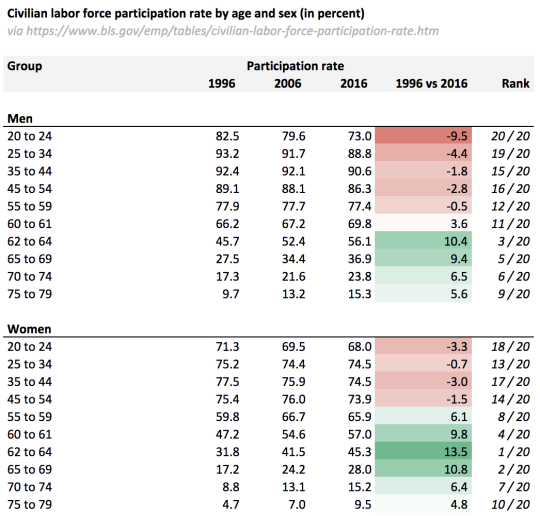
    They begin by talking about declining labor force participation rates, particularly among young men. Remember that the participation rate is distinct from the unemployment rate. Here is a chart from the essay:
    image

    Participation is down for young people, but up for older people. This is perhaps signaling that older demographics still need to work in order to maintain certain needs and/or a particular lifestyle.

    The possible explanations for this declining rate among young people are interesting. The authors argue that it is a combination of the declining cost of media entertainment content and the amplification of social status signaling, among other things.

    The declining cost of online content has meant that this form of leisure activity has become incredibly cheap, if not entirely free (beyond the mostly fixed cost of an internet connection). So there’s always something enjoyable to do.

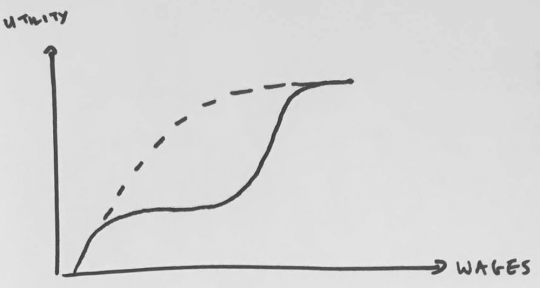
    At the same time, the authors argue that once people make enough money to satisfy basic needs, there becomes a tradeoff between trying to make more money and simply spending more time on leisure.

    Historically, the motivator to make more money has been arguably associated with social status signalling through conspicuous consumption. But with the advent of social media, we are all now signaling globally, instead of just locally.

    Due to increased competition, the argument is that people are now feeling demotivated by all the conspicuous consumption that they see online. It is simply too difficult to compete. The Gini coefficient is too high.

    So why not just spent more time on leisure?

    One potential policy implication is that raising the minimum wage wouldn’t be enough to spur increased labor force participation. Labor isn’t responding in the same way to wage increases. There would need to be a much more significant increase in income for that to happen – hence the “kinky labor supply curve.”

    One view of the status quo is that media companies are aggregating human attention and selling it at a discount–far below minimum wage–to advertisers in a massive arbitrage on human capital. So, the state could set the price of an hour of human attention at the minimum wage rate, and charge media companies 12% (the federal income tax rate on minimum wage) of that wage rate for each hour of human attention they consume.

    One possible solution is an attention tax. But their takeaway is that this lost productivity will more than likely be made up for with technology, which could ultimately translate into something we are already seeing: increased inequality.

    Check out the essay here. It’s an interesting read.

  • Lyft announces subscription plan

    Last week, Lyft announced a new subscription plan. 

    It costs $299 every 30 days and you get 30 rides included (up to $15 each). So it represents a possible 1/3 discount on rides. If you go over the 30 rides per month or over $15 on any one ride, you simply pay the difference. Though as a subscriber, you get 5% off additional rides.

    Subscriptions are good for business. They can be like an annuity. And I suspect that with the above model, there will be unutilized rides every month that the company is just able to bank. You can’t carryover rides with this plan.

    But moreover, Lyft’s “All-Access Plan” is designed to help you ditch your car. Trade your car payment for a ride subscription plan. So if the numbers didn’t quite work for you before, maybe they do now. Depending on the situation, I can certainly see this plan being cost effective.

    But as ride hailing/sharing continues to nibble away at public transportation and personal vehicle ownership, what will this mean for cities?

  • Decline of children in some, but not all, parts of Chicago

    The Institute for Housing Studies at DePaul University recently published this overview of the “socioeconomic factors affecting demand for housing in Chicago.”

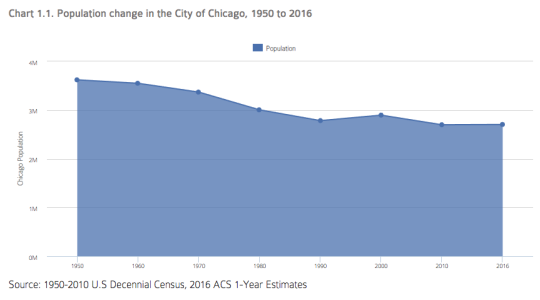
    Here is the change in population in the City of Chicago from 1950 to 2016:

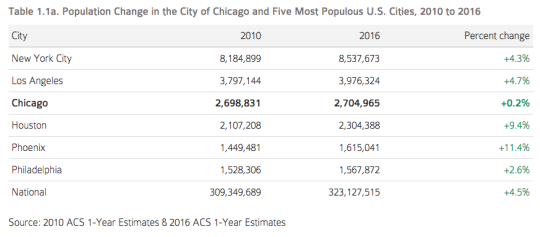
    And here is a comparison between Chicago and the five biggest cities in the US. Note the “sun and sprawl” phenomenon. Also note that the list below is for city proper boundaries.

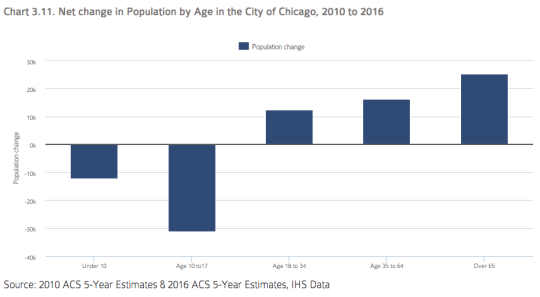
    One particularly interesting set of stats is the decline of children (population under the age of 18) in the city:

    Since 2010, the city has lost over 40,000 children and teenagers. 

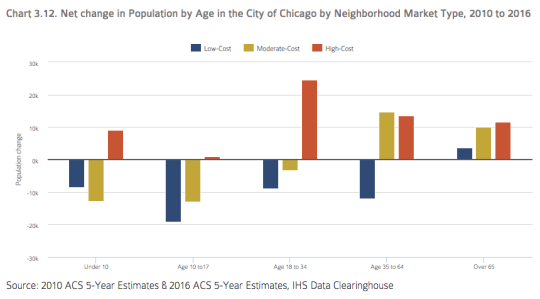
    But, if you break it down by neighborhood market type, it is the low-cost and moderate-cost neighborhoods that lost the population. The high-cost neighborhoods were up.

    The study posits that the old trend of moving to the suburbs after you have kids may not be for everyone – provided, of course, that you have the means. And it goes beyond Chicago. DC is predicting a 25% increase in K-12 students within the District.

    For the rest of the charts, click here.

  • Toronto vs. Boston

    I worked late this evening, which is pretty typical these days. After I got home, I flipped on the Raptors vs. Celtics and sat down to write something about cities, as is the case every day.

    But the game was too close and too good to resist. The Raptors turned things around in Q3 and ultimately went on to spank the Celtics with a 10-0 run in the last few minutes of the game. It was sweet, particularly because Toronto and Boston are likely to end up at the top of the eastern conference this season.

    So needless to say, I spent more time watching basketball and less time writing about cities. But that’s okay because I am pretty excited about this year’s Raptors. Here are a few Kawhi Leonard highlights.

  • BIG’s IQON in Quito

    BIG just announced its first project in South America. It is a 33 storey residential building in Quito, Ecuador. When completed, it will be the tallest building in the city. The developer is Uribe and Schwarzkopf. 

    Here are a couple of other images:

    The building is made up of “concrete boxes” that, when rotated, create terraces for the apartments. On one corner of the building the apartments are “through-units”, meaning they have two exposures. In this case, it is north and south.

    While different, we are starting to see some similarities across BIG’s projects, which isn’t meant as a criticism. I am thinking of Telus Sky, Vancouver House, and even KING Toronto. 

    They are, at least partially, about expressing the individual apartments and creating opportunities for outdoor spaces. This also serves to break down the overall scale of the building.

    What do you think of the project?

    Images: BIG

  • First-year building project

    Each year, first-year graduate students at the Yale School of Architecture are tasked with designing and then physically building a new single-family house in an economically depressed neighborhood. Sometimes, like this year, the house may have multiple dwelling units.

    I have always thought that this is a great exercise both from a pedagogical standpoint and from a positive impact standpoint. Young architecture students get to experience designing and building something from scratch, and lower-income families get a new house. I toured one of the completed houses in New Haven back in, I think, 2005. 

    This building project, which was started in 1967, is fairly unique among architecture schools, though others have replicated the model. When I was living in the US, I spent a few weekends working on homes for Rebuilding Together Philadelphia. But the scope was fairly limited. It was nothing like this.

    I think more schools should do this. And I also wonder if there aren’t permutations of this model that could live outside of the university context.

    Image: Yale

  • Average age of a first-time mother

    image

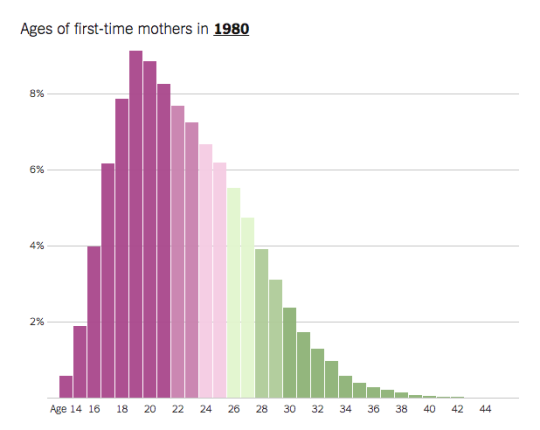
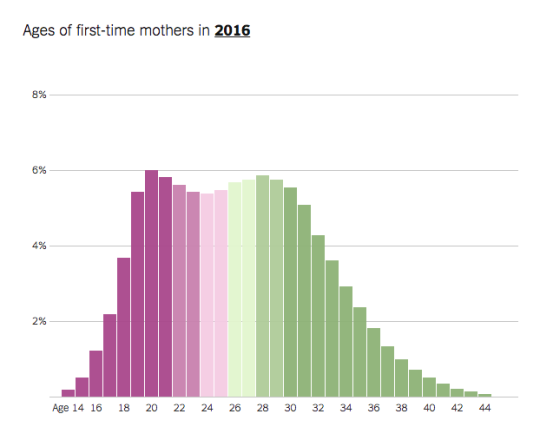
    According to a recent study in the New York Times, the average age of a first-time mother in Manhattan is 31.1 years old. In San Francisco County, the number is nearly 32. And in the US as a whole, it was 26.3 in 2016.

    This is what the national distribution looked like in 1980:

    image

    And this is what it looked like in 2016:

    image

    Perhaps not surprisingly, the biggest factor influencing the age of a first-time mother is education. Becoming educated and building a career takes time. First-time mothers tend to be older in big cities (particularly on the coasts) compared to rural areas.

    The concern that researchers have with all of this is that it is symptomatic of growing inequality. Scrolling over the NY Times’ map, it would appear that there’s nearly a 10 year gap between the coasts and many parts of the country.

    On the one hand you have people who are finishing high school and having kids fairly soon after. And on the other hand, you have people going to college, establishing their career, and waiting, in some cases a decade, to have kids.

    This is significant because it can create a virtuous circle (excerpt from article):

    “A college degree is increasingly essential to earning a middle-class wage, and older parents have more years to earn money to invest in violin lessons, math tutoring and college savings accounts — all of which can set children on very different paths.”

    Unequal childhoods can lead to unequal outcomes.

    Images: New York Times

  • Japan’s solution to housing affordability

    image

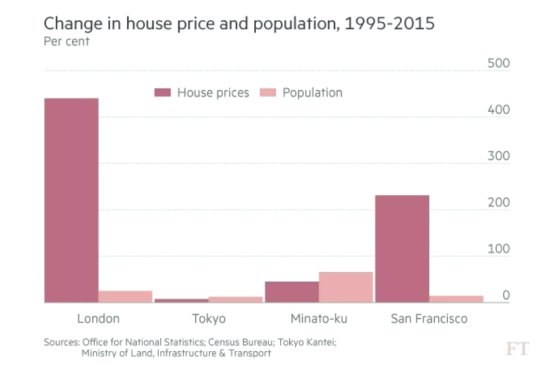
    There’s a debate among urbanists as to the full impact of housing supply on overall affordability. But it should make intuitive sense that as new people move to a city and as new jobs are created, there will be a need for additional housing. Here is an excerpt from Vox citing a recent FT article talking about how Japan may have figured out the solution to rising home prices:

    The reason, argues Financial Times writer Robin Harding, is that Tokyo does a better job of allowing housing supply to keep up with housing demand. In 2014, Tokyo issued permits for 142,417 new housing units. In contrast, the entire state of California — which has three times the population of Tokyo — issued permits for only 83,657 new housing units. Little wonder that demand for housing has outstripped supply in the Bay Area.

    In the United States, local housing markets are plagued by grassroots “Not In My Back Yard” (NIMBY) activists who organize to stop efforts to build town homes and apartment buildings in their local neighborhoods. Because every construction project is located near somebody, the result tends to be that little housing gets built anywhere.

    I don’t have a copy of the FT article and I do firmly believe that supply matters a great deal, but I think there are also a number of other factors that need to be taken into consideration here. Japan has a depopulation problem. The country has lost about 1.4 million people since 2010. 

    They also have fairly insular views around immigration. They are over 3.5x larger than Canada in terms of population and yet they take in fewer immigrants each year. So I think it’s worth looking at this conclusion closely. (This is me trying to avoid confirmation bias.)

    Image: Vox

  • In support of narrative memos

    This is not new. It has been reported on before. But I just finished reading this article about Jeff Bezos’ relentless commitment to “high-quality and high-velocity decision making” at Amazon.

    Here are a couple of high level points:

    – There are decisions that cannot be easily reversed (Type 1) and there are decisions that can be (Type 2). Knowing which is which is important. To help get better at this, they are very diligent about tracking the outcomes of previous decisions.

    – Make decisions without all of the info you wish you had, because if you don’t, you’re probably moving too slow. Speed is paramount. If you’ve categorized your decisions properly (see above), being wrong may not actually be that costly.

    – There’s a company philosophy centered around “disagree and commit.” It is about moving forward – since speed is so important – without full consensus. In other words: We may not all agree, but can we disagree and commit to this?

    Perhaps the most interesting, and seemingly paradoxical, aspect of Amazon’s “high-velocity decision making process” is that it is built upon narrative memos, instead of PowerPoint decks. In fact, decks have been banned at the company since 2004.

    The reason for this is that narrative memos are more difficult to write, which means you really have to understand what you’re talking about. It encourages deeper thought and it allows nuances and interdependencies to come through.

    Apparently important meetings start with everyone just sitting in a room reading the narrative memo, which are often between 4-6 pages. Once everyone has read the memo and is on the same page, the meeting starts.

    As someone who writes a daily narrative, this approach really resonates me. It would be a hell of a lot easier if I could just show up here every day and throw down a few bullet points. But then both of us would get far less out of this practice.

    Writing takes time. Bezos has acknowledged that these memos cannot be written in a day or two. But clearly there’s a belief that more time spent up front translates into greater overall speed. Their market cap suggests that is working.