Daily insights for city builders, delivered every morning at 6 AM ET. I’m Brandon Donnelly — a Toronto-based real estate developer and founder of Globizen. I’ve been writing here since 2013.
I came across this video the other night. (If you can’t see it embedded above, click here.) It is a tour of the UK and Ireland’s different accents by Andrew Jack. It is an extraordinary demonstration of his skill.
Above is a chart from Moovit showing usage from January 15, 2020 to April 12, 2020, for a collection of US cities including San Francisco, Chicago, New York, Philadelphia, Seattle, and others. Early March is when usage started to really fall off, with most of the cities now sitting somewhere around 70-75% below January levels.
For the most part, the cities included in this chart have followed a similar trajectory. But there are a couple of outliers. Philadelphia doesn’t seem to have fallen quite as much as other major US cities (-55.7% as of April 12, 2020). I’m not sure why. San Francisco looks to have “corrected” a lot faster. Perhaps because of an easier/quicker shift to working from home? And then there’s Seattle.
The first confirmed US case of COVID-19 occurred in the Seattle area on January 21, 2020. Looking at the above chart (and implying causation), that single case appears to have had an immediate impact on transit usage. Over the subsequent three days, ridership dropped to -4%, -8.3% and then to -9.1%. Usage then remained consistently lower relative to all of the other cities in this index.
Was that it? Did Seattleite’s behaviors really change that quickly? (And yes, I did have to look up the demonym for the fine people of Seattle.)
I am a huge fan of Malcolm Gladwell (and not just because he is Canadian and also went to the University of Toronto). Last week he kicked off a new Munk Dialogues series focused on the world after COVID19. (The next Munk Dialogue will be with Fareed Zakaria on Wednesday, April 15 from 8 PM to 9PM Toronto time.)
In case you’re not familiar with the Munk Debates, they are normally a biannual event held here in Toronto. Their mission is to help people rediscover the “art of public debate” and they do that by convening some of the world’s brightest and most creative thinkers. Right now they are doing that online.
In this Q&A with Gladwell, they touch on a lot of the topics that we are all debating right now on Zoom calls with our colleagues and friends. When will we get back to “normal?” What will change forever? Is working from home the new normal? Will people still want to go for Mandarin buffet? I won’t spoil it for all of you, but I did want to mention three points that I found myself agreeing with (I guess that is partially spoiling it).
The first is his analogy to weak link sports such as soccer. Here you’re only as good as your weakest player. This is in contrast to strong link sports such as basketball. In this case, you’re only as good as your best player. If you want to win a championship, you get someone like Kawhi Leonard. Gladwell argues that this pandemic has further exposed us as a complex weak link society. We don’t even have the basic PPE and testing in place to fight this virus.
The second is about whether this will create a more permanent shift to working from home. I have said before on the blog that I think it’s easy to overreach at a time like this. We might think that everything will change, but we also have short memories. Gladwell takes it a step further and argues that the exact opposite will happen. This pandemic will actually set working from home back a generation. We are going to be so sick of isolating that we will race back to what we had before.
Finally, I like the point that right now is an opportunity for experimentation. This is true of all crises. It’s a lot easier to question the status quo when the status quo has already been disrupted. And we are seeing this happen at all scales, from people experimenting and learning new things at home to new companies being formed. Hopefully there will also be lasting benefits to our public health systems.
Anyway, I would encourage to watch the video. If you can’t see it embedded at the top of this post, click here.
One of Alphabet’s moonshot projects is an autonomous delivery drone service called Wing. As far as I can tell, they’re only company offering this kind of service to the general public in North America — though they are only operating in a few test locations in Virginia, Finland, and Australia.
Specifically:
Canberra, Australia
Logan, Australia
Helsinki, Finland
Christiansburg, United States
Not surprisingly, demand for Wing deliveries has surged during this pandemic. According to the Verge, the company made over 1,000 deliveries in the past two weeks, which represents a doubling of deliveries in the US and Australia. The most popular items seem to be essentials like toilet paper and coffee.
This is perhaps a good example of the argument that COVID-19 isn’t going to change things per se, it will simply accelerate the adoption of things that were already in the process of happening. I was and am of the opinion that drones will become an integral part of delivery logistics. (Full disclosure: I own a bit of Alphabet and Drone Delivery Canada stock.)
There is still a lot that will need to happen. Alphabet/Wing is also working on an autonomous traffic management platform, because you obviously need something robust if you’re going to scale this up. How you make this work in dense urban environments is also a whole other kettle of fish, though already people are starting to reconsider how rooftops are used.
Venture capitalist Albert Wenger wrote on his blog today that the road back from COVID-19 could start — as early as May — provided we’re able to get our act together around three essential things: masks, tests, and tracing for everyone. We have all been talking about the importance of these things over the last few weeks, but I think it’s worth mentioning just how quickly some of this is starting to happen.
Both Apple and Google have announced that they are building a voluntary contact-tracing network. By May, they hope to release a set of APIs that other software developers will be able to build on top of. Bluetooth will be what is used to detect when humans are in close proximity to each other. Eventually, both companies plan to integrate contact tracing right into their operating systems.
Here’s how it might work:
Of course, we are also seeing new startups emerge, like this one here called Coronatrace.
Similar to what Apple and Google have in mind, the app will be a voluntary contact-tracing network. By using it, your phone will begin to log how you move about, something that is already happening today with many of the apps we already use. Should someone test positive for COVID-19 (they would need to update their health status within the app), it would then immediately notify the network and anyone who might have crossed paths with them.
Obviously it would be far better to simply have a vaccine. But the experts are saying that will take some time — 12 to 18 months? And in the interim, we’re going to need to get the global economy back up and running. Seeing solutions like these being developed makes me hopeful we’ll be able to do that sooner rather than later.
This week it was announced that Foursquare and Factual are planning to merge. Both use location data to improve advertising and overall business intelligence. But unlike Foursquare, Factual doesn’t have a consumer-facing app. So most of us probably haven’t heard of them before. But they are some of the data and tech behind many of the companies that we do all know, including Starbucks.
I have long been fascinated by location-based startups — like Foursquare — because they are inherently spatial. And how we move about our cities and spaces is rich with information. Companies want this data because, among other things, it is a register of intent. Me going somewhere signals certain things, including where else my kind might want to go.
But location data can also be used for many other things beyond advertising and retail analytics. Foursquare has started sharing aggregated and anonymized foot traffic data with local governments and public health officials in the fight against COVID-19. That data is currently powering http://www.visitdata.org. Foursquare is also publishing a regular insights report.
Here is a chart from them showing casino visits in Clark County since March 1:
In many ways this chart is fairly obvious. In fact, it actually mirrors my own journey into isolation. After the NBA shutdown on Wednesday, March 11, things started to feel pretty real and on Friday I was working from home. But there’s a lot more that can be done with location data and there’s a lot more that will be done going forward. I am confident that will help not only business, but also society more broadly.
There is a growing global concern around China’s “wet markets.” Last week, Dr. Fauci was on the record saying that they need to be shut down immediately and that it boggles his mind that we continue to allow something which very clearly results in zoonotic viral infections. This is as China begins to slowly reopen its economy — including its wet markets.
The more precise problem is China’s meat supply chain. Last month, Bain & Company published a brief arguing that this current pandemic — it was still just an outbreak at the time of publication — highlights the need for China to shift away from open-air markets toward the cold-chain model that is common in North America and Europe.
Here is one of their charts comparing China and Europe:
There are both upstream and downstream problems. The downstream problem is its “wet markets.” Chinese consumers apparently prefer “hot and fresh,” as opposed to chilled and frozen meat. But there are going to need to be changes, including stricter safety regulations and widespread food-tracing so that epidemics can be quickly identified and quashed. Now is the time for these changes.
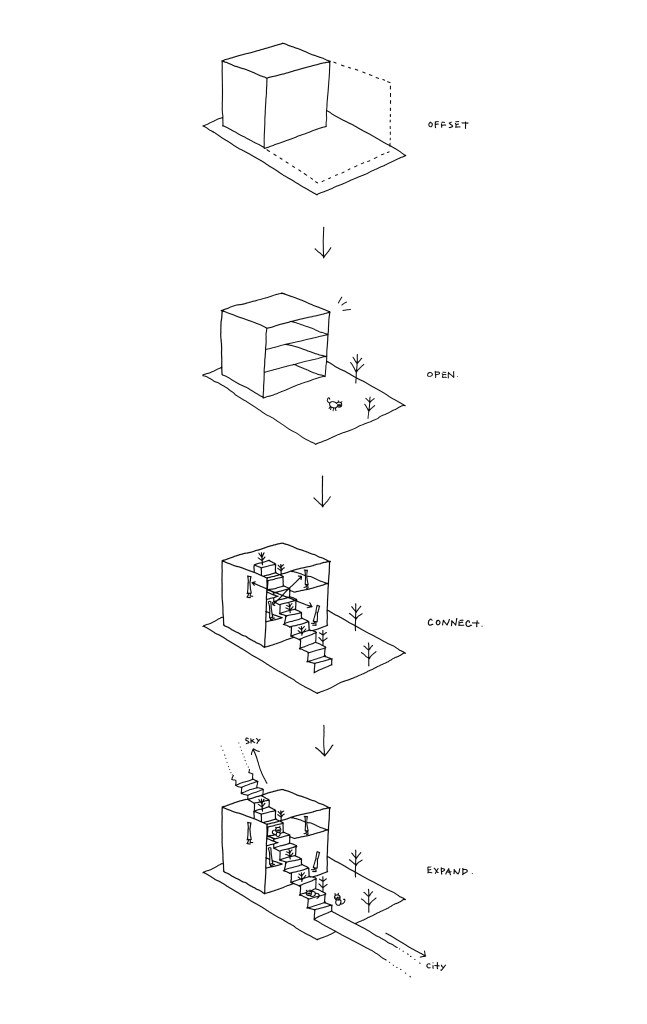
The house is setback from its south property line as a result of the surrounding context. A south-facing green space is then introduced, preserving one of the existing trees.
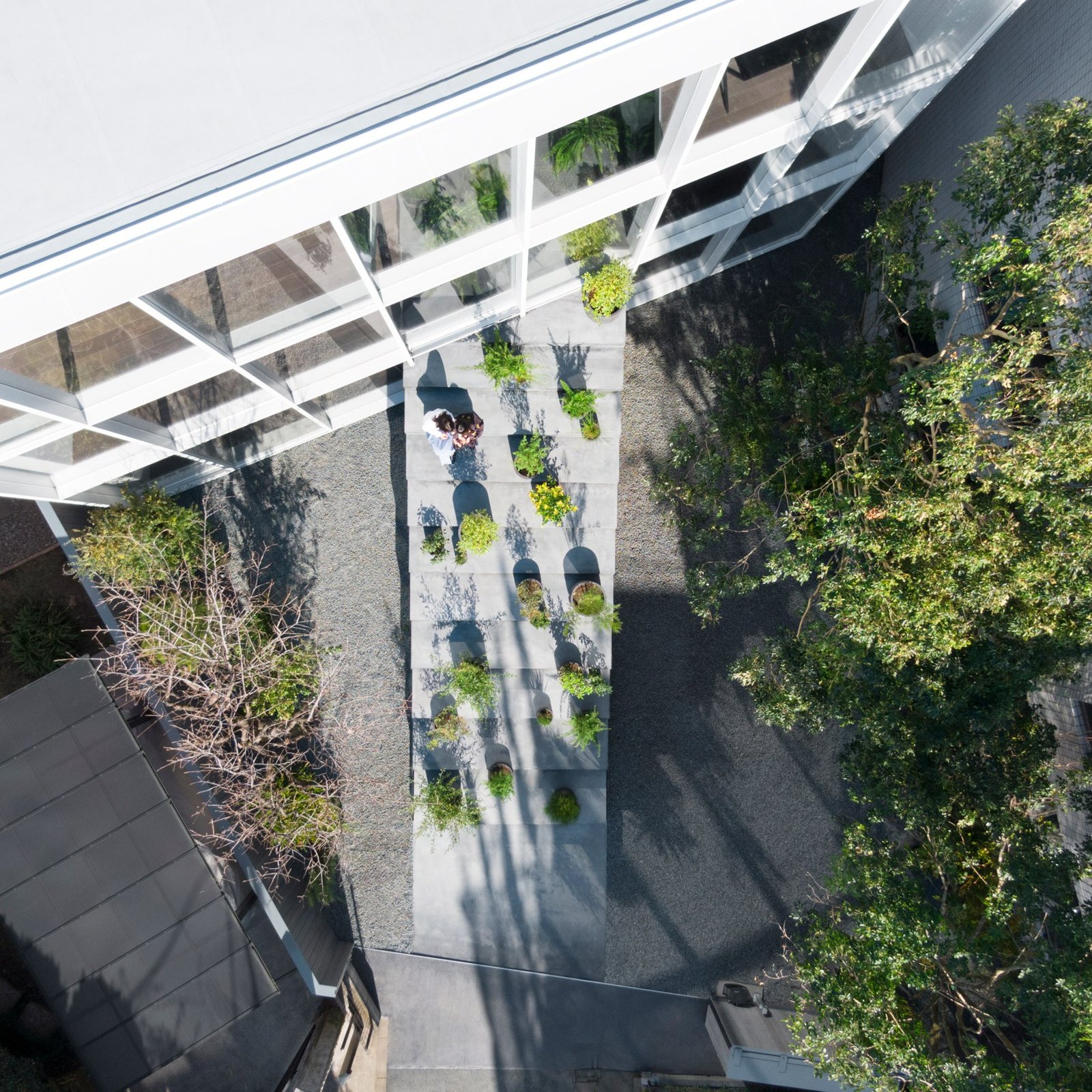
Given that the house serves as a multi-generational household, a central “staircase” is introduced that visually connects all three floors of the house and serves to mitigate any sort of feelings of social isolation across the families.
(The staircase-like structure is only partially functional.)
Finally, the staircase is then expanded outward to connect with the broader city. As you can see from the context plan below, the staircase is on axis with a neighboring city street.
Seth Godin wrote on his blog today about what it means to be a lifelong fan — whether it be of a sports team, a car company, a political party, or, in his words, “anything where affiliation drives our sense of self and community.”
There’s a powerful sentence in the middle of his post and it’s this one here:
“People like us do things like this.“
We often make decisions about products, brands, and even where to live based on a narrative that we craft for ourselves. We tell ourselves that I am the kind of person who lives in this neighborhood and drives this car. People like us do things like this.
There’s an innate, emotional, and sometimes nonsensical desire to be part of what Seth calls our chosen “tribe.” And tribe does really feel like the right word. We all want to be a part of something. It helps to create meaning.
One of the debates that is happening in cities all around the world right now is about whether or not it makes sense to redistribute public space in order to help with current social distancing measures. We are all being told to stay at home as much as possible, but as we venture out for food and/or sanity walks, many have started noticing that a lot of our sidewalks are in fact too small if you’re trying to stay 2m away from other humans. So with vehicular traffic way down, the question becomes: Should we start borrowing some of that space for pedestrians?
Here in Toronto the official position is no. Closing down streets and lanes to car traffic is usually referred to as creating an “open street.” And the intent of these open streets is typically to bring people together for public life, which, of course, is the exact opposite of what we’re trying to do right now. What this implies, however, is that there’s a belief that additional space for pedestrians would induce demand, similar to what is believed to happen when you add additional lanes on a highway.
Lewis Mumford probably had it best when he allegedly said, “Adding highway lanes to deal with traffic congestion is like loosening your belt to cure obesity.” So on the one hand, if you believe that more lanes doesn’t solve traffic congestion, you might also be inclined to believe that more and bigger sidewalks isn’t going to dampen the anxiety we currently feel when other humans get anywhere near us. The additional space would simply get filled with more bodies.
But maybe you could argue that this is a little bit of a different situation. We’re in a global pandemic for God’s sake and most of us have the better sense to stay home unless it’s absolutely necessary. Perhaps in this case, demand would not increase and the greater supply would simply better serve the demand that is already there. Perhaps. I don’t have a strong stance on this, but I’m fairly certain that technology could help with this decision.