Daily insights for city builders, delivered every morning at 6 AM ET. I’m Brandon Donnelly — a Toronto-based real estate developer and founder of Globizen. I’ve been writing here since 2013.

  • A question of land value

    Let’s say that we have a piece of development land worth $100. That is the market value of the land based on its highest and best use at this particular point in time. Now let’s assume that the land was just encumbered with a new burden: inclusionary zoning. All of a sudden there is now a requirement to make available X% of any residential units built at 50% of average market rents for the area.

    Technically, the land is now worth less than $100. And there is a school of thought out there that, in instances like this one, the price of all land should automatically reset downward to offset and account for the inclusionary zoning burden. But as I have argued before on the blog, land prices tend to be fairly sticky, unless the owner is distressed and really needs to sell.

    So what can often happen is that the land owner will stubbornly cling to the original $100 number. The thinking being, “I was once told that my land is worth $100 and so that’s the minimum price I’m willing to accept.” In this scenario, you may need a broad increase in rents in order for a transaction to occur. This way the market rate units might be able to fully subsidize these new affordable units, preserving any margins and justifying the original $100 number.

    Of course, the impact of inclusionary zoning is a hotly debated topic and there are a number of variables to consider. And so I will leave it at that for today. The real purpose of this post is to consider another permutation. Let’s once again say that we have a piece of development land worth $100. But instead of being owned by 13 siblings — and 3 cousins that live abroad and can’t be reached other than by fax — it’s owned by the government.

    In this case, the government wants to sell the land and is considering two options. It can either (1) sell it for $100 and maximize immediate taxpayer revenue or (2) it can sell it for $80 with the condition that the buyer agree to deliver X% of affordable units (and a bunch of other goodies and positive externalities). I would also add that this fictitious town is experiencing what some might call a housing crisis.

    If you were a private sector actor, you would probably choose option 1. You would take the additional $20 and retire to Florida (I’m off by a few zeros). But this is the government we’re talking about and presumably the government is thinking about the broader public good. Which option do you think is better at maximizing that?

  • Sidewalk Labs, Uber, Lime, and the demise of urban density

    Today I am going to talk about 3 things that recently happened and/or that are on my mind.

    Sidewalk Labs pulled out of Toronto. I think this is sad. A lot of people have said that they’re surprised, but not surprised. The official reason is that this unprecedented environment has made it financially infeasible for them to develop the 12-acre site, while still adhering to their core principles. I don’t have any inside knowledge of the situation, but I can’t help but think that this is probably just an opportune excuse. They were getting beat up pretty badly by Toronto on all fronts, even though they had put forward an incredibly ambitious development proposal. As I said before, I can’t imagine many (or any) “conventional” developers coming forward with something like this. The last plan I saw was 1/3 non-residential, and 40% of the residential component was to be priced below market. And never mind all of the other innovations that were being contemplated.

    In other tech news, Uber just led a $170 million investment in Lime (the micromobility scooter company). I think this is smart — both from an overall mobility standpoint and, selfishly, as a shareowner of $UBER. It is being reported that this round of investment values Lime at about $510 million. This is a 79% decline from April 2019 when it raised its last round. So presumably, Uber is getting a pretty good deal here. The bet is that the urban landscape demands multi-modal transportation solutions, everything from bikes and scooters to cars and public transit. There is also an argument to be made that in the short-term, our post-pandemic world is going to gravitate toward individual mobility and away from things like public transit. I’ve heard a few people say that, as we re-open the global economy and try to maintain social distancing, we’re going to face two major mobility bottlenecks: transit and elevators. Sounds like more testing would be a prudent idea.

    Above, I was very careful to say “in the short-term” because I think the narrative that is emerging around the demise of urban density is entirely overblown. Few of us are clamoring to jump back into a mosh pit right now (perhaps a metaphorical mosh pit), but I also don’t believe that we will suddenly look to sprawling Brasilia as a source of urban inspiration. While it is true that “disease did shape architecture in the 20th century” (Alex Bozikovic wrote a good piece on this over the weekend) and that there have been oscillations in terms of how we view urbanity, I also know that this isn’t the first pandemic that our cities have lived through. The Hong Kong flu of 1968 is thought to have killed one million people around the world after, allegedly, emerging in one of the densest cities ever created. Hong Kong’s relationship with Beijing is a tenuous one right now, but it still remains one of the world’s most important global cities.

    Perhaps cities are more resilient than we give them credit for.

    Photo by Touann Gatouillat Vergos on Unsplash

  • The redevelopment of Toronto’s residential market

    Somehow — even after I sarcastically put out the above tweet — I ended up on a BISNOW panel next week about the impact of COVID-19 on Toronto’s residential real estate market.

    When I was asked if I would do it, I replied with: “Does this mean I will need to put on pants?” That was interpreted as a, “yes, I will join the panel.” And so here we are.

    It’s on Wednesday, May 13 at 2:30pm. Steve Keyzer of Gin & Sonic fame (Colliers International) and Kevin Stark (Trinity Development Group) are also speaking on the panel. To register, click here. I’ll do my best to be as controversial as possible.

  • Toronto Regional Real Estate Board releases housing market statistics for April 2020

    The Wall Street Journal reported today that the median home price across the United States rose 8% year-over-year in March to $280,600. One explanation for this is that while, yes, demand did drop off, so too did supply and that has led to a shortage of available housing. The other possible explanation is that these March deals were papered earlier in the year (or late last year) when most of us were blissfully unaware of what was about to happen and so the real impact of this pandemic isn’t yet showing up in these numbers.

    Let’s drill down.

    The Toronto Regional Real Estate Board also released numbers today, but for the month of April. Not surprisingly, residential resales across the region are down by 67% compared to April 2019. The number of listings is also down by a similar amount (-64.1%). Overall though, pricing remained relatively flat (0.1% increase). And by overall I mean for all housing types and for all areas of the region. There are larger variances within specific areas and for certain types. See below.

    Drilling down even further, my friend and agent Christopher Bibby noted in his monthly newsletter over the weekend that transaction volumes in the central (resale) condominium market are down some 85-90%. So the market is effectively at a standstill. Those who do not need to sell or move are justifiably deciding not to right now. But just as Warren Buffet got on stage over the weekend — with some great flowy hair, I might add — and told us in Times New Roman never to bet against America, I am not about to bet against Toronto. This too shall pass.

  • A YouTube channel about simple living and small homes

    I just subscribed to Kirsten Dirksen’s YouTube channel. She makes videos about simple living, self-sufficiency, and small homes, among other things. She has nearly 1.3 million subscribers and her videos have almost 500 million views. I think many of you will really enjoy her channel.

    The above video is about an apartment in Lapa, Lisbon that was renovated by architect João Gameiro. Originally constructed in 1819, the top floor space had been pretty badly neglected. João renovated it by striking, what seems to me like, the right balance between old and new.

    Some of the other homes featured on her channel include a laneway house in Toronto, a tiny floating home in Berlin, and an off the grid cabin in Joshua Tree.

  • The case for being a generalist

    As many of you know, I am huge of Malcolm Gladwell. And one of the things that he has popularized through his writing is this idea that we all need to spend at least 10,000 hours specializing on someting in order to become truly exceptional at it. The Beatles did this because of all the time they spent playing music. Bill Gates did this because he was fortunate enough to have access to a computer at an early age. And Tiger Woods did this because his father gave him clubs as a toddler and got him to start practicing the game of golf. But is this truly the rule or the exception?

    In this recent TEDx Talk by David Epstein (embedded above), he argues that we’re actually ignoring one of the less intuitive but more common journeys. For every Tiger Woods, there are many Roger Federers. For every success story that hyperspecialized at an early age, there are countless examples of dilettantes who dabbled — and perhaps struggled — across different fields, only to find their true passion later in life. And so while it may seem like they’re not making progress, or even falling behind in the short term, this may not be the case in the long term.

    All of this reminded me of a post I wrote early last year about finding meaning in life and business. In it, I cited an article from New York Times Magazine recounting the outcomes of Harvard Business School graduates — some of which went on to be happy and wildly successful, and some of which ended up miserable after school. The takeaway here was that non-linear paths, experimentation, and a bit of struggle along the way, is nothing to be ashamed about. In fact, it may be exactly what is needed in order to prepare for today’s increasingly complex and wicked world.

  • New Yorkers are actually pretty healthy

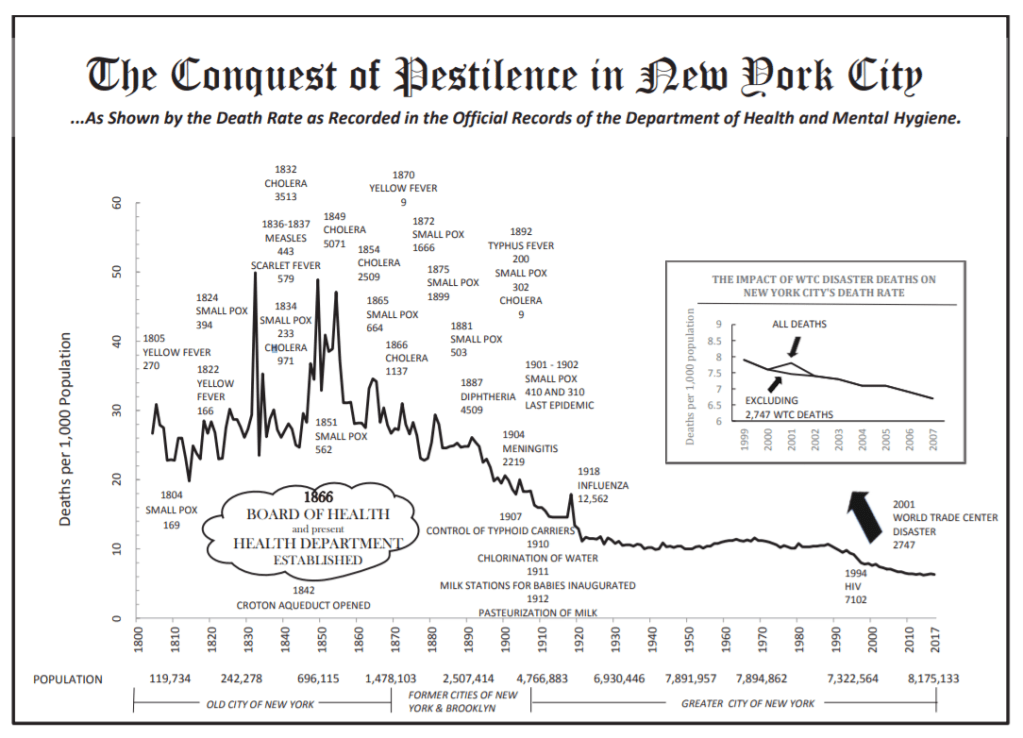
    Nicole Gelinas’ recent piece in CityLab is a good reminder that — despite all of the debates around COVID-19 and urban density — New York City is actually a really healthy place to live. Part of this obviously has to do with the city’s investments in public health. But the biggest factor, Nicole argues, is the city’s transit network. Six million people move around New York City each day without a car. That translates into a meaningfully lower traffic fatality rate. New York State’s rate is about 4.8 per 100,000, whereas Florida’s is 14.7 deaths per 100,000. Taking transit (and having an urban morphology that supports taking transit) also brings along with it other benefits, such as increased walking. And I have to believe that is an important factor. The obesity rate in New York City is thought to be about 22%, compared to a shocking 42% for the country. All of this rolls up into a life expectancy of about 81.2 years for New Yorkers, as of 2017. This is compared to 78.6 years for the US as a whole.

    For more on the health of New Yorkers, check out this 2017 Summary of Vital Statistics. (It’s the source of the above chart.)

  • Examining the solar potential of cities

    The MIT Senseable City Lab recently asked: How does urban morphology affect the solar potential of cities? If you assume that transparent photovoltaic cells are on the way and that building facades are soon going to become a place where we generate solar energy, then this is actually a pretty interesting question. Are some built environments naturally better suited than others?

    To answer this question, they looked at the “urban surfaces” of ten cities, including New York, Singapore, Toronto (pictured above), Hong Kong, Paris, as well as others. These surfaces included roofs, facades, and ground planes.

    What they, not surprisingly, discovered is that you need a lot of exposed facades to get the numbers up. And so the cities that come out on top in terms of annual solar irradiation are cities like New York and Singapore. They have a lot of tall buildings, but they also fluctuate in height, giving greater exposure to the facades.

    All of this is potentially relevant because — if building facades become a big deal for solar — it could start to inform how we plan our cities. In fact, I would go so far as to bet that, over the long-term, solar energy will have a greater impact on urban morphologies than this current pandemic.

    Image: MIT Senseable City Lab

  • Exposure tracing APIs to be released May 1

    The “contact tracing” API that Apple and Google are working on and that I wrote about earlier this month is set to be released on May 1. Given all the concerns around privacy, it’s now being referred to as “exposure tracing.” The idea, here, is to emphasize that it is being designed to trace the coronavirus and not individuals.

    To be clear, we’re talking about APIs, and so third party apps will need to be built on top of this tech before we can start downloading anything to our phones. But I am sure that will happen very soon and I will gladly opt in.

    It’s also worth mentioning that this entire concept of smartphone exposure tracing only works when Apple and Google cooperate. Whatever apps ultimately get built need to work across both platforms, otherwise there would be far too many gaps in the network. So this — along with the focus on privacy — has become a bit of good PR for “big tech.”

    The smart people working on exposure tracing over at Oxford University seem to think that (alongside other interventions) we could stop this virus with only about 60% of the population using an exposure tracing app. (They ran models with a pretend city of 1 million people.) But even at 50% penetration, they believe it could make a meaningful contribution.

    These are numbers I think we could easily get to in major cities. Overall, I suspect it could also make people feel a lot more comfortable about going out. And going out is what’s going to be required as we gradually reopen the global economy. How many of you think you will opt in to something like this once it becomes available?

  • Brutalist wine warehouse for sale near Bordeaux

    I am sure that many of you have been eagerly waiting for an old Brutalist wine warehouse to come on the market near Bordeaux, and so here is a listing from Espaces Atypiques. The site is over 1 hectare. The ground floor is about 2,000 square meters. And the central atrium space is some 25m tall. It’s listed for €550,000 and I reckon it needs a bit of work.

    I don’t know where exactly it’s located in Saint-Émilion, France (nor have I ever been) and I can’t vouch for the condition of the existing building in any way shape or form, but I do think it would be a lot of fun to turn a Brutalist structure like this into a hotel, restaurant, and creative event space. Public gathering space(s) in the atrium; private rooms along the perimeter.

    Image: Espaces Atypiques