Daily insights for city builders, delivered every morning at 6 AM ET. I’m Brandon Donnelly — a Toronto-based real estate developer and founder of Globizen. I’ve been writing here since 2013.

  • The return of hard assets

    April 24, 2026 · View original


    Back in 2011, Marc Andreessen wrote a widely cited blog post where he argued that “software is eating the world.” In some ways, it feels like just yesterday that I first read it. But it has been 15 years, and boy, has the world changed. Now, the worry is that AI is eating software.

    It has become significantly easier to write code, to the point that in the span of only two years, Google has gone from 0% of its new code being written by AI to now over 75% of it! But it’s not just big companies. I know lots of non-technical people who wanted software that could do “X,” and so they just vibe coded a solution. Done.

    In fact, I’ve been experimenting and doing the same for several months now. It has become so easy that I feel an obligation to do it. But as we know, if everyone can do it, then it means there is no longer any value. The value will necessarily need to be created in other ways.

    Earlier this week, we spoke about Uber and how being asset light — previously a hallmark of the gig economy — is potentially now a liability. Well, this is a broader theme. Josh Brown, CEO of Ritholtz Wealth Management, even coined a term for this: HALO. This stands for Heavy Assets, Low Obsolescence.

    The general idea is that you now want physical stuff with a big moat that is immune to being disrupted by someone in their parents’ basement using Claude Code. Hard assets are, arguably, where you want to be today. I guess that means real estate is back, baby!


    Cover photo by Tim Mossholder on Unsplash

  • Designing for the jobs to be done

    April 23, 2026 · View original


    I was on a panel this week, put on by BILD, called “Design That Sells.” The focus of the panel was on how innovative product design can help sell homes in the current market environment. When I was first asked to be on the panel, I thought to myself, “I’m not sure I’m qualified to talk about this right now. Market conditions, rather than design, are the challenge!”

    Of course, focusing on your customers’ needs, solving their problems, and innovating with great design is always going to be the way. I think we’ve consistently tried to do this with our projects, and so that’s what I talked about.

    But what the discussion also got me thinking about — though I didn’t mention this during the panel — is the late Clayton Christensen’s theory called “Jobs to Be Done.” I’ve written about this before on the blog, specifically about his milkshake case study.

    The key idea behind the theory is that customers “hire” products and services in order to complete specific “jobs” for them. The problem is, businesses sometimes don’t actually know the job that people are hiring for! In the case of the milkshake case study, this ended up being the job:

    > “Most of them, it turned out, bought [the milkshake] to do a similar job,” he writes. “They faced a long, boring commute and needed something to keep that extra hand busy and to make the commute more interesting. They weren’t yet hungry, but knew that they’d be hungry by 10 a.m.; they wanted to consume something now that would stave off hunger until noon. And they faced constraints: They were in a hurry, they were wearing work clothes, and they had (at most) one free hand.”

    This is why people were buying milkshakes in the morning, and why their efforts to sell more later in the day were not working. Now, let’s talk about a case study that is closer to home. If you visit the Christensen Institute’s site, you’ll find a case study of his theory from the condominium industry.

    The objective was for a Detroit-area developer to sell more homes targeted toward retirees and divorcees. They priced accordingly, had all the luxury finishes, and spent on elaborate marketing, and yet their inventory wasn’t moving. Was it a design problem? A pricing issue?

    Nope:

    > So, Moesta took a Jobs to Be Done approach: He set out to learn from the people who had bought units what job they were hiring the condominiums to do, and the conversations revealed an unusual clue: the dining room table. Prospective customers repeatedly told the company they didn’t need a formal dining room. And yet, in Moesta’s conversations with actual buyers, the dining room table came up repeatedly. “People kept saying, ‘As soon as I figured out what to do with my dining room table, then I was free to move,’” says Moesta. The table represented family.  > > What was stopping buyers from making the decision to move, he hypothesized, was not a feature that the construction company had failed to offer, but rather, the anxiety that came with giving up something that had profound meaning. “I went in thinking they were in the business of new-home construction,” Moesta recalls. “But I realized they were in the business of moving lives.”

    To solve this problem, the company offered moving services, two years of free storage, and a “sorting room” in the condominium where new owners could dump their stuff and then take their time deciding what to keep and what to discard. And it worked. Brilliant.

    Once you understand the actual barriers and “jobs to be done,” you can solve for them. Sometimes it might be a design problem, but it could be something totally unexpected. Regardless, the solution lies in caring about and understanding your customers. This is true in all market conditions.

  • When asset light becomes an asset liability

    April 22, 2026 · View original


    One of the great features of the so-called gig economy is that many of its businesses operate with an asset-light model. Uber, for instance, relies on drivers showing up with their own cars. This is the opposite of, say, the real estate industry, which, for a lot of business models, is both capital-intensive and asset-heavy.

    But there is one problem with the asset-light model, and it’s that it may not work forever. The Financial Times just reported that Uber has committed to spending $10 billion over the next few years on actual cars and on equity investments in various strategic companies.

    For instance, earlier this month, electric vehicle company Lucid announced that Uber will be investing $500 million in the company and buying at least 35,000 of its cars.

    This is gig-economy blasphemy, but it’s very obviously an existential concern for the company. Uber needs to be in the AV race, or else asset-light could be an asset-liability. The thing that helped Uber become successful in the past now seems to be what they need to overcome in this new mobility race.

    On a loosely related note, I find it somewhat amusing that cities are now starting to push back against robotaxis out of fear that they will displace Uber drivers. If you were following Uber in its early days, you’ll know that cities fought the company vehemently because of the taxi lobby. Now they’re trying to protect it.


    Cover photo by Erik Mclean on Unsplash

  • The market logic of Japanese rail

    April 21, 2026 · View original


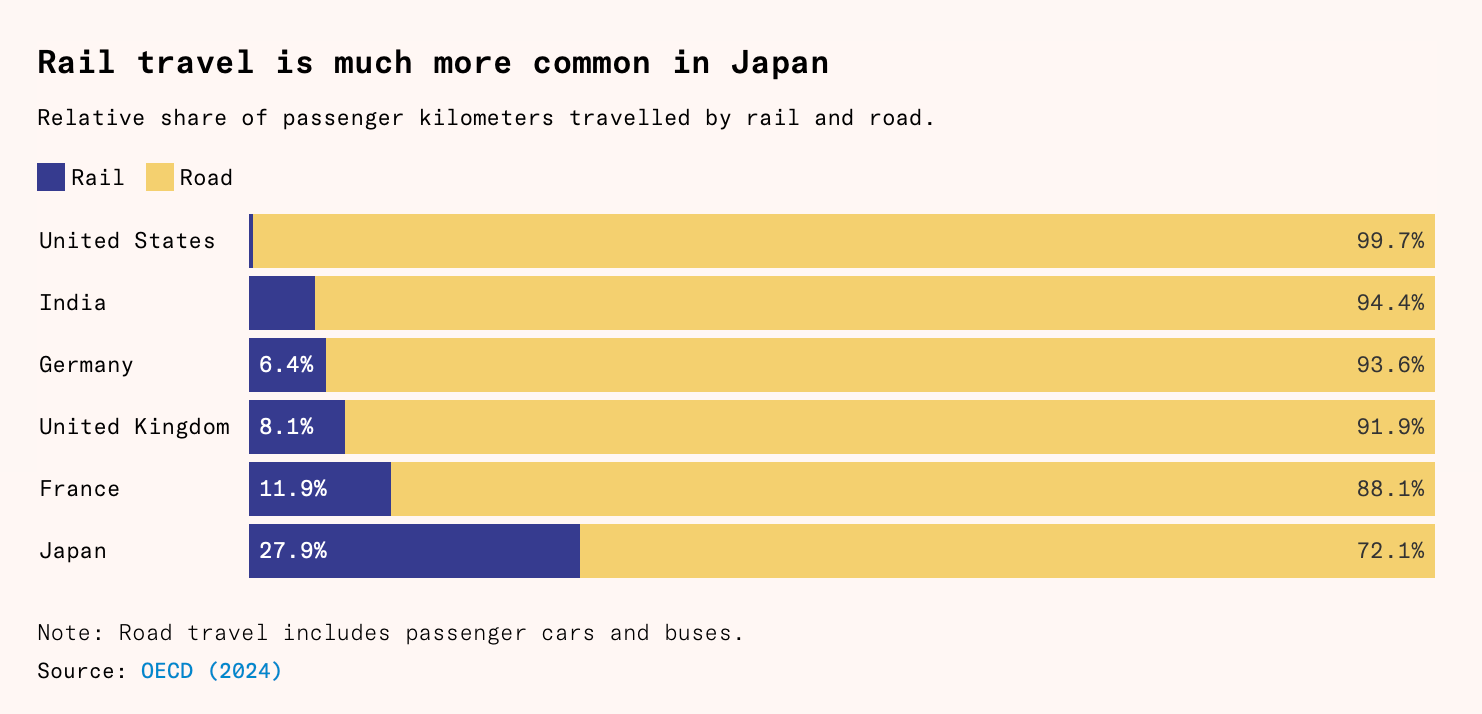
    We have spoken many times before about the fact that Japan is built around rail-oriented urbanism. But if you have the time right now, I’m going to suggest that you read this longish article by Matthew Bornholt & Benedict Springbett called “Why Japan has such good railways,” because nowhere else in the developed world uses rail for passenger kilometres more than Japan, and they explain why.

    One common hypothesis, which is mentioned in the article, is that it’s largely cultural. The Japanese are rule-abiding collectivists who are more willing to take public transit compared to us selfish and individualistic North Americans. But this doesn’t seem right. In fact, one could argue that the Japanese solution is actually more free-market oriented.

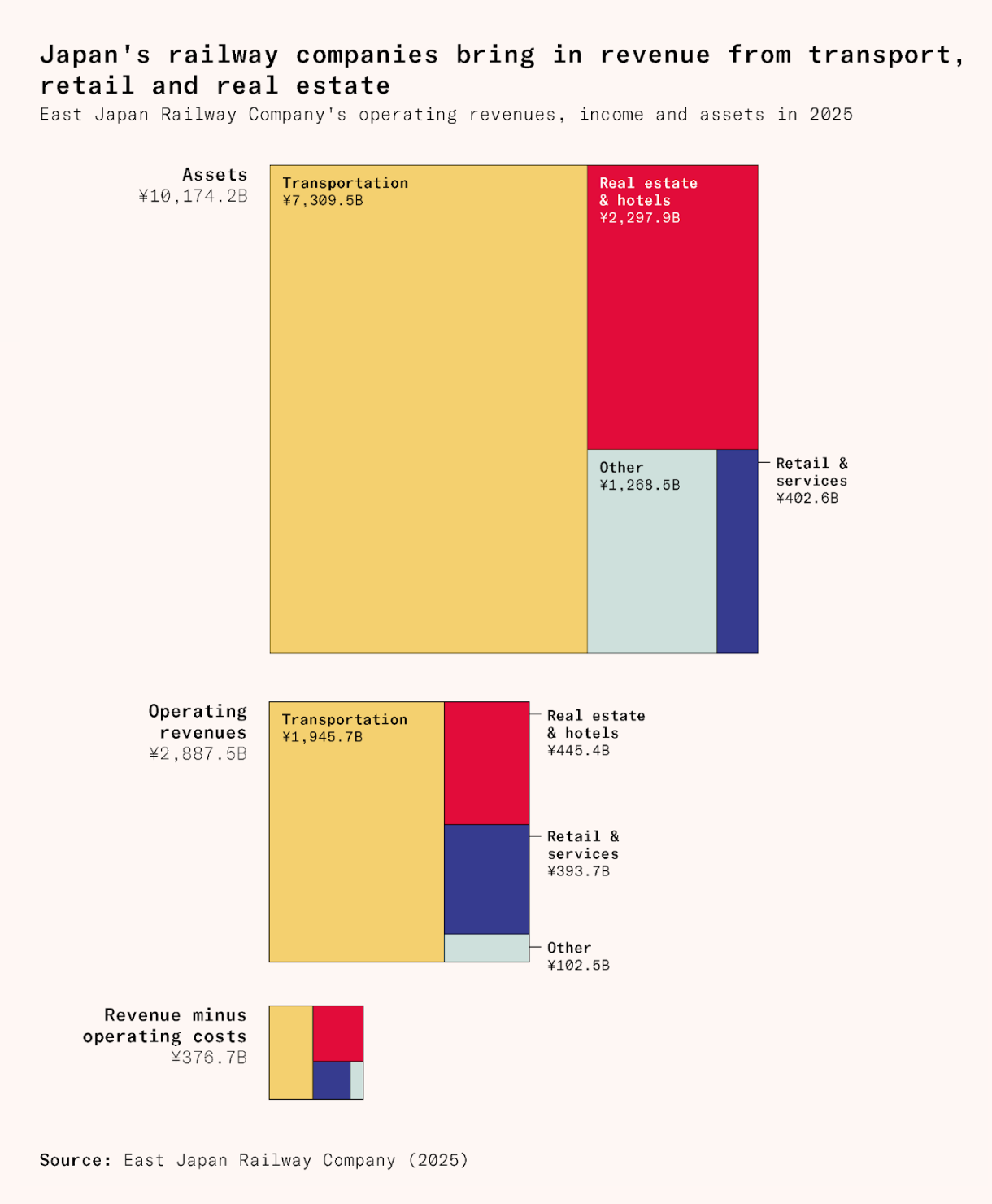
    The Japanese rail model seems to work so well because (1) most of the network is private, (2) liberal land-use policies have allowed Japan’s urban centres to develop enough density to properly support the use of rail, and (3) the rail operators make money in a bunch of other ways beyond rail. They’re typically also in the business of real estate.

    Here’s a quote from the article by the president of the Tokyu Group that I absolutely love:

    > I think that though we are a railway company, we consider ourselves a city-shaping company. In Europe for instance, railway companies simply connect cities through their terminals. That is a pretty normal way of operating in this industry, whereas what we do is completely different: we create cities and then, as a utility facility, we add the stations and the railways to connect them one with another.

    This is a fundamentally different model that allows rail companies to capture some of the value that they inherently create. To use the example of Toronto’s Eglinton Crosstown line, it’s the difference between saying, “I’m going to build a rail line and then, presumably, other stuff will happen,” and, “I’m going to develop this midtown corridor and then I’m going to run rail underneath it to maximize value creation.”

    If Japan can do it, so can we. Ironically, a big part of it means easing land-use controls and allowing transit-oriented development to simply be what it wants to be — dense and proximate to rail.


    Cover photo by Mylène Larnaud on Unsplash

    Charts from Work in Progress

  • Information wants to be free

    April 20, 2026 · View original


    I recently came across a real estate product called LandGlide. It’s an app that provides parcel boundaries and detailed property information for over 99% of the US population. It’s also “available” in Canada, but it doesn’t tell you much about properties here. In the US, you can easily access things like:

    – Owner’s name or legal entity – Mortgage balance and terms – Assessed value and tax amounts – Square footage and year built – Granular details (even down to whether the home has a fireplace)

    The reason for this difference is that in the US, property data is generally considered public record, whereas in Canada, we have stricter privacy laws. But it’s not like we make this information strictly private. We just gate it and make it more cumbersome and costly to obtain through services like GeoWarehouse.

    I know that some of you will argue that it’s better to “sort-of-kind-of” restrict this data from being freely displayed online. But hear me out: this philosophical data difference is an important one that hurts innovation.

    In Canada, property data is monopolized and, therefore, cumbersome and expensive to access. It’s an unnecessary barrier to innovation. In the US, the same kind of data has become commoditized. It’s easy and cheap to access, and so the barriers to building new ideas on top of it are significantly lower.

    For example, Paul Crowe, who is the CEO of a Toronto-based real estate company called House Beat, responded to one of my tweets by saying, “For what I can get in the US for $0.15 / API call from one provider, [it] would cost over $18 per call in Canada, across 2-3 integrations.”

    What this suggests to me is that we’re okay allowing some/all of this data to get out there; we’d just like it to be harder and more expensive to access. Why?

    Information, as the saying goes, wants to be free, which is why I’m so bullish on blockchain technologies. Blockchains are public databases that make information widely accessible and allow anyone to innovate on top of them. As the world continues to move on-chain, we are going to see the enormous benefits that this brings.

    Already, we can see what happens when you don’t have or allow it.


    Cover photo by Jakub Żerdzicki on Unsplash

  • Competing against the market

    April 19, 2026 · View original


    I just saw The Real Estate God argue the following (on Twitter): “What people don’t understand about the S&P is that every single person in the country who has money is also invested in it. When your money goes up 15%, so does everyone else’s. You gained zero relative wealth. You need to outperform the S&P if you want to actually get ahead.” The implication of this is that when you then go out and compete for a “fixed pool of high-quality assets” — such as a home — you have no comparative advantage against everyone else.

    Yes, and no.

    I think this tweet is true in a narrower, segmented sense. One of my personal life philosophies is that it’s important to do things that others can’t or aren’t willing to do. It’s important to be disciplined, make sacrifices, and put in the work; otherwise, you revert to the mean. You have to be different! It’s one of the reasons that I’ve maintained a daily blog for nearly 13 years. I enjoy it and there are benefits to doing so, but it’s also painfully difficult and not something most people care to do (perhaps rightly).

    Small improvements and outperformance can also make a huge difference when looking at a long enough time horizon. Consider this simple table showing a starting balance of $100k and annual returns ranging from 10% to 15% per annum.

    If 10% represents the expected return of “the market,” look at how much of a difference even one percentage point (increase to 11%) can make. Over a 30-year period, it’s more than half a million dollars. And between 14% and 15%, the delta is over $1.5 million! The simple and commonly discussed lesson here is that small incremental improvements compound and can make all the difference when applied with consistency and discipline.

    But to find alpha in this way (outperformance), you arrive at a subset of “being different.” To outperform the market, you generally need to be right about something that most people think is incorrect. Because if everyone believes something to be true, it’s not being any different; it’s just “the market” and there’s no alpha in that.

    So in this sense, if you want a high degree of relative wealth creation, if you want to retire early with a yacht in Monaco, and you don’t want to wait for the decades of compounding to start delivering the bulk of its fruit, then yes, you will likely need to look beyond just the S&P and take on additional risk to get there.

    This is the “yes” part. Now let’s consider the “no.”

    It is estimated that about 40% of Americans have no exposure to the stock market, that the wealthiest 10% own roughly 93% of all outstanding stock shares, and that the wealthiest 1% own about 50% of the market. Canada exhibits a similar story of high concentration, although it’s less extreme, and Canadians tend to be more invested in residential real estate compared to stocks and business equity.

    Regardless, there is a question of allocation. When the market goes up 15%, it doesn’t affect everyone equally, and it actually increases overall inequality given the above concentrations. Though if you’re competing for a €6M apartment in Paris, you are admittedly competing within your narrow socio-economic band against people who probably have exposure to equity markets.

    There’s also a behavior gap. If you buy the S&P 500 and hold it for 30 years, you would be an extreme statistical outlier. Most people don’t do this. They get emotional, they sell when it falls, and they try to time the market. Here, for example, is a study that found that in 2024 the average equity investor earned 16.54%, compared to the S&P 500’s 24.02%.

    > Despite strong performance in the equity markets, investors continued to underperform due to their behavior. Withdrawals from equity funds occurred in every quarter of 2024, with the largest outflows taking place just before a major return surge.

    So even if you are just buying the S&P 500, there are still ways to be different and achieve relative outperformance. You just have to be patient and have the right temperament.

    That said, even if you were extremely disciplined and you behaved for, say, 30 years, it would still be mathematically impossible to achieve something like Elon Musk-level wealth. You could be a multimillionaire with Monaco yacht level wealth, but not a centibillionaire. For that, you’ll need to actively take on more risk and, yes, outperform the market.


    Cover photo by Sean Pollock on Unsplash

  • What are your luxury criteria?

    April 18, 2026 · View original


    I recently watched a few episodes of L’Agence on Netflix. I don’t watch much TV, but it is somewhat shocking that I haven’t gotten more into this show before. It’s about beautiful real estate and all things French, which are unapologetically two of my favourite things.

    Another great feature of the show is that everyone seems to be in their late 30s and shopping for a €6,000,000 apartment with a rooftop terrace and views of the Eiffel Tower. It’s a great way to start questioning all of your life decisions.

    In fairness, the buyers are varied, but I do find it interesting that there are some recurring purchase criteria. Many of them want something “central.” Many of them have kids and have no hesitation about raising them in an apartment. And many of them have a non-negotiable desire to be able to walk out their door to amenities without having to drive.

    All of this really resonates with me, but it obviously isn’t true for everyone or for all geographies. “Luxury,” which is the focus of this show, means different things to different people. What are your criteria?


    Cover photo by Alexander Kagan on Unsplash

  • Toronto cycling year in review

    April 17, 2026 · View original


    The City of Toronto just released its 2025 Cycling Year in Review report. You can download it here. At the highest level, Toronto is now considered to be the 7th most bike-friendly city in North America, according to the Copenhagenize Index. Our snowier sibling, Montréal, is number one on the continent. And globally, we’re ranked 55th.

    Neither of these positions is particularly impressive given our scale and prominence as a global city, but progress is being made. In 2025, City Council approved 33 km of new bikeways, installed 14.11 km, and upgraded 9.02 km. Our infrastructure continues to get better.

    What I find particularly noteworthy and telling, though, is the adoption of the city’s bike share network. 2025 was another record year, with 7.8 million rides, representing a 13% increase from 2024. We’re still not at the level of Montréal, which recorded 13 million rides in 2024, but adoption is growing quickly.

    We have gone from around 665,000 rides in 2015 to nearly 8 million in the span of a decade. That’s a compounded annual growth rate of approximately 28%! Once again, we are reminded that if you build it, and make it easy and safe, more people will ride bicycles.


    Cover photo by Jason Ng on Unsplash

  • Are HST and DC rebates enough?

    April 16, 2026 · View original


    In addition to the recently proposed HST rebate for new homes, the federal government and the province of Ontario announced that they will be providing funding to help municipalities reduce their development charges by up to 50% over the next three years. And according to some estimates, these two measures will temporarily cut the cost of building a new home in Ontario by something in the range of 15-20%.

    From what I have seen, most, if not all, of these savings are now going to the consumer. As Mike Moffatt points out in this recent Globe and Mail article, developers are passing them along because of competition, because they need to compete with lower-priced resale homes, and because, frankly, it’s the only way to try and unstick this market.

    What is not so clear, though, is whether this is enough. Moffatt argues that “now that new homes can be sold at prices that make them viable to build, more homes will be built, adding further downward pressure on resale prices.” This is certainly one of the policy goals — to get more developers building again. But I don’t think we’re there quite yet. I guess we’ll find out soon enough.


    Cover photo by Jaipreet Singh on Unsplash

  • Success is making Miami into something else

    April 15, 2026 · View original


    Miami is a popular place these days for a whole host of reasons, namely that it’s sunny and warm, it doesn’t have state income taxes, and the broader market doesn’t seem to think that climate risk will pose an insurmountable challenge in the foreseeable future.

    But beneath the surface, there are shifts taking place. HOA fees and insurance premiums are rising (some people have a different view of climate risk), and the city is becoming increasingly unaffordable for the middle class.

    Between July 2024 and July 2025, Miami-Dade County lost an estimated 10,115 residents. This was the third-largest absolute population drop of all US counties last year, though it should be noted that this can be largely explained by changing immigration policies and a meaningful decrease in international migration.

    There are still plenty of people moving to the city; they just tend to skew richer. According to data from 2023, the average inbound salary was $178,000, and the average outbound salary was $89,000. The net result (via the Miami Herald):

    > Higher earners are moving here, lower-wage workers are leaving and the population as a whole has started to shrink. That’s not good for a community’s long-term economic health.

    Wealth is a good thing. But is it now too much of a good thing? At the very least, it demonstrates the fragility of finding the elusive equilibrium between being a successful city and remaining affordable and accessible to the middle class.

    To paraphrase Jane Jacobs, “The more successful a city is, the more it is under pressure to be something else.”


    Cover photo by Sarah Thorenz on Unsplash