Yesterday, Bianca and I biked around 60 km from Cortina d’Ampezzo to Dobbiaco and then back again. It was the most beautiful bike ride that either of us had ever been on. Here's the Strava report.
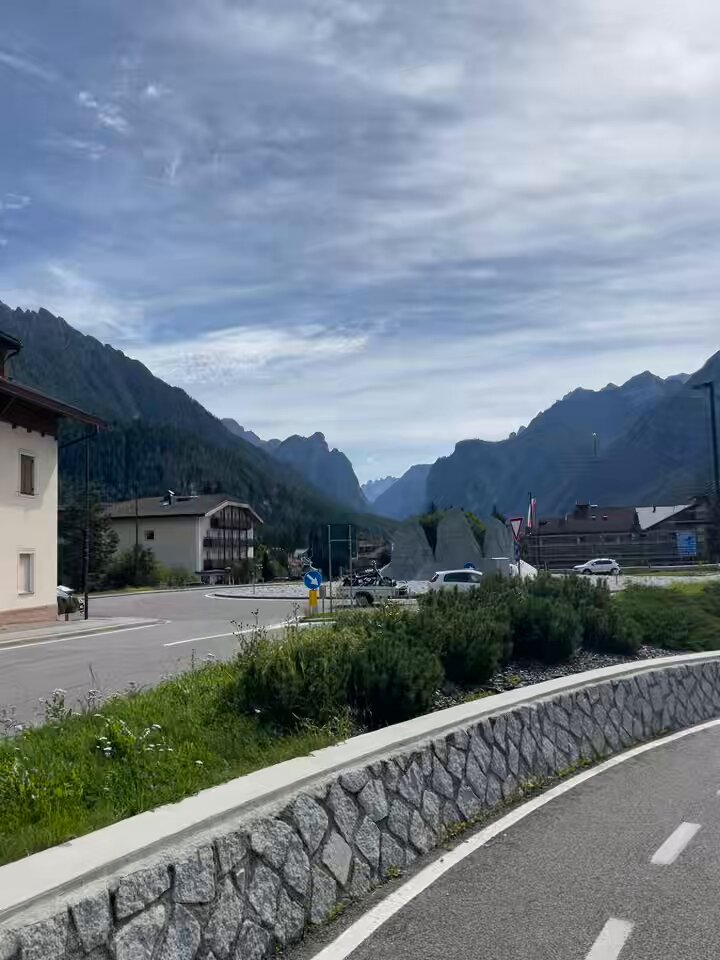
Leaving Cortina, we were on a paved bike trail that had one side dedicated to cyclists and one side dedicated to pedestrians. The views of the valley were breathtaking — both the mountains and the community itself. It felt like we were riding through an idyllic mountain town that couldn't possibly be a real place.
Yesterday, Bianca and I biked around 60 km from Cortina d’Ampezzo to Dobbiaco and then back again. It was the most beautiful bike ride that either of us had ever been on. Here's the Strava report.
Leaving Cortina, we were on a paved bike trail that had one side dedicated to cyclists and one side dedicated to pedestrians. The views of the valley were breathtaking — both the mountains and the community itself. It felt like we were riding through an idyllic mountain town that couldn't possibly be a real place.
The trail then switched to gravel and that's what we rode on through most of the mountains, including over bridges and through mountain tunnels. I couldn't tell you how many times we had to stop to take photos.
Here we were greeted by a bike counter. It was 13:11 and we were cyclist number 243 for the day. The counter for the year was acting up, but I'm guessing it was trying to say between 50-60k cyclists year to date. It was also here that we learned we were on a 560-kilometer trail that runs from Venice to Munich, all the way through the Alps. That would be a fun adventure for another day.
Overall, the cycling infrastructure was incredible. It was one of the things we were most impressed by. When we arrived in the predominantly German-speaking town of Dobbiaco — which is also known as Toblach in German — we were on a dedicated bike path that looked like this:
I couldn't even find any roads leading to some of the homes we were passing. It seemed like residents would have to drive their car onto the bike path just to get home. And once we arrived in the center of town, we were presented with bike lanes, like this, to take us around and underneath busy traffic roundabouts.
This is some of the most impressive biking infrastructure that I have ever experienced, and it's in a small town of 3,300 people. It's also an alpine town that gets bitterly cold winters — significantly colder than even cities like Toronto. So if they can make this happen, why can't we?
The Mediterranean is out, and the Alps are in. Yesterday, we hiked over 12 km up to Lago di Sorapis in Cortina d’Ampezzo (here's the Strava post). It was definitely on the more difficult side, but not as difficult as something like the Grouse Grind in North Vancouver — which has been called "Mother Nature's Stairmaster." The difference here is that there are a handful of exposed faces with steep drop-offs, the kind that immediately make my palms sweaty and force me to grab the steel support cables with everything I've got. The views and payoff (Lago di Sorapis) were worth it though. The Dolomites are such a beautiful and unique mountain range.
France uses a nutritional rating system for the front of food packaging called a "Nutri-Score." Other countries have introduced similar initiatives, but supposedly France was the first to use this particular rating system, which ranges from A (best) to E (worst).
Here's what it looks like on a package of chorizo:
Nutri-Scores were first introduced in supermarkets in 2017 and are applied on a voluntary basis. But having been in a handful of French grocery stores over the last week, I can tell you that it is widely used. So much so that I was more surprised when it wasn't there. What might they be trying to hide?
The Nutri-Score is also widely supported by the general public and, according to some surveys, nearly 90% of the French population believe that it should be mandatory on all food packaging.
So how does it work? The system is based on an algorithm that looks out for good stuff like fruits and vegetables, fiber, protein, and healthy oils, while penalizing bad stuff like sugar, saturated fat, and sodium, among other things.
It's an algorithm that is likely to be in constant flux. My understanding is that they have special rules for things like cheese. But regardless, I find that this simple rating system has a significant impact on my buying and eating decisions. Take the above chorizo. It has a score of "E." Do I really want that or should I go for the jambon next door that has a rating of "B?"
This also made me think of France's mandatory Energy Performance Certificate (or Diagnostic de Performance Énergétique). This is a diagnostic that is required of all properties being sold or rented in the country.
It ranks both energy consumption and CO2 emissions from A (most efficient) to G (least efficient). It also provides recommended renovations. And if you lie — and actual performance deviates too far from the stated rating — you could be in trouble.
But just like the Nutri-Score, I am sure that these energy efficiency scores similarly affect buying and renting decisions, especially if there's a capital expenditure recommendation tied to a low score.
This is how commercial real estate is bought and sold. A building condition assessment is done, somebody comes up with a cost for all the work that will need to be done, and then it gets factored into the price: "Yeah, so, I was going to pay you $50 million, but now I have to spend $2 million on CapEx."
But on the residential side, I don't think this is often the case. Not unless someone is measuring performance and telling you what improvements should be made and, in some cases, need to be made for the property to be legally rentable. Out of sight is out of mind.
No businessperson, landlord, or entrepreneur wants to deal with more bureaucracy and red tape. But I'm of the strong opinion that too much of the food we eat is over-processed shit. I also believe in continually striving to be better — especially when it comes to our built environment. And that starts with measurement and benchmarking.
The trail then switched to gravel and that's what we rode on through most of the mountains, including over bridges and through mountain tunnels. I couldn't tell you how many times we had to stop to take photos.
Here we were greeted by a bike counter. It was 13:11 and we were cyclist number 243 for the day. The counter for the year was acting up, but I'm guessing it was trying to say between 50-60k cyclists year to date. It was also here that we learned we were on a 560-kilometer trail that runs from Venice to Munich, all the way through the Alps. That would be a fun adventure for another day.
Overall, the cycling infrastructure was incredible. It was one of the things we were most impressed by. When we arrived in the predominantly German-speaking town of Dobbiaco — which is also known as Toblach in German — we were on a dedicated bike path that looked like this:
I couldn't even find any roads leading to some of the homes we were passing. It seemed like residents would have to drive their car onto the bike path just to get home. And once we arrived in the center of town, we were presented with bike lanes, like this, to take us around and underneath busy traffic roundabouts.
This is some of the most impressive biking infrastructure that I have ever experienced, and it's in a small town of 3,300 people. It's also an alpine town that gets bitterly cold winters — significantly colder than even cities like Toronto. So if they can make this happen, why can't we?
The Mediterranean is out, and the Alps are in. Yesterday, we hiked over 12 km up to Lago di Sorapis in Cortina d’Ampezzo (here's the Strava post). It was definitely on the more difficult side, but not as difficult as something like the Grouse Grind in North Vancouver — which has been called "Mother Nature's Stairmaster." The difference here is that there are a handful of exposed faces with steep drop-offs, the kind that immediately make my palms sweaty and force me to grab the steel support cables with everything I've got. The views and payoff (Lago di Sorapis) were worth it though. The Dolomites are such a beautiful and unique mountain range.
France uses a nutritional rating system for the front of food packaging called a "Nutri-Score." Other countries have introduced similar initiatives, but supposedly France was the first to use this particular rating system, which ranges from A (best) to E (worst).
Here's what it looks like on a package of chorizo:
Nutri-Scores were first introduced in supermarkets in 2017 and are applied on a voluntary basis. But having been in a handful of French grocery stores over the last week, I can tell you that it is widely used. So much so that I was more surprised when it wasn't there. What might they be trying to hide?
The Nutri-Score is also widely supported by the general public and, according to some surveys, nearly 90% of the French population believe that it should be mandatory on all food packaging.
So how does it work? The system is based on an algorithm that looks out for good stuff like fruits and vegetables, fiber, protein, and healthy oils, while penalizing bad stuff like sugar, saturated fat, and sodium, among other things.
It's an algorithm that is likely to be in constant flux. My understanding is that they have special rules for things like cheese. But regardless, I find that this simple rating system has a significant impact on my buying and eating decisions. Take the above chorizo. It has a score of "E." Do I really want that or should I go for the jambon next door that has a rating of "B?"
This also made me think of France's mandatory Energy Performance Certificate (or Diagnostic de Performance Énergétique). This is a diagnostic that is required of all properties being sold or rented in the country.
It ranks both energy consumption and CO2 emissions from A (most efficient) to G (least efficient). It also provides recommended renovations. And if you lie — and actual performance deviates too far from the stated rating — you could be in trouble.
But just like the Nutri-Score, I am sure that these energy efficiency scores similarly affect buying and renting decisions, especially if there's a capital expenditure recommendation tied to a low score.
This is how commercial real estate is bought and sold. A building condition assessment is done, somebody comes up with a cost for all the work that will need to be done, and then it gets factored into the price: "Yeah, so, I was going to pay you $50 million, but now I have to spend $2 million on CapEx."
But on the residential side, I don't think this is often the case. Not unless someone is measuring performance and telling you what improvements should be made and, in some cases, need to be made for the property to be legally rentable. Out of sight is out of mind.
No businessperson, landlord, or entrepreneur wants to deal with more bureaucracy and red tape. But I'm of the strong opinion that too much of the food we eat is over-processed shit. I also believe in continually striving to be better — especially when it comes to our built environment. And that starts with measurement and benchmarking.