I'm excited to learn that the University of Pennsylvania Stuart Weitzman School of Design has just launched a new master's program that is intended to fill the gap in education between design and real estate development. It's called the Master of Science in Design with a concentration in Property Development and Design (or MSD-PDD).
From the sounds of it, it's an expansion of the certificate program in real estate development that I did while I was there. Good. It's also something that I've been advocating for at the University of Toronto for over a decade. We need more bilingual city-building professionals who understand both design and real estate development.
My initial comment is that I hope they're really drawing on and leveraging the resources of the Wharton School. That's what will really make this program stand out against many similar programs. When I was there, I remember them having two different real estate finance classes: one for MBAs and one for designers (which had been made deliberately easier).
I thought this was bullshit, so I met with the program coordinator and requested to be admitted to the MBA one. He strongly advised against it and said that it's, you know, really hard. But that only made me want to take it even more. I ended up getting an A.
So my piece of unsolicited advice for this nascent program is: don't baby the designers when it comes to business and finance. Because the market certainly won't.
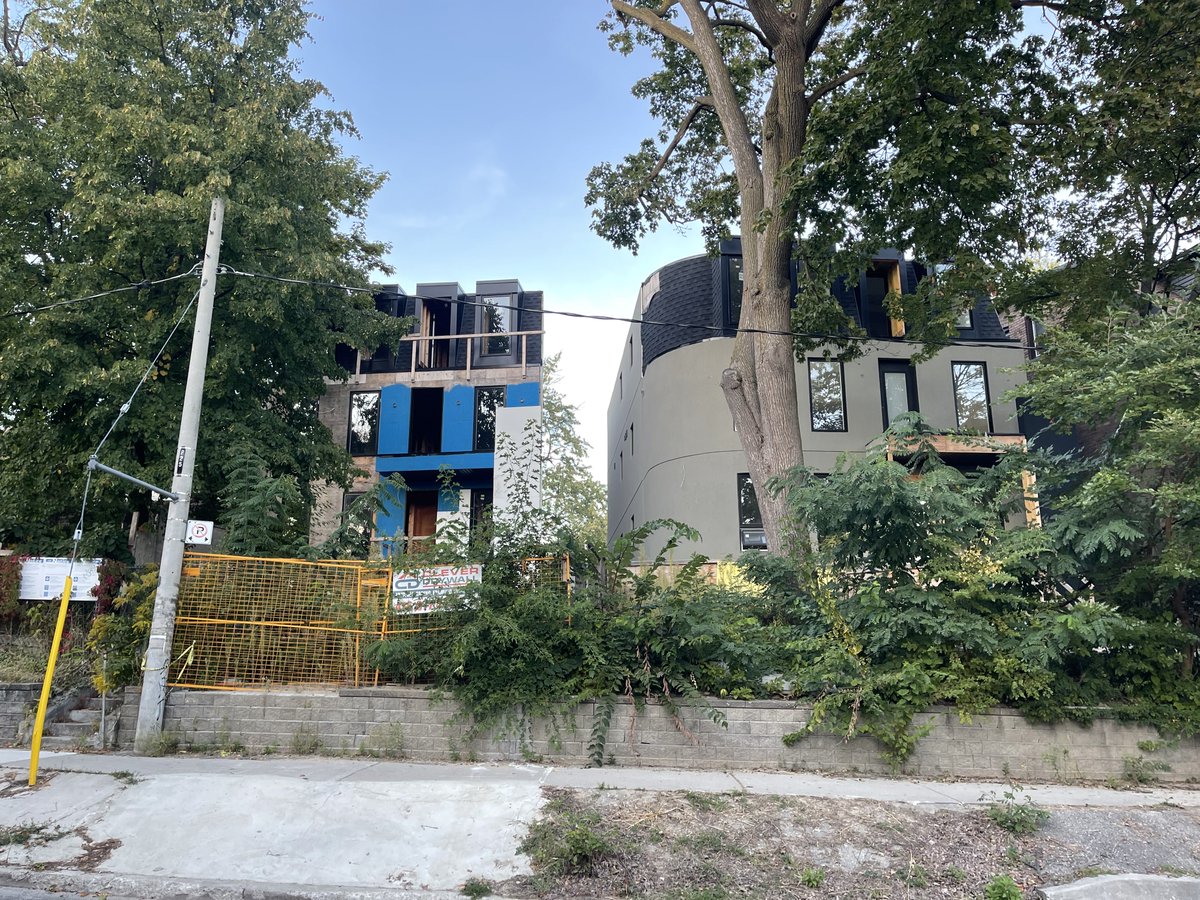
Bianca and I went for a walk around the Junction over the weekend, as we like to do, and I was pleasantly surprised to find a number of "multiplexes" under construction. That is, small infill rental projects with four or five homes, sometimes including a laneway house at the back. (Sorry, no sixplexes were spotted just yet.) It immediately made me think, "Wow, it's happening! Toronto is intensifying its neighborhoods."
For those of you who haven't been following closely, many of Toronto's neighborhoods have been bleeding population over the past few decades. It's only where we've allowed larger-scale new developments that we've really seen populations increase. That's what has precipitated our current push to expand housing options in our low-rise neighborhoods. And already, you can find evidence that it's starting to work.
That said, it's worth mentioning a few things. Some of the planning notice signs that I stumbled upon dated back to 2022, and some were current. This raises at least two lines of questions. One, why is a small project that went to the Committee of Adjustment in 2022 still under construction? Was it because of planning delays, or something else? And two, why are today's projects still having to go to the CofA? Are we still not there yet in terms of the planning policies?

I don't know the precise answers to these questions, but I do know that planning staff actively monitor which variances are requested and ultimately approved. If the same variance continues to show up, then it's a clear indication that it should just become policy, and not be something that needs to be sought. This should give some comfort that we should only get better at facilitating this scale of housing.
The H-1B visa is a nonimmigrant employer-sponsored program that allows US companies to hire foreign nationals in "specialty occupations," typically requiring a bachelor's degree or higher. The vast majority of these occupations are computer-related (69% of petition filings according to 2017 data). And they are disproportionately filled with high-skilled talent coming from two countries: China and India (85% of filings for the same time period).
So this week's announcement that H-1B visas will now require employers to pay $100,000 per year per visa is a direct way of saying, "we want fewer people from China and India working in tech in the US."
But as with most economic policies, it's more than that. And we already have the research. In 2020 (and then in 2023), Britta Glennon of the University of Pennsylvania (my alma mater) studied the effects of restricting high-skilled labor on offshoring. More specifically, she looked at two visa supply shock periods: the first being a 2004 cap that lowered H-1B visas by 70% and the second being a 2008–2009 lottery program which generated a random negative shock.
What she uncovered in the first case was that the 2004 policy change increased foreign affiliate employment by 27%! And in the second case, a random one-percentage-point drop in H-1B visa supply caused an increase in the foreign affiliate growth rate of between 12 and 16%. Said differently, when H-1B visas become harder to get, US tech companies simply hire more people in other countries.
More specifically, they ramp up hiring in these three countries: China, India, and Canada. China and India are what you might call a direct channel. The company just opens or expands an existing office by hiring the people that would have otherwise come to the US. Canada, on the other hand, largely serves as an indirect channel. We become a conveniently-located conduit through which US firms can hire the same high-skilled humans from China and India (because we don't restrict high-skilled talent in the same way).
So another way to interpret this week's announcement is that the US is making deliberate moves to increase high-skilled tech employment in Canada, China, and India. That's a good thing for these countries. Of course, the real opportunity is not as an affiliate or back-office location for US firms. The real opportunity is to harness this high-skilled talent and empower them to start their own companies in the countries where they will now live.
Next to the US, China is likely in the best position to do that. But it’s also Canada’s opportunity to squander.
Update: After clearly stating that it would be an annual fee of $100k and that the big tech companies all "love it," it appears the US has backpedaled. It will now be a one-time fee of $100k paid at the time of petition filing. This is still a lot. Currently, the fees are in the hundreds of dollars.
I'm excited to learn that the University of Pennsylvania Stuart Weitzman School of Design has just launched a new master's program that is intended to fill the gap in education between design and real estate development. It's called the Master of Science in Design with a concentration in Property Development and Design (or MSD-PDD).
From the sounds of it, it's an expansion of the certificate program in real estate development that I did while I was there. Good. It's also something that I've been advocating for at the University of Toronto for over a decade. We need more bilingual city-building professionals who understand both design and real estate development.
My initial comment is that I hope they're really drawing on and leveraging the resources of the Wharton School. That's what will really make this program stand out against many similar programs. When I was there, I remember them having two different real estate finance classes: one for MBAs and one for designers (which had been made deliberately easier).
I thought this was bullshit, so I met with the program coordinator and requested to be admitted to the MBA one. He strongly advised against it and said that it's, you know, really hard. But that only made me want to take it even more. I ended up getting an A.
So my piece of unsolicited advice for this nascent program is: don't baby the designers when it comes to business and finance. Because the market certainly won't.
Bianca and I went for a walk around the Junction over the weekend, as we like to do, and I was pleasantly surprised to find a number of "multiplexes" under construction. That is, small infill rental projects with four or five homes, sometimes including a laneway house at the back. (Sorry, no sixplexes were spotted just yet.) It immediately made me think, "Wow, it's happening! Toronto is intensifying its neighborhoods."
For those of you who haven't been following closely, many of Toronto's neighborhoods have been bleeding population over the past few decades. It's only where we've allowed larger-scale new developments that we've really seen populations increase. That's what has precipitated our current push to expand housing options in our low-rise neighborhoods. And already, you can find evidence that it's starting to work.
That said, it's worth mentioning a few things. Some of the planning notice signs that I stumbled upon dated back to 2022, and some were current. This raises at least two lines of questions. One, why is a small project that went to the Committee of Adjustment in 2022 still under construction? Was it because of planning delays, or something else? And two, why are today's projects still having to go to the CofA? Are we still not there yet in terms of the planning policies?
I don't know the precise answers to these questions, but I do know that planning staff actively monitor which variances are requested and ultimately approved. If the same variance continues to show up, then it's a clear indication that it should just become policy, and not be something that needs to be sought. This should give some comfort that we should only get better at facilitating this scale of housing.
The H-1B visa is a nonimmigrant employer-sponsored program that allows US companies to hire foreign nationals in "specialty occupations," typically requiring a bachelor's degree or higher. The vast majority of these occupations are computer-related (69% of petition filings according to 2017 data). And they are disproportionately filled with high-skilled talent coming from two countries: China and India (85% of filings for the same time period).
So this week's announcement that H-1B visas will now require employers to pay $100,000 per year per visa is a direct way of saying, "we want fewer people from China and India working in tech in the US."
But as with most economic policies, it's more than that. And we already have the research. In 2020 (and then in 2023), Britta Glennon of the University of Pennsylvania (my alma mater) studied the effects of restricting high-skilled labor on offshoring. More specifically, she looked at two visa supply shock periods: the first being a 2004 cap that lowered H-1B visas by 70% and the second being a 2008–2009 lottery program which generated a random negative shock.
What she uncovered in the first case was that the 2004 policy change increased foreign affiliate employment by 27%! And in the second case, a random one-percentage-point drop in H-1B visa supply caused an increase in the foreign affiliate growth rate of between 12 and 16%. Said differently, when H-1B visas become harder to get, US tech companies simply hire more people in other countries.
More specifically, they ramp up hiring in these three countries: China, India, and Canada. China and India are what you might call a direct channel. The company just opens or expands an existing office by hiring the people that would have otherwise come to the US. Canada, on the other hand, largely serves as an indirect channel. We become a conveniently-located conduit through which US firms can hire the same high-skilled humans from China and India (because we don't restrict high-skilled talent in the same way).
So another way to interpret this week's announcement is that the US is making deliberate moves to increase high-skilled tech employment in Canada, China, and India. That's a good thing for these countries. Of course, the real opportunity is not as an affiliate or back-office location for US firms. The real opportunity is to harness this high-skilled talent and empower them to start their own companies in the countries where they will now live.
Next to the US, China is likely in the best position to do that. But it’s also Canada’s opportunity to squander.
Update: After clearly stating that it would be an annual fee of $100k and that the big tech companies all "love it," it appears the US has backpedaled. It will now be a one-time fee of $100k paid at the time of petition filing. This is still a lot. Currently, the fees are in the hundreds of dollars.
Share Dialog
Share Dialog
Share Dialog
Share Dialog
Share Dialog
Share Dialog



