Daily insights for city builders, delivered every morning at 6 AM ET. I’m Brandon Donnelly — a Toronto-based real estate developer and founder of Globizen. I’ve been writing here since 2013.

Category: Uncategorized

  • Sticky cities, shifting world

    December 28, 2025 · View original


    Canadian geographer Mario Polèse’s book, The Wealth and Poverty of Regions: Why Cities Matter, is not new. It was originally published in 2010. But it’s perhaps a good follow-up to yesterday’s post about the untethering of wealth. Here’s an excerpt from a review of the book by Jeb Brugmann:

    > All cities, Polèse explains, share the same basic economic causes and effects. These are economies of localization (i.e., locating activities close together) and of urbanization (i.e., clustering lots of diverse activities together at scale). Polèse shows how these urban economies—usefully distinguished and defined in detail as economies of scale, proximity, diversity and concentration—combine with unique natural features and resource endowments, technology and infrastructure investments, national boundaries and market controls, and historical events to create quintessentially local and unique places. Every time he explains the status of another place—New York, London, Chicago, Paris, Montreal, the northern Mexico border, the North American west coast—he demonstrates again how the source code of geography combines with specific local and historical conditions to create a momentum of wealth or poverty.

    The rich may have the means to tax-optimize through physical mobility, but the draw to established urban clusters remains strong, which is why it can be a challenge to stay away from them for more than 183 days. There is a “stickiness” to established cities that is the result of momentum and compounding over centuries.

    Still, nothing is guaranteed, and there’s only so much that can be done if you’re swimming against a global landscape that is shifting away from you. Geography does matter. And today, the world’s economic center of gravity is rapidly shifting toward Asia. This is good for some cities and bad for others.

    Cover photo by Zhu Hongzhi on Unsplash
  • The great untethering of wealth

    December 27, 2025 · View original


    One of the themes we cover on this blog is the importance of place in a world where people are becoming increasingly untethered. While I’m a firm believer that great local places have enduring value, this does not mean that technology isn’t driving greater fluidity in the way people live, work, play, and optimize their taxes.

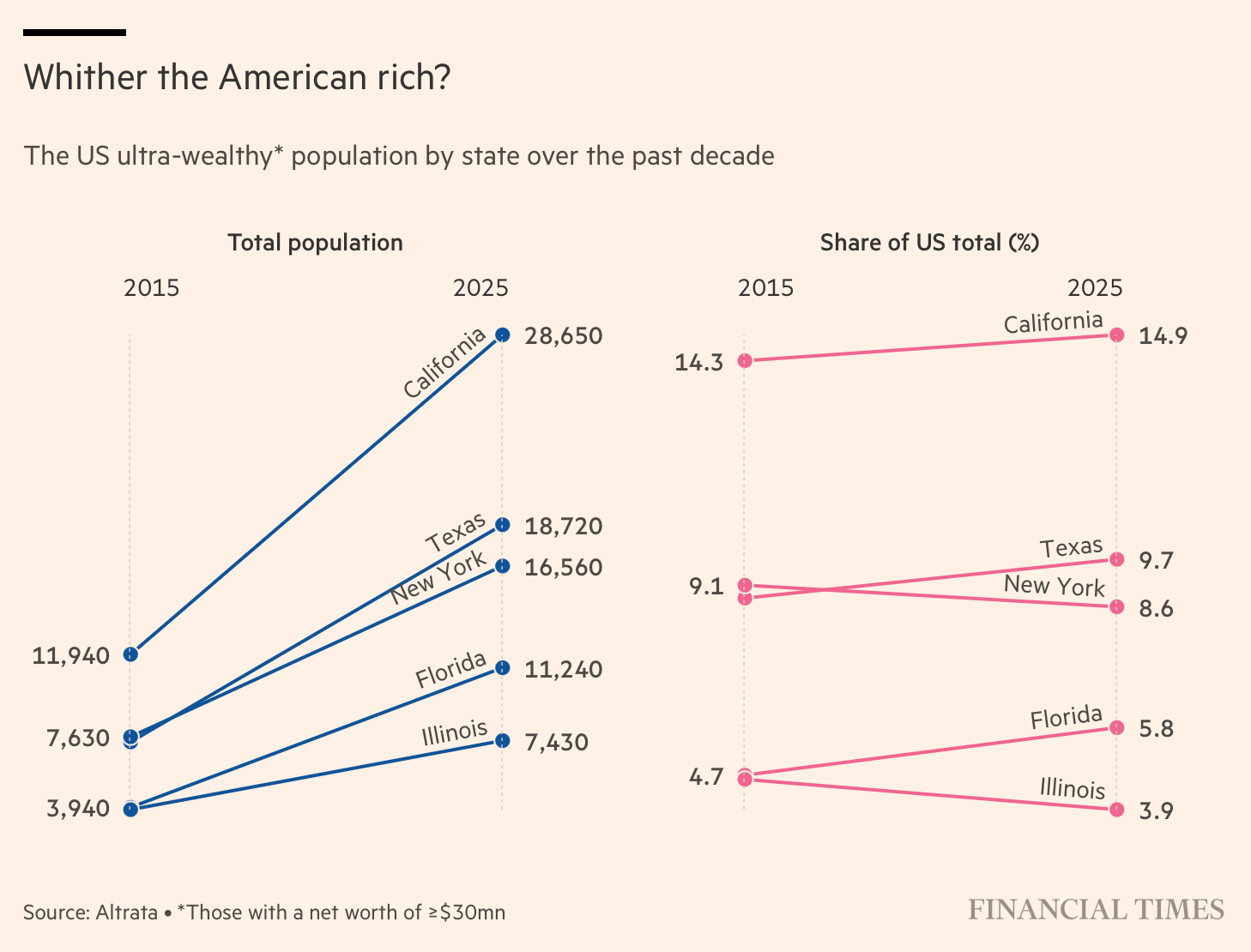
    Over the last decade, the population of ultra-wealthy Americans (those with a net worth greater than or equal to $30 million) has risen noticeably in two states: Texas and Florida. California, a high-tax state, still dominates; however, Texas has overtaken New York, and Florida has overtaken Illinois. Notably, both Texas and Florida have no state income tax — they also have warmer weather than New York and Illinois.

    As we have talked about before, there’s a longstanding migration trend in the US toward sun, urban sprawl, and lower taxes. But it’s not always as clear-cut as a rich person fully relocating to a lower-tax jurisdiction and completely severing ties. The enduring value of place means that many people still travel back and forth to meet whatever personal or professional obligations they might have.

    And today, there are apps, such as TaxBird, that will meticulously track the number of days you spend (or your phone spends) in each jurisdiction to ensure you don’t cross any important residency thresholds.

    The global standard is the 183-day rule (or roughly half a year). In many or most cases, if you are physically present in a place for more than 50% of the year, you are automatically considered a resident for tax purposes. But it’s not always this simple, so check with your tax advisor. Regardless, the untethering of life and work is surely allowing more people to tax-optimize in this way.

    None of this is surprising.

    As Charlie Munger used to say, “Show me the incentive, and I’ll show you the outcome.” But now we need to think about the longer-term ramifications for colder, higher-tax jurisdictions as capital and tax revenue continue to be siphoned off, not only to Texas and Florida, but to Dubai, Singapore, Hong Kong, Switzerland, Monaco and other places.

    Cover photo by Colin Lloyd on Unsplash

  • Where Americans flew in 2025

    The top United Airlines international destinations by US state

    December 26, 2025 · View original


    Whether you live in North Dakota or Texas, there’s a reasonable chance that when you travel internationally, you enjoy going to Cancun. Or perhaps you fly into Cancun and then go to a neighboring town like Tulum. United Airlines just released the following map showing the most-booked international destinations from every state for passengers traveling on United Airlines between January and October 2025. The top three destinations are London, Cancun, and Tokyo:

    First, it’s important to keep in mind that this data only includes people flying on United; it doesn’t capture all international air travel. Second, maps like this are necessarily going to be influenced by an airline’s biggest hubs. In the case of United, its hub-and-spoke model relies on major airports and routes like San Francisco-Tokyo and Newark-Heathrow.

    Still, specific destinations appear on this map for a reason. Cancun is the number one “vacation” airport for Americans, which is an incredible success story, because it wasn’t a place until the 1970s. Prior to Cancun, Acapulco was Mexico’s top resort destination, but it was becoming constrained, and the government needed a replacement conduit for extracting US dollars from the American middle class. So, they developed Cancun.

    The popularity of Tokyo is likely partly a result of a weaker yen, in addition to being an important Asian hub and an incredible place to visit. According to the Japan National Tourism Organization (JNTO), over 2.7 million Americans visited the country in 2024 — a 33% year-over-year increase and a 58% increase compared to 2019.

    The country also saw 3.7 million international visitors in January 2025, which is the highest ever for a single month. Countries like the US and Canada also set all-time records for January arrivals. Part of this, I’m sure, has to do with Japan’s legendary “Japow.” I was part of this year’s cohort, and I’ve never seen so much snow as I did on the island of Hokkaido.

    There are also very specific one-off relationships that appear on United’s map. The number one destination for the state of Arizona is, for example, Taipei. And this is being driven by a semiconductor boom, specifically Taiwan Semiconductor Manufacturing Company’s direct investment in the state. At the time, it was heralded as “the largest foreign direct investment in a greenfield project in American history.”

    So, there’s a lot that can be gleaned from a map like this. If we were to zoom out and look at all international air travel, we would likely see some reordering. I suspect Paris would jump ahead of airports like Vancouver, given its hub status for other airlines. But it’s unlikely you’d see a completely different list. Americans fly east to London, south to Cancun, west to Tokyo, and north to Toronto. These are the primary hub airports.

    Cover photo by Yu Kato on Unsplash

  • Merry Christmas

    December 25, 2025 · View original


    Wishing you all a Merry Christmas and a restful holiday break.

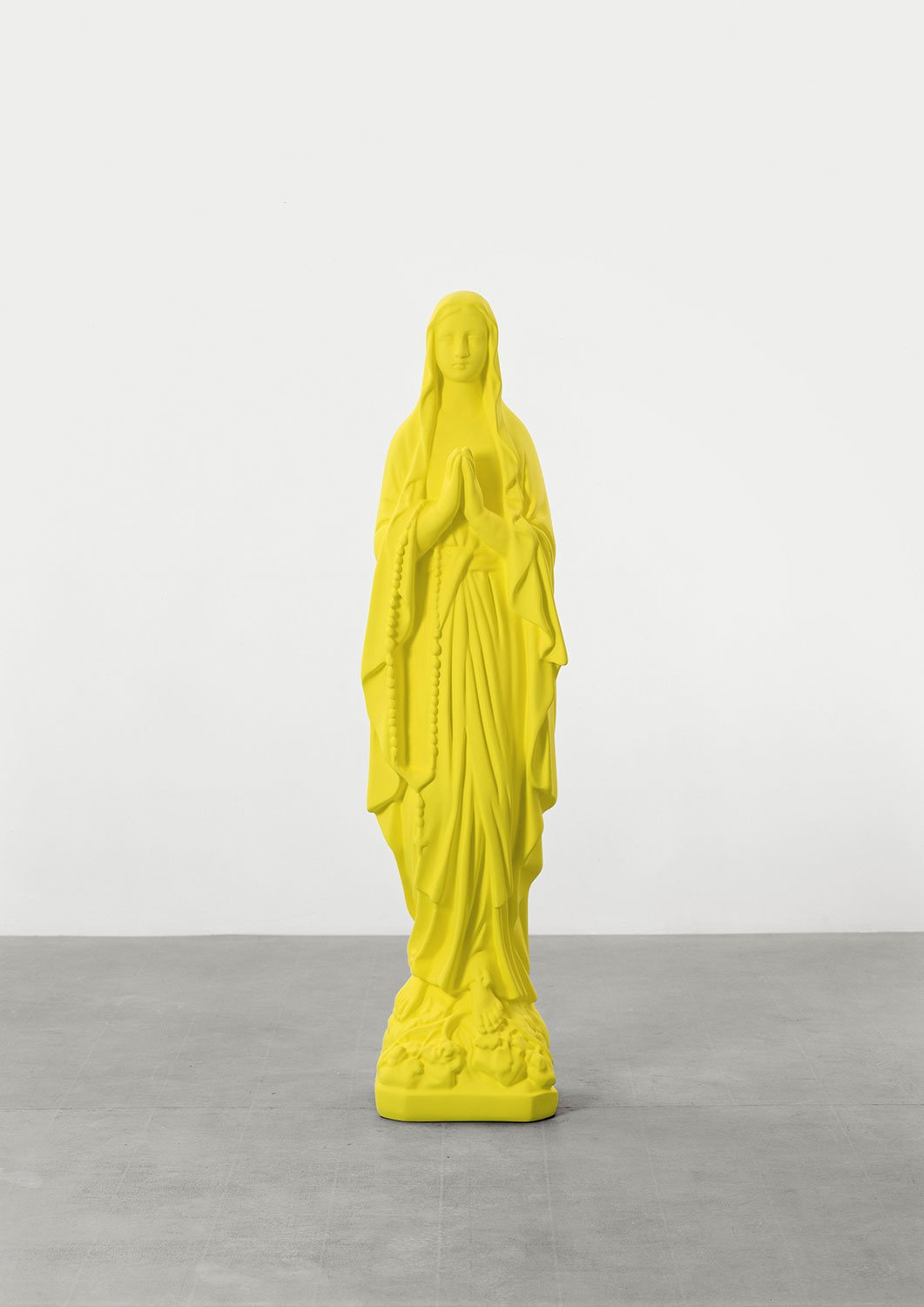
    Katharina Fritsch’s Madonnenfigur is one of the most iconic and polarizing works of contemporary German art. Based on a 12-inch, mass-produced souvenir statuette of the Madonna she found while traveling, Fritsch’s version stands 170 cm tall (her own height) and is coated in saturated, matte fluorescent yellow paint. This changes your perception of what would otherwise be a deeply familiar object (to most, at least). As far as I know, the artist has never clarified whether her work is intended to be religiously respectful or satirical — so that’s for you to decide.

    Art: Katharina Fritsch, Madonnenfigur | Madonna Figure, 1987

    Photo: Ivo Faber

  • A bias toward action

    December 24, 2025 · View original


    2025 was a tough year to be a real estate developer in Toronto. And it was a tough year for a whole host of reasons, not all of which you might immediately expect. In addition to it being challenging (and in some cases impossible) to underwrite new projects, raise capital, sell pre-construction homes and many other things, it was also a challenging market from a psychological standpoint.

    Real estate development is a business that arguably attracts “Type-A” personalities. These are people who stereotypically tend to be ambitious, driven, competitive, and impatient. Said differently, they tend to have a strong bias toward action and a strong internal locus of control. I’m certainly programmed this way. I have a real problem with free time, and I’m at my happiest when I’m achieving things. I’m sure that many of you are the same way.

    However, when the market is soft or shut off, the primary modus operandi of action gets neutralized. And since people with a strong internal locus of control believe that it is their individual actions that directly lead to successes and failures, this can create a psychological crisis. Am I the one failing? Is there anything else that I could be doing to create action, right now? (Simply waiting could be the correct answer.)

    The older I get, the more I realize that an important skill in life and business is managing your own psychology. In fact, it may be the most important skill of all. So, what I have been doing as of late is continually reframing the current market. Rather than focusing on what’s not happening, I like to remind myself that this market is surely presenting the greatest set of opportunities that I have seen in my real estate career.

    It may not feel like the typical kind of action right now, but everything is strategic preparation.

    Cover photo by Jānis Beitiņš on Unsplash

  • A look back at (almost) a year of New York’s congestion zone

    December 23, 2025 · View original


    It has now been almost a year since New York City implemented its congestion charge for the area of Manhattan south of 60th Street and, despite all of the critics, the results are overwhelmingly positive. Here are some of the most important data points:

    – Pollution is down by as much as 22% in the congestion zone area. – Traffic has declined by about 11% in the zone. As a reminder, traffic improved basically immediately following the $9 charge. – An average of 71,500 fewer vehicles entered the zone each day from January through to November 2025, totalling nearly 24 million fewer vehicles. – The congestion charge is forecasted to bring in $548.3 million in 2025, beating the initial goal of $500 million. (This revenue will be used by the MTA for bond issuances that will in turn fund further infrastructure improvements.) – Importantly, foot traffic in the zone is also up year-over-year compared to Manhattan as a whole (3.5% versus 1.4%, respectively). – Storefront vacancies in the zone declined more rapidly compared to Manhattan as a whole and the rest of the city. (Though the vacancy rate is still the highest in this area, presumably because of the higher rents in downtown and midtown.) – New York City’s sales tax revenue is also up 6.3% this year compared to the same period last year, outperforming all neighboring counties. This suggests that the congestion charge is not keeping shoppers away.

    So, why shouldn’t other North American cities follow New York’s lead?

    Cover photo by ian dooley on Unsplash

  • Why rent control isn’t “free”

    New research shows restrictive reforms can result in a 10% reduction in rental supply

    December 22, 2025 · View original


    One of the basic principles behind rent control policies is that you’re trying to make housing more affordable for some, while at the same time more expensive for others. Economics is the study of choice, and this is a choice, whether it gets talked about or not. Previously, we spoke about a memo from Howard Marks where he describes the impact of rent control in New York City. In economic terms, that impact looks like this:

    – Some people who couldn’t afford to live in New York City if rents were set by the free market get the opportunity to live in the city (their housing is more affordable) – Other people who would like to live in New York City and could afford higher rents can’t because there are no available apartments (rent controls reduce housing supply) – And lastly, landlords with unregulated apartments can command higher rents than would be the case if new housing supply were not being discouraged (their housing is more expensive)

    Today, let’s talk about a recent research paper (June 2025) published in the Journal of Housing Economics called, “Rent control and the supply of affordable housing.” What the authors discovered was the following:

    – Restrictive rent control reforms are associated with a 10% reduction in the total number of rental units available in a city – Restrictive rent control reforms led to an increase in the availability of units affordable to extremely low-income households – This was offset by a decline in the availability of units to other income groups, particularly those at slightly higher affordability thresholds

    Once again, we see the economic trade-offs inherent in supply-side interventions like rent control. It’s better for some and worse for others. However, governments tend to favor it because it’s “free” to them; the costs are borne by landlords and renters at higher affordability thresholds. I’ll let all of you comment on whether you think this is good or bad, but regardless, I think it’s crucial that we acknowledge the trade-offs being made.

    Cover photo by Benjamin Ashton on Unsplash

  • From Chicago to Park City

    How Utah architect John Sugden reinvented the International Style for the mountains

    December 21, 2025 · View original


    John Sugden (1922-2003) was one of the most important Utah architects of the 20th century. Born in Chicago in 1922, he studied at the Illinois Institute of Technology (IIT) under the legendary Mies van der Rohe, and worked at Mies’s firm from 1945 to 1952 before moving to Utah.

    For those who may not be familiar, Mies is a big deal in the architectural community. Some of his most noteworthy projects include the Farnsworth House (which hosted a 100th anniversary collaboration between Braun and the late Virgil Abloh in 2021); the Barcelona Pavilion (and its accompanying chair); Crown Hall at IIT (which is high on my list of buildings to visit); the Seagram Building in New York; and, of course, the Toronto-Dominion Centre complex.

    Sugden moved to Utah in 1952. He would then spend the rest of his career defining what the International Style — a major architectural movement that dominated modernism from the 1920s to the 1970s — could be in a mountain context, while educating the next generation of architects at the University of Utah’s Graduate School of Architecture.

    His first major project in Utah was a house for his mother: the Roberta Sugden House in Salt Lake City (1955). It is a classic steel-and-glass structure that takes obvious cues from the Farnsworth House but that was adapted to the Utah landscape. Today, it remains an icon of Mid-Century Modernism in the city.

    His own home and studio followed in 1984. Referred to as “The Glass Cube,” or the Mountain House Studio, it is located in Park City (just down the street from Parkview Mountain House in Summit Park). A perfect 33 x 33 x 33 foot cube, the home marks an important turning point for architecture and design in the area.

    By the 1980s, modernism had entered into a mid-life crisis in urban settings. Architects and designers were beginning to reject its austerity and lack of ornamentation in favor of a new movement: Postmodernism.

    But in the Wasatch Mountains, and outside of perhaps only Aspen, the International Style had yet to truly make its mark. Mountain homes simply did not look like this; they were heavy and rustic, and they had gabled roofs. Sugden changed that. His home/studio was the opposite of this: light, transparent, flat-roofed, and industrial in its orientation.

    It’s also worth mentioning that the construction of the Glass Cube roughly aligns with the rebirth of Park City. By the early 1950s, it was a dying ghost town in the mountains. Many of the silver mines that had made it a wealthy place at the end of the 19th century had already shuttered, and the city was without an economic purpose.

    The first ski operations opened in 1963 under the banner of Treasure Mountain Resort. However, it was a makeshift operation, and it would not be until 1971 that Aspen-developer Edgar Stern would acquire Treasure and transform it into Park City Mountain Resort.

    By 1974, he had successfully lured the US Alpine Ski Team to the city. And by 1981, he had moved on to even grander ambitions with the opening of his latest project down the street: Deer Valley Resort. It was also around this time (1982) that Toronto-based Noranda stopped all work and closed the last mining operations in the city.

    Then came Sugden’s modernist Glass Cube in 1984.

    Today, the Summit Park area is filled with countless new and under-construction modern homes, designed by award-winning firms such as Klima Architecture and Brach Design. No two homes are the same, and there’s a palpable willingness to experiment. It feels like an architectural playground, and I like to think that it all started with John Sugden’s simple glass cube.

  • When the music stops

    December 20, 2025 · View original


    When I was in grad school studying real estate, I remember one of my professors once making a joke about the lifecycle of developers. He said that developers usually start by first doing a small project. Then they take the profits from that project and roll them into a bigger project. Once that is done, they take those profits and roll them into an even bigger project. And then they go bankrupt.

    The point he was trying to make was that development is a risky business. One of the reasons for this — and there are countless reasons — is that projects take a long time. This means that during the regular course of a project, it is not unusual to be faced with a handful of very different markets. And during these varied market conditions, you are likely going to make different decisions (and wish you had made different decisions).

    Take, for example, land.

    One of the customary ways to buy development land in Toronto during the last cycle was to pay for it with the help of a land loan. Land loans are not based on any sort of debt service coverage ratio because, typically, there isn’t enough (or any) income to actually service the loan. It’s all based on the land’s future potential.

    Instead what happens is that you forecast how long you’ll need to hold the land, you budget for the interest costs during this period, and then you convince yourself that you’ll be able to “take out” this loan in the future — typically by way of a construction loan or by selling the land to someone else. Unless you have the resources to land bank, you are implicitly making the assumption that there will be a market in the future.

    This assumption works great in a rising market because the land often continues to appreciate (sometimes regardless of your actions) and usually you or someone else can create a productive use for it. But if the music stops during this period, it can be problematic, because now you may only have one way out:

    Cover photo by amirgraphy on Unsplash

  • Trading height for open space

    Park City Planning Commission assesses development proposal for 1500 Kearns Boulevard

    December 19, 2025 · View original


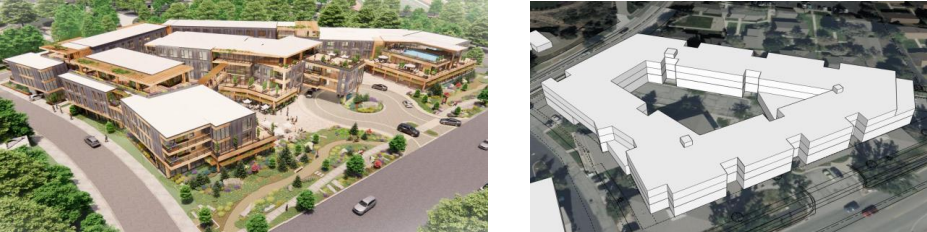
    Yesterday, we spoke about a slender single-stair apartment building on a small 60-square-meter site in Tokyo. Today, let’s talk about a different kind of proposal. Earlier this month, the Park City Planning Commission heard a redevelopment proposal from the Kensington Investment Company for a site near Old Town at 1500 Kearns Boulevard. The site is 2.71 acres, and the existing building houses 48,000 sf of office and retail space.

    The proposal is for a new mixed-use development including:

    – 117 residential apartments (97 market-rate and 20 affordable) – Over 9,400 sf of commercial/retail space – Over 20,000 sf of amenity space (including a rooftop terrace and patios) – 210 underground parking spaces

    Some of the key development approvals being asked for include:

    – Master Planned Development approval & Conditional Use Permit – A reduction of the north setback from 25 feet to 10 feet – A building height exception to 49.5 feet (from the 35 feet currently allowed)

    A formal vote has yet to take place, though apparently, the project is somewhat controversial. The developer is asking to increase the maximum height from three storeys to four. Ordinarily, the Planning Commission would want to see an increased setback accompany this ask, as opposed to a reduction.

    But here we have a classic development trade-off. The developer could, in theory, build more density under the existing permissions, but the ground plane and the overall development wouldn’t be as pleasant. So, the request is to build incrementally higher, but then open up the site more.

    Here’s a comparison between the developer’s proposal and what is permissible by-right:

    It’ll be very interesting to see how Park City votes on this one.

    Images via Building Salt Lake