
Hôtel Amour à la plage, Nice
Daily insights for city builders, delivered every morning at 6 AM ET. I’m Brandon Donnelly — a Toronto-based real estate developer and founder of Globizen. I’ve been writing here since 2013.
Hôtel Amour à la plage, Nice

This winter was supposed to be the 12th edition of a ski and snowboard trip that I do every year with a group of friends from both Canada and the US. Last winter we were in Fernie, British Columbia and this winter we were planning to go to Europe. But for obvious reasons, the trip has been cancelled. It’s going to be a tough season for the ski industry.
According to this recent FT article, the European Alps are home to more than a third of the world’s 2,084 ski resorts. Typically, these resorts bring in about €28 billion in revenues over the course of a season, which is similarly about a third of the global total and almost 7% of the value of the European Union’s overall tourism market.

But many/most resorts are closed right now. France has shuttered all ski resorts until at least January 7, 2021. And Switzerland, while “cautiously open,” is apparently getting pressure from its neighbors to close down again as further quarantine restrictions are put in place.
Interestingly enough, some resorts are already reporting higher than normal early bookings for the 2021-2022 season. This is according to the same FT article. Instead of several hundred early bookings, which would be typical, they’re reporting several thousand. And many of the bookings have moved upmarket compared to prior years.
What this starts to indicate is that we are likely to see an explosion in travel and leisure spending as soon as people feel safe and as soon as these restrictions are lifted. Demand is getting pent-up right now and that can mean only one thing: the 12th annual ski and snowboard trip needs to be a banger.
Charts: Financial Times
Airbnb’s IPO documents recently went public.
Not surprisingly, their business as a travel company has been heavily impacted by COVID-19. Last year, the platform saw 326.9 million nights and experiences booked, with 251.1 million being booked in the first nine months of 2019. This year, nights and experiences are down to 146.9 million for this same nine month period. Revenue is correspondingly down from $3.7 billion for the first nine months of 2019, to $2.5 billion for the first nine months of this year.

But what is also clear from their data is that people still really want to travel and have new experiences. As soon as April passed and the Northern Hemisphere entered the normally busy Q3 travel season, domestic travel began to quickly ramp back up. For many, this likely took the place of international travel. See above chart.
Of greater concern might be all of the regulation that now surrounds short-term rentals. As of October 2019, about 70% of the platform’s top 200 cities (by revenue) had some form of regulation impacting short-term rentals. But at the same time, no one city accounts for more than 2.5% of the platform’s revenue. So there’s strong geographic diversification.
If you’d like to take a look at the company’s S-1, you can do that over here. And for those of you who might be curious, these are Airbnb’s top 10 cities based on revenue:
New York-based Extell Development is, according to this recent WSJ article, in the midst of trying to build a $2 billion full-service ski and snowboard resort near Park City, Utah. It would be the first new resort in the United States in about four decades. These things are, clearly, difficult to get approved, and the fundamentals are, arguably, not all that great. In the early 1990s, the US had about 546 ski and snowboard resorts across the country. As of the 2018-2019 season that number had dropped to 476, according to the WSJ. People are skiing less than they used it, it would seem.
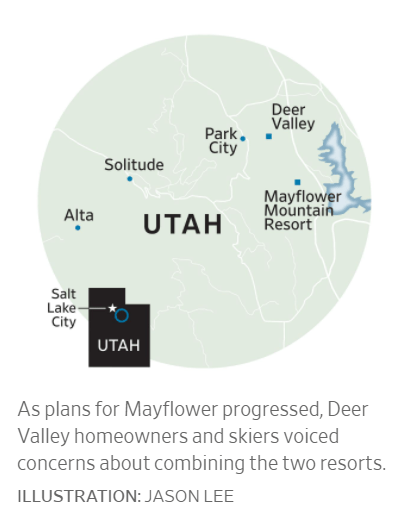
To be a bit more precise on its location, the proposed resort, which is currently called Mayflower Mountain Resort, is to be located next to Deer Valley Resort. And there’s even a plan floating around to possibly merge the two resorts. That’s apparently what the county planners want. I’m not all that familiar with Deer Valley because they don’t allow my kind there (snowboarders). But it’s an exclusive resort with a country-club kind of feel (or so I’m told). So it shouldn’t come as a surprise that the proposed merger doesn’t seem to be getting a lot of traction with the patrons of Deer Valley.
But here’s the interesting thing about the Mayflower site. It’s generally controlled (to what extent, I don’t exactly know) by an entity called The Military Installation Development Authority. And this entity has the power to do things like issue bonds and grant certain land-use approvals. This means that there may be an angle to streamline the approvals process (i.e. make this project actually feasible) and to leverage things like tax increment financing (TIF) in order to fund the project.
Supposedly a new mountain resort has been on the books for this site for some 30 years. Could now finally be the time? If they allow my kind, you can count me in.
Image: WSJ

Netflix has a new docuseries out about Latin American street food. I watched two episodes of it last night. The first was about a chef from Buenos Aires, Argentina and the second was about a chef — named Dona Suzana — from Salvador, Brazil. Even if you aren’t necessarily into food shows, it’s a good way to remind yourself just how much you probably miss traveling right now.
The story of Dona Suzana is an interesting one. Before opening her restaurant, she was doing laundry in order to make ends meet. Then at one point, the City of Salvador came to her community in order to undertake a large construction project. They needed someone to cook food for the construction workers and so they asked her if she would do it.
Since she had always dreamed of being a chef, she jumped at the opportunity and took out a loan to buy everything she needed in order to fit out her kitchen. She cooked for the workers and everyone loved the food. But she never ended up getting paid. They stiffed her.
That turned her off cooking for a bit and it was not until a trio of graffiti artists were working in her community and looking for a place to eat that she tried her hand at it again. They offered to pay her in advance and persuaded her to make them something. She agreed and the food was a huge hit.
In fact, the group of artists loved the food so much that they made her a sign with the name “RéRestaurante” (titled this way because Dona has a stutter) and began sharing photos of her dishes on social media. All of a sudden she had people showing up at her door. And today she has people from all around the world showing up at her door.
This is a wonderful success story. But I think it also says something about land use policies. As far as I can tell from the episode, she setup her restaurant at her place of residence — a community along the waterfront where her husband fishes and where she uses his catches for her renowned dishes.
Here in Toronto, we are operating in an environment where if you try and setup a coffee shop in a residential “Neighbourhood” — like, for example, Contra at 1028 Shaw Street — you might spend a few years fighting with your neighbors and battling it out at LPAT hearings in order to get the appropriate permissions.
I’m not necessarily suggesting that we should do away with all zoning (or maybe I am). But I would like to draw your attention to this contrast. Because one has to wonder whether RéRestaurante Dona Suzana would exist today and be known around the world had the barriers to entry not been so low for her. Of course, had there been more rules, maybe she wouldn’t have gotten stiffed the first time around.
Either way, I am currently in the market for some dende oil.
Photo by Milo Miloezger on Unsplash
Supposedly there are more than 14,000 airplanes parked around the world right now. And according to the latest numbers from IATA, this is expected to translate into an $84 billion loss for global commercial airlines in 2020. The industry is not expected to return to profitability until 2022. As a point of comparison, net profits were about $26.4 billion last year.
Some more numbers from IATA:

Here is something else from the Journal. The number of airline routes has doubled over the past two decades. That has included the number of city-to-city routes. IATA is predicting that by the end of this year we will see these urban routes decline by about 20% compared to last year. And who knows when they will return. Perhaps in 2022, along with profitability.
The reason I point this out is because if you follow the work and writing of planner Joe Berridge, you will know that he often cites airports as being a key piece of infrastructure for global cities. At one point, having a deep harbor was everything you needed in order to bring in goods and people. But today a solid airport is paramount.
Will the loss of this city-to-city connectivity have an impact on some cities?
I came across this video the other night. (If you can’t see it embedded above, click here.) It is a tour of the UK and Ireland’s different accents by Andrew Jack. It is an extraordinary demonstration of his skill.
Did he get any of them wrong?
Sadly, Andrew died last month from COVID-19.
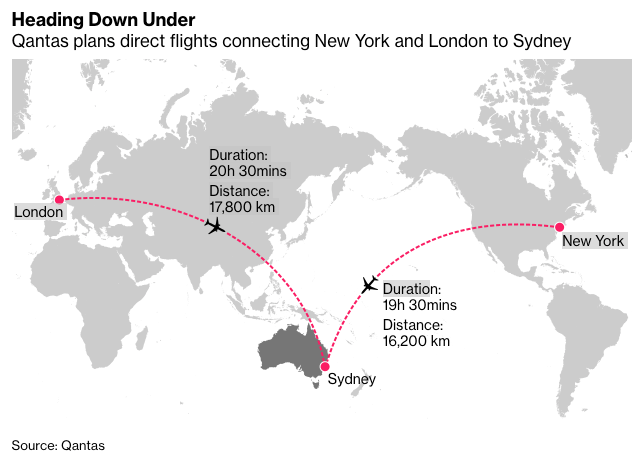
Over the weekend, Qantas Airways set a new record with a nonstop ultra long haul flight from New York to Sydney. At a distance of 16,200 kilometers and a duration of 19 and a half hours, this is now the world’s longest flight. Though, this was still a test voyage. It remains to be seen whether this will be a commercially viable route. The company also plans to offer a similar ultra long haul from London.
It’s fascinating to think about the logistics that go into a flight like this. The flight took off with its fuel tanks maxed out at 101 tons. But according to Wired, the loss factor on each additional ton of fuel is about 60% simply because of the additional weight. In other words, most of the incremental fuel to get all the way to Sydney just gets cannibalized by the heavier load. Wow. That doesn’t feel all that sustainable.
Similarly, every ten passengers roughly equates to one ton (200 pounds per person). So there’s a balancing act between reducing weight (optimizing fuel consumption) and maximizing revenue (adding lots of people). There’s also a question of how best to price discriminate across economy, premium economy, and first class.
Initially these ultra long haul flights were imagined to be flying hotels, where people could sleep, workout, and do all sorts of other things while they traveled halfway around the world. But the economics didn’t work. Too much wasted space on non-revenue generating items.
The other interesting thing about these ultra long haul flights is how much work goes into passenger comfort, specifically around our body’s natural rhythms. Angus Whitley of Bloomberg was onboard this maiden voyage and he talks about how the food they served — spiced with things like chili and lime — was designed to fire up your clock when you shouldn’t be sleeping.
And this isn’t new a feature of ultra long hauls. Qantas already employs things like hot chocolate laced with tryptophan in order to help people sleep onboard. I’m not great at sleeping on planes, generally because I don’t fit in the seats very well. But maybe it’s because I’ve been passing on the hot chocolate.
Image: Qantas via Bloomberg