Daily insights for city builders, delivered every morning at 6 AM ET. I’m Brandon Donnelly — a Toronto-based real estate developer and founder of Globizen. I’ve been writing here since 2013.

Category: Real Estate

  • Unlocking micro-spaces and micro-businesses

    Asian cities will often have buildings that look something like this:

    In this particular case — Tokyo — the building type is referred to as zakkyo. And apparently, it is something that emerged over time:

    Another is the city’s iconic multistory zakkyo buildings covered in neon signs, like those lining the famous Yasukuni Avenue, which house a spectacular variety of businesses. Zakkyo largely started out as office buildings and transformed over time to house everything from mahjong parlors to karaoke boxes. Almazán and McReynolds point out that these buildings offer a density of destinations rarely found in the West because they offer a vertical—not just a horizontal— dimension to walkability, with elevators that open onto the street and take customers directly up to businesses. Zakkyo are on narrow lots that pull pedestrians along the streets that they line. Unlike larger U.S. office buildings, their small lot sizes also facilitate the easy reuse of zakkyo space for different purposes.

    Okay, so small lot sizes seem to help. But what else is needed? Is there a world where this is possible anywhere in the West? It’s probably hard to imagine. Conventional real estate wisdom would tell you that multi-storey retail buildings don’t work.

    But they work in Tokyo, and probably for two reasons. The first is density. Tokyo is dense and I am told that zakkyo buildings tend to emerge around train stations, where foot traffic is high and people are generally looking for things to do and/or consume.

    The second has to do with rules. Tokyo has an overall policy framework that allows for micro-spaces and micro-businesses. Said oppositely, Tokyo hasn’t erected so many barriers that the only way to open a business is with scale and lots of money.

    Liquor licenses are a perfect example:

    So maybe these are possible in the West, after all. Assuming you have any sort of meaningful pedestrian density, the only real prerequisite might be to just get out of the way of small business.

    And I think this is a powerful way to think about cities. We often think about doing new things to elicit certain outcomes. But what outcomes are we missing out on and not seeing because of the rules that we’ve already put in place?

  • There’s something to be said about hard assets

    Here is a recent post by Scott Galloway comparing Uber and WeWork. In it, he praises the virtues of asset-light business models:

    For most of business history, having assets was good, and having more was even better. However, one of technology’s tectonic unlocks has been elevating information (bits) over objects (atoms). In the information age, owning assets is one business, while operating them is another, and each demands distinct capital structures, management approaches, and operational skills. Businesses offering the greatest return on invested capital don’t have much capital (assets) and can scale up faster, as they don’t bind themselves to cars, apartments, or even inventory.

    We know this. Uber doesn’t own cars. Airbnb doesn’t own rental properties. And most hotels, as Galloway mentions, also don’t own their real estate. Generally speaking, hotels are brands that enter into fee-earning management contracts with people who own real estate.

    However, WeWork is not this. According to Galloway, WeWork had $47 billion of pre-IPO lease obligations. These ran/run through to 2038. In this regard, WeWork is more bank-like: they have a similar mismatch of short-term assets and long-term liabilities.

    Galloway also argues that asset-light businesses offer the greatest ROI because they can scale up faster. And this is certainly one of the virtues of tech businesses. In more asset-heavy businesses like real estate development, each project/asset is largely a discrete effort.

    But there are significant advantages to owning real estate; one of them being that, at the end of the day, you own a hard asset.

    Venture capitalist Fred Wilson once wrote on his blog that one of his big lessons from the dot-com bubble was that he learned to take his tech wealth and funnel portions of it into hard assets — namely real estate in New York City.

    This, of course, comes with its own set of risks. But clearly there is something to be said about owning real estate.

  • The toughest market I have faced in my real estate career

    Once a year, I teach a session in Carleton University’s Certificate in Real Estate Development program. That once a year is coming up this Thursday, and so I’m spending today (Sunday morning) preparing for the class.

    This is the third time I’ve participated. And my usual topic is to cover the complete condominium development process, provide commentary on what’s happening in the market, and then discuss how developers might best navigate whatever it is that’s going on.

    These latter points are particularly important today. A lot has changed over the last year. In fact, you could rightly call it a real estate sea change.

    This is the toughest market that I have had to face in my real estate career. 2008 was certainly bad. I couldn’t find work in the US at that time, or in Ireland where I had spent a summer working for a real estate firm. But I did manage to find work in Canada. Here, things didn’t feel quite so bad.

    According to all the gray hairs, the early 90s recession was considerably worse. That was the really scary time in Canadian real estate. (See: Bay-Adelaide stump.) But already today, the comparisons have started: “This is feeling more like the early 90s than the GFC.”

    It’s probably too early to really tell. But regardless, this downturn is going to mean problems for some, and opportunities for others.

  • A lot less new housing

    During COVID, every developer was terrified that their costs were going to run way from them. According to this recent Globe and Mail article, residential building costs increased 55% since 2020. At the same time, city fees were being increased and some people, for whatever reason, believed this would not have an impact on home prices. Developers will always seek to profit maximize and charge whatever the market will bear, so why bother trying to reduce costs? This is/was one school of thought.

    Despite this cost fear, the market managed to keep up for a period of time. Capital was cheap, as we all know. And that kept things going, until it was no longer the case. According to the same Globe article, there are 83 residential projects and 28,428 homes that have not launched (sales) over the last two years in the Greater Toronto Area because of market conditions. This year alone, the number is estimated at 14,000 homes. So supply has fallen off, and that’s because demand and buying power have fallen off.

    But let’s think of this in economics terms. Price and quantity demanded are usually inversely correlated. Meaning, if the price of something goes up, demand will go down. And if the price of something goes down, demand will go up. So in theory, there are still prices that will get 28,428 people excited to buy a new home. I mean, if I were to list a condo in downtown Toronto for $500 psf right now, I’m pretty sure that most with the means would jump at the opportunity.

    The problem is that whatever these prices are, they are largely beneath the floor price of where most developers can build to today. Developers weren’t bluffing, costs really are too high now. And when this happens, the answer is simple: you can’t build. A new equilibrium will eventually be found. But in the short-term, we should all expect new housing supply to remain limited. And because there’s always a lag with real estate, the effects of this shortage will be felt in the years to come.

  • The Livabl Launch podcast

    Matthew Slutsky (formerly of BuzzBuzzHome fame and now of Livabl fame) recently invited me on his podcast to talk about some of our current and upcoming condominium projects, as well as about the market in general.

    Despite my best attempts, I only briefly talk about NFTs and crypto (in the context of our One Delisle project). So if any of you are sick of hearing that from me, the episode should be overall fairly tolerable.

    To have a listen, click here. It’s about 30 minutes.

    Thanks again for having me, Matthew.

  • Zurich is hot

    Zurich is today one of the hottest real estate markets in Europe:

    And based on UBS’ Global Real Estate Bubble Index for 2023, it also has the highest bubble risk:

    According to Bloomberg, there are a number of reasons for this: low housing supply, a constrained geography, a key interest rate that is less than half of the ECB’s, and Google. Google is one of the largest employers in the city, with more than 5,000 employees. And supposedly the starting salaries for a software developer there can reach 200,000 Swiss francs (nearly CA$300,000).

    I also just learned that the minimum wage in Switzerland is 23.90 Swiss francs per hour. Based on 160 hours per month, that’s 3,824 francs per month or 45,888 francs per year. In Canadian dollars, that’s over $68,000 per year. Pretty healthy. Although, as we can see here, Zurich is also expensive.

    Charts: Bloomberg & UBS

  • 1/21st of a second home

    I don’t know for exactly how long, but for a very long time people have been trying to solve this real estate problem: “I have a desire to own a home, or multiple homes, around the world. However, I don’t know how often I’d actually use it/them, and this desire is both expensive and a pain in the ass.”

    And so unless you have a lot of money and can make the pain in the ass part go away, there seems to exist an ongoing need to make fulfilling this desire both cheaper and easier. Perhaps the most common ways are through a timeshare property or through some kind of fractional ownership structure, where you own a share of a property.

    Some companies are even “tokenizing” this second structure on blockchains. I have read about one company that is buying vacation homes and then issuing 365 corresponding tokens. Each token represents 1 day of occupancy (and actual title ownership apparently). In theory this sounds kind of neat, but you’re also buying a second home with potentially 364 other strangers.

    So here’s another approach that I just learned about. The UK-based company, August, has devised a model that works like this:

    • August starts with “homeowner curation.” Meaning, they start by vetting homeowners to make sure that they’re not weird or something.
    • Once they have a suitable collection of homeowners, August sets up a new real estate entity that all of the homeowners must then fund equally.
    • This entity, by way of August, goes out and buys 5 properties, and each homeowner receives an equal share of the ownership. (Typically, they target 16-21 groups per entity.)
    • August renovates the 5 properties, gets them ready for occupancy, and then manages them on ongoing basis. This includes bookings.
    • Finally, each homeowner gets an average of 8-10 weeks per year across all of their homes.

    In terms of the homes themselves, their pied-à-terre collection includes homes in Paris, Rome, Cannes, Barcelona, and London. They are typically between 70-100 square meters with 2 bedrooms and 1-2 bathrooms. And the average price/value is supposedly around €1,250,000 (post-renovation?), with the entry price of a share starting at €340,000.

    I’m not sure if this share figure is based on 21 homeowners, but if it is, then that’s €7,140,000 of equity being raised in order to buy somewhere around €6,250,000 of real estate. Is the spread their margin for setting this all up? There’s also an annual fee per owner (€8,600), which presumably covers operating costs and the ongoing management of the properties.

    A model like this naturally provokes a lot of questions. What happens if somebody wants to sell? Does the next buyer need to be similarly vetted for overall weirdness? And how liquid is 1/21st of a 5-property apartment portfolio? I don’t know these answers, but intuitively these shares have got to be less liquid than a 100% sale.

    However, as a solution to the problem of “I have a desire to own homes across Europe but I’m not quite rich enough to make it truly carefree”, this seems like a pretty clever solution.

  • The Citadel effect

    Last year, the formerly Chicago-based hedge fund Citadel announced that it would be moving its global headquarters to Miami. (Though to be clear, the company still has an office in Chicago.) Today, the Miami housing market is feeling the effects:

    “They’ve been buying here aggressively,” said Michael Martinez, a real estate agent with Sotheby’s in Miami, who recently brokered the sale of a $5mn home in Coconut Grove, a quiet salubrious suburb, to a Citadel employee. Most of the luxury homes he has sold in recent months have been to hedge fund buyers, half of them from Griffin’s firm, he estimates. “The Citadel migration is definitely occurring.”

    But it’s not just Citadel.

    According to another agent quoted in the article, there are many other “hedge fund buyers” active in the market, and many/most of them are buying all cash. In desirable suburbs like Coral Gables and Coconut Grove, homes between $3-7mm now account for about 40% of all listings.

    I remember visiting family in Miami in and around the GFC of 2007-2008. It was at this time that I really fell in love with the place. You could see how it was using art and culture to carve its identify. It was (and still is) this really exciting and sexy place.

    But it was also reeling from the GFC. I remember seeing listings for large and newish 2-bedroom waterfront condos for ~US$150k in some areas. If I had any money, this likely would have been a smart move given how Miami has grown since then.

    So I think this story is less about the Citadel effect and more about Miami’s continued rise as a global city and global financial center. Notwithstanding the whole climate risk thing, this city region has some pretty powerful tailwinds.

    Photo by Ryan Parker on Unsplash

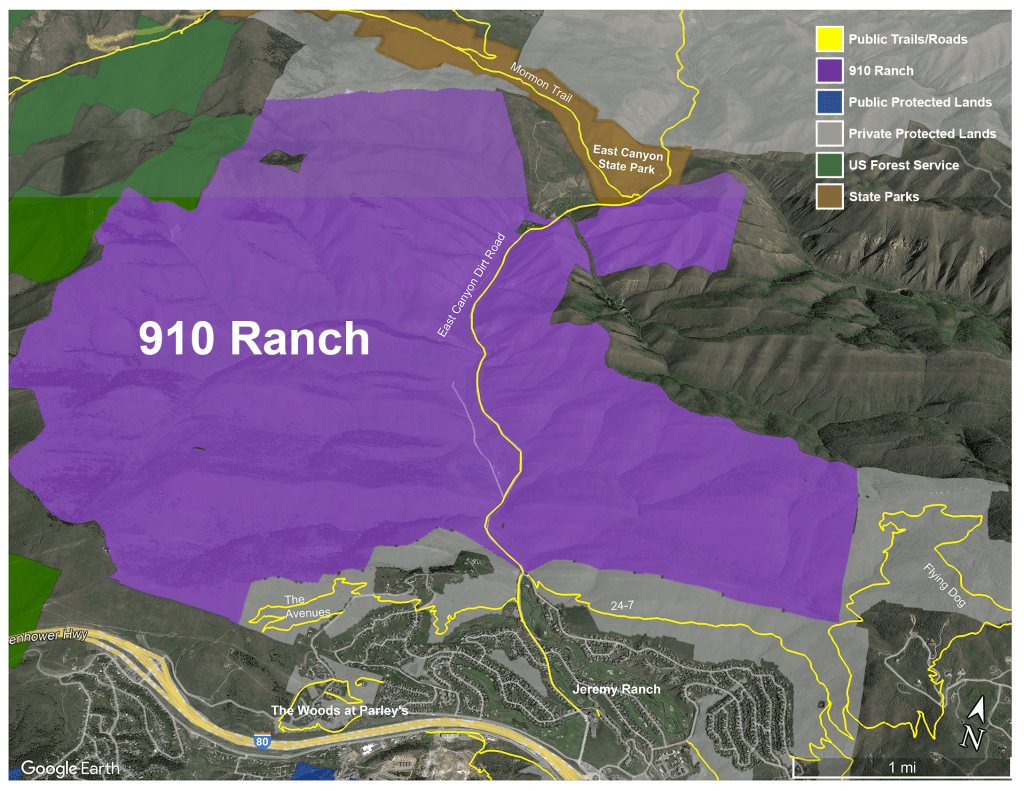
  • Summit County, Utah to vote on acquisition of 8,576-acre ranch

    Summit County Council is holding a special meeting this week to vote on the acquisition of an 8,576-acre property next to Jeremy Ranch and around the corner from Parkview Mountain House.

    The County Manager has recommended approval of the deal and these are the terms:

    – $55 million total purchase price (about $6,413 per acre)

    – Structured through a $15 million three-year option to purchase, with a right to extend for another year for an additional $5 million (option fees to be applied toward the purchase price)

    – During the option period, the County will have control of the property and pay $5,000 per month in rent

    Another way to look at this deal is that Summit County needs to initially come up with $15 million of equity. This is because they are getting seller financing for the remaining $40 million. (Implied loan-to-value of about 73%.)

    After 3 years, they will have to put in another $5 million, which lowers the implied LTV to about 64%. But in both cases, and assuming the $5k per month is all the County needs to pay, there’s effectively no interest on this 4-year “financing”. ($60k per year on $40-45 million.)

    The purchase price is also only ~$6k per acre, which should tell you that this is not development land. Its value is what you see here:

    And this is exactly what Summit County intends to do with the land: conserve it. As one of the last contiguous mountain ranches in the area that is privately owned, this sure seems like a win for the community. It’s a pretty good deal, too.

    Images: Summit County, Utah

  • Toward a culture of innovation and entrepreneurship

    One way you could oversimplify the Canadian economy is to say that it revolves around three things: natural resources, real estate, and high immigration. (You can tell me I’m wrong in the comments below.) More recently, we’ve also been touting the growing number of tech workers in our cities. But in some ways this is a bit of a vanity metric. 

    I think of it in terms of two different categories of workers. There are tech workers that are the result of foreign companies opening satellite offices to take advantage of the weak Canadian dollar and our more enlightened immigration policies. And there are tech workers that are the result of Canadian-based companies innovating, growing, and needing more talent. Think Shopify.

    The former situation is not at all bad, but a lot of the value is going to accrue outside of the country. Whereas in the latter situation, we get to be the principal recipients and we get all of the positive externalities associated with innovation and entrepreneurship. One of these is a powerful compounding effect. Successful startups tend to beget even more new companies. 

    So even though I work in and benefit from one of the three things that I mentioned at the beginning of this post, I believe that we need to be much better at encouraging a culture of innovation and entrepreneurship in Canada. We’ve become too complacent.

    This is a critically important topic that we don’t seem to be talking about nearly enough. So I plan to do more of that here on the blog.