Daily insights for city builders, delivered every morning at 6 AM ET. I’m Brandon Donnelly — a Toronto-based real estate developer and founder of Globizen. I’ve been writing here since 2013.

Category: Real Estate

  • Toward smaller condominium apartments

    Statistics Canada recently published some data (from 2022) looking at investors in the condominium apartment market. Here is what they believe to be the share of condominium apartments used as investment properties in Ontario’s 10 largest census metropolitan areas:

    It’s worth noting that this is after excluding condominium buildings where every single suite is owned by a single investor. This is/was most prevalent in London, and it’s the result of there being property tax benefits to registering a condominium (individual unit assessments), even though for all intents and purposes it’s a rental building (building in its entirety assessed).

    The article goes on to rightly suggest that the prevalence of investors, and the way that condominiums are financed, could be leading to the construction of more buildings with smaller suites. Here’s the proportion of new condominium apartments under 600 square feet by period of construction:

    The unsurprising takeaway is that condominium suites have gotten smaller. In the 1990s, the average condominium apartment built in the Toronto CMA was 947 square feet. This is compared to 640 square feet after 2016. And the same thing happened in Vancouver, which went from an average of 912 square feet to 790 square feet.

    Investor preferences certainly have something to do with this. But what the article doesn’t specifically mention is that this phenomenon is also a direct response to rising build costs: making suites smaller was how the market tried to maintain some level of affordability. Put differently, imagine how expensive new condominiums would be if the average size was still 947 square feet.

    But there are obviously limits to this. I was with one of our architects the other week and he made an interesting comment to me. He said, “Brandon, before when build costs used to go up and things got less affordable for consumers, we could just make the suites smaller to offset the impacts. But I don’t see how we can go any smaller now. We’ve reached the limit.”

    This is one of the reasons why I think this downturn is going to ultimately be a good thing for Canada’s housing markets. It’s a reset. It’s forcing everyone out of complacency and, hopefully, it means that when the next cycle begins we’ll be starting from a better foundation.

  • The art of high-rise living

    Today, I’m excited to share that I’ll be attending the second annual Elevate event this December as an industry ambassador. This means I get to ride alongside industry celebrities like Norm Li. (He better be DJ’ing.)

    Put on by Zonda, in partnership with Livabl and ARCHITECT Magazine, the event is focused exclusively on “the art of high-rise luxury living.” Everything from the overall state of the housing market to how to sell branded residences.

    Here’s the agenda and here’s the list of speakers.

    I wasn’t able to attend last year, but I heard from a number of industry friends that it was very well done, which is why I agreed to participate this year. That now means I have a discount code you can all use if you’d like to attend — BRANDONVIP30.

    For those of you who like art and culture things, the event also happens to fall right after Art Basel. This was done on purpose, and so now you have at least two good reasons to be in Miami Beach in December.

  • Development charges are an insidious problem

    Here is a recent chart from Mike Moffat showing how much development charges have increased in the City of Toronto from 2009 to today:

    We’ve, of course, seen this before. Back in 2020, I shared an article that developer Urban Capital published where they did a cost comparison between a project they had done in 2005 and a project they were doing in 2020. What they uncovered was that development charges alone had increased by 3,244%! The most of any line item in their pro forma.

    Development charges over the last real estate cycle have been an insidious problem. Meaning, the industry knew they were crazy high, and we were all trying to be vocal about it, but let’s face it — the general public doesn’t have a lot of sympathy for developers complaining about high fees. They are also largely hidden from purchasers and renters. The charges just get lumped in.

    If our industry could figure out how to be more transparent and separate out these charges, much like a sales tax, I think it would go a long way to showing consumers what they’re actually paying when it comes to new housing. And then maybe something positive would happen. Because this is a major reason why new housing has gotten so expensive in this region.

    Can you imagine if property taxes had increased by 3,244% over the last 15 years? I can’t. Because no one would have ever allowed that to happen.

    For better and for worse, the current market is going to serve as a rude awakening for municipalities. We’ve reached the breaking point. The housing market is, as we’ve talked about, in a “state of economic lockdown.” And when people don’t buy new homes, it means developers no longer have the money to pay development charges.

  • Equitable Bank launches construction financing product for laneway houses

    A few weeks ago, Equitable Bank launched a new construction financing product for laneway homes and garden suites in Canada. Here is the announcement. This is generally good news. When we completed Mackay Laneway House back in 2021, the banks hadn’t yet gotten their head around this housing type. I remember RBC getting tripped up on the fact that there were two detached dwellings on the same residential lot.

    That said, there are some important conditions around this new mortgage product:

    “The Laneway House Mortgage is offered on properties that are free and clear, or in combination with new or existing mortgages where Equitable Bank holds, or will hold, the first position.”

    In other words, they want no debt on the property or they want sufficient equity in the property — but Equitable Bank needs to hold the mortgage. I suspect that most of the people who have built laneway and garden suites have done so by leveraging the equity in their main house; so I’m not sure how “innovative” this product will end being in practice. You’ll also need to switch to Equitable Bank if you have your mortgage with another lender.

    Still, if you’re looking to build one of these homes — and I continue to believe that they make a ton of sense both financially and from a city-building standpoint — it wouldn’t hurt to see what Equitable Bank can offer.

  • Who owns single-family houses in the US

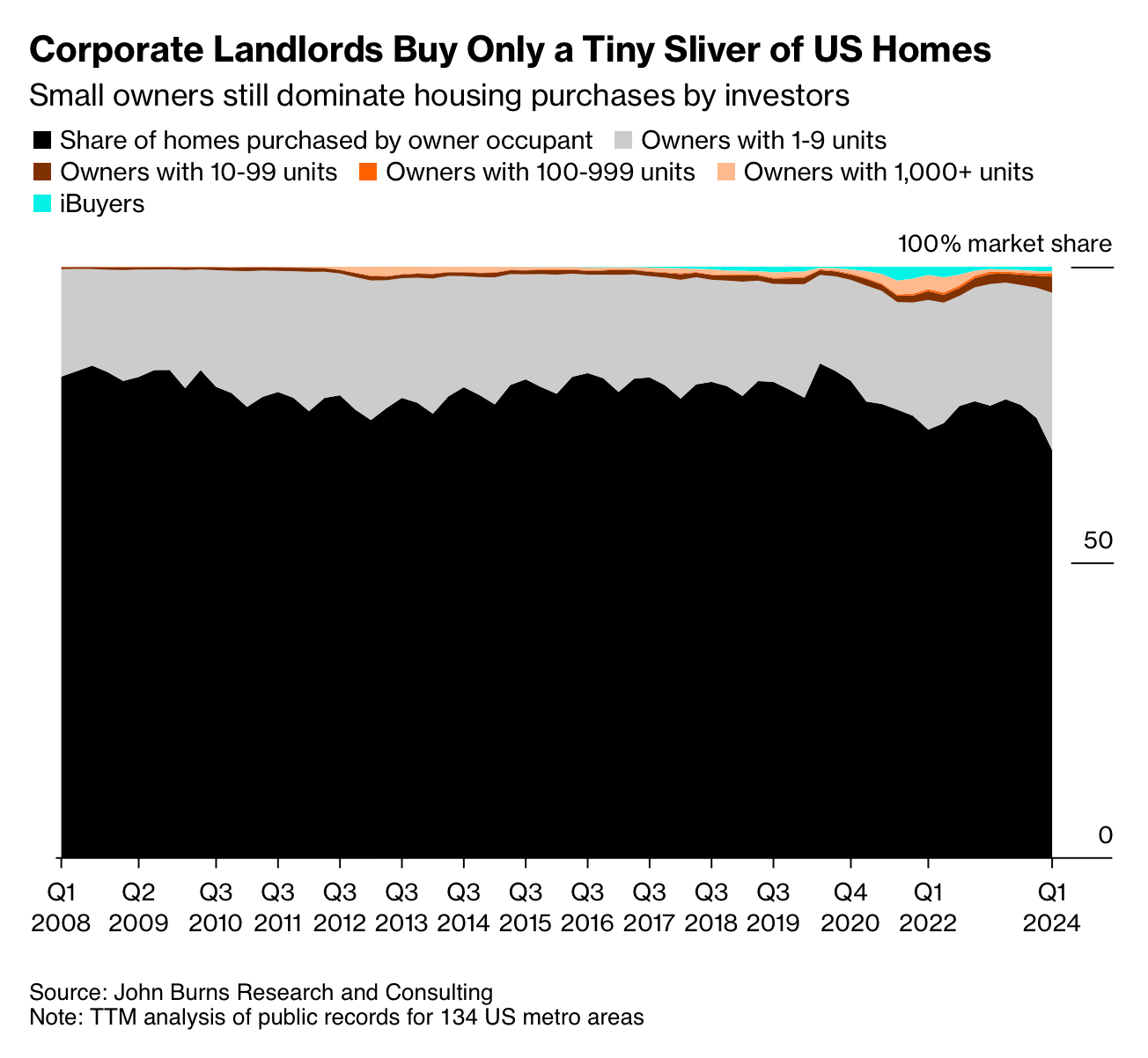
    Here is a chart from a recent Bloomberg article summarizing who owns single-family houses in the US.

    As of Q1-2024, about 69% were owner-occupied, about 26.6% were owned by small landlords (1-9 homes), and the rest were owned by what many are now calling “corporate landlords.”

    The point of this graph was to show that, despite getting a lot of political attention, corporate landlords still own very little. Let’s call it sub 4%, excluding iBuying companies like OpenDoor. So how much of a problem is this, really?

    Smaller landlords control much more of the US market. And at the end of the day, a house owned by a small landlord versus a corporate landlord doesn’t change the supply-demand balance of a market. It still represents an available home.

    The first and more important problem to solve is overall housing supply. Because that does change the supply-demand balance of a market. And once again, there’s no shortage of data to support the finding that increased supply tends to moderate rental growth.

    For the record, I also dislike using the term home to refer to single-family houses. Home is not a housing type. It is simply a place where people live permanently. So whenever I see a title like “US homes,” I get confused, because I don’t actually know what they’re referring to.

    If you read the article, it would appear they’re only talking about single-family houses. But implying that these are the only kind of home feels to me like an anachronism.

  • Detroit is back!

    Fascinatingly, buildings are always a product of their time.

    Detroit’s Book Tower, for example, started construction in 1916. This is right around the time that Detroit became the 4th largest city in the US (after New York, Chicago, and Philadelphia). From 1910 to 1920, the city’s population grew by about 113% to nearly a million people (more people than the city has today).

    Because this was the time, the tower was obviously grand. It totalled almost half a million square feet of office space (483,973 sf to be exact, according to Wikipedia). It had a large 3-story atrium with an ornate glass dome. And up until the 1970s, it seems that it remained a desirable office address on Washington Boulevard.

    But as we all know, things changed for Detroit. Grand and ornate no longe made economic sense. And so the owners at the time, whoever they were, covered up the ornate dome, filled in the floors of the atrium, and presumably did whatever they could to eek out as much leasable square footage as possible. Necessity trumped grandeur.

    Then in 2007, the then-landlord filed for Chapter 11 protection. And in 2009, the last tenant left the building, leaving it 100% vacant — or “unencumbered by tenants” as we like to say in the business.

    Thankfully in 2015, Dan Gilbert of Bedrock came along to do what he does, and acquired the building for a reported $30 million. This works out to about $61 psf for what was once the tallest building in Detroit and one of its most prestigious office addresses. Things change.

    But what Bedrock has done since is work to return the building to what architect Louis Kamper had originally created nearly a century ago. The atrium is back. The ornate glass dome is back. And there are now 229 apartments, 117 extended-stay hotel rooms, 3 food and beverage concepts, and about 40,000 sf of office space. Official website, here.

    What an awesome way to say, “Detroit is back!”

    Photos: Rebekah Witt via Fast Company

  • Stubborn flexibility

    I’ve been having more coffee meetings over the last few weeks. And one of the things they are doing — besides making me jittery — is reminding me that at least two things happen during bear markets:

    1. Conviction gets tested.
    2. People get really creative.

    Let’s start with number one. It’s easy to have conviction in something when it’s obviously working and lots of other people are doing it. But what about when that is no longer the case?

    Take the example of Amazon. In this 2018 post by Fred Wilson, he reminds us that at the peak of the internet bubble in 1999, Amazing was trading at around $90 per share. Two years later it was somewhere around $6 per share. And it was not until 2007 that Amazon would start trading above its peak again.

    In hindsight, holding on was very obviously the right thing to do. But to do that from 1999 to 2007, you would have needed patience. And to have patience, you would have needed a high degree of conviction in Amazon as a company and in the internet as the harbinger of an important societal shift. That wouldn’t have been easy — just like many things today are not easy.

    At the same time, bear markets force people to get really creative — we’re now onto thing number two. In this case, it’s not a question of patience. It’s, “the thing I was doing before no longer works and I don’t know if/when it will work again, so I’m going to get creative and try something new.” Bear markets give you this wonderful opportunity because the opportunity cost of not doing the status quo disappears (or greatly reduces).

    On some level, though, these are two contradictory things: are we sticking to our guns or are we trying something new? But in my mind, you want both. This is not about saying, “lots of people used to want to buy cryptocurrencies and condominiums, but now a lot of people don’t, so I’m going to move onto the next hot thing.” It’s something more calculated than this.

    To return to Amazon, I think it’s akin to Jeff Bezos’ old mantra that you want to be stubborn on vision, but flexible on the details. Right now, lots of people are being forced to be flexible. But the vision part is what you still need conviction around. Otherwise, how will you get to where you want to go?

  • Remember unfunded inclusionary zoning?

    Over the weekend, we spoke about how the “GTA condo market is in a state of economic lockdown.” What this generally means is that the math isn’t making sense to build new condominiums. And so the market is necessarily pausing.

    We spoke about what this will likely mean for supply in the coming years, but I think it’s also interesting to talk about this in the context of something else: unfunded inclusionary zoning.

    As a reminder, inclusionary zoning is, in its most basic form, a requirement to build a certain amount of affordable housing as part of new housing developments. And what I mean by “unfunded” is that there are no subsidies or other incentives being provided to the project.

    This means that the cost of providing this housing — and there is an additional cost — needs to be shouldered by the project, which ultimately means the market-rate units need to pay for it.

    Which is why if you look at most policy studies, you’ll often find recognition that, because of this economic reality, IZ tends to work better in areas where home prices/rents are higher. And again, that’s because the market-rate homes need to shoulder the cost.

    We have questioned, many times, on this blog, whether this is the right approach to delivering affordable housing, but I think this question becomes even more critical in our current market environment.

    If the entire market is, for the most part, in a state of economic lockdown, should we really be layering on additional costs and making it broadly more difficult to build any sort of new housing? It seems counterintuitive.

    For more on this topic, check out this recent Sightline article by Dan Bertolet.

  • Ontario should have more solar energy

    I have a very close friend (Peter Vogel) who is in the solar business. He runs business development for a company called Otter Energy. And by volume, I believe they are the largest in Ontario. Since 2009, they have installed over 350,000 panels.

    So when Peter and I hang out, I get the benefit of learning about solar. And he is great at reminding me that installing panels on the roof of buildings in Ontario makes a ton of sense from both an environmental and financial standpoint.

    Generally speaking, the amount of benefit you will see depends on the building’s ratio of roof area to overall building area. Low-rise buildings with a lot of roof area (think industrial assets), are absolute no brainers. But it can also work very well on many other asset classes, including mid-rise multi-family.

    Here are some high-level figures that he recently walked me through:

    • As a rule of thumb, solar in Ontario typically generates between 12-14 kWh’s per year per square foot of roof area (usable flat roof).
    • The average payback period for an install is usually somewhere between 4.5 to 7 years.
    • However, on income producing properties, the permanent decrease in operating expenses and the corresponding increase in net operating income (NOI) will increase your asset value on day one.
    • Consider spending $100k on solar panels to increase your NOI — through lower electricity costs — by $10k. If you were to then capitalize this increase in NOI by 5%, it would mean your asset value has right away increased by $200k. If the cap rate for this asset is even lower, say 4%, the increase goes up to $250k.
    • These multiples can get even better with larger installs. Here are some numbers from a real-world 100,000 sf commercial building in Ontario. In this case, the solar system cost about $800k (net) and resulted in annual operating cost savings of about $140k. This means, that at a 5% cap rate, the owner spent $800k to increase the value of their asset by $2.8 million on day one.
    • Of course, in addition to all of this, you get long-term energy cost certainty. That’s worth something too.

    The business case is compelling. So I think more building owners should be looking at solar. We are certainly looking at it from a development perspective. If you’re interested in learning more, feel free to reach out to my friend. There are a lot of details that help strengthen the case for solar, including depreciation allowances and tax credits.

  • I really want to live over there

    One way to describe cities is to call them labor markets. Historically, people have chosen to live in cities because they have provided economic opportunities (among, of course, many other things). That’s why the data is very clear: wages are higher in larger cities.

    But what we have also seen over the last few years — and what is causing a lot of dislocation in real estate markets — is an untethering of work. More people are working from home and from locations that offer greater lifestyle benefits (or greater tax benefits).

    We spoke recently about what this divide between in-person and remote work might mean, but regardless of this outcome, I think there’s an important truth here: Lots of people would like to live somewhere else. (In my case, my daydreams take me to Paris.)

    And for the first time ever, really, it is possible for more people to do this and stay connected to work somewhere else. Earlier innovations, such as the streetcar or car, also compressed geographies and empowered people to travel greater distances. But now the catchment area has seemingly expanded to the world.

    I’m not saying anything particularly novel here, but I do think it’s important to point out that this desire exists in many of us. Because this tension between “I do work here” but “I really want to live over there” seems like it’s only increasing.