Daily insights for city builders, delivered every morning at 6 AM ET. I’m Brandon Donnelly — a Toronto-based real estate developer and founder of Globizen. I’ve been writing here since 2013.

Category: Real Estate

  • TikTok studios are the new multi-family amenity

    I just finished reading about an apartment building in Los Angeles that is currently retrofitting its amenity spaces to include, among other things, an appropriately spread out co-working space, two podcast rooms, and a TikTok studio. This latter amenity will be a roughly 100 square foot room with camera-ready lighting, tripods, and mirrors. It was described in the article as the perfect place for one or two people to create things and entertain themselves.

    The gist of the article is that home offices are the new must-have amenity and that developers have started to rethink apartment amenities in light of this. But I also take this to be a sign of the times. We are living in a world of content creation. Whether you’re a so-called influencer or not, TikTok has, for a lot of young people, replaced many other forms of entertainment and everybody, at this point, probably needs their own podcast.

    It is also true that there’s an “amenities arm race” going on within the apartment sector. This is nothing new and doesn’t have much, if anything, to do with this pandemic. Amenities have been how you differentiate your offering. And when you’re constantly selling (i.e. leasing all the time), they do become important. So here’s to podcast rooms and TikTok studios. If you had your pick, what kind of amenities would you like to see in your building?
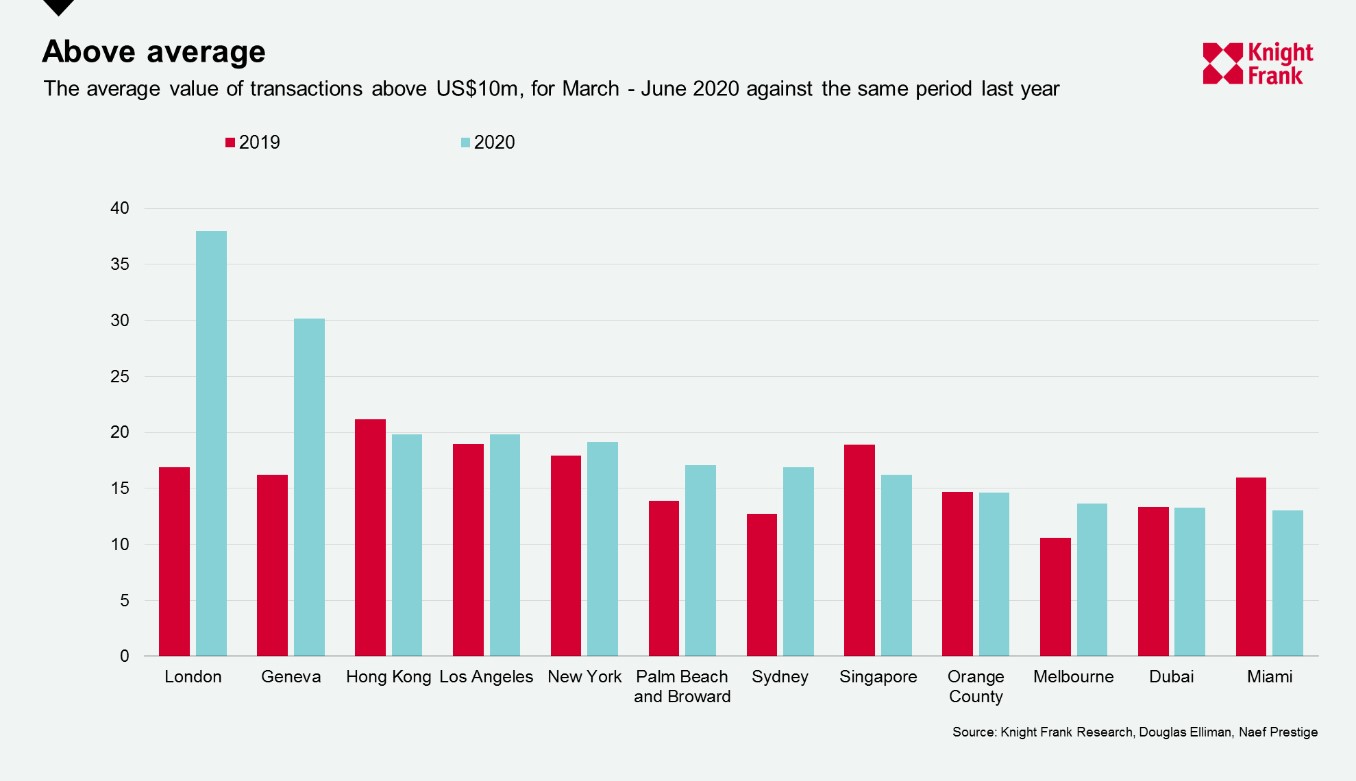
  • Super-prime property transactions in the first half of 2020

    This is a chart from Knight Frank showing the average value of “super-prime” residential real estate transactions in 12 global markets between March and June 2020, and versus the same period last year.

    Knight Frank classifies super-prime real estate as having a value greater than US$10 million and ultra-prime real estate as having a value greater than US$25 million.

    In this particular chart, London takes the top spot with an average super-prime transaction value of US$38 million. This is a big jump compared to 2019 where the average value was US$16.9 million.

    Typically it is Hong Kong that takes the top spot in this ranking, but this year it fell to third. Still, Hong Kong had the highest number of transactions with 60 super-prime sales taking place in the first half of 2020. This is down from 155 in the first half of 2019.

    Overall, Knight Frank recorded 281 super-prime transactions across these 12 cities in the first half of this year. This is, not surprisingly, a decline compared to last year, which saw 594 transactions over this same time period.

    But all things being considered and given some of these price increases, the super-prime market is certainly holding its own.

    Chart: Knight Frank

  • Coming soon

    onedelisle.com / #onedelisle

  • Canadian real estate fundamentals

    Last week was the Vancouver Real Estate Forum. Benjamin Tal (chief economist at CIBC) opened things up, as he usually does, and he was pretty candid about what might be coming this winter. Here is an excerpt from a recent Globe and Mail article summarizing the event:

    “It’s reasonable to assume that the next six months will not be very pretty,” said Mr. Tal. “The honeymoon of the summer is basically over. Now we enter the winter months, and I think the next few months will be much more difficult. We will have a situation where we will clearly see a second wave, and it’s already starting. This second wave will overlap with the flu season, so everybody will be very confused. The fear factor will rise, and that’s something we have to take into account when we look at the trajectory of the economy.”

    Indeed, today kind of feels like the official start of the second wave. Here in Toronto, indoor dining, gyms, and a bunch of other things were just shut down for the next 28 days.

    But I think the more important takeaway from the article is this one here: the fundamentals around Canadian real estate remain incredibly strong. Another excerpt:

    “Let’s visit the market in 2023: I suggest the market will show the same trend we have seen in as 2019. This is a pause, but the fundamentals of the real estate market in Canada are so strong that the demand factor will continue to be there and supply will be limited. I suggest that after a two- to three-year period of some sort of softness, despite the V-shaped recovery that we are seeing, I see continuation of the trend.”

    As I’ve said before on the blog, it’s easy to get caught up in shorter-term and ephemeral headlines. But if one can look through some of that to the other side of this health crisis, I think we would all be in a position to make better decisions.

    As a general rule, I don’t like making long-term real estate decisions based on what is expected to take place in the next 6 months.

  • Extell Development to build $2 billion ski resort near Park City

    New York-based Extell Development is, according to this recent WSJ article, in the midst of trying to build a $2 billion full-service ski and snowboard resort near Park City, Utah. It would be the first new resort in the United States in about four decades. These things are, clearly, difficult to get approved, and the fundamentals are, arguably, not all that great. In the early 1990s, the US had about 546 ski and snowboard resorts across the country. As of the 2018-2019 season that number had dropped to 476, according to the WSJ. People are skiing less than they used it, it would seem.

    To be a bit more precise on its location, the proposed resort, which is currently called Mayflower Mountain Resort, is to be located next to Deer Valley Resort. And there’s even a plan floating around to possibly merge the two resorts. That’s apparently what the county planners want. I’m not all that familiar with Deer Valley because they don’t allow my kind there (snowboarders). But it’s an exclusive resort with a country-club kind of feel (or so I’m told). So it shouldn’t come as a surprise that the proposed merger doesn’t seem to be getting a lot of traction with the patrons of Deer Valley.

    But here’s the interesting thing about the Mayflower site. It’s generally controlled (to what extent, I don’t exactly know) by an entity called The Military Installation Development Authority. And this entity has the power to do things like issue bonds and grant certain land-use approvals. This means that there may be an angle to streamline the approvals process (i.e. make this project actually feasible) and to leverage things like tax increment financing (TIF) in order to fund the project.

    Supposedly a new mountain resort has been on the books for this site for some 30 years. Could now finally be the time? If they allow my kind, you can count me in.

    Image: WSJ

  • Everything has a cost

    A new report was just published by Urbanation and the Federation of Rental-Housing Providers of Ontario (FRPO) arguing that the Greater Toronto Area is undersupplying rental housing to the tune of about 20,000 units per year. This number considers both purpose-built rental housing and condominiums that are purchased by investors and later rented out. (Shane Dingman also covered the report in this recent Globe and Mail article.)

    These findings probably won’t come as a surprise to a lot of you. It is pretty common for most big/growing cities to operate with a perpetual housing supply deficit. With all of the barriers to development, it’s often impossible to keep pace with demand. This naturally creates upward pressure on pricing. But the other factor that cannot be ignored is development costs. How much does it cost to actually deliver new supply?

    Here’s an excerpt from the report that speaks to this consideration:

    While the results of the infill development potential exercise are encouraging, the economics
    of intensifying these sites may be too difficult for owners to ultimately move them forward in many cases even with a zero land cost, as achievable rents outside of Central Toronto are
    often not high enough to offset development and operating costs.

    It’s also something that we’ve talked about many times before on the blog. Even with free land, there are going to be countless sites and neighborhoods where it does not make economic sense to build anything new: development costs > potential revenues. And so to build, somebody is going to have to pay. Either the costs need to be subsidized or the revenues needs to be topped up somehow. Otherwise, supply = 0.

    If you’re facing a deficit of 20,000 units per year, this seems like something you may want to consider. How might we increase supply? And how might we increase the supply of affordable housing? Many, including some of the folks interviewed in Shane’s Globe and Mail article, believe that inclusionary zoning is one such solution. Force new developments to deliver a certain percentage of affordable units (kind of like forcing restaurants to offer up 5-10% of their tables at a loss).

    But again, I think it’s important to remember that whenever costs exceed revenues, somebody is going to have to pay for that shortfall, otherwise supply = 0. Something has to give, whether that be reduced costs, greater density, or higher rents on the remaining market rate units. I think part of the allure of inclusionary zoning is that it creates the allusion of a free lunch. But here’s the thing: everything has a cost.

  • Knock knock — more on Opendoor

    Packy McCormick’s latest “Not Boring” essay is up and it’s about Opendoor. It’s a good follow up to last week’s announcement.

    Maybe that’s why housing is one of the last major categories that technology has left alone. Sure, companies have tried. Tons of them. The startup graveyard is filled with companies led by entrepreneurs who realized that the way we buy and sell homes sucks, but couldn’t ultimately figure out how to change it. They weren’t thinking big or long-term enough. The companies that have made the biggest impact, like Zillow and Redfin, make it easier to search for houses, but then kick buyers over to agents to go through the offline process, the same way it’s always been done. 

    This is topic/problem that is near and dear to me because I spent a year of my life working on a startup that initially set out to solve this exact problem. But like countless others, we couldn’t figure out how exactly to change things. So we pivoted.

    Has Opendoor finally cracked the code? I don’t know. But they’re on to something. It is, however, worth noting that the company was founded in 2013. And so what is happening today is already 7 years in the making — and probably longer if you consider the founder’s past startups.

    Tough problems clearly require time. Money doesn’t hurt either.

  • Weekly link roundup — laneway housing to SPACs

    Here’s a weekly round up of links and articles that you may find interesting. The topics cover the sorts of things that we usually talk about on this blog.

    • The latest Mackay Laneway House update is now live on the Globizen Journal. The ground floor steel is complete, with framing currently underway. The post has some background on the challenges faced in order to get to this stage.
    • Brick comparison. Here’s a recent tweet of mine. I’m curious if any of you can tell the difference between these two brick finishes and if you have a clear preference. One of them is stamped concrete and the other is real brick (precast concrete with brick slips).
    • Pools as art. Apparently this is a trend right now, but it’s not necessarily a new one. Pablo Picasso accidentally created one when he “signed” the bottom of one in Spain back in the early 1960s. A pool would be fun right now. [FT paywall]
    • Alley house in King’s Cross by architect David Adjaye is currently on the market for £6.5 million. Lots of black. I love the mint green room with the exposed concrete ceiling. Oh, and there’s a pool.
    • Nightclubs are, not surprisingly, really struggling. Most have been closed since March. Unlike restaurants, you can’t really hack together a solution with outdoor dining, heat lamps and takeout. They’re predicated on people being proximate to each other. [Sorry, another FT paywall]
    • SPACs are so hot right now, particularly in the world of Chamath Palihapitiya and Social Capital. A good follow-up to this week’s earlier post about $IPOB’s merger with real estate startup Opendoor.
    • Monocle has just published a new book about “gentle living.” It’s a guide to “slowing down, enjoying more and being happy.” I’m trying to do more of this, or at least be more mindful about it. It doesn’t always/usually work. Perhaps I need this book.
    • “Decade of the home.” Opinion piece about the current desire for suburban over urban locations. If you’re a regular reader of this blog, you’ll know that I am steadfast in my belief that urban life is going to prove to be incredibly resilient on the other side of this.
    • McKinsey report about the impact that lockdown is having on digital adoption, e-commerce penetration, and the overall customer experience. You’ll need to enter some information in order to download the PDF, but it’s free.

    Photo: Lost House by Adjaye Associates via The Modern House

  • Percentage of US mortgages in forbearance

    This recent WSJ article, which is largely about single-family home landlords in the United States, has some interesting charts about mortgaged homes. The following chart shows the percentage of US homes that are worth less than their debt (i.e. they’re underwater). Following the financial crisis, the figure was about a quarter of all mortgaged US homes, and it stayed that way until almost 2012. This percentage surprised me.

    The other chart that I’d like to share today shows the percentage of US mortgages in forbearance (i.e. people deferring payments). Not surprisingly, the percentage really increased in April, peaked in early summer, and has since started to seemingly decline. I say seemingly because who knows what this fall/winter will bring. As of September 6, the number was about 3.5 million home loans (or about 7.01%).

    The point of the WSJ article is that there are a segment of people who are house-rich, but cash-poor. They have equity that they have built up, but maybe not a lot of cash to weather a storm. That could force some to sell. And it could be a boon for the rental-home landlords, who have been, in many cases, betting on the the suburban rental market since the last recession.

  • Housing supply in Tokyo

    It has been well documented that Tokyo tends to build a lot of housing. And the argument goes that this has helped to maintain a certain level of housing affordability. The city is constantly building and rebuilding. It also has different views about housing. Now, we could, of course, debate how much of its relative affordability is a direct result of supply but, regardless, there seems to be a lot of it. In 2014, the city of Tokyo saw 142,417 housing starts, according to this recent FT article. This is compared to ~5,000 units across the Bay Area (2015 data), 83,657 units for the state of California, and 137,010 units for all of England.

    If you’re wondering how Toronto is doing, here are the latest numbers: