
Daily insights for city builders, delivered every morning at 6 AM ET. I’m Brandon Donnelly — a Toronto-based real estate developer and founder of Globizen. I’ve been writing here since 2013.

Category: Places

  • The future of Vancouver’s West End

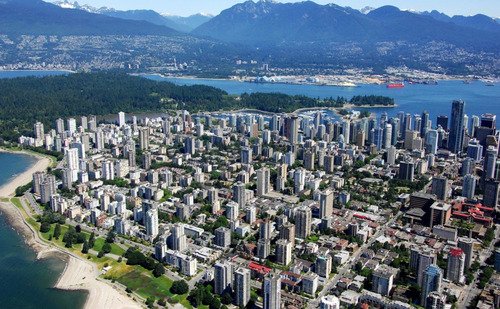
    Spacing Vancouver recently published an interesting look at Vancouver’s West End neighborhood. And it led me into a deep dive of the neighborhood’s recently adopted Community Plan (November 2013). So today I’d like to talk a bit about the neighborhood and also their plans for managing growth over the next 30 years.

    Officially established in 1969, the West End spent the next 3 decades as the most densely populated area of Vancouver. But starting in the 2000s with the development of high-rise condo towers in neighbouring areas such as Downtown South to the southeast and Triangle West and Coal Harbour to the northeast, the West End lost this position. Today it’s the 4th most densely populated neighborhood in the city.

    The bulk of the housing (77%) is in the form of apartments with 5 or more storeys. And 81% of residents are renters. This is well above the city average of 52% and is likely a reflection of the neighborhood’s younger demographic (25-29 years old is the largest segment) and its position as a landing ground for new Vancouverites.

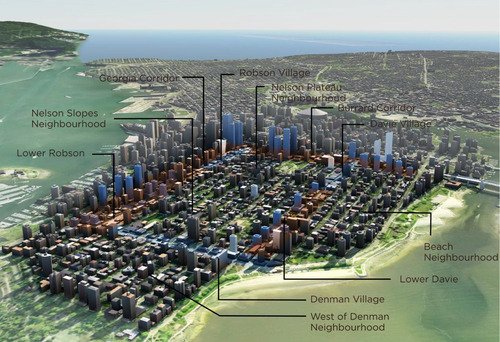
    But as a large central area with exceptional access to natural amenities, I would imagine that development pressures are and will continue to be significant. To plan for this growth, the city wants to intensify the central areas of the neighborhood with low-rise and mid-rise form and the periphery with high-rise towers. And already this is happening with developments such as the 62-storey Shangri-La Hotel.

    Here’s an image depicting their 30 year vision:
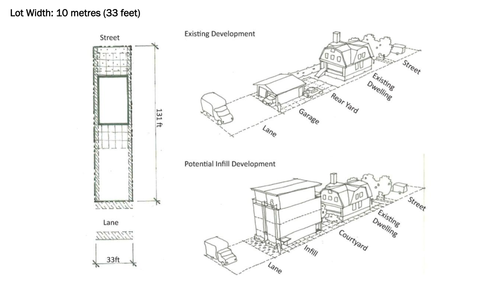
    But what stands out for me in the Plan is Vancouver’s continued commitment to laneway intensification. The Plan refers to it as “Laneway 2.0” and they specifically mention the opportunity to redevelop the West End’s wide laneways with “ground oriented infill housing.” Below is an example of how this could be done on a small residential lot, but the Plan also includes images for how the same might be accomplished on underutilized apartment building sites.
    Laneway housing is a topic I’ve written about extensively on ATC. Toronto is absolutely behind on this. And as I’ve argued before, we need to be looking at urban intensification across all scales, from low-rise to high-rise, if we want to create inclusive and vibrant cities. With the West End Community Plan, Vancouver seems to be doing just that.
  • Les escaliers de Montréal

    Montreal is one of my favorite places on the planet. In fact, if I have one regret in life it’s that I didn’t do my undergrad at McGill University. Living in Montreal as a poor student would have been the best. Though I shouldn’t complain because I did spend quite a bit of time there when I was a poor student.

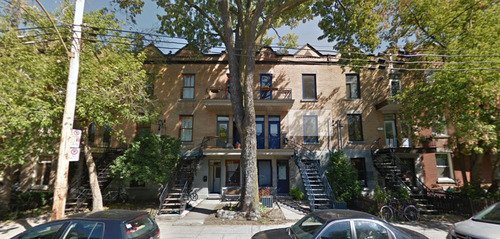
    If you’ve ever been to Montreal, the image at the top of this post will look familiar. The urban landscape of Montreal–at least in the residential areas–is filled with exterior staircases. They’re all over the place. And this always strikes everybody as a bit odd given that it’s a pretty cold and snowy place a lot of the time. Nonetheless, those staircases are quintessentially Montreal.

    Some people think it was done to minimize the amount of interior space that needed to be heated, but I’ve never really gotten a definitive answer. Either way, all those stairs are an interesting byproduct of Montreal’s commitment to one predominant building type: the multiplex. A multiplex is essentially a small apartment building containing a handful of units. They’re usually only around 3 storeys high. And they’re all over the Ville de Montréal.

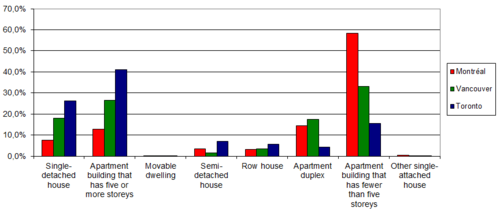
    To be honest though, I don’t think I’ve ever really explicitly thought about this defining Montreal quality. But then last night I stumbled upon an interesting blog post called “Les escaliers de Montréal vs towers of Toronto." (escaliers = stairs) In it the author talks about how Montreal is essentially this city of multiplexes (with stairs everywhere) and Toronto is this, more modern, city of towers surrounded by single family homes.

    And here’s the data to back it up:

    When it comes to single-detached houses and apartment buildings taller than 5 storeys, Toronto dominates. But when it comes to apartment buildings less 5 storeys, it’s all Montreal. And if you add in apartment duplexes, you’ve accounted for almost 75% of Montreal’s housing stock. Note: These figures are for the city proper and don’t include any amalgamated suburbs.

    The author’s explanation for this comes down to zoning and timing. Since Montreal is an older city, the belief is that Montreal was simply further along in its evolution when formal land-use planning came into effect and started to order the city. I generally agree with this hypothesis, but I think it’s also worth keeping in mind that, just because a Toronto house might be zoned as single family, doesn’t mean it’s actually begin used as such.

    A lot of the older houses in Toronto have been subdivided into what are effectively illegal multiplexes. Since this is all happening under the radar, nobody really knows what the actual stock of multiplexes might be. Nonetheless, there’s no denying that there are some real differences between the urban fabric of Montreal and Toronto. 

  • New York YIMBY

    Yesterday a friend of mine sent me this NY Times article covering a site called New York YIMBY.

    I’ve spoken about the term YIMBY before and this site is exactly that: a site dedicated to “saying yes in my back yard” to new development in New York. It was founded by 23 year old Nikolai Fedak and currently receives 75,000 monthly visitors. He has plans to expand to other cities and I’ve already emailed him to see if he has any plans for a Toronto YIMBY.

    At a time when it’s common to hate on developers and new developments, it’s refreshing to see a site dedicated to the exact opposite. That’s not to say that all developments are good (New York YIMBY has no problem blasting the ones that suck, as it should), but it’s certainly framing development as a positive thing for cities. 

    In growing cities like New York and Toronto, development is going to happen. And so I would rather we focus on how to make it happen in the best way possible instead of just saying no.

  • 50% of apartments in New York are under a form of rent control

    A friend of mine who lives in New York recently sent me this interesting article: “The Perverse Effects of Rent Regulation.” And he sent it to me, because he wanted me to take note of this stat:

    There are, effectively, two rental markets in Manhattan. Roughly half the apartments are under rent regulation, public housing or some other government program. That leaves everyone else to compete for the half with rents determined by the market.

    50% is a big number. I would never have guessed that the New York rental market would be split in such a way. But it is split because it’s fairly clear what would happen if it weren’t: 

    “Poor people would be priced out of Manhattan,” he says. “Period.”

    This, as the article argues, could threaten the diversity that has made New York the economic and cultural hub that it is today. But at the same time, there are a number of important questions: Is 50% the right split? And are the control mechanisms in place the right kind of mechanisms? Should rent controls be attached to people as opposed to apartments, which is how it’s typically done today?

    Diversity is hugely important and there will always be a portion of any city’s population that cannot afford market rents. But intuitively, and I could be wrong, 50% seems high. It seems high because these types of rent regulations achieve the exact opposite for the balance of the market that has to pay market rents: their apartments become more expensive.

    I’ve been having a lot of discussions lately about affordable housing and rent control always comes up. I think that in a lot of cities there needs to be some sort of intervention in the market to keep them from becoming homogenous playgrounds for the rich. But I also believe that many policies–which may sound great in theory–can have unintended market consequences. These need to be seriously looked at.

  • 80% of New York’s 150 million taxi trips could be shared

    I’ve been a big fan of MIT’s Senseable City Lab since I was a grad student at Penn. Their work sits at the intersection of cities and technology, and so I’ve always found it incredibly fascinating.

    Recently, the lab examined data from all of New York’s 13,586 registered cabs and looked for ways that technology and mobile tech could potentially optimize the way the system works today. In particular, they were interested in examining instances where people were heading to the same place at the same time, and were within no more than a 3 minute walk of each at the start of the trip.

    What they found was that, of the 150 million taxi rides taken in New York City during 2011, almost 80% of them could have been shared.

    That is, 80% of the time, there was an overlap in both time and route. That’s an hugely interesting stat because it starts to show just how much waste and inefficiency there currently is in the system. Think about all the trips and carbon emissions that could be potentially eliminated through optimization.

    Here’s a video they produced on the project. Click here if you can’t see it below.

    [youtube https://www.youtube.com/watch?v=Gyq_Zr96uzs?rel=0]

    It’s a great example of how technology is and will continue to creep into every segment of the economy. It’s exactly what I was talking about in my post, “Disrupting everything.”

  • New York City on Market Street

    On my walk to the subway this morning I was confronted by a transformed Market Street in Toronto’s St. Lawrence Market area. New York City had taken over.

    There were NYC yellow cabs, NYPD cars, FDNY trucks and lots of film people milling about in Canada Goose jackets. Toronto, once again, stands in for New York.

    image

    But while I think it’s great that we’re (presumably) creating a bunch of local jobs, there’s also a part of me that hates to see this. I hate it because I want the Toronto brand to be strong enough so that movies actually take place here, instead of just being filmed here.

    I mean, who wants to be the stand-in? It’s much better to be the actor.

  • How Bloomberg transformed the streets of New York

    Here’s a great video by Streetfilms that shows the incredible transformation of New York’s public realm during the Bloomberg administration. I found it via The Urbanophile blog. It’s about 5 minutes long.

    Video Description: “There’s nothing more dramatic than looking back five or ten years at Streetfilms footage to see how much the streets of New York City have changed. In this wonderful montage, check out the incredible changes at Times Square, Herald Square, the Brooklyn waterfront, and many other places that outgoing NYC DOT Commissioner Janette Sadik-Khan and her staff have intrepidly transformed.”

    It just goes to show what can be accomplished with the right leader and political will. I wish we (Toronto) had a mayor who understood the value of beautiful public spaces and bike lanes. It’s unfortunate that these things often become attached to political orientation. This shouldn’t be the case. It’s just good city building.

  • Airbnb subpoenaed for information on its 15,000 New York City “landlords”

    Last Monday, the Office of the New York Attorney General subpoenaed Airbnb for information about all of its 15,000 “landlords” who rent out spaces in New York through their service. Airbnb has since refused to provide the information.

    This is an interesting case. Airbnb is one of those startups that seemed initially like an idea too crazy to work, but has since grown to become a serious disruption to the hotel industry. However, the problem is that many jurisdictions have laws pertaining to illegal hotels. In the case of New York, the law prohibits short-term rentals under 30 days unless the permanent resident is present alongside the guest(s).

    What this means is that renting out your apartment while you’re away for the weekend-which from my experience here in Toronto is how a lot of people use the service-is technically illegal in New York. State senator, Liz Krueger, believes that apartment building residents shouldn’t have to worry that their neighbouring apartment could turn into a de facto hotel room.

    While I do sympathize with this concern, I think there’s a gradient of use here. Not every Airbnb user is operating a de facto hotel. Many, whatever that percentage might be, simply use it to earn extra income while their place sits idle. And to do this, the permanent resident is trusting their home to a stranger.

    So in a way, there’s a filter in place that isn’t there when the unit is being operated strictly as a hotel suite. Therefore, maybe we just need to expand the definition of having a “permanent resident present” to include having their belongings and life in the place.

    It’ll be interesting to see how this all pans out. But whatever the result, it’s clear that Airbnb is definitely shaking up the status quo. Do you think residents should be freely allowed to rent out their places on any term?

  • Tech is now the second largest job sector in New York City

    According to a recent report called Building a Digital City, which I found via Fred Wilson’s blog, tech is now the second largest job sector in New York City behind financial services (which includes real estate). There are an estimated 262,000 tech workers in the city earning wages in excess of $30 billion.

    This is a really interesting stat that speaks to the diversity of New York’s economy and the ability for it to continually reinvent itself. But what I found particularly interesting, was the following comment by Fred Wilson:

    “And the reason tech is growing so fast in NYC is that it is embedding itself in all of these other industries. It’s not entirely clear to me whether Gilt is a tech company or a fashion/retail company, it is not clear to me whether ZocDoc is a tech company or a health care company, it is not clear to me whether Codecademy is a tech company or an education company.”

    This is very much the way I think about so called tech companies today. I recently had a Rotman colleague say to me that he felt the startup world was becoming saturated. Everyone is now seemingly working on some new app.

    But I like to think of it slightly differently. As Fred’s comment above suggests, a lot of startups today aren’t purely tech companies. They’re just out to solve a problem and it just so happens that technology and the internet are creating all sorts of opportunities for new solutions.

    I also read a blog called Platform Connected and the author put it like this:

    “In the future, every company will be a tech company. We already see this change around us as companies move to restructure their business models in a way that uses data to create value. We are moving from linear to networked business models, from dumb pipes to intelligent platforms. All businesses will need to move to this new model at some point, or risk being disrupted by platforms that do.”

    So there you have it. Software really is eating the world.

  • Sky High and Going Up Fast: Luxury Towers Take New York

    A tower being built on Park Avenue is part of Manhattan’s booming ultraluxury construction business, a trend that is warping the real-estate market and driving up overall costs.

    Sky High and Going Up Fast: Luxury Towers Take New York