Daily insights for city builders, delivered every morning at 6 AM ET. I’m Brandon Donnelly — a Toronto-based real estate developer and founder of Globizen. I’ve been writing here since 2013.

Category: Places

  • A single room with a single book, Tokyo

    This recent post by Benedict Evans talks about the firehose that is the internet. To illustrate this point, he gives the example of unread emails. If you were to look at your phone right now, how many unread emails would it show?

    My work email account is mostly read because reading and responding to emails is one of the ways that I manage to remain gainfully employed. But my personal email currently has 27,230 unread emails. Most of these are newsletters and emails from people wanting to somehow optimize this blog or help me reach 1 trillion followers on Instagram.

    Whatever the purpose, it’s almost impossible to keep up. And since having unread asymmetric emails of little consequence doesn’t bother me in the slightest, I let it go.

    This is one way to deal with the firehose — acceptance. And in Benedict’s post he makes the argument that maybe the push that we are seeing toward the metaverse is exactly that — full acceptance. “When software eats the world, it’s not software anymore.”

    But the opposite way of dealing with information overload is extreme simplification. And there is something so beautiful about minimalism in a world of too much.

    Today I learned about a bookstore in Tokyo called Morioka Shoten (shoten = bookstore). It is located in Ginza (pictured above) and the proposition is “a single room with a single book.” The bookstore consists of, you know, a single room and at any given time there is only one book for sale.

    Each book is available for six days, after which time a new book is made available. In addition to selling one book at a time, the single room shop is used for things like events and exhibitions.

    It’s a radical idea and perhaps it is best suited to Japan. But maybe we all need things that slow us down and focus our attention on only a few things or even a single thing. Maybe we need it to offset the information firehose.

    Image: Morioka Shoten

  • A few observations from Paris

    The last time I was in Paris was in 2006. That’s a long time ago and so it was great to be back in the city earlier this week. I don’t know the city as well as I do many other cities, but I speak enough French to be dangerous and we spent a good amount of time on this trip just exploring. On average, we clocked about 20,000 steps a day. So here’s a list of some of the things I was reminded of or learned of on this visit. If any of you are more familiar with the city, please feel free to speak up in the comment section below.

    • I love Paris.
    • The Parisian art of people watching is alive and well. One of my favorite things about Paris is how so much of the cafe seating faces out toward the street. That’s what you’re supposed to be watching: urban life.
    • Most cities have a clear message. In Los Angeles, it’s probably that you should be more famous. In Boston, it’s arguably that you should be smarter. And in New York, it is perhaps that you should be richer. In Paris, the message feels loud and clear: You should be more fashionable.
    • Compared to Toronto, the center of Paris feels far more static. Less construction. Less change. Less that is new. That’s not such a bad thing given how beautiful the city is. But in my view, cities are about balancing preservation and progress. From what I could tell, a lot of the new construction seemed to be happening in the suburbs and in the outskirts of the city.
    • That said, COVID feels much further along in Paris. The city was very open and everyone seemed to be back in the office. Locals said that the city was operating at maybe 80%. It felt busy.
    • Dress shoes are dead in Paris. Everyone wears cool sneakers no matter how young or old. Think business suits with Nike Air Maxes. My hypothesis is that it’s just far more practical given how much people walk in Paris. I plan to adopt this strategy immediately.
    • In addition to walking, everyone seemingly bikes and/or uses an electric scooter. Again, it didn’t seem to matter how young or old. Paris also seems to have solved the scooter clutter problem, as has many other cities. There are designated spots (painted lines next to on-street car parking) and that’s where you’ll find the scooters. Toronto needs to get on board.
    • Traveling at 300 km/h on a train is a highly civilized way to move between urban centers.
    • There’s nothing wrong with having a picnic and drinking a bottle of wine (or two) in a park. In fact, it is probably something that should be celebrated. Let people be grown-ups.
    • When you purchase a baguette, you should immediately take a bite out of it to see how fresh it is.
    • The Eiffel Tower, much like the CN Tower, looks far better when illuminated.
    • Balconies of any size can be wonderful. We had a small Juliet balcony off of our hotel room in Nice and we used it every day for croissant eating and to dry our bathing suits. In a more permanent situation, I am sure we would have started growing things on it.
    • Midrise buildings do indeed create nice urban street walls. But it’s important to keep in mind that Paris’ midrise blocks are also deep and dense and with lots of courtyard conditions. That’s how the city is able to house so many people at such low building heights.
    • Facing conditions between buildings is less of a concern when you employ less glass. Smaller punched windows allow you to better manage privacy. I would go so far as to argue that if Paris were an all-glass city, much of its current built form would be fairly unlivable.

    What did I miss in this list?

    Photo by Alexander Kagan on Unsplash

  • 🏊‍♂️ Sunrise swims

    Les Goudes, Marseille

  • 🌊 Front door of our room

    Les Goudes, Marseille, France

  • 🏖 The nicest body of water I have ever seen

    Hôtel Amour à la plage, Nice

  • Legendary literary hangouts in New York City

    The New York Times’ recent celebration of the city’s “legendary literary hangouts” is an important reminder of one of the great features of city life. Cities have a way of mixing different people together and inspiring the creation of great things. And sometimes that happens rather informally. (That’s one of the reasons why there’s tremendous value in the nighttime economy.) Tina Jordan writes: “You might think of them as solitary creatures, furiously scribbling or typing alone, but as long as there have been writers in New York City, they have socialized together in an assortment of bars, restaurants, apartments and clubs.”

    For the full thing, click here.

  • What is the FSI of Paris?

    In the world of development, there is something known as a floor space index (FSI). Some places call it a floor area ratio (FAR), but they mean the same thing. It is one measure of density. To calculate it, you simply divide the total building area by the site area. For example, if you had a 25,000 square foot piece of land and you were to build a single storey building that occupied every bit of the site (also 25,000 sf), you would have an FSI or FAR of 1.0. If you built a two storey building on only half of the site, you would similarly have an FSI or FAR of 1.0. The area didn’t change, you just moved things around. That’s how FSI’s work.

    A ratio like this tells you how intensely you may be using a piece of land, but it doesn’t tell you everything or necessarily give you the full picture. Which is why I find it silly when too much emphasis is placed on this singular number. I don’t think anyone in the history of the world has ever traveled to a city — let’s take Paris — and remarked how beautiful it is because of its floor space indices. Nobody thinks like this. It’s way too esoteric. What guides our experiences is built form, the ground plane, relationships to streets, materiality, light, context, and many other important things.

    To give a specific example, let’s take One Delisle. This project was in effect approved twice. After it was approved by City Council in July 2020 an adjacent land parcel was acquired. It wasn’t absolutely necessary to do this, but we felt it made for better city building and so we did it. (We wanted to look back knowing we did the right thing.) That meant that we needed to go back to Council to revise our approvals, which ended up happening at the beginning of this year (public staff report, here). There was no change to the tower and and no change to any of the key setbacks or stepbacks. But the overall FSI did go down!

    Will anyone notice or care about this lower ratio? I doubt it. Which is why I think it’s silly to try and plan our cities around them. It feels like design by spreadsheet. Thankfully, I think many people recognize this.

    Photo by Thibault Penin on Unsplash

  • Façadism in Montréal

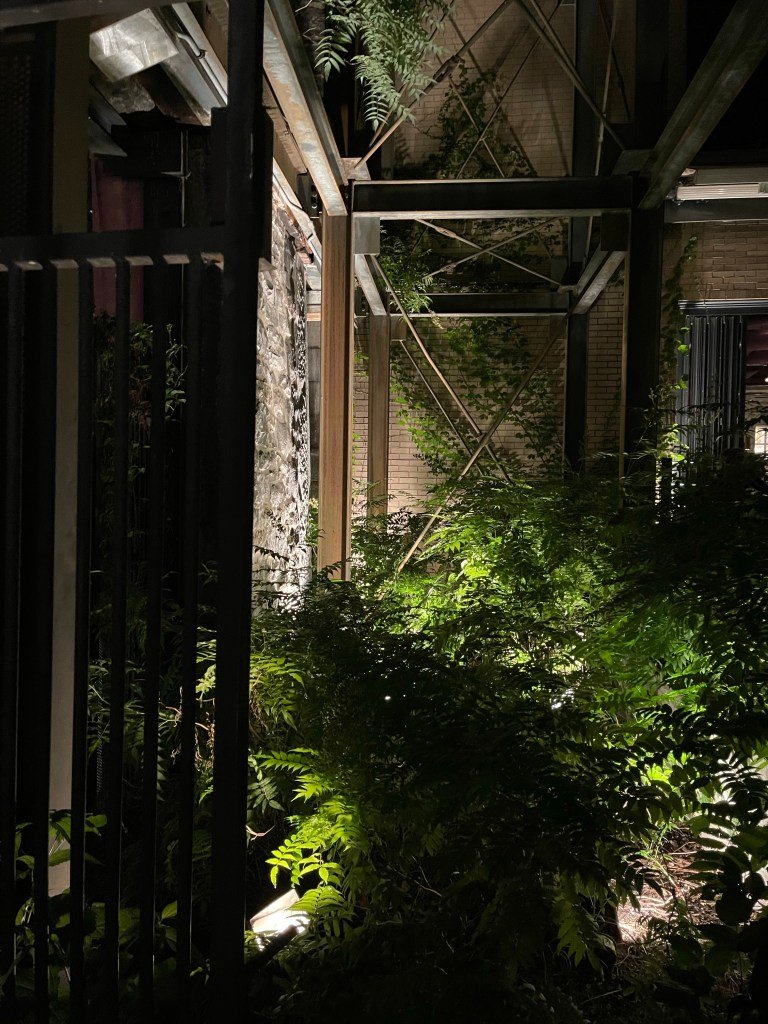
    These are photos from the terrace of a restaurant in Old Montreal called Boris Bistro. It’s not new — it’s been around since 1999 — but that doesn’t change the fact that its outdoor space is absolutely magical.

    The terrace sits behind an old stone facade on McGill Street that is held up with a three-storey steel structure. Hello façadism! I have tried to figure out the vintage of the original building through a cursory look online, but I came up with nothing. (Drop it in comment section below if you happen to know.)

    What we were told at the restaurant was that the original building burnt down, leaving just the facade and then an open space behind it. The size of the trees on the terrace do suggest that it’s been this way for a long time.

    There’s an office building beside it that looks to be of a 90s vintage (465 McGill Street) and this open space was apparently a place for office workers to go smoke. But now the ground floor of the office building and the terrace function as one large contiguous space.

    The result is what you see above. Magic.

    Montréal has been city building for a lot longer than Toronto. Some 400 years depending on how you calculate it. This history has created one of the most beautiful built environments anywhere in the world.

  • The Tokyo Toilet

    One of the biggest challenges with living through this pandemic has been finding a good public toilet. Drinking in the park is all fine and dandy, but at some point you’re going to need to find a place to pee. From experience, I can tell you that this can be a challenge in places like Toronto and Vancouver. But from the looks of it, the situation is a bit different in Tokyo. Japan, apparently, views its toilets as a symbol of its world-renowned hospitality culture. And so it takes great pride in the design of its public toilets. Last year, Tokyo invited 16 creators from around the world to redesign 17 of its public toilets throughout Shibuya. The list of creators includes big names like Tadao Ando, Kengo Kuma, Shigeru Ban, Toyo Ito, and many others. And the result is probably the nicest collection of public toilets that you have ever seen (somewhere around 9 of them are already operational with the balance expected to open sometime this year). The uniforms worn by the maintenance staff were even designed by Nigo (creator of the fashion brand A Bathine Ape). That’s attention to detail.

    For more about The Tokyo Toilet project and to check out the completed toilets, click here.

    Image: The Tokyo Toilet