Daily insights for city builders, delivered every morning at 6 AM ET. I’m Brandon Donnelly — a Toronto-based real estate developer and founder of Globizen. I’ve been writing here since 2013.

Category: Montréal

  • Are short-haul flights on the way out?

    May 19, 2026 · View original


    Jet fuel costs have nearly doubled since the US and Israel attacked Iran in February. This is obviously straining the overall economics of air travel, but the most impacted segment is the one that has always been tenuous: short-haul flights.

    As I understand it, airlines generally prefer flights that are at least 2 hours long. Takeoff and landing consume the most fuel, and add a lot of wear and tear on a plane’s equipment, so you want a long enough flight to amortize these costs. This is why for the 10 years spanning 2016 to 2026, US flights spanning less than 250 miles declined by 11% — the largest drop of any route length.

    Now, in some cases, these short-haul flights are simply necessary loss leaders. For example, the flight from Milwaukee to Chicago is comically short. It’s only about 70 miles, translating into an actual cruising time of around 20 minutes. But it’s an important route for connecting passengers and the overall hub-and-spoke airline model.

    This also makes it slightly harder for rail to effectively compete, because you need to solve for two clear passenger demands (again, assuming they’re connecting): (1) people leaving Milwaukee will want to check their bags at the point of departure and (2) they don’t want to arrive downtown, they want to arrive at the airport for their connecting flight.

    That said, both of these wants are solvable. Hong Kong, for instance, allows in-town check-in where passengers drop their bags downtown before boarding the airport train. This is particularly convenient if you have to check out of your hotel and need to rid yourself of your luggage until you arrive at your final destination.

    Very cool, so what’s my point?

    I mention all this because if short-haul flights are the flight segment that airlines don’t love to operate, then it only strengthens the opportunity for high-speed rail to fill this gap in the market and become a seamless component of overall global mobility.

    Here in Canada, the obvious opportunity is the Toronto-Montreal corridor. This is arguably the single best opportunity in North America when you consider its geography, construction viability (lots of undeveloped land to lay new track), and ability to replace short-haul flights. The broader Windsor-Quebec City corridor is also, as we know, the densest part of Canada with roughly 50% of our entire population.

    But the overall opportunity is twofold: it will service origin-destination travel and it will connect Toronto and Montreal as global airport hubs. In fact, this is one of the stated reasons for why Air Canada joined the high-speed Alto project as a core consortium partner:

    > Connections with other modes of transport, such as rail or bus, are part of the solutions the company is already developing to offer the most relevant mobility option, responding in a sustainable way to the specific needs of each of its customers. In the longer term, the contribution of its expertise to the Cadence team will enable the airline to contribute to the harmonious integration of a future intercity rail network with existing airport hubs in the Quebec-Windsor corridor, for the benefit of all travellers.

    Here’s a specific example. Montreal largely serves as Canada’s direct gateway to France’s secondary cities, Francophone Africa, and the Mediterranean. So if you live in Toronto and want to fly to Marseille or Algiers or Mallorca, you are going to connect in Montreal (or connect across the Atlantic somewhere in Europe).

    The multi-modal train option would include an in-town baggage check at Union Station in Toronto, a 3-hour train ride to Montreal, a seamless rail connection from Gare Centrale to YUL (with the REM airport train set to open in 2027), and then your flight to Europe or Africa.

    The overall travel time should be comparable, except in the high-speed rail option you’d have more uninterrupted time to work, watch a movie, or sleep. And now that Air Canada gets to rid itself of its less profitable (or unprofitable?) short-haul flights, it should have the margin to aggressively market these tickets.

    If this customer experience is designed properly — with one booking, competitive fares, clean transfers, and convenient baggage handling — it will quickly dominate the market. We know this because it’s already working in Europe.

    Cover photo by 7 on Unsplash

  • Jesta Group announces $30M bulk condominium buy in downtown Toronto

    And a larger $500 million condominium program

    May 13, 2026 · View original


    Montreal-based Jesta Group has just announced the acquisition of a bulk condominium portfolio in downtown Toronto valued at $30 million. This also marks the launch of a larger $500 million program targeting more than 1,000 residential units over the next 12 months. Here’s a snippet from the press release:

    > “Toronto’s fundamentals remain strong and the current market environment has created a unique window to deploy capital at scale,” said Anthony O’Brien, Senior Managing Director at Jesta Group. “We are aggressively pursuing opportunities that fit this investment ethos and encourage developers with qualifying inventory to reach out directly.”

    Anthony’s email is [aobrien@jesta.com](mailto:aobrien@jesta.com).

    Sentiment seems to be changing here in Toronto. Maybe it’s because summer is coming and the winter was long, or maybe it’s because our looming supply bottom is drawing nearer. Regardless, a $500 million program certainly suggests that somebody believes we are at or near the bottom.


    Cover photo by Rodolfo Flores on Unsplash

  • Toronto cycling year in review

    April 17, 2026 · View original


    The City of Toronto just released its 2025 Cycling Year in Review report. You can download it here. At the highest level, Toronto is now considered to be the 7th most bike-friendly city in North America, according to the Copenhagenize Index. Our snowier sibling, Montréal, is number one on the continent. And globally, we’re ranked 55th.

    Neither of these positions is particularly impressive given our scale and prominence as a global city, but progress is being made. In 2025, City Council approved 33 km of new bikeways, installed 14.11 km, and upgraded 9.02 km. Our infrastructure continues to get better.

    What I find particularly noteworthy and telling, though, is the adoption of the city’s bike share network. 2025 was another record year, with 7.8 million rides, representing a 13% increase from 2024. We’re still not at the level of Montréal, which recorded 13 million rides in 2024, but adoption is growing quickly.

    We have gone from around 665,000 rides in 2015 to nearly 8 million in the span of a decade. That’s a compounded annual growth rate of approximately 28%! Once again, we are reminded that if you build it, and make it easy and safe, more people will ride bicycles.


    Cover photo by Jason Ng on Unsplash

  • Who says buildings need stepbacks?

    January 19, 2026 · View original


    > Tweet: Who says buildings need stepbacks? https://t.co/PXlIf8o6Rv

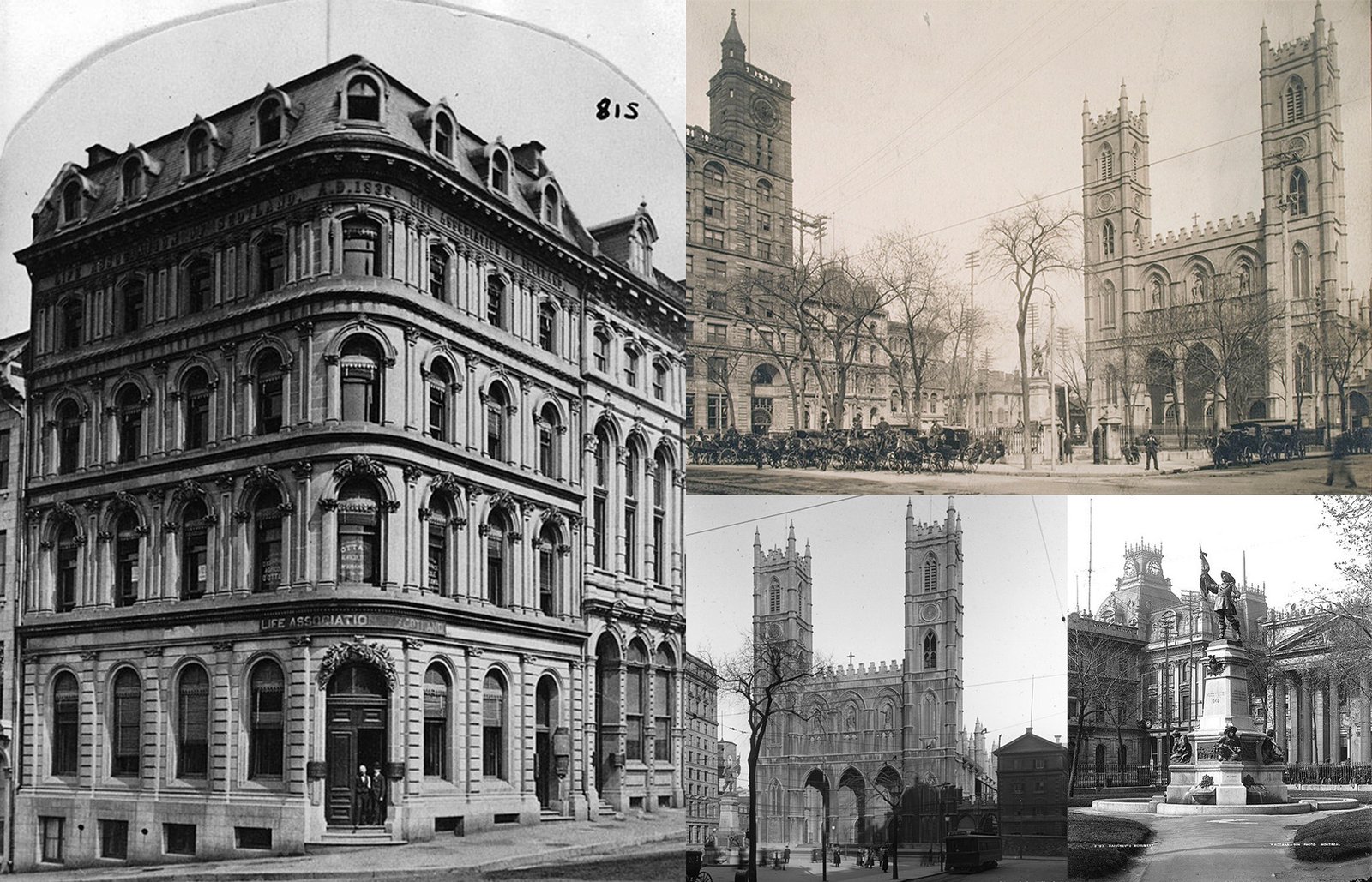
    I recently tweeted a photo of 701 Côte de la Place-d’Armes in Montréal and asked: Who says buildings need stepbacks?

    The response was exactly as I expected. Modern planning, as you know, is obsessed with setbacks, stepbacks, angular planes, shadow studies, skyviews, and lots of other things that inform the overall massing of new buildings. But then you point out a building like 701 Côte de la Place-d’Armes — which is not set back from the street and does not have any stepbacks above — and lots of people seem to love it.

    In fact, I specifically chose to share this building because it’s exactly the kind of architecture and urban design that conveys the feeling of grandeur I get when I’m in Montréal. I also chose it because it’s taller than six storeys, which is the height that Toronto is hoping to one day deliver along its major streets at scale.

    But here’s a question: If this stepback-less building is so great, why are stepbacks so in-demand?

    Firstly, I should point out that when the building was completed in 1870, it only had five floors. The top floor was an attic storey and had a mansard roof reminiscent of Haussmannian Second Empire architecture.

    Then in 1909, the attic floor was removed, and three new floors were added (a net increase of two floors). If you look closely above the fourth floor, you’ll see a slightly different architectural expression, but one that remains harmonious with the original design of the building.

    This approach breaks many of the rules for how modern planning thinks about heritage buildings. Today, it is likely that someone would have asked for a stepback above the existing building, with a completely new expression above it. Admittedly, this can produce desirable results. But it’s not what was decided in 1909, and the result is a very handsome building.

    This gets us back to our original question: Why do we insist on stepbacks, but still like architecture like this one so much? I think there are at least two answers at play here.

    The first has to do with architecture and design. If you were to pluck random people off the street and ask them about their architectural tastes, I would bet you that more people would prefer something Neoclassical or Beaux-Arts over something modern. And if people actually like the architecture, then I think they become more comfortable with scale, or perceived scale.

    The second answer has to do with the fact that one way to look at stepbacks is as a defensive architectural tool. They have become a tool we use when someone doesn’t actually want a building to be built. We use them to try and soften the massing by hiding as much of it as possible.

    The problem with this approach is that it also means we’re not playing offence. And if you want urban grandeur, I think you need to play offence. You need to be confident and decisive about what you’re trying to do. And I think this is part of the reason why so many people seem to like 701 Côte de la Place-d’Armes. It is all of these things, and it’s not in their backyard.

    Cover photo by Macy Nguyen on Unsplash; historic photo from Hôtel Place d’Armes

  • Blurring the line between grade and below

    January 10, 2026 · View original


    I’m writing this post from the concourse level of Place Ville Marie Esplanade in Montréal (also known as Galerie PVM) while I wait for my next meeting. Like the PATH in Toronto, the space I’m in is part of an underground network of restaurants, shops, and circulation spaces that runs through downtown Montréal.

    But what makes the space I’m in right now particularly noteworthy is that I’m sitting beneath an enormous glass roof supported by 18 glass beams measuring 15 meters long and 0.9 meters tall. So, while I am below grade, I have a clear view of The Ring, Mont-Royal, and the street life happening above me.

    Underground “malls” like Toronto’s PATH and Montréal’s RÉSO were a somewhat obvious urban solution to inclement weather. But they are often criticized for sucking life underground and making the streets at grade feel dead.

    When I’ve toured my American friends through Toronto’s CBD in the past, I’ve heard comments like, “How come you have no retail downtown? It feels dead.” And then I have to cheekily say, “Oh, well, we actually have tons of it, we just decided to hide it all underground so it’s harder to find and confusing to navigate.”

    The way you start to counteract these negatives — lack of street life and challenging wayfinding — is to do what Sid Lee Architecture did masterfully here at Place Ville Marie. To the extent possible, you make grade and below grade feel like one space.

  • Toronto to Montréal by train

    January 9, 2026 · View original


    Yesterday morning, I took the train from Toronto to Montréal. I’m here for one night for a few meetings. I love trains. You can show up right before departure, the seats are more spacious, and they go downtown to downtown. Plus, there’s something romantic to me about whizzing through the landscape. But currently, this trip takes just over 5 hours once you factor in the above stops (see cover photo). That’s too long in this day and age, so Canada is, as I understand it, working on a new high-speed rail solution called Alto.

    The first phase will connect Ottawa to Montréal (construction is expected to start in 2029), and a subsequent phase will connect Ottawa to Toronto. The top speed will be around 300 km/h, which I’m guessing will result in an effective speed closer to 200 km/h when you factor in stops and any speed limits required near urban centers. With this, the goal is to bring the journey from Toronto to Montréal down to around 3 hours.

    One thing to keep in mind is that Ottawa does not lie on the fastest route between Toronto and Montréal; it adds about 70 km. But it’s of course necessary. In theory, an express route with no stops running TGV or Shinkansen-like trains could bring the journey time down closer to 2 hours. But that’s not what is being planned from what I have read. Regardless, 3 hours is still a big deal and a meaningful improvement. It makes the trip faster than flying, and certainly faster than driving.

    Could current drive times ultimately change with autonomous vehicles? Maybe, but it’s unlikely to be by this much. I hate long road trips and the same would be true even if a robot were driving me. So I look forward to one day — in my 50s? — doing this journey in 3 hours. If we could get it down to 2 hours and change, that much better. That’s a trip worth taking for a night out or just to stock up on bagels.

  • Sticky cities, shifting world

    December 28, 2025 · View original


    Canadian geographer Mario Polèse’s book, The Wealth and Poverty of Regions: Why Cities Matter, is not new. It was originally published in 2010. But it’s perhaps a good follow-up to yesterday’s post about the untethering of wealth. Here’s an excerpt from a review of the book by Jeb Brugmann:

    > All cities, Polèse explains, share the same basic economic causes and effects. These are economies of localization (i.e., locating activities close together) and of urbanization (i.e., clustering lots of diverse activities together at scale). Polèse shows how these urban economies—usefully distinguished and defined in detail as economies of scale, proximity, diversity and concentration—combine with unique natural features and resource endowments, technology and infrastructure investments, national boundaries and market controls, and historical events to create quintessentially local and unique places. Every time he explains the status of another place—New York, London, Chicago, Paris, Montreal, the northern Mexico border, the North American west coast—he demonstrates again how the source code of geography combines with specific local and historical conditions to create a momentum of wealth or poverty.

    The rich may have the means to tax-optimize through physical mobility, but the draw to established urban clusters remains strong, which is why it can be a challenge to stay away from them for more than 183 days. There is a “stickiness” to established cities that is the result of momentum and compounding over centuries.

    Still, nothing is guaranteed, and there’s only so much that can be done if you’re swimming against a global landscape that is shifting away from you. Geography does matter. And today, the world’s economic center of gravity is rapidly shifting toward Asia. This is good for some cities and bad for others.

    Cover photo by Zhu Hongzhi on Unsplash

  • Canada announces high-speed rail between Quebec City and Toronto — finally!

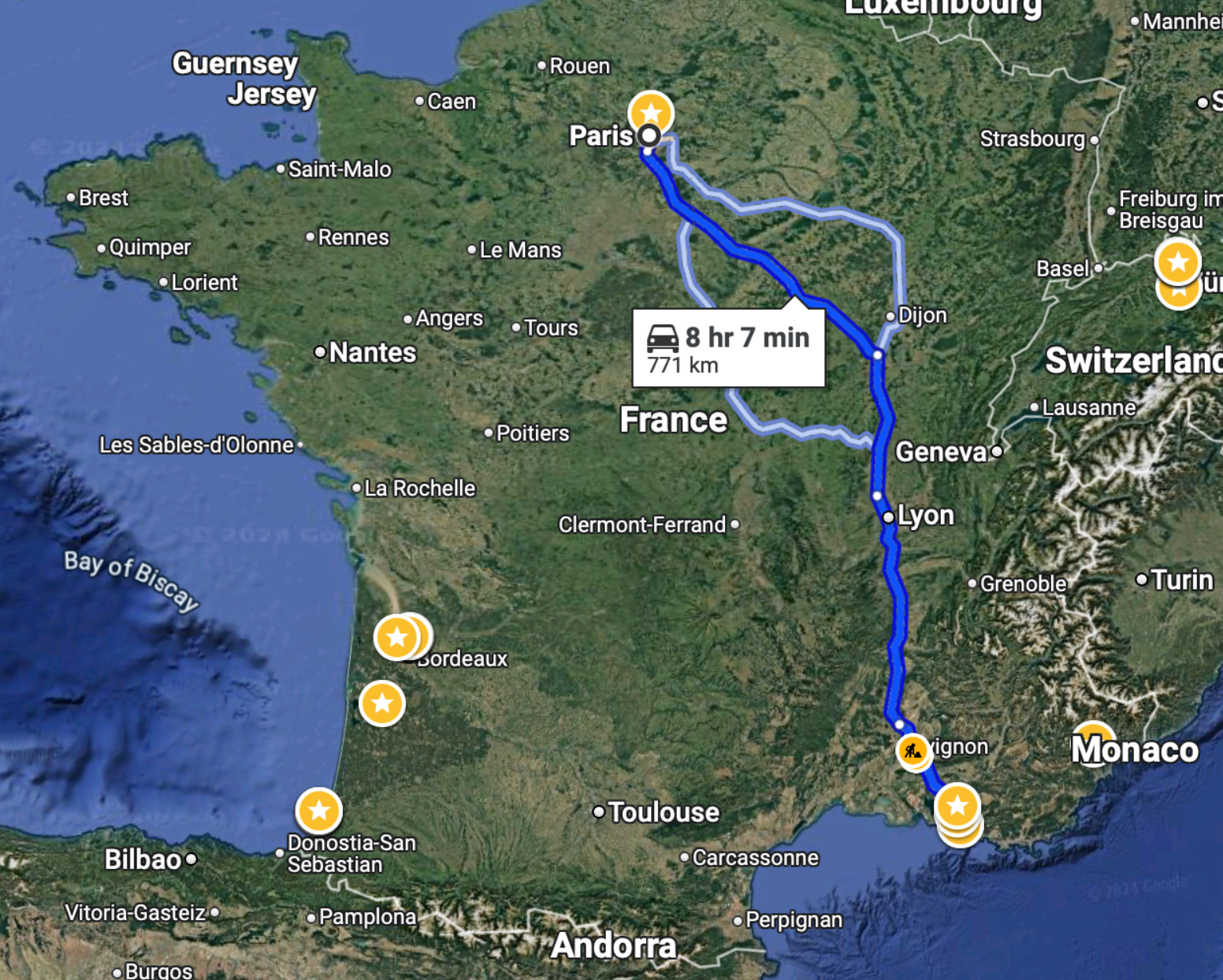
    The train from Paris to Marseille takes just over 3 hours:

    To drive this same distance, it would take just over 8 hours:

    So unless you had a very specific reason, I don’t know why you’d ever want to drive this route. I certainly hate long drives and would avoid this at all costs.

    On a related note, the Canadian government announced this week that it will actually be moving forward with a high-speed train linking Québec City to Toronto, stopping in Peterborough, Ottawa, Montréal, Trois-Rivières, and Laval. And unlike previous announcements, it will actually go pretty fast — upwards of 300 km/h, which is comparable to what the TGV does on the above route.

    There are three consortia currently competing for this contract, but apparently the federal government has already chosen a winning bidder. An announcement is expected next month. At the same time, the project office owns all of the bids, and so there’s a chance that elements from each of them could be used in the final project.

    According to official messaging, the design alone is expected to take some 4 to 5 years, which is an eternity and way too long. But at least we seem to be moving forward. This rail link is a no brainer. It will compress the geography of an importantly bilingual corridor with nearly 20 million people — about half the population of Canada! It’s our megalopolis.

    Now we just need to move forward with urgency and with an unwavering commitment to creating the best high-speed rail service in the world. Let’s not accept mediocrity. And let’s not cancel it once we’ve already sunk millions into it. That would be a terrible outcome for such an obviously important nation-building project.

    LFG.

  • Montréal is making yet another case for pedestrian-only streets

    There are parts of Toronto that are pedestrian only. There’s the Distillery District, some small laneways in Yorkville, the Toronto Islands (though this is a bit of a unique situation), and various other pockets around the city.

    There are also streets that we temporarily open up to only pedestrians, such as Market Street and King Street, and areas, such as Kensington Market, that we have been rigorously considering pedestrianizing for as long as I can remember.

    What is clear is that pedestrian-only streets are controversial. Motorists fear that it will make driving in the city even more inconvenient. And businesses fear that it will limit their customer base.

    While it is true that not all streets can and should be pedestrianized, there are countless examples of streets and areas that appear to be thriving because of it.

    Take, for example, Montréal.

    Since 2021, the city has been pedestrianizing a stretch of 30 blocks along Mont-Royal Avenue during the summer months. And according to Mayor Valérie Plante, the commercial vacancy rate for the street has dropped from 14.5% in 2018 to 5.6% in 2023:

    Maybe you don’t want to infer causality here, but at the very least, it seems to suggest that the street isn’t dying and bereft of human activity. This year, pedestrianization is also planned to be extended further into the fall.

    This won’t necessarily be the outcome for all streets, but I do agree with this recent Globe and Mail article that, oftentimes, the reasons for not pedestrianizing are “a question of philosophy, not geography.” Because there’s lots of research and data to support doing this.

    If any of you are business owners along Mont-Royal, I’d love to hear about your experiences and how you think, for better or for worse, it has changed the area. Leave a comment below or drop me a line.

  • Open-air corridors and exterior exit stairs

    Montreal is, in many ways, a city of winding exterior stairs. If you’ve been there, then you know. The city is overwhelmingly a city of low-rise apartments (less than five storeys). And with these, comes lots of exterior circulation. But this tradition doesn’t just apply to older buildings. Here is a contemporary tall-building example which follows a similar approach.

    Designed by MSDL Architects, the project, called The Laurent & Clark, consists of two tower volumes. They read as two separate towers, but they’re connected and share egress paths. On the east side is a conventional “scissor stair” tucked behind two elevators. And on the other end, connected by an open-air corridor, is an exterior exit stair that runs all the way up the tower.

    Here is a circulation diagram via Azure:

    This is novel (at least in this part of the world). The suites in the west tower are all dual aspect; meaning, they have windows on both ends.

    They also have direct elevator access (see cores above), which means a lot less non-revenue generating circulation space. I mean, if you think about it, the open-air corridor on the north side of the west tower is akin to building a simple balcony. Extend the slab and add a guard rail. And so you could argue that this portion of the building has a near 100% efficiency factor.

    However, the downside is that you need more elevators. Here, it looks like they have 6 for their 356 suites. That’s an overall ratio of just under 60 suites per elevator, which is lower (i.e. better) than what you’d typically find in a conventional tower. The crude rule of thumb is 1 elevator for every 100 suites. That said, these direct-access suites would be premium.

    But perhaps the most important takeaway is this: If cold and snowy Montreal is cool with open-air corridors and exterior exit stairs, then maybe your city should be as well.