Daily insights for city builders, delivered every morning at 6 AM ET. I’m Brandon Donnelly — a Toronto-based real estate developer and founder of Globizen. I’ve been writing here since 2013.
This is an interesting article about the neighborhood-based social network, Nextdoor, and how it has become a tool for housing politics:
Overall, activists both for and against more housing regard Nextdoor as an increasingly influential and even critical tool in the fight, which conflicts with the platform’s marketing as a friendly, kinder social media. Rather than being the neighborhood bulletin board, Nextdoors around the country are looking more like the local zoning commission hearing.
Housing debate is no stranger to social media, but in the case of Nextdoor, the audience gets focused down to the scale of a neighborhood. And that clearly changes things.
And I think it raises a number of important questions:
Is 2 storeys appropriate for next to a subway station and next to an existing mid-rise building?
Is a mid-rise building truly unprecedented in this context? See below.
Are mid-rise homes inappropriate for “residential streets?”
How does building height factor into flood plain concerns? Wouldn’t lot coverage be more relevant?
And when does a mid-rise become a “high-rise?”
For more context, here’s the proposal and its immediate surroundings:
2/ The year is 2022 and Toronto has a #HousingCrisis. Yet our @CityPlanTO policies still tell developers that they MUST build wasteful, "Mayan Pyramid" designs next to our Subway stations… because they are "abutting low-rise residential neighbourhoods"..?!?! 🙄#TOPoli#ONPolipic.twitter.com/f4I4VGXkN3
I fully appreciate that there’s little incentive to support new development in a place where you already live — even if you happen to live in a similarly-scaled building across the street. And I am sure that I’ll receive a number of emails following this post.
But optimizing the use of land around our existing transit stations is one of the best things we can do as city builders.
Update: I have redacted the contact information on the above poster.
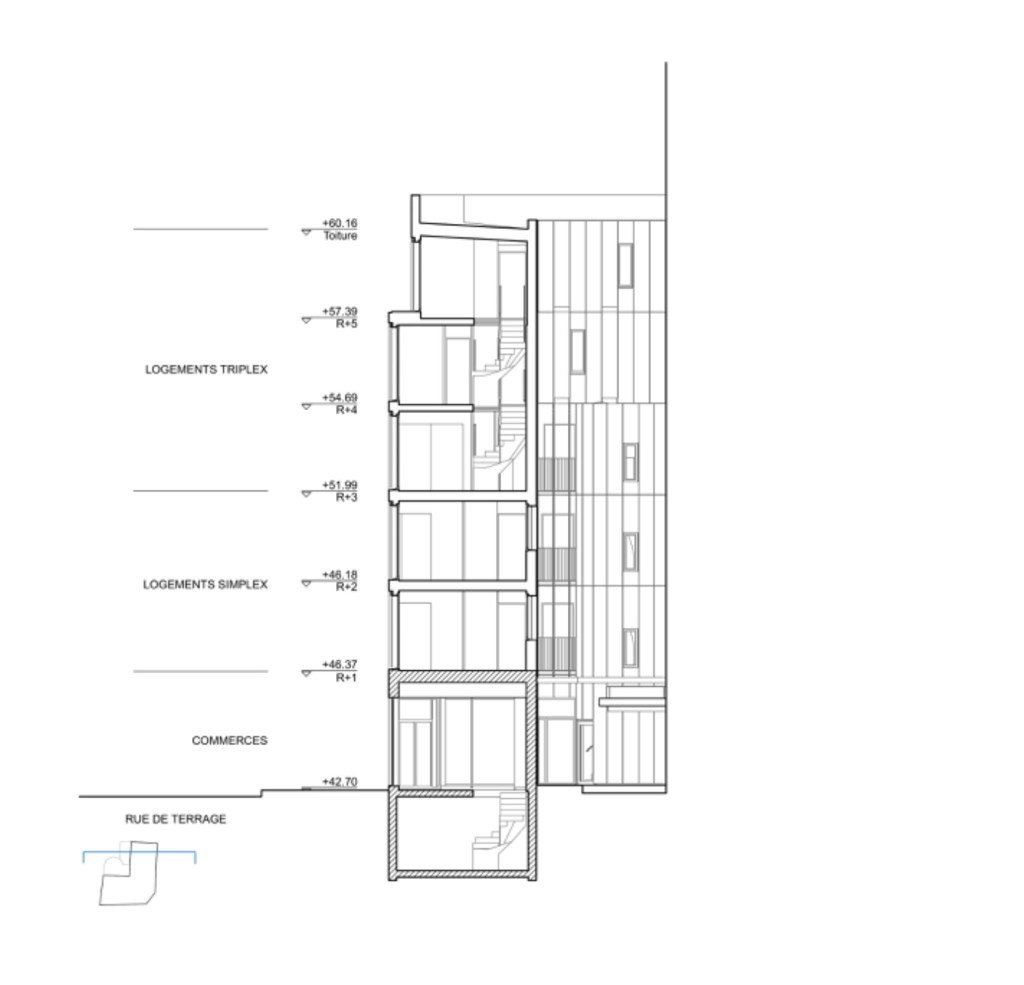
But here’s where things get really remarkable: the area of this corner site is less than 100 m2 (~1,000 sf), the construction budget was €940,000 (excluding VAT), and almost the entire structure was built out of cross-laminated timber. So overall, this is an incredibly sustainable build: it uses land and services efficiently and it uses low-carbon materials.
At this point, you should now be wondering, “why can’t we just do this everywhere?” And this would be the right question.
Lloyd correctly points out in his article that one of the things that makes this building feasible is that it only has one exit stair (as well as no elevator). Typically you need two means of egress, which can serve as a real barrier to smaller builds like this one here.
But in this case, and this is part of the argument, the building is small enough that, should a fire or emergency happen, occupants could be rescued through their windows. So technically there are still two ways of getting out.
In this year’s predictions, I mentioned that we would see “supportive building code changes”, which would help to encourage more infill housing. Exiting is one of the changes I had in mind when I wrote the post. So here’s hoping that policy makers are reading this blog, looking to projects like this one in Paris, and recognizing the benefits.
Talking about exit stairs may not be as exciting and seemingly impactful as something like a foreign buyer ban, but I promise you that removing the many barriers to building this scale of housing would ultimately bring more benefit to our cities.
This data is from 2019, but I imagine that things would look pretty similar today and that it might even be a little more pronounced. The dataset from the above article looked at how many people have cars in a given area (a darker dot = fewer cars) and then plotted this against population density and income per capita.
Here’s what that looks like for the regions of New York, Boston, Los Angeles, and Houston (data from 2013 to 2017):
What is fascinating about these charts is that they show two different correlations. In dense and transit-rich cities such as New York and Boston, car usage is most closely linked with population density and not with income. The dark dots form a horizontal line near the top.
However, in the case of Los Angeles and Houston, car usage is instead most closely linked with income and not with population density. The dark dots form a vertical line near the left — the lowest income per capita.
So what does this tell us?
It tells us that if you design a city to broadly require a car, then you are likely to sort people based on those that can afford a lot of car and those that cannot. On the other hand, if you design a city around transit, then you are likely to instead create a place where both the rich and poor get around in similar ways.
There is also evidence that the latter is being increasingly viewed as more desirable. 2017 was the first year in the US where high-income young people (ages 26 to 33) drove less than low-income young people. Presumably these high-income people had choices, and so I tend to view this as a preference.
As a whole, this is surely a good thing for our cities. But now I think we need to be careful not to allow density and walkability to become the new luxury that only the rich can afford.
The central bank tightening and interest rate hikes that we saw last year will come to an end in the first quarter of 2023 as inflation gets under control. This will ultimately lead to a recession but my sense is that it will be more mild than severe. For this reason, I don’t think anyone should expect ultra-low rates to return in the short-term.
Much of the real estate sector went on pause in the second half of 2022. But ultimately this reset to a more balanced market is going to be necessarily painful for some. And I think we will see that pain play out in the first half of the year. This will obviously be bad for some, but it will create opportunities for others.
Construction costs tempered in the second half of 2022 and started to show some evidence of price softening. I think we will see more of this in 2023, which will be healthy for the market. Cost management over the last few years has been a meat grinder for the development industry.
Pre-construction condominium sales for well-located projects will return in a more fulsome way by the spring. This will be driven by buyers now having clarity around where interest rates will be hanging out in the short-term and, in the case of Canada’s largest cities, by record-high immigration levels.
For the tertiary/fringe housing markets that saw big run ups in pricing during the pandemic, I unfortunately think it will take many years for prices to fully rebound. The price increases we saw in these submarkets were of course a result of low rates, but it was also driven by a view on urban decentralization that in my view did not actually materialize.
The desire to add more housing to single-family neighborhoods will continue to pick up steam across North America. How exactly this plays out will be market specific, but in Toronto I expect to see new planning policies put in place, as well as supportive building code changes.
Public transit ridership will remain below pre-pandemic levels throughout 2023. This will continue to exacerbate public finances.
Autonomous taxis will grow rapidly this year. Companies, such as Cruise, will expand into a number of new US markets and, at some point during the year, I will take my very first ride in an autonomous vehicle.
2023 will be a big year for augmented reality and “phygital” goods. Last year I thought Apple would release a new product in this space. That didn’t happen, but it will this year. At the same time, we will see more companies releasing products that blur the lines between our online and offline worlds (hence “phygital”). This will include NFTs and other crypto-related things that will start to operate more seamlessly in the background of consumer-facing products/services.
I continue to be bullish on Ethereum and I think it will overtake Bitcoin in terms of market cap in the next 2-3 years. But I was very wrong about Solana last year. And now I am struggling with its value proposition. Today, layer 2 chains such as Polygon feel more likely to win out. Broadly speaking, I suspect 2023 will be a positive year for crypto, but not a record-setting one.
In summary, I think we are going to see more pain at the beginning of 2023, but that on the other side of it will be healthier and more balanced markets. This means that we can look forward to the end of the year feeling much better than it does right now. All of this said, please keep in mind that I’m often wrong and that nothing in this post should be construed as actual advice.
The Ontario Line will zip across the core and up to Eglinton, easing gridlock and alleviating TTC misery. It will also plow through peaceful Toronto neighbourhoods, displacing homes, businesses and everything in its path.
I know exactly what business model it is serving and why it is done, but I’ll ask the question anyway: Why do we need to make everything out to be a problem?
In this case, we’re talking about a new and important piece of city building infrastructure. A subway line that will run through the densest parts of this country and alleviate congestion at key interchanges, as well as broadly across the city.
It is something that we, as a city, have been griping about for many decades. And now, it is finally happening! Will it involve constructing things? Yes. Will it actually displace “everything in its path?” No.
But as we all know, this is the way media works today. They set the agenda (i.e. tell us what we should be terrified and/or pissed off about) and then they sell our attention. And an effective way to do that is to make sure that the headlines get us really worked up.
It asked whether developers should build more 3-bedroom apartments/condominiums. And not surprisingly, the vast majority of people voted yes. Of course, the problem with this poll is that it says nothing about the overall affordability of these larger suites. (We’ve talked about this many times before on the blog.)
So it is akin to asking: Should Mercedes put this concept car into production and make it widely available? My answer would obviously be yes. It’s a sweet car. I would like one. But I also don’t like spending money on depreciating “assets”, so in the end I probably wouldn’t buy it. That said, if you’re in the market for a sweet 3-bedroom condominium, I could sell you one right now.
My overly simplistic view of taxes is that it is generally good practice to tax the things you want less of — you know, things like cigarettes and pollution — and reduce taxes on the things you want more of — you know, things like housing and income.
The irony of this poll is that the vast majority of people voted for road tolls as the way to increase municipal funding. But in practice, this is not what we do at all! We heavily tax new housing and we are extremely reticent to even accurately price the usage of roads and highways.
Here in Toronto, I guess we kind of tried a few times, but in the end it never passes. Part of the problem, I think, is visibility. New home taxes are easy to hide from consumers. It is also easy to just vilify big bad developers. Road prices, on the other hand, are highly visible and they hit you repeatedly.
Perhaps what we ought to do is become more transparent about the charges that are levied on all new housing. I bet most people would be surprised.
“On some level, we’re [Toronto] still trying to be a Victorian city.” —Peter Clewes
It is not an exaggeration to say that Peter Clewes, of architects-Alliance, is one of the most important architects working in Toronto today. Over the last two decades, Toronto has built a lot of new condominiums and Peter’s firm has been behind many of them.
I mean, I currently live in a building designed by architects-Alliance. My mom lives in a building designed by architects-Alliance. And the first condominium I ever lived in around 2005 or so, was naturally also designed by architects-Alliance.
Peter’s work is everywhere. And it has been instrumental in helping to define this new Toronto. But what is this new Toronto? It’s hard to say really.
Toronto may have built a lot of new things and added a lot of new people over the last two decades, but it has done so almost begrudgingly and without the confidence to say, “we are building this way because this is the kind of global city we want to become.”
I think Peter gets a lot right in this excellent interview with Azure about Toronto, condominiums, and city building. Despite everything that has changed, on some level, we are still trying to be a Victorian city.
Of course, we are no longer that city. It’s long gone. Time to think much bigger.
Earlier this year, the Mayor of New York City, Eric Adams, and the Governor of New York, Kathy Hochul, assembled a panel of civic leaders and industry experts to try and come up with a plan for a “New” New York.
Initially, this panel was intended to be entirely focused on reviving the city’s business districts, and in particular those that have been slow to recover from the pandemic. But scope creep happens and it ultimately grew to include two other important goals: make it easier to get around and encourage “inclusive, future-focused growth.”
The recommendations from this panel were released today and it’s in the form of a report with 40 specific initiatives. In keeping with its original intent, the first recommended initiative is one that you would expect: “Make Midtown and other business districts more live-work-play.” And what that means is the following:
We will remove barriers that have kept Midtown and other business districts stagnant by making it easier to convert and redevelop outdated office buildings to other uses, including residential, thereby empowering the market to create more vibrant, mixed-use districts. We will also update old-fashioned regulatory codes that have prevented small businesses from locating, expanding, and innovating in those districts, providing zoning flexibility for businesses to thrive. And we will unite our business districts behind a shared goal of vitality by aligning incentives for businesses to help maintain vibrant business districts.
New York isn’t the first city to be encouraging office-to-residential conversions and it certainly isn’t going to be the last. I think most of you know that I am a firm believer in office-centric cultures and that I’m in mine 5 days a week. But this is a recalibration that is going to need to take place in some submarkets.
And here is one of the capitals of the world — New York City — telling us that it needs to happen there.
When it comes to greenhouse gas emissions, we know this:
Households in denser neighborhoods close to city centers tend to be responsible for fewer planet-warming greenhouse gases, on average, than households in the rest of the country. Residents in these areas typically drive less because jobs and stores are nearby and they can more easily walk, bike or take public transit. And they’re more likely to live in smaller homes or apartments that require less energy to heat and cool.
We also know this:
Consider housing. For decades in the United States, the majority of new homes have been built in the suburbs and, increasingly, exurbs, where climate footprints are larger. As a result, for many people today, it is often easier and cheaper to find a home in a high-emissions community than a lower-emissions one.
An important caveat to these points is that if you use consumption-based carbon accounting — that is, you consider all of the goods and services that people tend to consume — then other things like income also play a major factor. Wealthy households, for example, tend to fly more frequently, and that is bad for emissions.
But even with this more accurate accounting, the two biggest contributors to a household’s carbon footprint still tend to be housing and driving. And that’s why when you look at emission maps, like these over here, the urban core still usually performs the best. Density, it turns out, is hard to beat.