Daily insights for city builders, delivered every morning at 6 AM ET. I’m Brandon Donnelly — a Toronto-based real estate developer and founder of Globizen. I’ve been writing here since 2013.

Category: Park City / Utah

  • The richest person in Utah wants to buy the largest ski resort in the US

    June 10, 2026 · View original


    The richest person in Utah is a man named Matthew Prince. Prince, who grew up in Park City and was once a ski instructor at Park City Mountain Resort, is the co-founder of a tech company called Cloudflare. I’m assuming his riches came from the tech company and not from being a ski instructor. But he still seems to like skiing because he’s been mounting a highly public and aggressive campaign to buy the resort from Vail.

    There is a narrative in the ski and snowboard community that Vail has destroyed the industry through poor management, expensive lift tickets, homogeneity, and just an overall loss of what the vibe used to be. The market may also agree with this narrative because Vail’s stock price is down nearly 60% over the last five years.

    So Prince’s message to Vail is “you’re a bad capital allocator” and his pitch to the Park City community is one that sounds really nice. It’s basically a community-first rescue mission. He has promised zero personal profit of any kind (he apparently has enough money), pledged to reinvest 100% of the resort’s profits into infrastructure upgrades and employee compensation, and floated ambitious ideas to build a massive gondola network connecting Main Street Park City to some of the neighbouring canyons (which would be totally awesome).

    Vail’s response continues to be that the resort is absolutely not for sale. But Prince is trying to encourage them to adopt a more asset-light model, where they control the brand and the Epic Pass, and local billionaires like Prince run the physical properties.

    To provide a bit of real estate context here, Vail owns the mountain infrastructure, the snowmaking equipment, and the overall business operations, but much of the resort sits on land owned by Toronto-based Talisker. My understanding is that the land lease gives Vail all the practical indications of ownership for a very long time, but I thought I would explain this nuance given that we like to talk about real estate specifics on this blog.

    I have no idea where this public pursuit will go, and I know nothing about Prince’s values as an individual, but the story is certainly compelling. There’s something to be said for a rich local wanting to buy a resort just for the love of skiing.


    Cover photo by Patrick T’Kindt on Unsplash

  • Parkview Mountain House featured in Monocle

    March 4, 2026 · View original


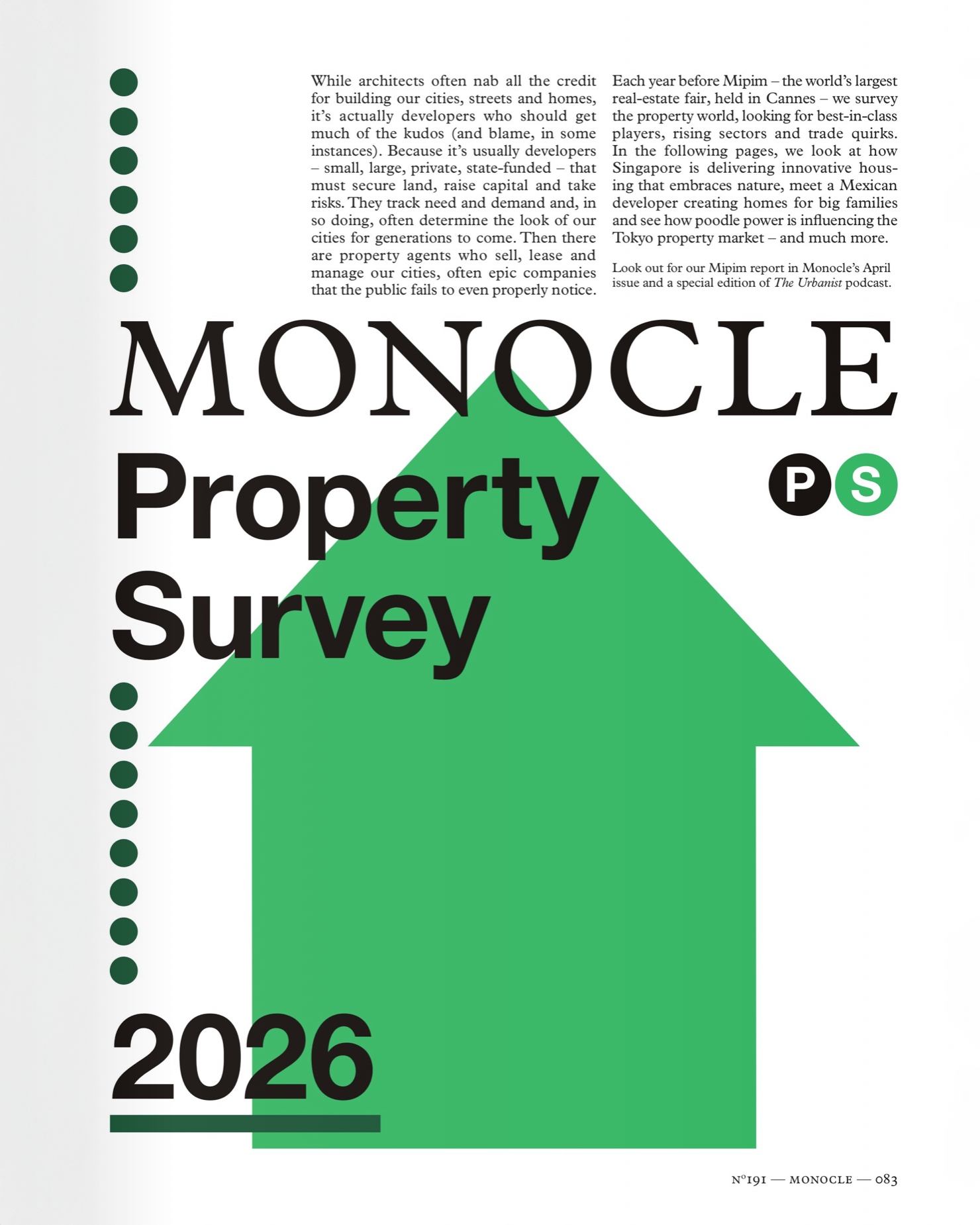
    The March issue of Monocle just dropped, debuting a new format called the Monocle 100. It’s a list of the people, places, and things worth knowing about. And in the middle of it is something called the Monocle Property Survey, which was deliberately timed to coincide with MIPIM, the massive real estate conference that takes place every March in Cannes.

    As a quick aside, our team contemplated going to MIPIM this year in search of both friends and money, but then we thought to ourselves: Why bother going to the South of France when we have Toronto in the middle of March to enjoy?

    The first thing the Property Survey does is give a rare nod to developers: While architects often nab all the credit for building our cities, streets and homes, it’s actually developers who should get much of the kudos (and blame, in some instances). Because it’s usually developers — small, large, private, state-funded — that must secure land, raise capital and take risks.” It almost feels weird hearing somebody say something positive about our kind.

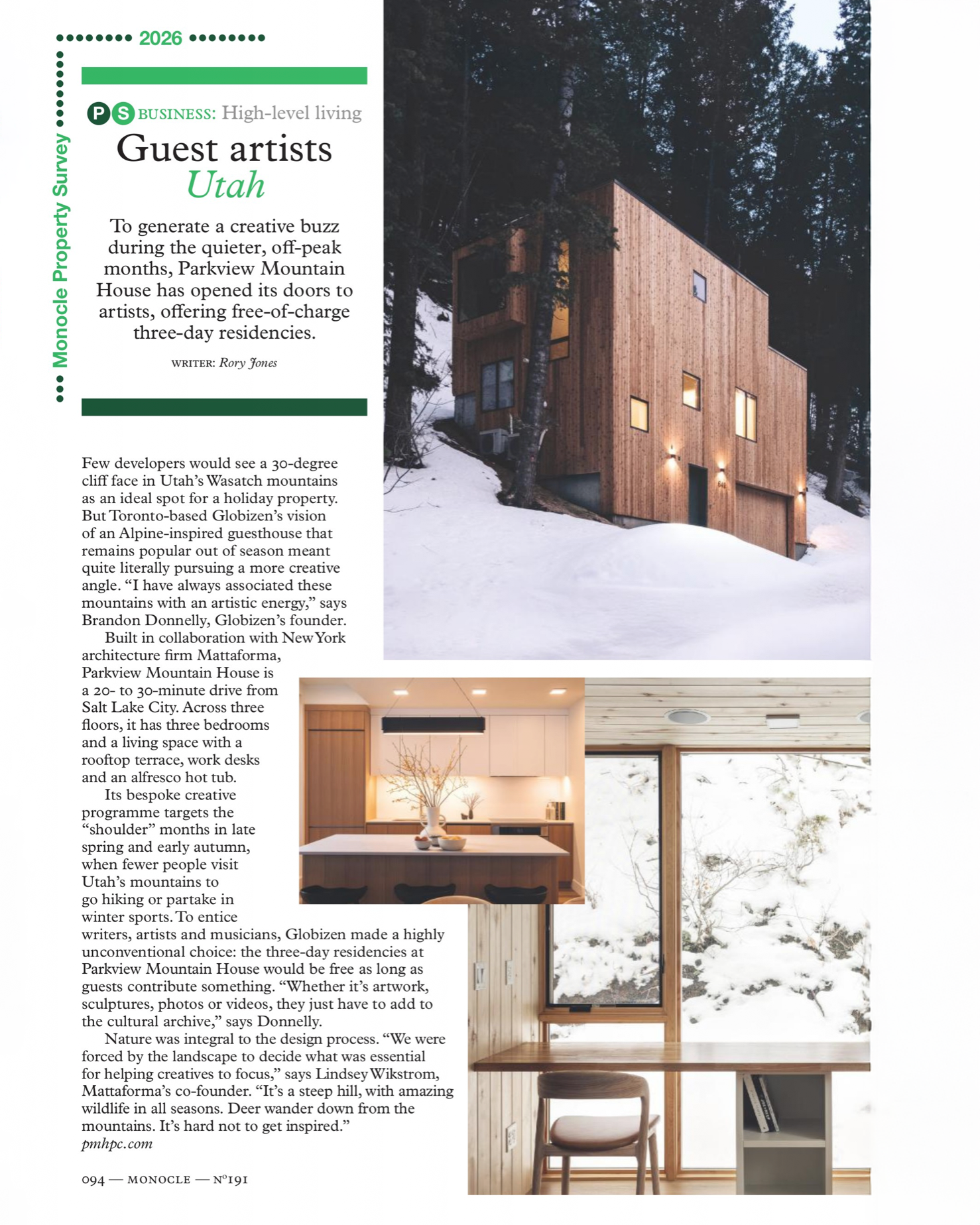
    But even better, the survey includes a full page on our unique creative residency program at Parkview Mountain House (Park City, Utah):

    A big thanks to the Monocle team for the feature. If you’re in Toronto and would like to pickup a copy of this month’s issue, visit their shop in Little Italy at 776 College Street. And if you’d like to learn more about PMH, including our creative residency program, visit pmhpc.com.

  • Salt Lake City proposes new small lot development ordinance

    February 23, 2026 · View original


    One of the big housing trends that we have seen across North America over the last several years is the push to allow greater supply in low-rise neighbourhoods.

    Here in Toronto, this has come through a well-known program called Expanding Housing Options in Neighbourhoods (or EHON), which I believe launched around 2020. But you can find countless similar programs in other cities.

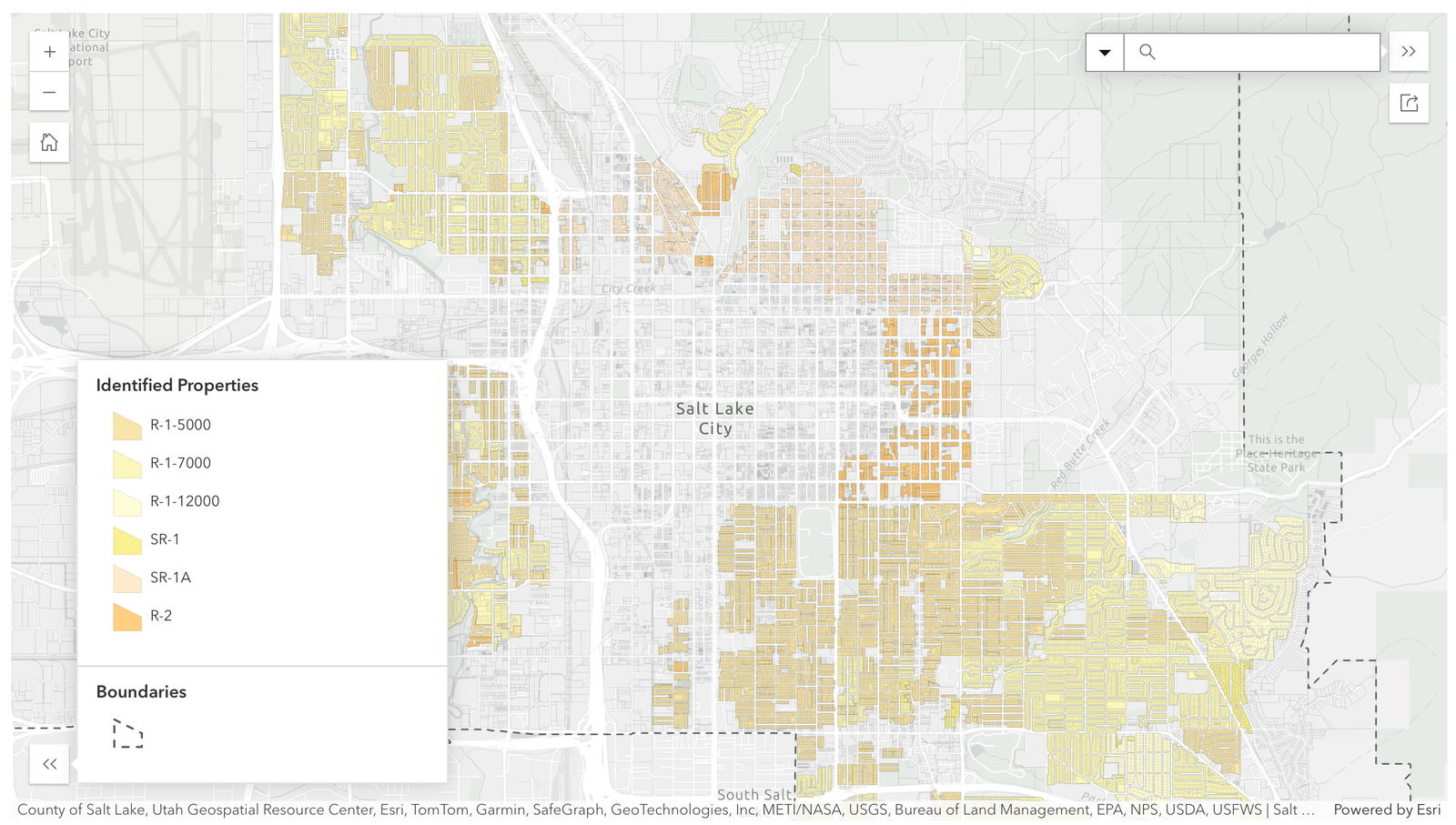
    Salt Lake City, for example, is currently looking at updating its single-family exclusive zoning) to allow for “gentle infill opportunities” on smaller lots. The zones under consideration cover 77% of the land zoned for residential in SLC. And interestingly enough, this program is also called Expanding Housing Options.

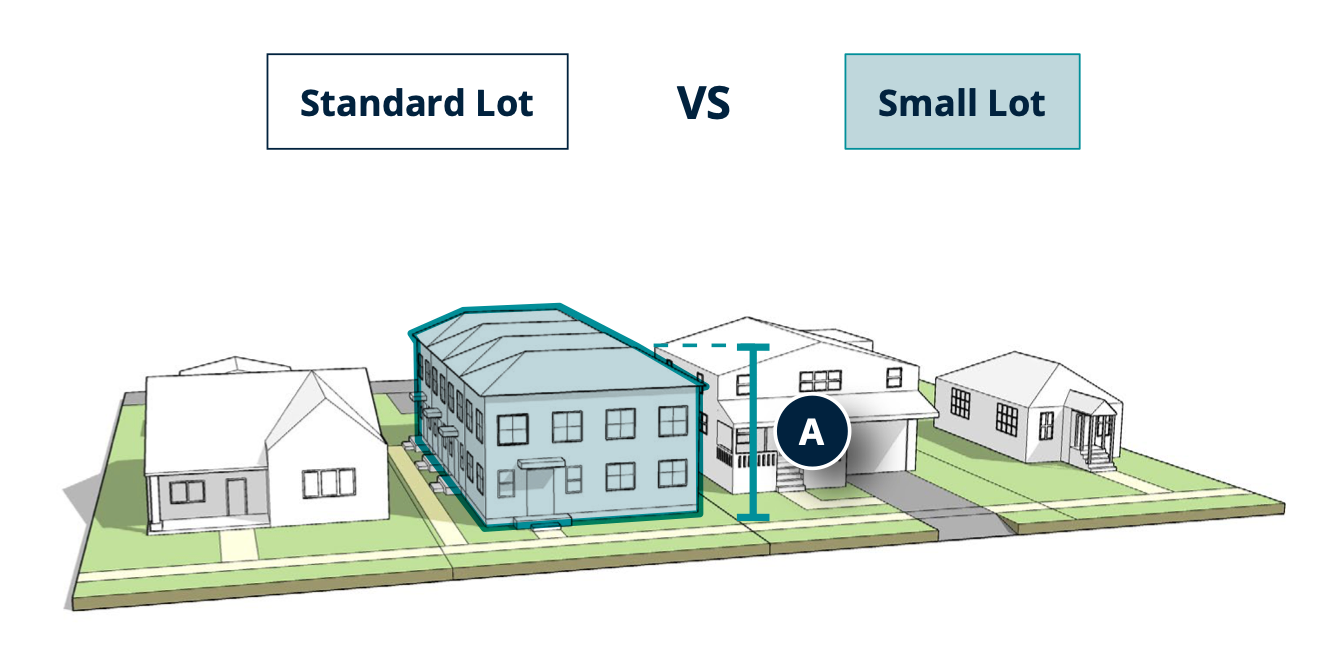
    In their case, they are proposing to create a new definition for “Small Lot Dwellings,” which would, among other things, reduce the minimum lot area per dwelling to 2,000 sf, reduce the number of required off-street parking spaces from 2 to 1 per dwelling, and allow up to four homes per lot via fourplexes and townhomes.

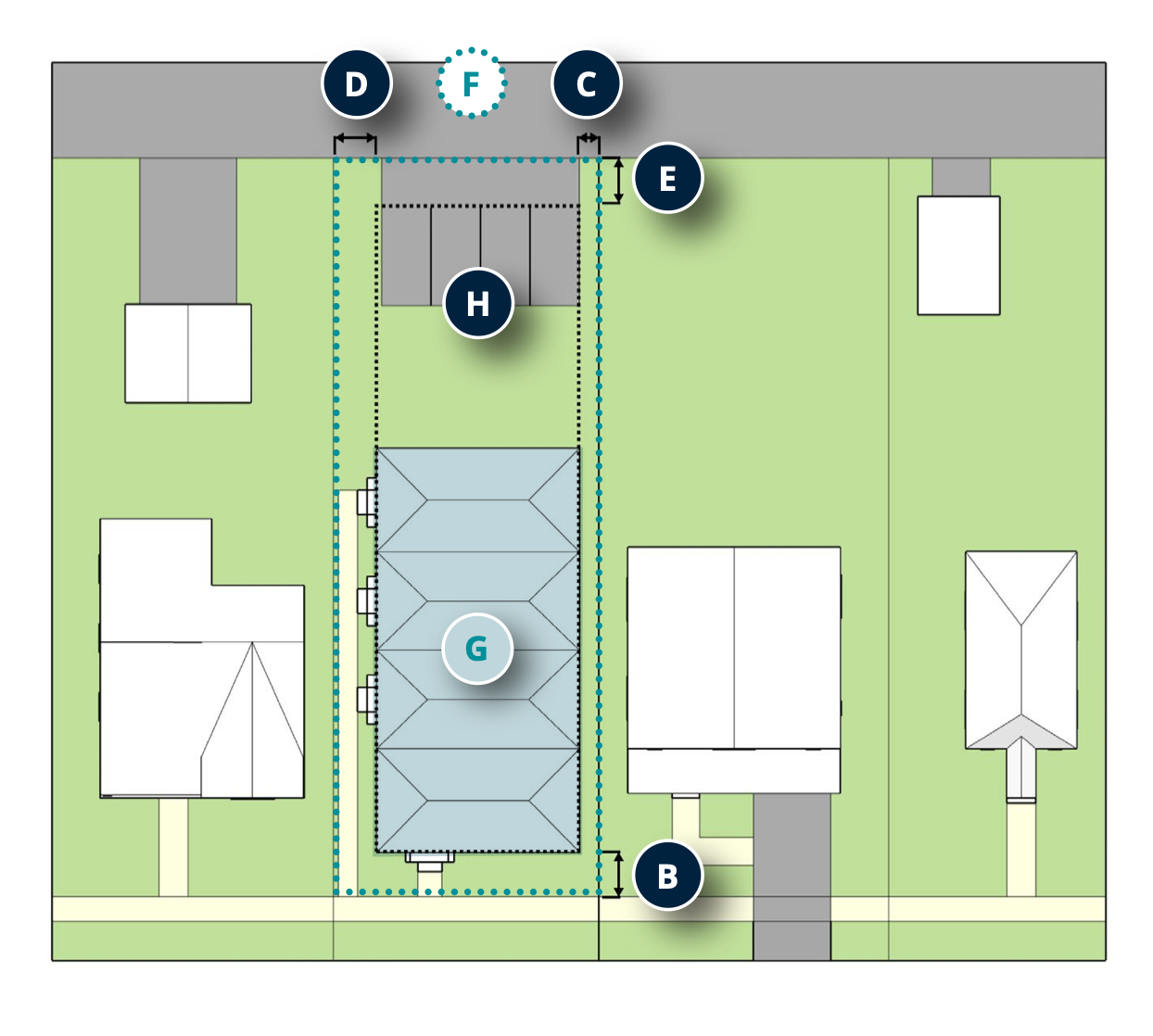
    One of the things that I found interesting about their proposed policies is that they seem to explicitly encourage “sideways” multiplexes and row houses like this:

    This starts to tell you something about the scale of SLC’s urban fabric, even though there are no dimensions on this conceptual site plan. These are big lots.

    Despite sometimes having the same moniker, cities are responding to their urban contexts in different ways. SLC uses explicit density math: at least 2,000 sf of site area per dwelling. Whereas Toronto increasingly relies on built-form standards: here’s the envelope you can build, if you can fit a fourplex within it (or a sixplex in certain wards), go for it. And don’t worry about parking.

    If Toronto mandated one parking space per dwelling unit, virtually no multiplexes would ever get built in the city. Our lot sizes simply don’t allow for it. Moving away from the car is also the only way that Toronto will be able to continue to grow and scale up.

    Despite these local nuances, the overall ambition remains the same. Low-rise neighbourhoods across North America are being asked to house more people on the same amount of land, and that’s a positive step forward.


    Cover photo by Ashton Bingham on Unsplash

    Map and planning diagrams from Salt Lake City Planning Division

  • 15th annual

    Plus, Extell and Hilton announce new Waldorf Astoria in Park City

    January 28, 2026 · View original


    Whistler is out, the Interior of BC is in. Huge real estate deals are out, powder chasing is in. If you’re a long-time reader of this blog, you’ll know that I do a ski and snowboard trip with a group of friends each year around this time.

    Our last three trips were to Park City (where it snowed so much we lost power); Trois Vallées (which also served as my bachelor party and which involved equal parts snowboarding and dancing on tables); and Hokkaido (where it looked like Toronto looks right now).

    This year — for annual number fifteen — we’re headed to Revelstoke and Kicking Horse in the Selkirk and Purcell Mountains.

    On some trips we like to combine an urban trip with the mountains, so that we can also gawk at architecture and urbanism. That’s what we did in Japan last year. But this year’s trip is not about that. It’s about unadulterated time in the mountains.

    It has been a weird season for snow. The west coast has been too warm with not enough of it, and the east coast has been too cold with unusual amounts of it. I have no idea what’s in store for us this week, but here’s to hoping it looks like the cover photo of this post.


    In some related real estate news, Extell Development Company and Hilton just announced that they’ll be opening a Waldorf Astoria Resort and Residences in the new Deer Valley East Village.

    It’s going to have 132 hotel keys and 105 one- to six-bedroom branded residences ranging from 1,099 to 5,155 square feet. Of the 105 branded residences, 56 will be “hotel residences” located above the hotel, and the remaining 49 residences will be in a more exclusive standalone residential building.

    Architecture for the project is by KPF and the interiors are by AvroKO.

    If you missed my recent post about the East Village and the new Four Seasons that is also currently under construction, click here.


    Cover photo by Zach Wear on Unsplash

  • Thoughts on the new Deer Valley Four Seasons

    Spoiler: It’s not for me

    January 18, 2026 · View original


    New York-based Extell Development is currently under construction on a Four Seasons Resort and Private Residences in the new Deer Valley East Village in Utah. When I was there in December, Bianca and I went by to check out the overall progress in the village, and the crew was in the midst of laying the decking for the ground floor. ODA designed the architecture, interiors, and landscaping.

    The residential offering consists of Private Residences and Hotel Residences. The former are located in an owner-exclusive building and the latter are in the hotel building, where the units can be put into the Four Seasons Rental Program. I’m not sure if this is indicative of their overall inventory, but the remaining Hotel Residences are meaningfully larger than the Private Residences.
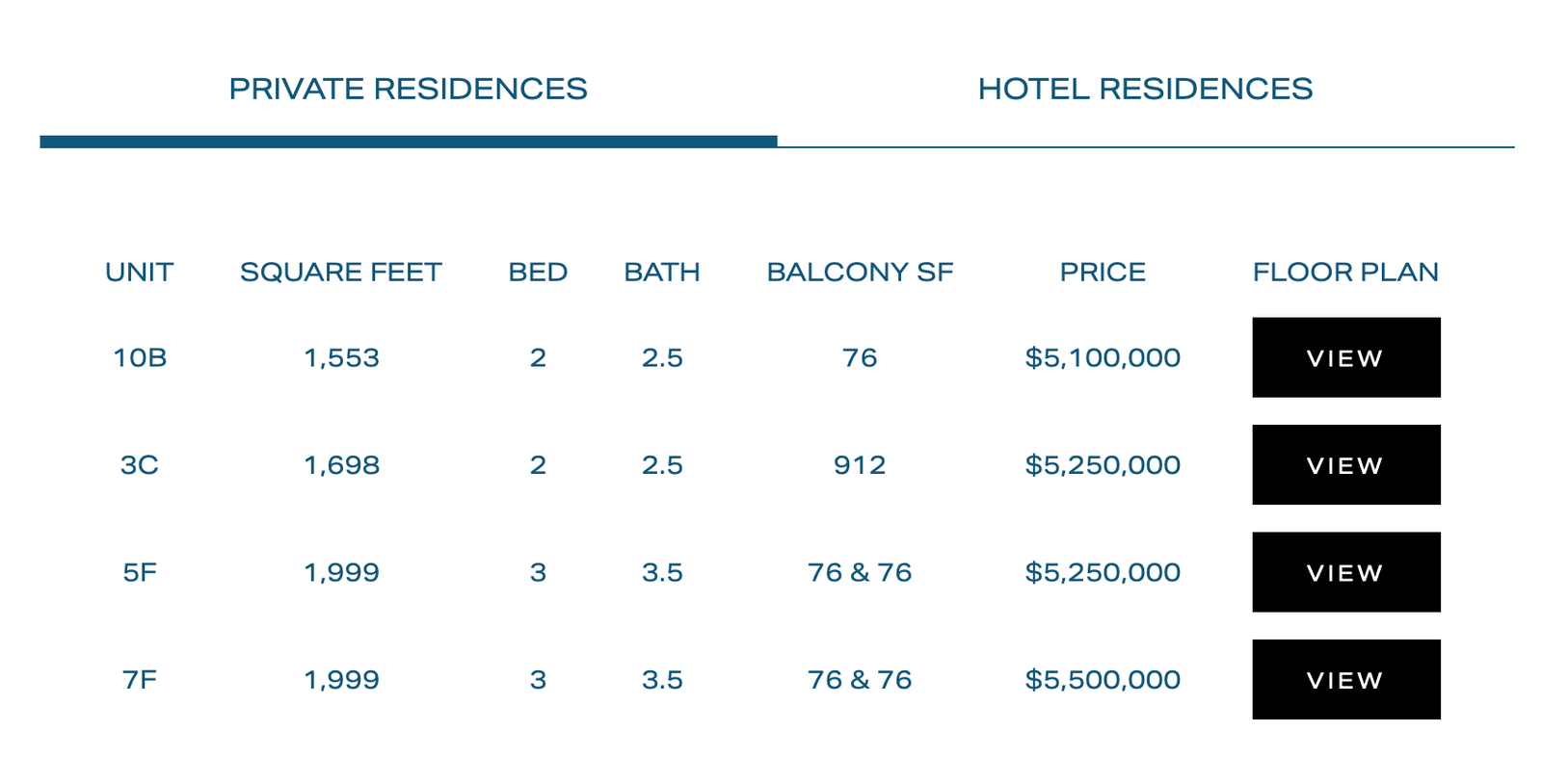
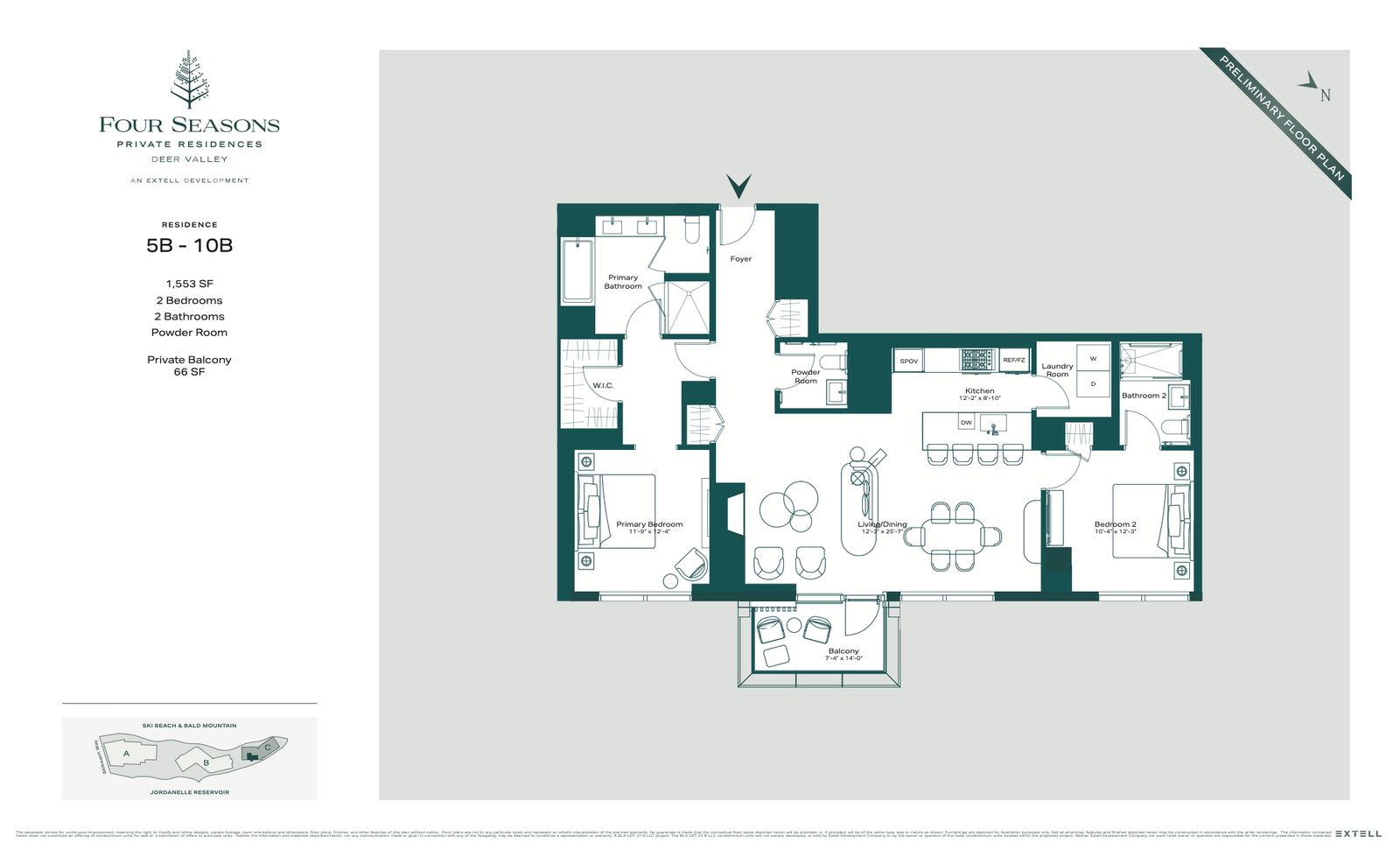
    Based on current availability, the smallest remaining Private Residence (1,553 sf) is going for US$3,283 psf.
    As a Park City booster, I think this additional village is exciting. There are now two large interconnected resorts and four distinct villages lining the Wasatch Back: Park City Mountain Resort, Park City Canyons Village, Deer Valley, and the Deer Valley East Village. Visit Utah would say that there’s also a third resort in Woodward Park City (which happens to be adjacent to Parkview Mountain House).

    But as a real estate developer and snowboarder, I do wonder about two things.

    First, Deer Valley East Village is located in an area on the Wasatch Back that receives noticeably less snow compared to other areas because of its lower elevation and broad east exposure. If I refer back to Jim Steenburgh’s book, Secrets of the Greatest Snow on Earth, the average annual snowfall at the base of the Jordanelle Gondola (located just north of the East Village) is probably less than 150 inches. This compares to 350+ inches at higher elevations in Park City and 500+ inches in the Cottonwood Canyons.

    Because of this, the East Village has obviously invested heavily in snowmaking equipment. But artificial snow is not the same as natural snow. The higher elevations will be just fine, but the lower elevations will likely see marginal conditions. So why build a new village here? And was and is this a consideration for buyers at this new Four Seasons? Or are the luxury amenities and après events the real deciding factors? I’m not their target demographic, but from my perspective, this is reason enough not to buy here.

    On the topic of the target buyer, my second question is about Deer Valley’s “no snowboarding” rule (which is another reason why I’m not their target demographic). There are only 3 resorts in the United States that ban snowboarding. One of them is Deer Valley, and the other two are Alta (Utah) and Mad River Glen (Vermont). This seems to be a wildly popular rule among resort guests, and I support Deer Valley’s decision to weed out “riff-raff” like me. Deer Valley is also known for capping daily lift tickets to keep the crowds down, so they don’t seem to be hurting for patrons.

    But according to recent data from Snowsports Industries America (SIA), the rough participation split in the US between skiers and snowboarders is somewhere around 60-70% and 30-40%, respectively. There are also many instances where families have a mix of skiers and snowboarders. If you’re the Four Seasons at Deer Valley, this segment of the market is excluded. Oh well. The rich snowboarders have Park City, The Colony at Canyons Village, Powder Mountain, Aspen, and many other locations.

    My assumption is that the ban on snowboarders is an unapologetic feature of Deer Valley and developments like the Four Seasons. It creates an air of exclusivity and differentiation. Some data also suggests that snowboarders tend to be a more ethnically diverse group compared to skiers (SIA reports show that among female snowboarders, 25% are Hispanic, and among males, 13% are Black — the highest diversity rates in winter sports), so one could argue that it’s not just about the type of device used to get down the mountain. And, it seems to be working.

    In July 2025, the Extell announced that they had closed a $600 million construction loan for the project from JVP Management and that 60% of the hotel residences were already sold. This is believed to be the largest construction loan on record for a hotel and residential condominium project in Utah.

    At the same time, I’m also certain that the Four Seasons lost sales to certain buyers, perhaps a wealthy Boomer or Gen Xer with kids or grandkids who snowboard. Extrapolating this demographic trend, it is also believed that Millennials represent the first generation in the US with near-parity between skiers and snowboarders. So what will this mean for luxury real estate as these Millennials become the dominant buyer segment? My prediction is that the real estate market will respond.

    Would you buy at the Deer Valley Four Seasons? Or have you already?

    Cover photo: Deer Valley Four Seasons

  • From Chicago to Park City

    How Utah architect John Sugden reinvented the International Style for the mountains

    December 21, 2025 · View original


    John Sugden (1922-2003) was one of the most important Utah architects of the 20th century. Born in Chicago in 1922, he studied at the Illinois Institute of Technology (IIT) under the legendary Mies van der Rohe, and worked at Mies’s firm from 1945 to 1952 before moving to Utah.

    For those who may not be familiar, Mies is a big deal in the architectural community. Some of his most noteworthy projects include the Farnsworth House (which hosted a 100th anniversary collaboration between Braun and the late Virgil Abloh in 2021); the Barcelona Pavilion (and its accompanying chair); Crown Hall at IIT (which is high on my list of buildings to visit); the Seagram Building in New York; and, of course, the Toronto-Dominion Centre complex.

    Sugden moved to Utah in 1952. He would then spend the rest of his career defining what the International Style — a major architectural movement that dominated modernism from the 1920s to the 1970s — could be in a mountain context, while educating the next generation of architects at the University of Utah’s Graduate School of Architecture.

    His first major project in Utah was a house for his mother: the Roberta Sugden House in Salt Lake City (1955). It is a classic steel-and-glass structure that takes obvious cues from the Farnsworth House but that was adapted to the Utah landscape. Today, it remains an icon of Mid-Century Modernism in the city.

    His own home and studio followed in 1984. Referred to as “The Glass Cube,” or the Mountain House Studio, it is located in Park City (just down the street from Parkview Mountain House in Summit Park). A perfect 33 x 33 x 33 foot cube, the home marks an important turning point for architecture and design in the area.

    By the 1980s, modernism had entered into a mid-life crisis in urban settings. Architects and designers were beginning to reject its austerity and lack of ornamentation in favor of a new movement: Postmodernism.

    But in the Wasatch Mountains, and outside of perhaps only Aspen, the International Style had yet to truly make its mark. Mountain homes simply did not look like this; they were heavy and rustic, and they had gabled roofs. Sugden changed that. His home/studio was the opposite of this: light, transparent, flat-roofed, and industrial in its orientation.

    It’s also worth mentioning that the construction of the Glass Cube roughly aligns with the rebirth of Park City. By the early 1950s, it was a dying ghost town in the mountains. Many of the silver mines that had made it a wealthy place at the end of the 19th century had already shuttered, and the city was without an economic purpose.

    The first ski operations opened in 1963 under the banner of Treasure Mountain Resort. However, it was a makeshift operation, and it would not be until 1971 that Aspen-developer Edgar Stern would acquire Treasure and transform it into Park City Mountain Resort.

    By 1974, he had successfully lured the US Alpine Ski Team to the city. And by 1981, he had moved on to even grander ambitions with the opening of his latest project down the street: Deer Valley Resort. It was also around this time (1982) that Toronto-based Noranda stopped all work and closed the last mining operations in the city.

    Then came Sugden’s modernist Glass Cube in 1984.

    Today, the Summit Park area is filled with countless new and under-construction modern homes, designed by award-winning firms such as Klima Architecture and Brach Design. No two homes are the same, and there’s a palpable willingness to experiment. It feels like an architectural playground, and I like to think that it all started with John Sugden’s simple glass cube.

  • The banking and legal hurdles of building in the US as a Canadian

    December 14, 2025 · View original


    We completed and started renting Parkview Mountain House in Park City, Utah about a year ago. Construction took slightly longer than we had initially scheduled, but we finished construction under budget, which is always a good thing. Getting our building permits was easier than expected (thank you, Summit County) and closing them out involved as much back and forth as you would expect for a challenging mountain site. I would happily build another project in Park City.

    Some of our greatest challenges happened on the legal and financing side. When we acquired the site, we formed a single-purpose Limited Partnership in Utah that was initially owned by one of Globizen’s Canadian corporations, and later with two other partners (another Canadian corporation and a New York LLC).

    Limited Liability Companies (LLCs) are very common in the US. They offer a kind of hybrid “sweet spot.” They offer the limited liability that comes with corporations, but with the option of having the pass-through taxation you get with Limited Partnerships. However, they don’t exist in Canada, and so the legal and tax advice we got was to instead form a Limited Partnership. I’ll come back to this later.

    The first challenge we had was the seemingly simple task of opening up a bank account for the project LP. Wells Fargo, Chase, and others would not accept a Utah LP owned by a Canadian corporation. Too foreign. Too complicated. We finally managed to get one opened with US Bank, and they’ve been great, but being Canadian still poses challenges. For example, I can’t use their mobile app in Canada. And I can’t deposit cheques/checks online without first verifying my mobile number. But I can’t verify my mobile number because their system won’t send codes to Canadian numbers.

    The next hurdle was construction financing. It was frustrating to learn about all of the simple and cost-effective “one-close solutions” available to US entities, but not available to foreign nationals. We could have gotten a great rate, and a construction loan that automatically converts to a permanent facility at substantial completion. Instead, we had to finance construction through a combination of equity, lines of credit, and a private loan. Not ideal, but at least the draws were flexible and easy.

    Then came our take-out loan at completion. This proved to be impossible with our legal structure and foreignness. So much so that we ended up having to convert our Utah Limited Partnership to a Limited Liability Company, and become “members” of the LLC personally. This is a clean, common, and widely accepted structure for real estate ownership in the US. But in order to do this, we had to have KPMG advise us on how we could do this without triggering a massive tax liability. We were able to figure that out and close the facility. But our year-end tax filings are going to be a little more complicated this year.

    In the end, we overcame the obstacles. But it was certainly challenging, more so than the actual building part I’d say. Every time I mentioned that I was Canadian, I came to expect a pause, where the other person would then need to start processing what to do next. As international as the US is, it feels paradoxically insular when it comes to the things I described in this post. But this is how you gain experience. Now we’ll be slightly better prepared for our next US project, whatever that might be.

    Note: Nothing in this post should be viewed as legal or financial advice. I’m just sharing our experiences.

  • Thinking makes it so

    November 26, 2025 · View original


    There is a great quote in Shakespeare’s Hamlet: “There is nothing either good or bad, but thinking makes it so.”

    The point of this quote is to argue that the universe is fundamentally neutral. When an event happens, it is neither good nor bad; the label is determined by the judgment we ultimately bring to it.

    Take snow, for instance.

    Here in Toronto, I find that when it snows, people tend to look at it as a bad event. They think of the traffic that will ensue and the work that will be required to clear out walkways and driveways. But I love snow (maybe because I don’t have a driveway). Snow is good. As an avid snowboarder, it gets me excited for the winter season.

    And right now I can tell you that I’m praying to the snow gods for a dumping or two in Northern Utah. The entire Mountain West region is off to a slow start this season and has had to delay resort openings. My judgment tells me this is “bad.”

    Now, let’s consider the real estate development market.

    The prevailing narrative right now is that it’s bad. But Hamlet would say that only thinking makes it so. An alternative way to think about the market is that it’s presenting a generational buying opportunity.

    Like snow, I would call that a good thing.

  • Salt Lake is at that point in the development cycle

    November 17, 2025 · View original


    Real estate may be local, but a lot of markets appear to be correlated. I felt that way this past summer when I was meeting with developers in Paris and I continue to feel this way when I read articles about other markets. Here’s a recent one from Building Salt Lake talking about the state of Utah’s multi-family market.

    Based on the article, cap rates appear to be in the mid-4s for newish product, which is too low right now:

    > Investors aren’t jumping at the 4.6 cap deals they can typically find in Utah today, she added, when they could get over 5.5 in other major markets. > > “Salt Lake, a 4.6 cap, I personally think it’s a little mispriced relative to where else we can put our money,” Schultz said.

    This means that there aren’t the asset trades to support new development. To justify ground-up development, developers need to see a positive spread between their development yield and the exit cap — one that compensates them for the additional risk of construction. If that spread isn’t there, or if it’s unclear what it might actually be, development shuts off.

    Rents and values coming down also doesn’t help:

    > Back in 2022, which was the peak of the market, you could underwrite double-digit rent growth on a typical 250-apartment deal Downtown. Now, he said, “we’re seeing that effective rents down about 8.25%.”

    > Overall multifamily values are down 26%, King said, though he added that’s not indicative of every single project or every deal. He also said that decline came after four years of record supply and double-digit rent growth.

    What should be clear from these excerpts is that Salt Lake City is not at the point in the cycle where developers are jumping to deliver new ground-up multi-family product. They’re at the point in the cycle where firms are looking and hoping to buy distressed assets below replacement cost.

    Cover photo by Saul Flores on Unsplash

  • Utah creates new Condominium Construction Loan Program

    October 4, 2025 · View original


    The state of Utah is trying to build 35,000 starter homes over the next five years. Last year, $300 million was allocated to something known as the Utah Homes Investment Program (UHIP). The initial idea was that these funds would be provided as low-cost deposits to financial institutions so that they could, in turn, offer low-interest loans to homebuilders who committed to building single-family starter homes.

    But this didn’t go as planned. Apparently, the low-cost deposits weren’t low enough to compensate for the perceived lending risk. So Governor Cox asked if the funds could instead be directed to the Utah Housing Corporation. Enter the Condominium Construction Loan Program. The way this newly created program works is that UHC can now provide low-cost loans — up to 100% LTC — directly to developers.

    However, there are some stipulations:

    Warrantable projects: The projects must be warrantable to the Federal Home Loan Mortgage Corporation, meaning the property and the individual condominium units need to be eligible for conventional mortgage financing. – Owner-occupancy requirement: The individual condominium units must be sold to an owner-occupant, with a recorded deed restriction in place for a period of not less than five years. This is obviously to stop investors from buying and reselling. – Equity sharing: The equity appreciation on the condominium unit is shared between UHC and the first owner-occupant. The homeowner earns 75% of the equity appreciation (15% per full year of occupancy, through five years), with the balance going to UHC upon sale of the unit.

    So it’s a trade-off: buyers get access to new homes at below-market pricing (because the developer’s cost structure is reduced), and in exchange, they give up some of the potential upside. Will it work and help Utah achieve its starter home goal by 2030? I don’t know. But it’s clear recognition that if you want to deliver below-market housing, you need to provide subsidies.