Daily insights for city builders, delivered every morning at 6 AM ET. I’m Brandon Donnelly — a Toronto-based real estate developer and founder of Globizen. I’ve been writing here since 2013.

Category: New York

  • The geographic inversion of New York’s subway ridership recovery

    May 27, 2026 · View original


    New York City is the most urban city in America, with the largest subway network by far, and yet, even here, ridership levels have yet to recover to their pre-pandemic levels. Recent data shows subway ridership hovering between 70% and 80% of 2019 levels, and the MTA anticipates that it will remain “at about that level through 2029.”

    The obvious explanation is that office workers continue to work from home on occasion, and that’s certainly a significant part of the story here. But it doesn’t appear to be the entire story.

    For example, looking at station ridership recovery across the city, there visually appears to be a geographic correlation with areas in Upper Manhattan, the Bronx, and the outer boroughs in general not recovering to the same extent as Manhattan.
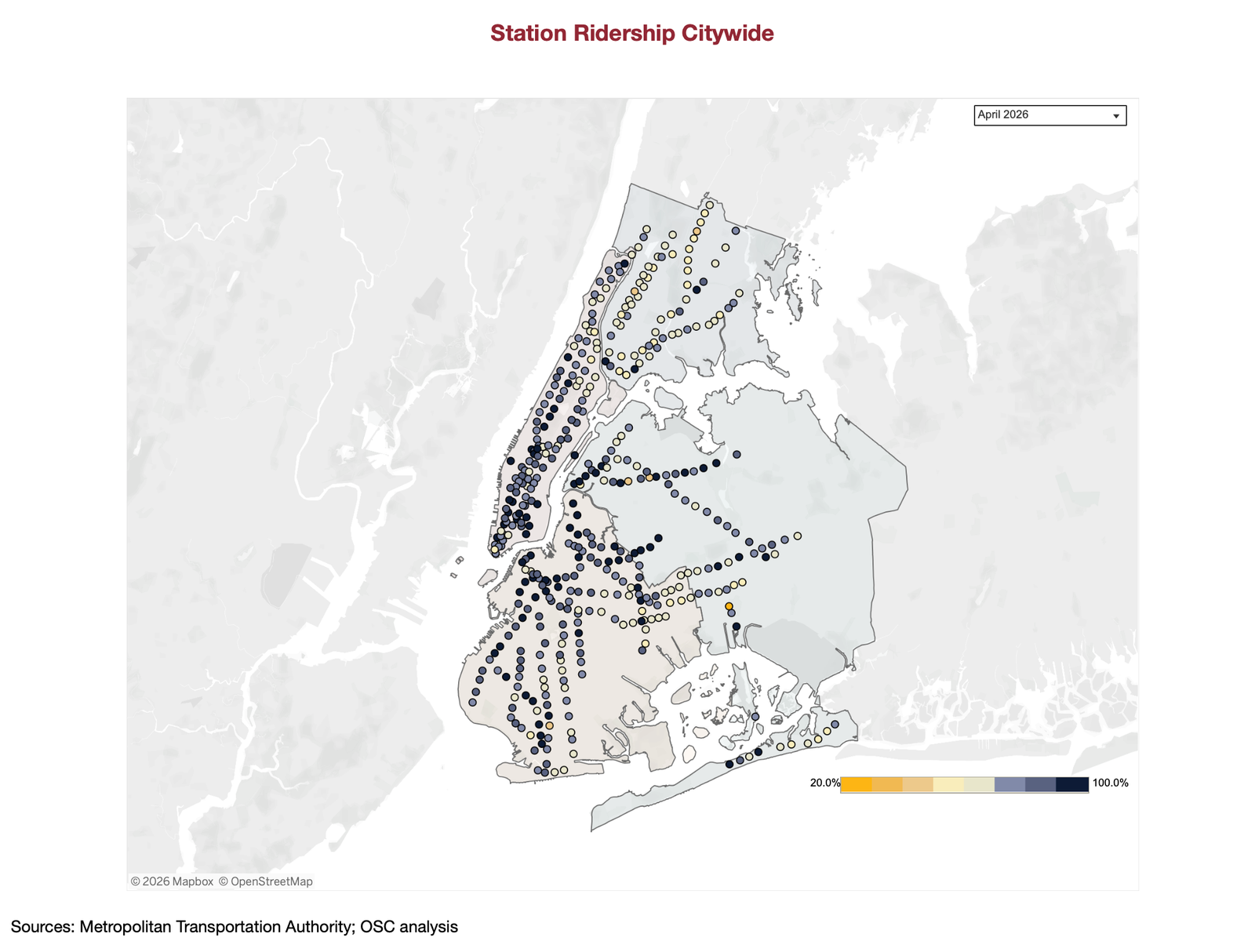
    In the early days of the pandemic, ridership levels were mostly correlated with median household incomes. Ridership remained higher in the outer boroughs, while residents in wealthier neighbourhoods simply worked from home. Since then, that correlation has weakened and the geography has inverted.

    This suggests to me that in addition to WFH, there has also been a structural mobility shift for many households. We know that car registrations in NYC spiked during the pandemic, and presumably that means some new mobility habits were formed.


    Cover photo by Igor Wang on Unsplash

    Chart from Subway Recovery Tracker
  • A new opportunity for congestion pricing

    March 27, 2026 · View original


    We’ve been talking about the merits of congestion pricing for as long as I’ve been writing this blog. But it remains politically unpopular, despite the overwhelming evidence that it consistently does what it’s supposed to do: it reduces congestion, shortens commute times, improves air quality, and raises money for alternative modes of transport, among other things.

    The status quo bias is strong, but right now we have an opportunity. Self-driving cars are in the midst of shifting the mobility landscape, and there’s a growing belief that (1) roads are going to need to be more accurately priced to deal with the surge in demand, and (2) this is a moment in time that grants us the opportunity to do it. Here’s a recent tweet by Chris Spoke of Toronto Standard that makes this point and that I agree with.

    The basic idea behind point number two is that many voters don’t like the idea of a congestion charge for themselves, but will probably mind a charge on robot cars a lot less — both because they are robot cars and because there are relatively few of them on the road today. However, at some point, robot cars will form the majority of vehicles on the road, so now would be a good time to establish new practices.

    What do you think?


    Cover photo by Minku Kang on Unsplash

  • A look back at (almost) a year of New York’s congestion zone

    December 23, 2025 · View original


    It has now been almost a year since New York City implemented its congestion charge for the area of Manhattan south of 60th Street and, despite all of the critics, the results are overwhelmingly positive. Here are some of the most important data points:

    – Pollution is down by as much as 22% in the congestion zone area. – Traffic has declined by about 11% in the zone. As a reminder, traffic improved basically immediately following the $9 charge. – An average of 71,500 fewer vehicles entered the zone each day from January through to November 2025, totalling nearly 24 million fewer vehicles. – The congestion charge is forecasted to bring in $548.3 million in 2025, beating the initial goal of $500 million. (This revenue will be used by the MTA for bond issuances that will in turn fund further infrastructure improvements.) – Importantly, foot traffic in the zone is also up year-over-year compared to Manhattan as a whole (3.5% versus 1.4%, respectively). – Storefront vacancies in the zone declined more rapidly compared to Manhattan as a whole and the rest of the city. (Though the vacancy rate is still the highest in this area, presumably because of the higher rents in downtown and midtown.) – New York City’s sales tax revenue is also up 6.3% this year compared to the same period last year, outperforming all neighboring counties. This suggests that the congestion charge is not keeping shoppers away.

    So, why shouldn’t other North American cities follow New York’s lead?

    Cover photo by ian dooley on Unsplash

  • Running through New York City

    September 19, 2025 · View original


    YouTube video

    I’m not a runner. I’ve just never gotten into it. But I can appreciate why people love it, and I imagine that some of the things I love about cycling also happen with running. One of those things is the ability to experience a place while working out.

    Here’s an example.

    I think this recent video by Satisfy does a great job of capturing what it must feel like to effortlessly glide through a city like New York. They also picked the perfect song, so turn your sound on. If you enjoy running and/or NYC, you’ll enjoy the video.

  • Waymo is now testing in New York City

    August 27, 2025 · View original


    Waymo has just been granted approval to test its autonomous vehicles in New York City. The permit allows up to eight of the company’s Jaguar SUVs to circulate in Manhattan and downtown Brooklyn. And according to the company, the plan is to start “immediately.” This first approval only runs until the end of September, after which it will need to be extended — but I’m guessing that shouldn’t be too difficult to obtain.

    What’s noteworthy about this announcement is that (1) New York City is a big and complex place and (2) it’s the first city for Waymo that receives snow. The company currently operates in San Francisco, Austin, Phoenix, and Los Angeles.

    That said, the company has been doing cold weather testing since, I think, 2012. And in 2016, they opened a 53,000-square-foot self-driving center in Michigan for this purpose. They’ve also run tests in Truckee, California, Upstate New York, and the Detroit area. So presumably its sensors are ready to melt snow and ice. But it’s looking like the true test will be on the streets of New York.

    Next should be Toronto.

  • New York’s declining share of millionaires

    May 1, 2025 · View original


    There is a nonpartisan, nonprofit think tank based in New York called the Citizens Budget Commission (or CBC). And this week they launched Competitive NYC. The intent is a kind of dashboard that provides insights into NYC’s overall competitiveness — specifically its ability to attract and retain both residents and businesses. I won’t summarize all of the findings; if you’d like to take a look, you can do that here. But I did want to point out one finding.

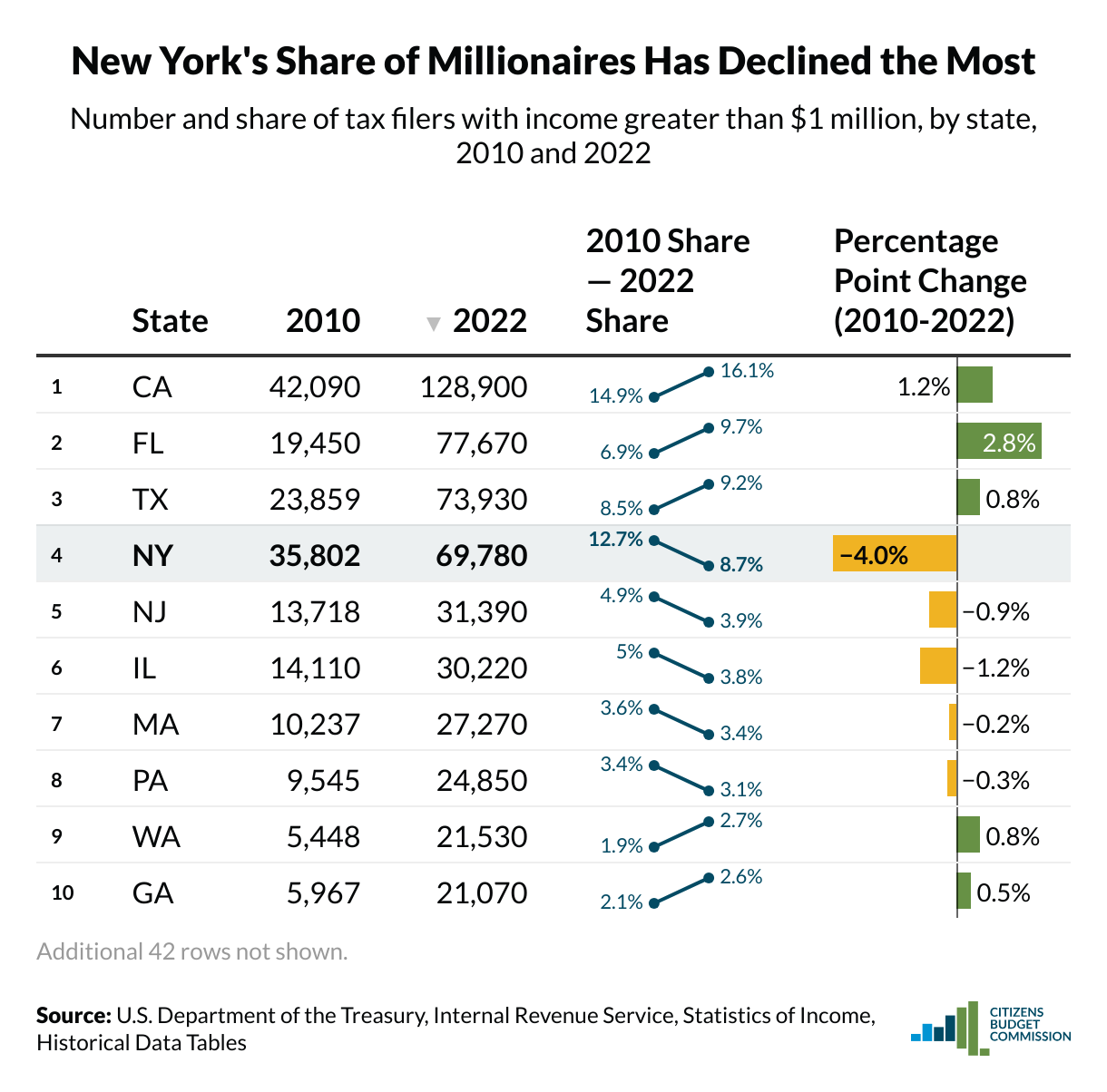
    Here’s a chart showing the top 10 states for people with incomes greater than $1 million:

    The number of “millionaires” in New York state increased from 35,802 in 2010 to 69,780 in 2022, but its share of US millionaires declined the most. Previously it was 12.7%, and in 2022 it had dropped to 8.7%. On the other end of the spectrum, the state with the biggest share gain was Florida.

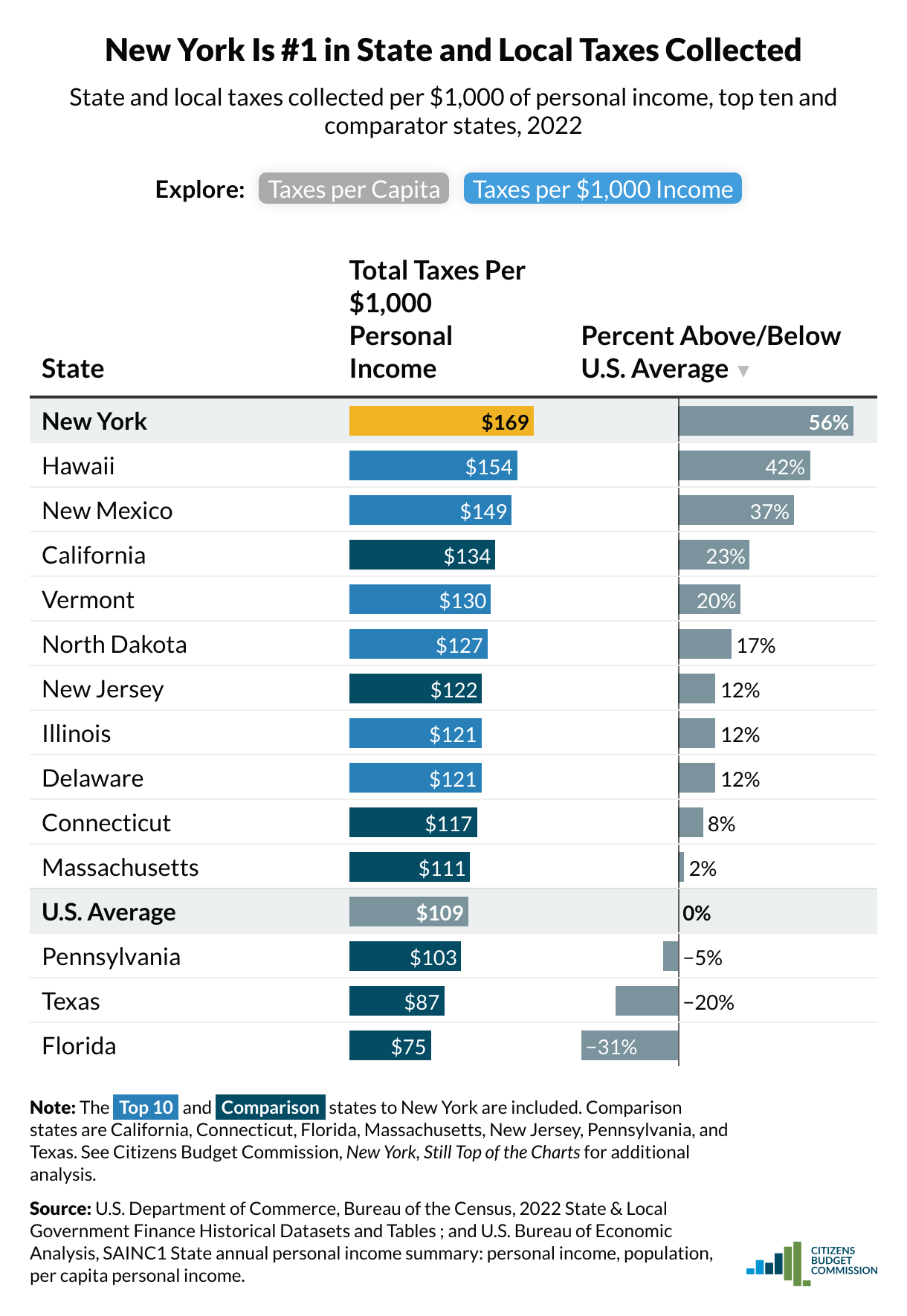
    The tracker goes on to suggest that high taxes may be a factor for households moving out of New York City. Here’s a chart showing taxes per $1,000 of personal income:

    New York state is the highest and is 56% above the US average, whereas Florida is 31% below the average. Florida also has the sunshine thing going for it. This migration trend aligns with what was talked about a lot during the pandemic. Between April 2020 and July 2022, NYC lost nearly half a million residents, a chunk of which went to Palm Beach and Miami-Dade Counties.

    It’s a reminder not to take competitiveness for granted, especially when there’s a clear trend toward places with warmer weather. People can and will vote with their feet.

    Cover photo by Andre Benz on Unsplash; charts from CBCNY

  • New York’s congestion pricing is doing what it’s supposed to do

    March 28, 2025 · View original


    New York City was supposed to terminate its congestion pricing program last Friday because, well, Trump told them to. But they didn’t do it and so harsh words were exchanged and then the deadline was extended for another 30 days. (This sounds oddly familiar.) Who knows what happens next month, but we are able to accurately quantify the benefits of nearly 3 months of congestion pricing.

    Firstly, it’s generating a lot of money. In the first two months of operation, congestion pricing has already brought in over $100 million in new revenue for the city. This is important because it’s money that can be used for transit and other infrastructure improvements.

    Equally important is the fact that this money was generated by creating measurable value for drivers. For all of the river crossings that lead into the CBD, average weekday travel times this past January are lower compared to January 2024. And in some cases, they’re lower by a lot. The Holland Tunnel, for example, saw travel times drop by 48%.

    Lastly, it’s encouraging more people to take public transit. Here’s a chart from Sam Deutsch over at Better Cities showing the increases in ridership since the program was implemented:

    The MTA as a whole is now averaging about 448,000 more public transit riders per day. And to put this number into perspective, Sam reminds us that Washington DC has the second most-used public transit system in the US and that it sees an average of about 304,000 total riders per day (January 2024 figure). So in other words, New York’s congestion pricing bump alone was nearly 1.5x DC’s entire ridership base.

    Some critics will argue that NYC’s subway is dangerous and that this program unfairly pushes people toward it. But crime data suggests otherwise. New York’s subway also saw over a billion rides in 2024! So I don’t know how you argue that less people should be taking it. It’s pretty clear that this is what moves the city. Imagine if the above went the opposite way and 448,000 more people started driving to work.

    Some people may not like it, but the reality is that congestion pricing is doing exactly what it’s intended to do: reduce traffic congestion, make money, and encourage more sustainable forms of urban mobility.

    Cover photo by Wells Baum on Unsplash

  • Finally, New York City gets its congestion relief zone

    January 6, 2025 · View original


    Good morning. Well, it finally happened.

    After decades of delay and negotiations, New York City finally implemented congestion pricing for the area of Manhattan south of 60th Street. This is a first for the United States, and so it’s a big deal not just for the city, but for this part of the world. It went into effect yesterday, on Sunday at midnight, so that the MTA could work out any kinks before this morning’s rush hour. And apparently everything went smoothly. Drivers are now required to pay $9 to enter the zone during peak hours (5am to 9pm during weekdays). The charge is also expected to rise to $15 by 2031. Of course, this is a highly contested initiative. Trump is still vowing to kill the program as one of his first acts in office and, as soon as the pricing came into effect, suburban drivers started protesting it in Manhattan. I thought Jarrett Walker had a clever response to this:

    > Tweet: Tip: An effective protest is one that doesn’t prove the other side’s point.

    One of the common rebuttals when it comes to things like road and congestion pricing is this one: “yeah, this might work in cities like London which have great transit systems, but it doesn’t work in our city because we don’t have that and it will unfairly disadvantage those who have no other alternative but to drive.” In fact, this exact excuse was recently raised by local politicians here in Toronto. But this is New York fucking City. It has the highest annual transit ridership in North America (beating out Mexico City by nearly 2x) and it has the largest system by total length. According to the 2012-2016 American Community Survey, 85% of people traveling to Manhattan’s CBD (I’m assuming lower Manhattan here) also take transit. And only 11% drive a car. So what exactly is the problem here?

    This objection also ignores the fact that, generally speaking, congestion pricing has two main goals: (1) to, of course, reduce traffic congestion and (2) to generate money for more efficient modes of transport. In this case, the MTA is hoping this new congestion relief zone will generate up to $15 billion that can then be reinvested in transit and other infrastructure. Demand for roads can also be relatively inelastic in the short term, meaning demand doesn’t change all that much as the price moves up and down. This makes it a good place to find money for public infrastructure, but it might mean that $9 is too low to have a dramatic impact on traffic congestion. We will see; I’m sure we’ll get some data soon enough.

    My prediction is that this will ultimately have an impact on congestion and that people in New York will get over the $9 charge. They’ll also come to appreciate the reduced traffic congestion within the zone. So I think this road pricing will stick, and my hope is that it will become an example for other cities in the US and across North America. Congratulations on finally getting this over the line, NYC. It was certainly a hard-fought battle.

    Cover photo by Veronika Galkina on Unsplash

  • New York’s first all-electric tower

    Here’s the thing:

    Nationwide, the biggest single source of emissions is transportation, dominated by low-occupancy cars and trucks. But in New York, most people use mass transit instead of driving. That means buildings “are by far the largest source” of climate pollution in the city, said Christopher Halfnight, senior director of research and policy at the Urban Green Council, a nonprofit focused on energy efficiency in buildings. Gas- and oil-burning furnaces and water heaters are together responsible for 40% of NYC emissions, according to Halfnight.

    In response to this, New York City has been passing laws that restrict greenhouse gases and that by and large incentivize electrification. One of these is Local Law 97, which will generally require buildings over 25,000 sf to reduce their GHG emissions by 40% (relative to 2005) by 2030.

    Already the market is responding. Alloy Development has just completed the city’s first all-electric tower at 505 State Street in Brooklyn. Tenants began moving in on April 5.

    When team members asked what the complex would look like absent gas, the answers were fairly straightforward. “Instead of a gas boiler, an electric boiler; instead of a gas cooktop, it was an induction cooktop. And literally that was it,” said Pires, noting that they had to revise the design of the electrical room to allow for higher amperage, since more incoming electricity would be needed for a larger electrical load.

    Some, or perhaps many, in the industry are fighting these new laws. In 2022, a co-op in Queens apparently went to the New York Supreme Court. But directionally, this certainly looks to be where we are headed. So you can either fight it, or you can try and get ahead of it, as Alloy has done here.

    For more information on 505 State Street, go here (Bloomberg) and here (project website).

  • New York City’s vacancy rate is the lowest since 1968

    Some four years ago, people were talking about the possibility of New York City being dead. But of course that was nonsense. Last week, New York City published the initial findings of its housing and vacancy survey and the key takeaway is that the city’s vacancy rate dropped to 1.41% last year (2023). This is a drop from 4.54% just two years ago and the lowest measurement since 1968. It’s also even worse at more affordable rent levels:

    The problem, as described by the city, is a supply-demand imbalance. Over the last two years, the city’s net housing stock grew by about 60,000 homes (~2%). This is, apparently, pretty good compared to recent years/decades; but it wasn’t nearly enough given that the city added 275,000 new households. This is the opposite of dead, and it’s not going to be addressed by just doing things like restricting short-term rentals.

    We have a structural delivery problem and New York City is not alone in facing it.