


4.2K+Subscribers
Popularity
20Supporters
Subscribe
It's fun to examine projects that I could never underwrite or build in Toronto. Here's another one from Tokyo — a 10-storey, single-stair apartment building on a busy street, next to a metro station.

The site itself is only 59.49 m2 (~640 ft2), and the building footprint is 47.97 m2 (~516 sf), for a total of 388.28 m2 (~4,179 ft2). There's retail on the first and second floors, one home per floor on levels 3 through 8, and then a two-storey home on levels 9 and 10. All of this is serviced by a single elevator, and a single open-air egress stair off the back.

The building itself uses a simple structural system involving 6 columns (which you can see evenly placed on the plans). According to the architect's notes, they started with a simple 4-column design, but apparently the columns were too large and compromised the suite layouts.

Tokyo is a unique city and this kind of housing wouldn't work everywhere. But there's a universal lesson here: removing barriers and allowing small infill projects is a good thing for cities. Until these projects are feasible, we won't know exactly what the market actually wants and could support.
Photos from Hiroyuki Ito Architects
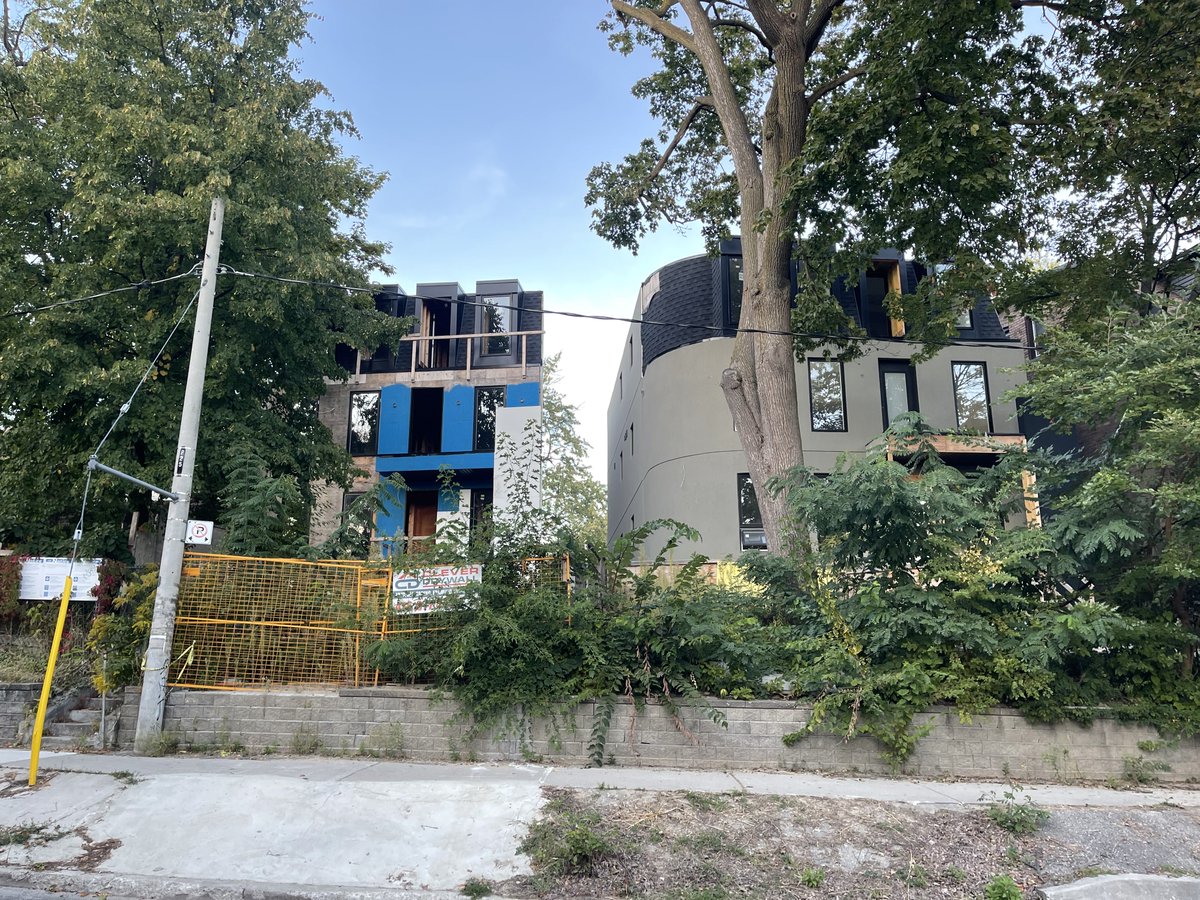
Bianca and I went for a walk around the Junction over the weekend, as we like to do, and I was pleasantly surprised to find a number of "multiplexes" under construction. That is, small infill rental projects with four or five homes, sometimes including a laneway house at the back. (Sorry, no sixplexes were spotted just yet.) It immediately made me think, "Wow, it's happening! Toronto is intensifying its neighborhoods."
For those of you who haven't been following closely, many of Toronto's neighborhoods have been bleeding population over the past few decades. It's only where we've allowed larger-scale new developments that we've really seen populations increase. That's what has precipitated our current push to expand housing options in our low-rise neighborhoods. And already, you can find evidence that it's starting to work.
That said, it's worth mentioning a few things. Some of the planning notice signs that I stumbled upon dated back to 2022, and some were current. This raises at least two lines of questions. One, why is a small project that went to the Committee of Adjustment in 2022 still under construction? Was it because of planning delays, or something else? And two, why are today's projects still having to go to the CofA? Are we still not there yet in terms of the planning policies?

I don't know the precise answers to these questions, but I do know that planning staff actively monitor which variances are requested and ultimately approved. If the same variance continues to show up, then it's a clear indication that it should just become policy, and not be something that needs to be sought. This should give some comfort that we should only get better at facilitating this scale of housing.
It's fun to examine projects that I could never underwrite or build in Toronto. Here's another one from Tokyo — a 10-storey, single-stair apartment building on a busy street, next to a metro station.
The site itself is only 59.49 m2 (~640 ft2), and the building footprint is 47.97 m2 (~516 sf), for a total of 388.28 m2 (~4,179 ft2). There's retail on the first and second floors, one home per floor on levels 3 through 8, and then a two-storey home on levels 9 and 10. All of this is serviced by a single elevator, and a single open-air egress stair off the back.
The building itself uses a simple structural system involving 6 columns (which you can see evenly placed on the plans). According to the architect's notes, they started with a simple 4-column design, but apparently the columns were too large and compromised the suite layouts.
Tokyo is a unique city and this kind of housing wouldn't work everywhere. But there's a universal lesson here: removing barriers and allowing small infill projects is a good thing for cities. Until these projects are feasible, we won't know exactly what the market actually wants and could support.
Photos from Hiroyuki Ito Architects
Bianca and I went for a walk around the Junction over the weekend, as we like to do, and I was pleasantly surprised to find a number of "multiplexes" under construction. That is, small infill rental projects with four or five homes, sometimes including a laneway house at the back. (Sorry, no sixplexes were spotted just yet.) It immediately made me think, "Wow, it's happening! Toronto is intensifying its neighborhoods."
For those of you who haven't been following closely, many of Toronto's neighborhoods have been bleeding population over the past few decades. It's only where we've allowed larger-scale new developments that we've really seen populations increase. That's what has precipitated our current push to expand housing options in our low-rise neighborhoods. And already, you can find evidence that it's starting to work.
That said, it's worth mentioning a few things. Some of the planning notice signs that I stumbled upon dated back to 2022, and some were current. This raises at least two lines of questions. One, why is a small project that went to the Committee of Adjustment in 2022 still under construction? Was it because of planning delays, or something else? And two, why are today's projects still having to go to the CofA? Are we still not there yet in terms of the planning policies?
I don't know the precise answers to these questions, but I do know that planning staff actively monitor which variances are requested and ultimately approved. If the same variance continues to show up, then it's a clear indication that it should just become policy, and not be something that needs to be sought. This should give some comfort that we should only get better at facilitating this scale of housing.
Designed by Selma Masic — in collaboration with Sei Haganuma (Haryu Wood Studio) — the house sits on a 3-meter-wide lot, has a total area of 63 square meters across three floors (~678 square feet), and allegedly houses a family of four. Bridgestone also appears to be its immediate neighbor.
To put these dimensions into perspective, 3 meters is roughly the width of a “typical” new apartment living room here in Toronto. Usually, if you have a floor plate that can accommodate an outboard bedroom up at the glass, you design for a structural grid somewhere between 6–6.5 meters.
This gives you around 10 feet for the living room and around 10 feet for the bedroom. (As a a Canadian, it's important to always bounce back and forth between metric and imperial.) In this case, the entire lot is only 3 meters wide, though a corner lot always enhances a floor plan.
All of this is fascinating because, compared to North America, it represents a completely different way of conceptualizing space. Of course, the point of posts like this one is not to suggest that this is what all homes should be like. The point is that there are benefits to allowing those who would like such a home to be able to build it.
Cover photo by Selma Masic
Designed by Selma Masic — in collaboration with Sei Haganuma (Haryu Wood Studio) — the house sits on a 3-meter-wide lot, has a total area of 63 square meters across three floors (~678 square feet), and allegedly houses a family of four. Bridgestone also appears to be its immediate neighbor.
To put these dimensions into perspective, 3 meters is roughly the width of a “typical” new apartment living room here in Toronto. Usually, if you have a floor plate that can accommodate an outboard bedroom up at the glass, you design for a structural grid somewhere between 6–6.5 meters.
This gives you around 10 feet for the living room and around 10 feet for the bedroom. (As a a Canadian, it's important to always bounce back and forth between metric and imperial.) In this case, the entire lot is only 3 meters wide, though a corner lot always enhances a floor plan.
All of this is fascinating because, compared to North America, it represents a completely different way of conceptualizing space. Of course, the point of posts like this one is not to suggest that this is what all homes should be like. The point is that there are benefits to allowing those who would like such a home to be able to build it.
Cover photo by Selma Masic
Share Dialog
Share Dialog
Share Dialog
Share Dialog
Share Dialog
Share Dialog


