Daily insights for city builders, delivered every morning at 6 AM ET. I’m Brandon Donnelly — a Toronto-based real estate developer and founder of Globizen. I’ve been writing here since 2013.

Category: Food

  • A few observations about Salt Lake City

    Utah is beautiful. See here.

    People in SLC are really nice. Strangers greet you on the street. Motorists are also more polite and patient. I had no idea how to respond. I suspect it might have something to do with there being less traffic and, in turn, less frustration. But again, even if you ignore what happens on the road, people are nice.

    You will need a serious utility vehicle to navigate the topography of this region. Venturing into the surrounding canyons requires 4-wheel drive or chains during snowstorms. I was only there for a week and already I have visions of a classic Defender in my mind. Do they come in electric versions?

    The streets are too wide for proper enjoyment as a pedestrian. This is a challenging problem to fix, as I have mentioned before. That said — and this is going to be an unpopular opinion — the city felt void of any sort of real traffic. The distances travelled are great, but the highways actually flow freely. You also never really need to worry about parking.

    Electric scooters are popular in SLC. As is cycling — both for getting around and as a reason to wear tight-fitting bright clothes.

    SLC feels as if it is both under the radar and also rapidly emerging. My new favorite restaurant in SLC is a place called Post Office Place. We walked in without a reservation on a Friday night and they gladly took us. I couldn’t understand why the place wasn’t rammed. I mean, they have Marseille-style panisse on the menu!

    The Granary District is an area to watch. It is a former industrial area to the southwest of downtown. It is already home to breweries, food halls, and creative offices. But it needs some more time to properly fill in. We stayed at the Evo Hotel in Granary (highly recommend). The campus amenities include a rock climbing facility, an indoor skatepark, and plenty of places to work and Zoom.

    Most of the new infill housing appears to be mid-rise in scale and most of it is wood-frame construction on top of concrete.

    By my estimation (and by estimation I mean that I have a spreadsheet for this), the ski and snowboard communities surrounding SLC are some of the most accessible in North America. Land at SLC airport and you’re in the mountains in 20-30 minutes.

    Park City-Canyons is the most well-known ski destination. But if you’re a more aggressive skier — the kind that keeps your gloves together with duct tape and counts the number of ski days per season — you’ll want to head over to the Cottonwood canyons and places like Snowbird and Brighton.

    Snowbird remains one of my all-time favorite ski destinations for two reasons: the mountain itself and the brutalist architecture at the bottom of it. There’s none of that faux alpine crap over here — just exposed and unabashed concrete and wood. And who doesn’t love brutalism, right? (I haven’t been to Brighton yet but one of my local friends told me that it’s a great snowboarders mountain.)

    The Canyons Village at Park City is developing really nicely. As I understand it, it’s only about 30-40% built out at this stage. The Pendry Hotel just recently opened (announcement here) and I can tell you that the restaurants were generally busy every night of the week (summer experience). The project team did a wonderful job creating a place and a new anchor in the village.

    What did I miss in this list?

  • CloudKitchens quietly expands across Latin America

    Despite having somewhere around 4,000 employees and being valued at upwards of $15 billion (2021 figure), CloudKitchens remains an incredibly secretive company. In 2020, it was reported that they had spent over $130 million in the preceding two years on properties in about two dozen cities, and this week the Financial Times reported that they have been quietly building “dark kitchens” across Latin America, alongside a new food and convenience goods business called Pik N’ Pak.

    The way this all supposedly works is that the “dark kitchens” prepare the food for delivery and pick-up takeaway, and any excess space within these buildings is used to store convenience goods like over-the-counter medicines and pet foods. I guess it is literally about picking and packing various items that you can then attach to takeout orders. In both cases, the food and goods are delivered to customers using local app companies such as Uber Eats.

    All of this appears to represent a shift in the supply chain for takeout food and various convenience goods. But what I am really curious about right now is what the real estate footprint of this network looks like within our cities. What is the optimal square footage of a ghost kitchen? What radius do they serve? And how does this ultimately change the landscape of our cities? I don’t know the answers to these questions, but change appears to be underway. Here’s an excerpt from the above FT article:

    “…the growth of dark kitchens across Latin America has caused controversy in certain cities. The proliferation in São Paulo, the largest city in the Americas, sparked objections from residents living nearby, with banners against new facilities appearing in well-heeled neighbourhoods. The town hall has proposed local regulation of dark kitchens and earlier this year placed a temporary ban on the issue of new licences. People have complained about noise, smells, smoke and motorcycle drivers — known colloquially as motoboys — waiting outside to collect orders. One unhappy local said his son had been nicknamed “bacon” and bullied in school because of the odour on his clothes, according to Cris Monteiro, a city councilwoman.”

    Travis Kalanick seems to have a knack for upsetting people and changing the way our cities operate. Although, the same could be said about a lot of other startups.

  • How Toronto landed its first Michelin Guide

    Back in May, I happen to come across a 1912 copy of Michelin’s Guide to France. It was exceedingly cool to see and I’d love to find a copy for my own library. (For those of you looking for a reminder on how the Michelin Guide works, click here.)

    After returning to Toronto, I then serendipitously learned that our city would be getting its own guidebook this fall, which will be a first for both Toronto and for Canada as a whole. A Michelin-starred restaurant means something to some people, and has generally been proven to drive tourism dollars — so this is perhaps a big deal.

    But there’s a lot of opacity around how these guides work and how a restaurant gets awarded one, two, or three stars. Who are these secretive reviewers? And is it really worth the money that governments need to pay to the French tire company? South Korea allegedly spent US$1.8 million back in 2016 to get its guide.

    Andrew Weir, who is the executive vice president of Toronto’s tourism marketing group, was recently interviewed about all of the behind-the-scene efforts that took place in order to make this upcoming guide happen. If you’d like to have a read, click here.

    In my view, all of this is very much an act of city building.

  • Love letter to Québec

    I watched this for the first time last night. It is the late and great Anthony Bourdain hanging out in Montréal and Québec City with two of Canada’s most respected chefs and restaurateurs: Dave McMillan and Fred Morin of the famed restaurant Joe Beef. Initially aired in 2013, it’s hard not to miss Bourdain when you watch it. And it’s also hard not to love Québec. This is an episode about humility, authenticity, good living, and, of course, some of the best food and drink in the world. Bourdain has a great line right before they visit Wilensky’s (in Le Plateau area of Montréal) where he says, “no matter how you feel about Québec as either separate or as an essential part of Canada, any reasonable person loves this place.” I couldn’t agree more.

    If you can’t see the embedded video above, click here.

  • The unit economics of food-delivery apps

    Here is another article/report thing from McKinsey talking about the “fast-growing food-delivery ecosystem.” In the US, the top food-delivery players are DoorDash, Uber Eats, and Grubhub (in this order).

    What is clear is that these platforms are growing very quickly and that COVID-19 was of course great for the business of eating at home. The demand is there.

    But what is also clear is that food-delivery is a low-margin business that depends on scale. Last-mile and single-point delivery is tough. This is despite the fact that consumers have shown to be willing to pay a fairly significant premium in exchange for the conveniences of on-demand meals.

    Here’s a chart from McKinsey that looks at the unit economics of delivery apps:

    It is a race to capture “stomach share.”

    But surely this evolves and gets further optimized with the continued rise of things like “ghost kitchens” and maybe autonomous delivery robots.

    I remember driving home one night during the thick of the pandemic and placing an order on Uber Eats for pickup. When I arrived, I found a small food truck and one lonely guy in the middle of an empty (and wintery) parking lot on Lake Shore East. He handed me my poke bowls and I was on my way.

    This is what is happening behind our apps and it’s changing the way we eat.

  • Façadism in Montréal

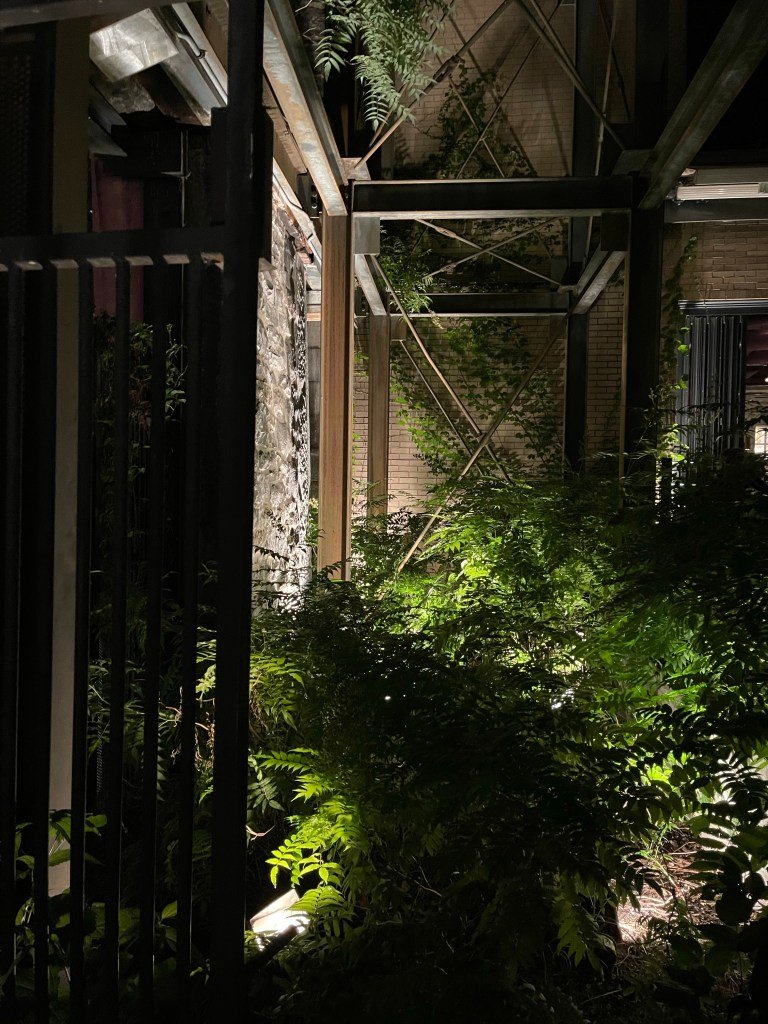
    These are photos from the terrace of a restaurant in Old Montreal called Boris Bistro. It’s not new — it’s been around since 1999 — but that doesn’t change the fact that its outdoor space is absolutely magical.

    The terrace sits behind an old stone facade on McGill Street that is held up with a three-storey steel structure. Hello façadism! I have tried to figure out the vintage of the original building through a cursory look online, but I came up with nothing. (Drop it in comment section below if you happen to know.)

    What we were told at the restaurant was that the original building burnt down, leaving just the facade and then an open space behind it. The size of the trees on the terrace do suggest that it’s been this way for a long time.

    There’s an office building beside it that looks to be of a 90s vintage (465 McGill Street) and this open space was apparently a place for office workers to go smoke. But now the ground floor of the office building and the terrace function as one large contiguous space.

    The result is what you see above. Magic.

    Montréal has been city building for a lot longer than Toronto. Some 400 years depending on how you calculate it. This history has created one of the most beautiful built environments anywhere in the world.

  • A new agricultural frontier in Canada and Russia

    Last year over the holidays, I attended a virtual wine tasting event that was put on by one of our partners. It was with a vineyard / winemaker in Spain and so it was evening for us and some ungodly hour for him.

    At the end of the tasting — which was exceptional, by the way — I asked him what he thought about the Niagara region. Some of you may know that I love to support local Ontario wines. His response was hilarious and something along the lines of: “When we think of Niagara wines, we think of a part of the world that shouldn’t produce wine but somehow does.”

    Ouch.

    This was maybe the case before. But I think the region, vines, and industry have all matured. We also have some exceptional winemakers, some of which have come from the Old World because our startup-y wine region affords them far more creative freedom.

    But you might also argue that things are changing because our climate is changing. The Financial Times recently published an interesting “big read” about how agricultural production and crop types are shifting around the world in the face of climate temperatures.

    It turns out that wine grapes are a pretty good leading indicator. A canary in the coal mine if you will. Because climate matters a great deal if you’re trying to make exceptional wines. And if you’ve been harvesting a particular thing at a certain time for the last 5 decades and you’re now doing it several weeks earlier, it might be a sign that something is changing.

    It also turns out that two countries, in particular, stand to disproportionately benefit from this shifting agricultural landscape: Canada and Russia. As temperatures change, a new agricultural frontier is going to be created. And it is expected that more than 50% of this land will be in these two countries. See image at the top of this post.

    Of course, there’s a flipside to this change. Countries on the other end of the spectrum with marginal growing climates and/or low production yields, could be severely impacted by higher temperatures. So perhaps it is a good idea to stay on top of what’s happening in the world of wine. Might I recommend something from Niagara?

    Image: FT

  • High-rise apartment pavilion turned Japanese izakaya in Zurich

    This past spring a new restaurant called Ooki Pavillon opened in the Sihlfeld neighborhood of Zurich. It’s an izakaya-style Japanese restaurant that is housed in a seven-sided pavilion that was initially constructed in the 1950s. The place looks great (see above), but what you may also find interesting is that the pavilion was initially built as an amenity space (leisure room) for one of Zurich’s first high-rise apartment blocks. Check it on street view, here. Supposedly there are only a handful of these sorts of pavilions remaining in the city. And so it is nice to see this one get repurposed (I don’t know what it was prior to Ooki). It is also a good reminder that, while many of our post-war apartment blocks aren’t the most urban in their approach, rethinking the ground plane can go a long way.

    Images: Ooki Pavillon

  • A mapping of restaurant “chaininess”

    This is an interesting study by Clio Andries (assistant professor at the Georgia Institute of Technology) and Xiaofan Laing (city planning graduate student). It looks at restaurant “chaininess” across the United States.

    To do this, they mapped over 800,000 restaurants and looked for, among other things, restaurants with the same name. If the same restaurant name shows up in multiple locations, it is considered to be a chain.

    Looking at the above snapshot of San Francisco, a yellow dot represents what is thought to be an independent restaurant and a dark purple/maroon dot represents a chain.

    San Francisco has a very high percentage of independent restaurants. In their study, the city receives a chainess score of 28, compared to the national average of 1,247. (Some cities in the southeastern US are in the 1,900s).

    One of the interesting takeaways from this study is that there appears to be a correlation between chaininess and built form. Generally speaking, the study revealed that auto-centric communities tend to have more chain restaurants, versus more independent restaurants in pedestrian-centric communities.

    This is perhaps intuitive if you’ve ever driven and traveled across the US, but it is interesting to consider what is actually leading to this food and beverage outcome. Density certainly plays a role.

  • Essential food logistics

    Blair Welch, co-founding partner of Slate Asset Management, was recently interviewed by Don Wilcox of RENX about the company’s recent acquisition of the Commercial Real Estate Business of New York-based Annaly Capital Management. As part of the deal, we also acquired $0.4 billion of grocery-anchored real estate assets across the US. These were purchased by Slate Grocery REIT (TSX: SGR.UN). What some of you maybe don’t know, though, is how we as a company view these kinds of assets as being essential food infrastructure, more so than as being retail assets. So here are a few excerpts from the article and quotes from Blair that explain why, in our view, this distinction matters.

    “We started buying grocery-anchored real estate in a big way in the financial crisis and I think we always looked at grocery-anchored real estate as food logistics, rather than a retail play,” Welch explained. “In the pandemic it’s really proven the local food store, or the spoke in the hub, is just as valuable as the hub itself.”

    Despite an increase in online grocery shopping (to about 10 per cent in the U.S.), people are still going to the stores. Or, at least, (are) getting their products from the local stores. Again, think “food logistics.”

    “That (10 per cent bought online) means 90 per cent is done in store,” Welch observed. “Now, here’s the interesting thing. Over 90 per cent – probably closer to 95 per cent – of the online sales are done at the local store.

    “So what we are saying is over 99 per cent of all the sales are done at the local stores, whether it is click and collect, or someone delivers. You are not changing the distribution pattern.”

    Here are a few more words and a comparison to what Amazon is and has been doing when it comes to food logistics:

    “If I’m Kroger or Walmart if I have to pay $10 (per square foot) for my warehouse what’s the difference if I’m paying $10 for my store? It’s the same cost, they just look at it as a distribution cost,” he said.

    However, those stores are in the middle of most neighbourhoods. Exactly where Amazon wants to be.

    “I think Amazon is an amazing company. I think their acquisition of Whole Foods and others is actually to get closer to the consumer. And the Whole Foods (acquisition) was just under 400 grocery stores in a market of 35,000 stores.

    “If I am Walmart with 5,000 stores or Kroger with about the same under different banners, that infrastructure is extremely valuable.”

    Slate will soon own more of it.

    For the full article, click here.