Daily insights for city builders, delivered every morning at 6 AM ET. I’m Brandon Donnelly — a Toronto-based real estate developer and founder of Globizen. I’ve been writing here since 2013.

Category: Environment

  • The French Alps and Utah are getting the Winter Games

    In my humble and partially biased opinion, two of the greatest places on earth to snowboard are the French Alps and Utah. I say the French Alps because, after 13 years of annual trips, I have yet to find better food and better après parties. And I say Utah because it’s, like, pretty hard to beat the greatest snow on earth.

    Well today, both of these places were announced as future hosts of the Winter Olympics. France will host the games in 2030 (once it has successfully met certain conditions) and Utah will host the games in 2034. This is exciting.

    But it was also entirely expected.

    France was the preferred choice since June. And Utah was the only choice for 2034. To host the Winter Games, you generally need to have at least two things: money and snow. And right now, fewer places want to spend the former on something that may or may not generate an ROI, and fewer places are getting the latter.

    Remember this post looking at the impact of climate change on the Winter Olympics?

    Because of these challenges, there is talk of the IOC adopting a permanent rotation of Winter Olympic cities. And Utah has been eagerly positioning itself to be one of the places. Biases aside, this feels like an obvious choice. Salt Lake City has some of the best and most accessible snowboarding in the world (SLC is a great airport) and — most importantly — it still snows there.

    Photo by Alex Moliski on Unsplash
  • EV charging stations > gas stations

    If you do a search for the number of electric vehicle charging stations in the US, you’ll likely get a number somewhere around 160,000. But to better understand what this means, you’ll probably want to ask a few follow-up questions:

    • Are these individual charging ports (for a single vehicle) or are these stations (locations with multiple charging ports)?
    • How many of these chargers are private versus publicly-accessible?
    • And how many of these are DC fast, versus just level 2? Level 2 is what most people have at home (I think), whereas DC charging is what you need if you’re stopping on the side of the road and need to supercharge your car in 20-30 minutes.

    Usually the biggest fear with EVs is range anxiety. We have come to expect that we’ll be able to find a gas station when we need it, but, for the most part, we don’t yet feel that way about EV charging stations.

    So for this concern, the more precise question would be: How many publicly-accessible DC-fast charging stations are there in the US? This is the filter that gives you stations that would be most comparable to how gas stations function today.

    The answer, according to the US Department of Energy, is about 10,597 stations and 44,160 charging ports. And according to Bloomberg Green, this puts the US on track to have public fast-charging sites outnumber gas stations in about 8 years.

    Of course, it’s probably safe to assume that the pace of EV adoption will only increase. And that means that this flip could happen well before 8 years. In my mind, that’s soon.

  • Toronto got flooded out today

    It rained a lot today. According to Environment Canada, Toronto’s Pearson Airport saw 97.8 mm of rain fall before 2 PM. This is the fifth rainiest day on record; the record being July 8, 2013, which saw 126 mm fall. But today feels a lot like it did in July 2013. The same rivers, streets, and underpasses flooded. People needed rescuing. Cars got marooned. And more than 167,000 customers were left without power. I lost power in the Junction around lunchtime and it didn’t come back on until just before 7 PM. That really hurt productivity, although I did manage to get in a workout during the outage.

    Sadly, all of this is expected. The thing about air is that its ability to hold water depends on its temperature. For example, according to Nasa, a given volume of air at 20°C can hold 2x the amount of water vapor compared to air at 10°C. So as the earth’s atmosphere warms, it is automatically going to hold more water vapor, and that means the potential for bigger and more severe storms. Some scientists predict that for every 1°C increase in atmospheric temperature, we should expect precipitation intensity during extreme storms to increase by about 7%.

    This means that flood and water management are only going to become increasingly more important to all cities — not just the most vulnerable cities like Miami. And it’s going to require constant adaption as we figure out how to best manage the climate damage we’ve done. Of course, it’s easy to want to do something about this on days like today when everyone is sharing videos of flooded streets and floating cars. But the trick is continuing to do something about it once most people have forgotten what July 16 was like.

  • Electric vehicles are approaching price parity

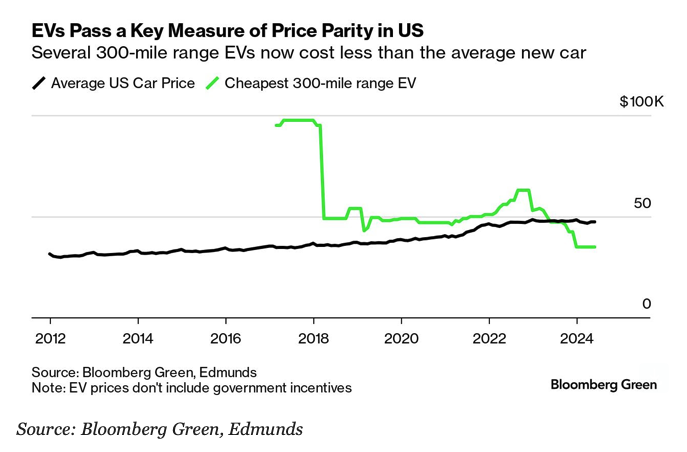
    According to Bloomberg Green, there are now at least three car manufacturers — Tesla, Hyundai-Kia, and GM — with electric vehicles that (1) have a range greater than 300 miles (480 kilometers) and (2) cost less than the average price of a new vehicle in the US (which is currently around $47,000). This means that we are now approaching price parity:

    This is an important adoption milestone, even if it does, at this point, feel totally expected. The International Energy Agency (IEA) is forecasting full price parity by 2030. But in my mind, I’m already done with ICE vehicles. When I bought my current car over 6 years ago, I knew it would be the last internal combustion engine I ever own.

  • 10 years of radical change in Paris

    I know that many of you already know this, but it’s pretty remarkable what Paris has been able to achieve over the last 10 years:

    Paris has closed more than 100 streets to motor vehicles, tripled parking fees for SUVs, removed roughly 50,000 parking spots, and constructed more than 1,300 kilometers (800 miles) of bike lanes since Mayor Anne Hidalgo took office in 2014.

    The result is that, according to city officials, air pollution in the capital has declined by about 40% since 2011. And bicycle usage has increased by some 70% — this is since 2019.

    Now, Paris does happen to be blessed with a dense urban fabric. But that doesn’t necessarily mean that this transformation was simple or easy. The difference is will. Most Parisians seem to support these actions.

    So the next time you’re stuck in traffic and cursing some scapegoat, maybe consider what you would be willing to do to dramatically reduce traffic congestion. Would you be open to radical change in your city?

  • Field Guide to Indoor Urbanism

    A few months ago, one of my old professors from architecture school — Phu Hoang — reached out to me through this blog. That’s one of the benefits of writing publicly — it becomes your calling card. In this case, it had been at least 16 years since I was in his design studio.

    We connected over a call. He told me about his and Rachely’s firm, MODU Architecture. And he let me know that he’s no longer teaching at Penn. He is now the Head of Architecture of the Knowlton School at Ohio State University.

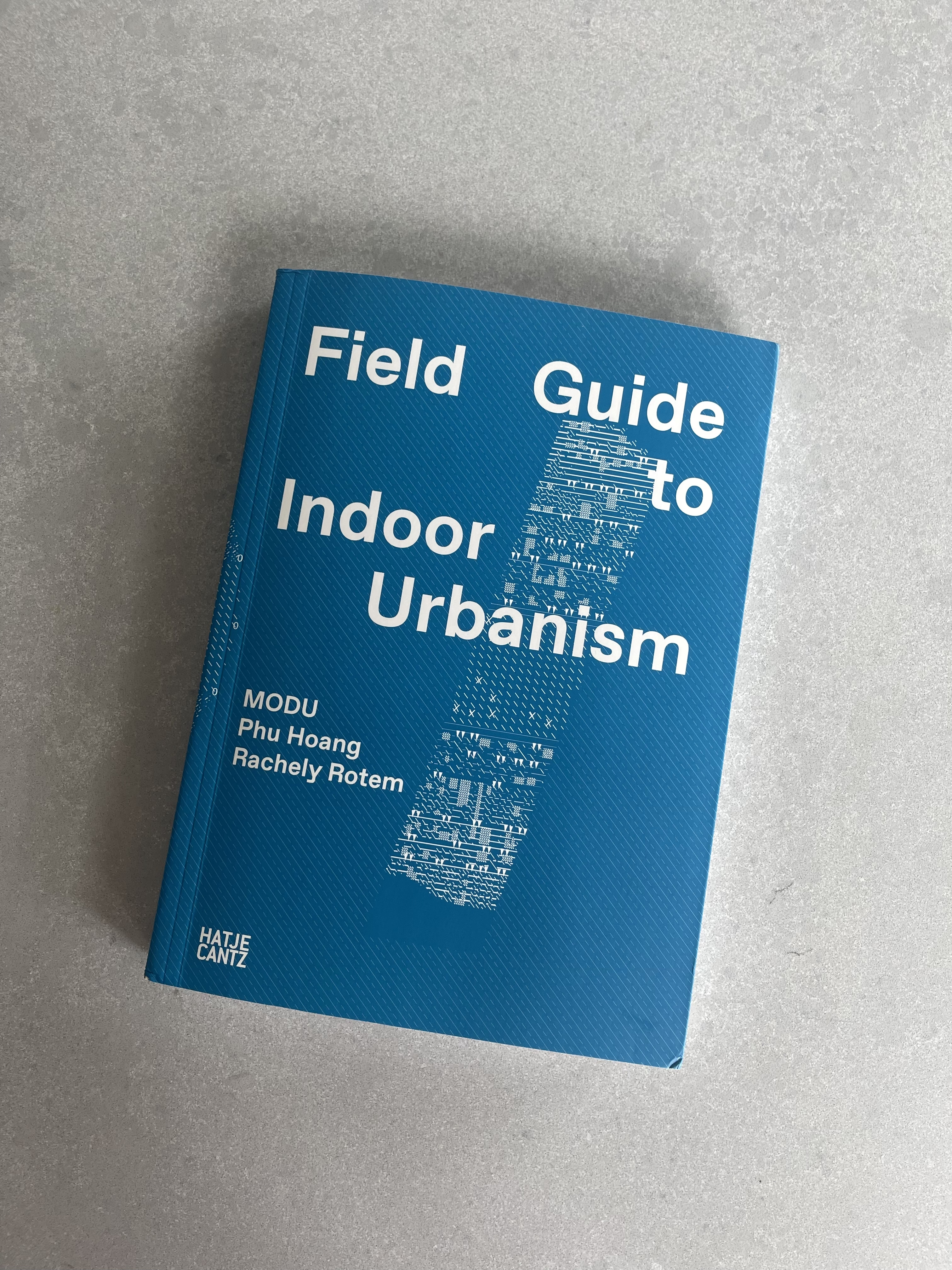
    Then, following the call, he was kind enough to send me a copy of his new book, Field Guide to Indoor Urbanism:

    The typical approach to modern building design is to have clearly defined boundaries between interior and exterior spaces. The outside is the outside. And the inside is a climate-controlled space that is, for the most part, sealed to the outside.

    Most of us spend the vast majority of our lives in these latter spaces. In fact, since the advent of modernism and the International Style over a century ago, the general idea has been that these spaces can and should be mostly the same.

    HVAC systems make it so that you don’t really need to worry about context or the environment. What works in Toronto can work in Phoenix. You just need to dial up your cooling loads.

    This is so much the case that whenever I’m in a city with a fairly benign climate, such as somewhere in California, I always find myself fascinated by the fluidity between interior and exterior spaces. It’s such a foreign concept to me that it stands out: “Wait, how is this not sealed?

    Indoor urbanism, on the other hand, makes the argument that this binary approach is the wrong way to think about spaces. Here’s an excerpt from a recent Metropolis article about MODU:

    They call this approach “indoor urbanism,” which privileges the blurred boundary between what has traditionally been considered interior space and exterior space. This in-between space–straddling open and closed, artificial and natural–deserves architects’ keen attention, especially as the planet warms. “Indoor urbanism recognizes that architecture and cities are situated on an environmental continuum, as a matter of degrees rather than absolutes,” write Hoang and Rotem in Field Guide.

    Examples of this thinking can be found throughout their work. This project in Jackson, Wyoming is one of my favorites both because I love Jackson and because it’s a cold and snowy place. And yet, even in this climate zone, their design includes for several “semi-exterior areas” that serve to connect you to nature.

    This is a decidedly different way to think about architecture and urbanism. But as our climate crisis intensifies, it’s only going to become more relevant.

  • Does above-grade parking kill street life?

    Here’s an unproven hypothesis that you can all challenge me on: many or most people only care about the environment while it is convenient to do so. Said oppositely, once it becomes inconvenient to care about the environment, we tend to start prioritizing other objectives.

    The example I have in my mind right now is parking. Now, to be clear, cars are not the best mobility solution for the environment. But let’s assume for a minute that you need parking and you have only two available options: below-grade parking or above-grade parking.

    The former is worse for the environment. If you were to look at the embodied carbon in below-grade parking versus above-grade parking, it would be higher. So from an environmental perspective, you want above-grade parking.

    It also makes for more flexible spaces. It’s hard to convert below-grade parking to much else. Again, this strengthens the environmental case, because now you’re building something that can be repurposed in the future.

    However, unless you’re forced to only build above-grade parking (as is the case in Miami), many/most cities tend to shun it. The most common objectives are (1) that it’s unsightly, and therefore needs to be wrapped with occupiable spaces, and (2) that it kills street life.

    What this suggests is that (1) and (2) are seen as being more important than the environment. And I think this is noteworthy in its own right. But here’s the other thing: this is arguably a false dichotomy. I mean, does above-grade parking necessarily kill street life?

    The above two street view images are from 1111 Lincoln Road in Miami Beach. It’s a parking structure and area of the city that I have visited many times. And I have to say, the street life seems fine to me. What do you think?

  • New York’s first all-electric tower

    Here’s the thing:

    Nationwide, the biggest single source of emissions is transportation, dominated by low-occupancy cars and trucks. But in New York, most people use mass transit instead of driving. That means buildings “are by far the largest source” of climate pollution in the city, said Christopher Halfnight, senior director of research and policy at the Urban Green Council, a nonprofit focused on energy efficiency in buildings. Gas- and oil-burning furnaces and water heaters are together responsible for 40% of NYC emissions, according to Halfnight.

    In response to this, New York City has been passing laws that restrict greenhouse gases and that by and large incentivize electrification. One of these is Local Law 97, which will generally require buildings over 25,000 sf to reduce their GHG emissions by 40% (relative to 2005) by 2030.

    Already the market is responding. Alloy Development has just completed the city’s first all-electric tower at 505 State Street in Brooklyn. Tenants began moving in on April 5.

    When team members asked what the complex would look like absent gas, the answers were fairly straightforward. “Instead of a gas boiler, an electric boiler; instead of a gas cooktop, it was an induction cooktop. And literally that was it,” said Pires, noting that they had to revise the design of the electrical room to allow for higher amperage, since more incoming electricity would be needed for a larger electrical load.

    Some, or perhaps many, in the industry are fighting these new laws. In 2022, a co-op in Queens apparently went to the New York Supreme Court. But directionally, this certainly looks to be where we are headed. So you can either fight it, or you can try and get ahead of it, as Alloy has done here.

    For more information on 505 State Street, go here (Bloomberg) and here (project website).

  • France’s rental ban on energy-inefficient homes

    One of the things that you’ll notice on real estate listings in France is an Energy Performance Diagnostics (EPD) rating. In French, it gets reversed, and so it’s a DPE (diagnostic de performance énergétique). What it tells you is how much energy the dwelling (or building) consumes and how much greenhouse gas it emits. And it is a requirement on all real estate listings and for all dwellings, except those that are occupied for less than 4 months per year. The output of this diagnostic is a rating from A (best) to G (worst).

    According to FT, this is how primary residences in France rank today:

    Less than 5% of homes are rated A and B (the most energy efficient). And many more are rated G and F. Beyond just being energy inefficient, this is potentially a problem because there are penalties and restrictions for the lowest rated homes, one of which is that you are not allowed to rent out the property. Right now and as of January 1 of this year, the upper consumption limit is 450 kWh per square meter per year. Go above this and the home becomes ineligible.

    This number is also planned to reduce over time:

    • January 1, 2023: Rental ban on properties with G+ energy label
    • January 1, 2025: Rental ban on all properties with G energy label
    • January 1, 2028: Rental ban on all properties with F energy label
    • January 1, 2034: Rental ban on all properties with E energy label

    Now here’s what this is thought to mean for overall rental supply:

    By 2028, 5.2mn homes rated F and G, or 17 per cent of total housing stock, will become ineligible for rental. By 2034, all E properties will also be excluded, amounting to about 40 per cent of homes.

    This raises an interesting question: Is it more important to have energy-efficient homes or to have greater overall supply? Now obviously the goal and ideal scenario is both; lots of affordable homes that are also energy efficient. And presumably, one of the objectives of this rental ban is to stick/carrot owners into investing in energy measures. But it’s not exactly obvious as to how many owners will be able to renovate their homes in time, and how many homes will become ineligible for rent. This will be an interesting policy to watch as it plays out.

  • Solar power as art

    The past week has felt more like a London winter, than a Toronto one. It has been mild, rainy, and gray. So right now feels like an opportune time to write about this solar-powered light/art piece called Sunne. Created by Marjan van Aubel, the light has been designed to hang right in front of a window using two simple cables. There’s no need for an external power source, because it has an integrated battery that harvests sun during the day. The light then automatically turns on at sunset, and has the ability to simulate some pretty stunning sun experiences.

    Now, if you happen to live in a place with a roof that gets good sun exposure, I suppose you could just install a bunch of solar panels and use them to generate power for cool-looking things in your home. But if you don’t have the ability to do that — for instance, maybe you live in a multi-family building — then this feels like a clever and extremely beautiful way to harvest some amount of sun. I’m sure that, eventually, we’ll have building facades that can generate a meaningful amount of solar power, but until then, you’ve got devices like Sunne.

    P.S. For what it’s worth, I’ll take cold, snowy and sunny, over mild, rainy and gray, any day of the week.

    Image: Sunne