
Daily insights for city builders, delivered every morning at 6 AM ET. I’m Brandon Donnelly — a Toronto-based real estate developer and founder of Globizen. I’ve been writing here since 2013.

Category: Economics

  • Over-building and then under-building: Is Toronto headed for a severe shortage of new rental housing?

    As we know — because here’s the data — this is the current state of affairs:

    The GTA condo market is in a state of economic lockdown. The math doesn’t make economic sense from both the demand side (investors) and the supply side (developers), leaving the market at a standstill.

    The above excerpt is from a recent CIBC Capital Markets article by Benjamin Tal (CIBC) and Shawn Hildebrant (Urbanation). And what it ultimately means is that the supply of new condominiums in the GTA is falling and will continue to fall for the foreseeable future. Below are two charts, from the same article, that show that.

    Because of this, I actually think that, if you need or want a place to live, right now is a near ideal time to buy a condominium, especially if it’s from developer inventory (in an already completed project) or it’s a resale. Of course, most people won’t want to do this because they’d rather buy when most other people in the market want to buy. This is how markets tend to go.

    It has been a while since the GTA has gone through one of these real estate cycles, but it is typical: developers are prone to both over-building and under-building. It simply takes too long to build a building, and so it is natural for there to be moments when supply and demand don’t exactly line up.

    Pre-selling condominiums is — in theory only — supposed to protect against too much overbuilding. But as we have spoken about many times before, it can be challenging for end users to buy a new home so far in advance. And so the new condominium market has come to rely on investors who want to buy early and then either sell later or rent later.

    According to the above article (and MLS data), the share of newly completed condominiums used as rentals reached a peak of 34% in 2023. So a third of new condos. My gut tells me that the actual number is much higher. Many rentals never reach MLS. Overall, I think it’s very safe to assume that the majority of new condominiums are owned by investors.

    But right now, fewer investors want to own condominiums, which is why the number of resale listings has spiked this year:
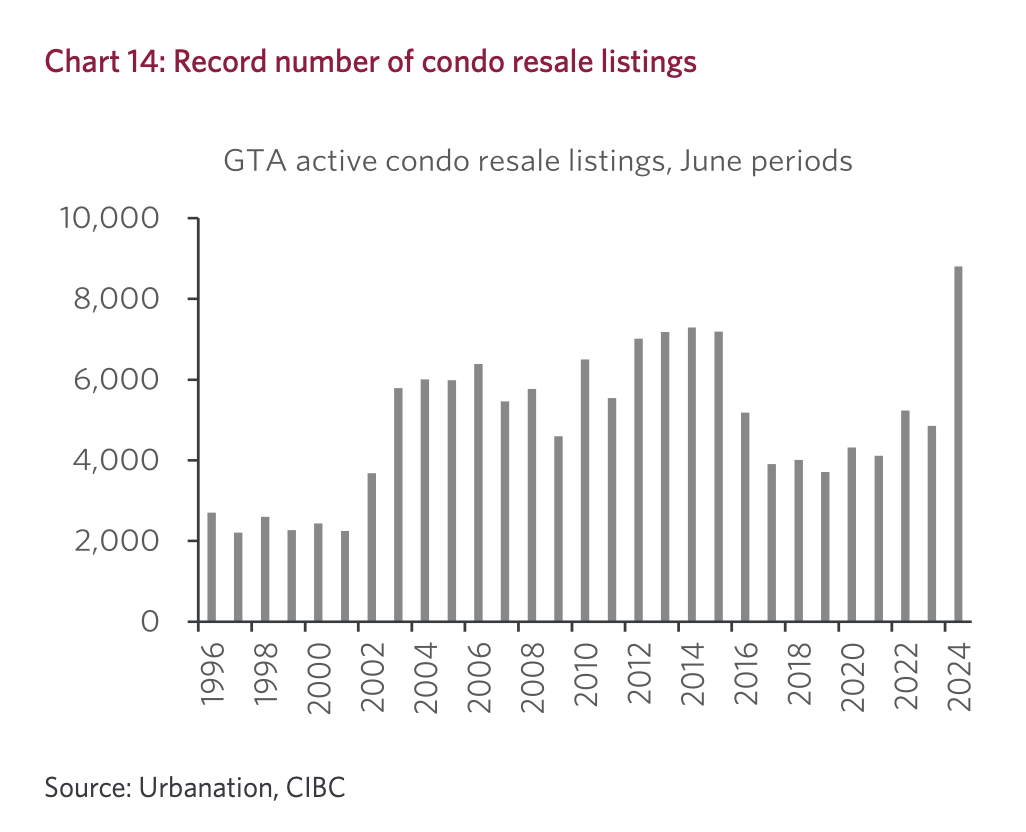
    This is, again, why I think right now is an excellent time to buy a condo. You know, be greedy when others… Regardless, this inventory will need to get absorbed and that will ultimately happen. Some of it will go to end users and some of it will go to investors who can make sense of the rental math and/or want to take a long view on Toronto. But if more goes to the former, we will be losing a lot of new rental housing.

    At the same time, while all of this is going on, construction starts are likely going to remain depressed (chart 3 above). It’s impossible to know how long this lasts, but at some point we will reach a moment in the cycle where we are under-building new housing. Maybe we’re already there. Development simply can’t turn on fast enough when demand spikes. There will almost always be a lag.

    So, since the majority of new condominiums have been serving as new rental housing, there’s a strong case to be made that at some point we will run into a potentially severe shortage of rentals. Condo investors are sometimes vilified in the media, but we will soon find out what happens when you take a big chunk of them out of the housing market.

  • In-person vs. WFH might become a critically important distinction

    I’ve been thinking more about yesterday’s post and what it might mean for cities, and I’d like to add some additional thoughts. The report that I linked to looks at what the fiscal implications of WFH have been on a number of US cities (at least so far). That is the chart that I shared summarizing New York City’s “agglomeration losses.”

    But along with this, there is an important assumption that we have not yet reached a new equilibrium. In other words, we are still in a period of adjustment, which feels right, especially if you talk to anyone in the commercial real estate industry. And that means that there are alternative and largely unknowable scenarios for the future.

    In the report, they study the following three:

    • Doom loop prevails (current state where city finances get worse)
    • Recovery (cities regain their pre-pandemic levels of agglomeration economies)
    • Virtuous boom loop arises

    Obviously the objective with their recommendations is to help cities achieve this last one. This is the scenario where cities regain prosperity because firms are able to simultaneously increase their concentration of high-value in-person workers (who benefit from agglomeration economies) and shift all the other stuff to WFH (which allows firms to save money and drive efficiencies).

    More specifically, this scenario assumes that agglomeration economies start to grow again; that wages increase because of it; and that firms, overall, become 10% more productive. It also assumes that office real estate values recover to pre-pandemic levels.

    The future is, of course, notoriously difficult to predict. But I am optimistic that the best and most desirable cities will figure out how to create a new virtuous boom loop. History has shown us that cities are remarkably resilient.

    However, implicit to this discussion seems to be the creation of two classes of workers: workers who are expected to show up in-person and do innovative things with their colleagues, and workers who are encouraged to stay at home and do the tasks that do not benefit from co-location. Of course, lots of people do both of these things. But for the purposes of this post, let’s just compare and contrast these two.

    Importantly, these two types of workers are expected to have different wage outcomes (in the above report). For WFH workers, wages are initially modeled to fall because of the loss in agglomeration-related productivity. But interestingly enough, before this wage decline happens, WFH workers are unambiguously better off — they have the same salary and none of the direct costs of going into the office.

    On the other hand, in-person workers are modeled to have their wages increase because of the gains in agglomeration-related productivity. The authors of the report have calibrated their models so that these two types of workers eventually become equally well off, once you adjust for changes in wages and things like the direct costs of commuting. But what would this really mean in practice?

    To oversimplify, we’re talking about two different types of workers:

    • An in-person worker who is expected to have higher wages, be more productive, and live closer to a city center because of their need to be physically present
    • A WFH worker who is expected to have lower wages, be less productive, and live further out (or in a different city) in order to equalize their lower earnings by way of less expensive real estate

    If this is how our labor markets evolve, then it strikes me that there could be far-reaching socio-economic implications. What I worry about is further segregation within our cities. The above scenario means doubling down on the role of big cities as centers for innovation and agglomeration economies. But in doing this, how do we ensure that we don’t exclude everyone else?

    Once again, I suspect that a good place to start would be lowering the cost of new housing and increasing the pace of production.

    Photo by Lerone Pieters on Unsplash

  • Doom loop or boom loop?

    One of the interesting things about return-to-office trends is that there’s a meaningful difference between smaller and larger cities. In smaller cities, most people have returned to working in their offices. But in larger cities, this hasn’t been the case. This makes intuitive sense. Larger cities tend to have more expensive real estate (which forces people to decentralize) and, in turn, longer and more punishing commutes. So in a larger city, the individual benefits of WFH (i.e. having zero commute costs) tend to be far greater.

    However, in-person interactions are critical to what are known as agglomeration economies. This is why we have things like financial districts — because there are real economic benefits to even competing firms locating proximate to each other. WFH arguably reduces these benefits. And in this recent report called, Doom Loop or Boom Loop: Work from Home and the Challenges Facing America’s Big Cities, the authors, Richard Voith, David Stanek, and Hyojin Lee, have tried to estimate what these agglomeration losses might be for cities like New York, San Francisco, and Philadelphia.

    Here’s New York City:

    If you agree with their assumptions, then you might also agree with their policy recommendations. Among other things, the report argues that larger cities, like New York City, should be focused on promoting themselves to industries/jobs that benefit the most from in-person interactions, recognizing that WFH isn’t going away. At the same time, cities should understand that reducing the cost and increasing the pace of housing production also helps to reduce agglomeration losses. It keeps more people centralizing around a particular place.

    To download the full report, click here. It’s an interesting read.

  • Unfair labor practice

    At the beginning of this month, the Government of Canada issued this direction, setting out the requirement for all public servants to be “in the workplace” at least three days per week. To ensure some flexibility, it also specified that it didn’t have to be exactly this schedule. But the intent was that public servants would need to spend a minimum of 60% of their regular schedules, in the workplace, whether measured on a weekly or monthly basis.

    Immediately, the Public Service Alliance of Canada reacted and said that it would be filing “unfair labor practice” complaints: “We will be using every recourse we have available to fight this mandate,” PSAC national president Chris Aylward said, arguing that the surprise policy update was “anti-worker” and “fundamentally breaks the trust of workers and unions with the Trudeau government.”

    Now, I understand that there are a whole host of legal considerations with a mandate like this. If remote work has, for example, become an implied term of these employment relationships, then it might be difficult for any employer to call these people back. Thankfully, I am not a lawyer. And so I don’t think this way. It is probably also the case that I’m now in my middle adulthood and have old school views on this topic.

    Because in my mind, this is the government saying, “hey everyone who works for us, we’d like you to come into the office at least three days a week so that we can work together as a team, collaborate, and hopefully innovate.” And this is employees saying, “no way, that’s totally unfair! How dare you demand we come into the office that much?” Like, since when did going into work become such a problem?

    At the same time, Canada is suffering from an existential productivity problem. This country has seen no productivity growth in recent years. And if you compare us to other developed countries, we are near the bottom. Even France — which is stereotypically famous for its relaxed work culture and its ban on after-work emails — is more productive than were are!

    This needs to change or we will remain a deeply troubled country. And like everything, it’s going to require work.

    Photo by Marc-Olivier Jodoin on Unsplash

  • This country has the highest fertility rate in Europe

    In 2023, there were 379,000 babies born in Italy. This is down from 393,000 babies in the prior year and represents a new record low. Already in 2022, the number of births was noted as being the fewest since Italy’s unification in 1861. The result is a “demographic winter.” Of course, this challenge is not unique to Italy. It is happening in most developed countries. Korea, for example, has a fertility rate somewhere around 0.72 babies per woman. Because of this, there are a lot of people in the world trying to figure out how to encourage more births.

    Here is Italy’s Prime Minister Giorgia Meloni:

    Meloni, herself a mother of a single child, has said it is a priority for her government to increase the birth rate and encourage women to have more babies “for the simple reason that we want Italy to have a future again”.

    So what’s causing this?

    One seemingly logical explanation could be that the employment rates for women and men are basically the same now. Fewer women are staying at home and so there’s less time to have and raise children. In fact, the opposite is true. If you look at fertility rates across Europe, high birth rates tend to correlate with high employment rates for women. I guess families need to be able to afford children. Here’s an excerpt from a Guardian article (c. 2015) on the topic of fertility:

    The map of the fertility rate in European countries more or less overlaps with that of women in work. In countries with relatively buoyant populations, such as France and Scandinavia, women play an important part in the labour market. According to data for 2010 published by the Organisation for Economic Co-operation and Development, the employment rate for women aged 24 to 54 in work was 83.8% in France, 84.4% in Finland, 85.6% in Denmark and 87.5% in Sweden, barely lower than the equivalent figures for men. In contrast, in southern Europe and Japan the share of women in work was much lower: only 64.4% of them had a job in Italy, 71.6% in Japan, 72.2% in Greece and 78.3% in Spain.

    Staying on the theme of being able to afford kids, another possible explanation might be that kids are expensive and so you need strong family-friendly government policies to help support them. While this I’m sure helps, there’s data to suggest that the correlation between these policies and birth rates is actually fairly weak. That’s why, even though many developed countries have expanded such policies, birth rates continue to fall. Here’s a graphic by John Burn-Murdoch from FT:

    So what the hell is it then? Well there is another possible explanation and it is that it’s more of a cultural thing. In the above article, John makes the argument that a number of other more important factors are leading to declining birth rates. Namely, more people are choosing to live alone, and not as a couple. Priorities have shifted, where family formation is no longer seen as central to a fulfilling life. And more young people are generally anxious. (He doesn’t get into why but I’m sure that it’s possible to blame TikTok.)

    But what really stood out to me was this graphic:

    Since the 1960s, parenting has gotten systematically more intense for parents. The average number of hours per day spent by mothers on “hands-on parenting activities” has grown significantly in most developed countries. However, there is one clear exception: France. It turns out that the French are, at least based on this data, less likely to be so-called helicopter parents. Parenting is less hands-on, kids get more freedom and — perhaps because of this — France has the highest fertility rate in Europe at over 1.8 babies per woman.

    This is not to say that France’s family-friendly policies aren’t doing something as well. I would imagine they are. But the above makes intuitive sense to me. If you create an environment where the threshold to be considered a good parent is constantly becoming more duanting and more life-consuming, it’s no surprise to me that more and more people are simply saying, no thank you.

  • What the NAR’s $418 million settlement could mean for the real estate industry

    The $418 million commissions lawsuit that was settled last week with the National Association of Realtors (NAR) is certainly a big deal. The NAR is trying to sound positive, but all signs point to this outcome being meaningful for the industry. TD Cowen Insights is forecasting that commissions paid in the US each year could fall by some $25 to $50 billion (from a total of ~$100 billion). And this is the headline you’ll see everywhere right now. But how might this actually happen?

    As we’ve talked about before, the status quo commissions set up is a good one for agents:

    • Sellers are typically the party who pays 100% of the commissions
    • But sellers don’t pay until the agent sells and they have fresh cash
    • Money being deducted from proceeds (a “take rate”) is a lot less noticeable and has a lot less friction than cash you just have to pay out of pocket
    • Buyers kind of don’t pay — or at least that’s how they’re supposed to feel

    This is “good” because it perpetuates the existing model. If buyers feel like they’re mostly not paying, they’re just going to go to the marketplace with the most supply of homes. And that marketplace is the Multiple Listing Service (MLS). However, this marketplace also does things like tell buyer agents how much commission they will make as part of each deal. And the belief is that practices like this are anticompetitive.

    So as part of the above settlement, the following new rules are expected to go into place by July 2024 in the US:

    • Seller agents will no longer be able to set compensation for buyer agents
    • All fields on MLS displaying broker compensation will need to be removed
    • Furthermore, agents will no longer even need to subscribe to an MLS in order to accept compensation
    • Buyers working with an agent will need to enter into their own buyer broker agreement and negotiate compensation separately
    • However, there’s nothing stopping buyers and sellers from negotiating whatever commission structure they want; the idea is simply that it will be more transparent and negotiated by each participant

    Why this is meaningful is that it decouples buyer agents and seller agents in a way that they aren’t today. Instead of everything originating from the sell side, each side of the transaction is now going to — theoretically at least — negotiate what they believe is fair compensation for their representation. At the same time, there’s no obligation to even subscribe to an MLS.

    This leads us to, at least, two important things to think about:

    1. What is fair compensation? Well, it should depend. If I’m a first-time buyer, I may want someone to walk me through the entire process. But if I’ve done it many times before, maybe I need very little. Or, if I’m an investor looking to renovate homes, maybe I want representation that is also an expert on construction. The point is that, in a truly open market, one should be able to find an agent and pay them based on the value that they’re creating. And this is presumably why everyone is expecting commissions to fall precipitously.
    2. If there’s no obligation to even subscribe to an MLS, does this then open the door for new and more open listing platforms? Right now, I don’t know how this will play out. I’d like to better understand more of the details around this settlement item and what it could mean for the landscape. But I do know that the way to spur the most amount of innovation would be to have the marketplace run on something like a blockchain, and then allow anyone to create their own listing platform on top of it. One day.

    This will be fascinating to watch play out. And I’m sure it’s only a matter of time before it spurs similar changes here in Canada. Expect further coverage of this topic on the blog.

    Photo by Tom Rumble on Unsplash

  • Fundamental and enduring

    I admire Warren Buffet’s humility:

    In the physical world, great buildings are linked to their architect while those who had poured the concrete or installed the windows are soon forgotten. Berkshire has become a great company. Though I have long been in charge of the construction crew; Charlie [Munger] should forever be credited with being the architect.

    This is an excerpt from his recent letter to Berkshire Hathaway shareholders, which, this year, he opens up with an obituary to his late partner, Charlie Munger.

    I don’t agree with everything Warren says and writes. He, for instance, doesn’t seem to like crypto and streetcars. Though, surely, he’d really dig my CryptoParisian.

    That said, I never miss his letters and his thinking has been broadly instrumental in how I tend to think about real estate.

    If you take his description (same letter) of what Berkshire does, and replace businesses with properties, this is what you get:

    Our goal at Berkshire is simple: We want to own either all or a portion of [properties] that enjoy good economics that are fundamental and enduring. Within capitalism, some [properties] will flourish for a very long time while others will prove to be sinkholes. It’s harder than you would think to predict which will be the winners and losers.

    This is a good way to think about real estate.

  • Real estate is a byproduct of economic growth

    I sometimes wonder if I wasn’t born and raised in Toronto if I still would have gone to architecture school and become a real estate developer. I mean, if I grew up in Paris, maybe I would have become a fashion designer. Or if I grew up in Park City, maybe I would have started a snowboard company, slash become a ski bum. I would enjoy doing all of these things. And places certainly do influence us, more than most of us probably appreciate.

    My point with all of this is that Canada likes to somewhat paradoxically over index on housing. I say paradoxically because we never seem to have enough of it for Canadians — certainly the affordable varietal — and yet:

    Canada relies heavily on its real-estate sector to power the economy. Housing investment in Canada as a share of gross domestic product reached 8.9% in 2022, according to the Organization for Economic Cooperation and Development, much higher than the 4.8% on average for the 38 member countries in the OECD.

    If you look at all of the industries that make up the Canadian economy, “real estate and rental and leasing” is at the top with 13.01% of GDP (as of 2020). And if you add “construction” on top of this, the total is about 20.09% (again, as of 2020). This feels suboptimal. And I say this as a developer and builder of real estate.

    Real estate is largely a byproduct of economic growth. When someone starts a business and then needs something like an office or a warehouse, that is a positive thing for the economy. Jobs are being created by the business and further jobs are being created by the people who will deliver the space they need. But if you aren’t creating new jobs in the first place, then just dealing in real estate will only take you so far.

    Immigration helps, but it can also create a mirage of growth and prosperity. If you look at real GDP growth across the G7 from 2019 to today, Canada looks pretty good. We’re second (+4.5%) only to the US (+8.9%). But if you look at GDP per capita over the same time period, we’re dead last (-2%), whereas the US remains on top (+7.2%).

    I’m not an economist; I just build things. But in my opinion, this is a problem. We should be doing everything we can to foster a stronger culture of innovation and entrepreneurship in this country. We have the talent. I mean, Ethereum has roots in this city! We just need more people turning this intellect into wonderful new companies.

  • Big global events, small mountain towns

    I was speaking with our lawyer in Park City this week, and he commented to me that he wouldn’t be going into the office next week because Old Town would be too hectic with the Sundance Film Festival going on. His office is right on Main Street.

    When small mountain towns host major international events, there are going to be spillover effects. This is true of Sundance in Park City (population ~8,500) and it is true of the World Economic Forum, which was hosted in Davos (population ~10,000) this past week.

    Perhaps the most obvious impact is that people can rent out their homes for large sums of money. And so lots of people both do that and try to profit maximize while doing it. Here are some anecdotes from Davos (via NZZ):

    Ten days before the WEF, there are still 25 listings on the Airbnb internet platform. The prices here range from 8,000 to 56,000 Swiss francs. The son of an apartment owner says that his family receives 12,000 francs a week for their three-room apartment, which is quite close to the convention center. However, he says he assumes that they could achieve significantly more. The family rents out the apartment through an intermediary.

    Another interesting impact in Davos happens on the retail side (also via NZZ):

    According to expert Robert Weinert, the average rent per square meter of retail space in Davos is 248 Swiss francs. A businessperson renting a storefront of 80 square meters must therefore pay almost 20,000 francs in rent per year. However, if that business vacates the store during the WEF, it can earn 60,000 francs – three times the annual rent for the facilities.

    What this means is that some retail spaces remain vacant all year, just so that they can be available for when the WEF arrives and people need temporary commercial spaces. And why wouldn’t this be the case: 20,000 francs for the year or 60,000 francs for a week. If I’m the landlord, I’ll take the additional 40,000 francs and not think about the property for the rest of the year.

    Of course, if you’re trying to create a vibrant community with things, like, occupied retail spaces, then this isn’t ideal.

  • What might happen in 2024

    Yesterday we looked in the rear-view mirror. Today we’re looking forward:

    • The market consensus right now is that this cycle of interest rate increases has come to an end, and that we should see rates start to come down next year. Having confidence that rates won’t go any higher in the near future is what markets need in order to start making more decisions. So this is, of course, positive. At the same time, I don’t think anyone should expect a return to ultra-low rates. Rates today are still low when viewed historically.
    • Lower rates are good for levered assets such as real estate, but I don’t think that our industry has fully felt and processed the impacts of higher rates. Unfortunately, I think that things will get worse (in 2024) before they get better (maybe toward the end of 2024 or perhaps in 2025). This is when a “risk-on” approach will return in commercial real estate. A year ago today, I thought 2023 would be the year for this, but as I said yesterday, I was overly optimistic in terms of my timing.
    • On the residential resale side, I think we will see greater optimism sooner, certainly for the most in-demand cities and areas. There is pent up demand waiting on the sidelines and, once we can get past the current bid-ask spreads and deadlock, I believe we’ll return to a more balanced market in 2024. To be clear, I’m not expecting bidding wars and the like. And because of our housing affordability crisis, I also think the Bank of Canada will be more resistant to lowering rates compared to other central banks. This will help the Canadian dollar.
    • If you’re a buyer of real estate, I generally believe that 2024 will turn out to be a pivotal year for you. Roughly speaking, you win acquisitions in one of two ways: either (1) you pay the most or (2) you believe in something that most other people in the market don’t. This second approach is harder to achieve in bull markets. But in slower markets, the door is open and history has taught us that it can be the foundation in which great fortunes are made.
    • As I mentioned yesterday, I agree with the prognostications that hard costs will soften further next year (perhaps even more than 5% on average). Obviously every market is different. But here in Toronto, I just don’t see us returning to the level of construction starts that we have seen over the last number of years.
    • Since 2021, I have used my hyper scientific Jimmy the Greek Reopening Index to keep tabs on office utilization and the overall return to office. And based on this, 2023 was a positive year. Initially, souvlaki consumption appeared dramatically lower on days like Monday. But I noticed discernible increases as the year went on. However, if you look at actual data, such as what we have from swipe cards, the great return to office seems to have stalled out at around 50%. I don’t think this will hold, though. I continue to believe that of the people who work in offices, most will spend > 50% of each week there. And we will see that in 2024.
    • 2023 was the year of AI. But Fred Wilson makes an excellent point, here. AI is 40+ years in the making. Last year only became the year of AI because a consumer-facing app — ChatGPT — was revealed that captured everyone’s attention. Crypto will eventually have this moment, but it will likely need to marinate a bit longer. Instead, I think 2024 will be the year of augmented reality (AR) and a further blurring of our offline and online worlds. Think digital art, fashion, and other collectibles (such as NFTs).
    • Right now, autonomous vehicles feel like they’re in the trough of disillusionment (within the hype cycle). There were moments last year where it felt like we were finally moving beyond this phase. But then some very suboptimal things happened. I think AVs are our reality in the next 5+ years, which means that for next year we likely want to be focused on the inputs: vision/LIDAR, battery tech, etc.
    • Zooming out, we should be thinking about the above two trends in the context of a broader shift toward greater automation. I think it will feel more insidious than immediate (certainly in 2024), but the longer-term impacts are going to be profound for our society. The so-called gig economy is likely to be impacted first. Eventually the overall economy will create new jobs, but we are still going to need to manage this transition toward more automation.
    • TikTok Shop is where to look for the future of shopping. I think the platform will continue to see strong adoption and ultimately prove to be a dominant e-commerce platform throughout 2024. Amazon, Meta, and others will see this, and try their best to catch up and copy it.
    • At the time of writing this post, the total crypto market capitalization is about $1.74 trillion. This is down from nearly $3 trillion at the peak of the market in 2021. The recent gains suggest that the so-called “crypto winter” might be over, and so combined with lower interest rates and more real-world use cases, I think that 2024 will be another strong year for crypto. Total crypto market cap at the end of the year will exceed its 2021 peak.

    And there you have it. My current thoughts for this upcoming year. I should note that I’m not an economist, analyst, or an expert on souvlaki demand for that matter. But I enjoy writing this post as an annual discipline. It forces me to think critically about the topics that interest me. And in the paraphrased words of Howard Lindzon, it gives me an archive that I can go back to and either cringe at or think to myself, “hey, I could have been a somebody!”

    And with that, a big thanks to everyone who has read this daily blog over the last year. This year marked its 10th anniversary. I wish you much success and happiness in 2024. Happy new year!