

In my opinion, we need far better urban data if we're actually going to make evidence-based decisions. Thankfully, there are lots of great companies that are focused on this space. One of them is Eco-Counter, which makes devices to count pedestrians and cyclists, among other things. This is an important job, because as Peter Drucker used to say, "you can't manage what you don't measure."
Let's look at their bike counters. According to their global map, they have 464 of them installed around the world. Montreal has 58 of them, which we've spoken about before, and is an impressive install base. And Toronto looks to have only one, which is located on Bloor Street on the north side of High Park.
The busiest route/counter in Montreal is at St-Denis Street and Rue des Carriéres. So far this year -- up to November 17, 2024 -- this counter has seen an average of just under 5,000 trips per day and a year-to-date total of 1,600,468 trips. Both of these metrics are notably up compared to 2023 when I last looked at the data.
The busiest route in Eco-Counter's entire network is on Boulevard de Sébastopol in Paris (an important main roadway, not a side street). It has seen an average of 13,667 trips per day and a year-to-date total of 4,386,996 trips. Not surprisingly, the Paris counter exhibits less seasonality. People still cycle in the winter in Montreal, but it's less than in the warmer months.
Finally, our lone Toronto counter adjacent to High Park has seen an average of 1,186 trips per day and a year-to-date total of 380,813 trips. Not quite Paris or Montreal (the latter of which has a colder climate), but I would argue that this really isn't an indicative location for Toronto given how underdeveloped the area is. Plus, you need to see each route as part of a network.
If you look at Montreal's top 5 bike counters, all of them have a year-to-date total that exceeds 1 million trips. This is important information if you're trying to make mobility decisions and these are significant figures. Imagine if these millions of people got off their bikes and instead decided to take transit or drive a car. That would change things.
Photo by Celine Ylmz on Unsplash

Montréal had its first snowstorm of the season this week, and if you look on X, you'll find images and videos like these😀

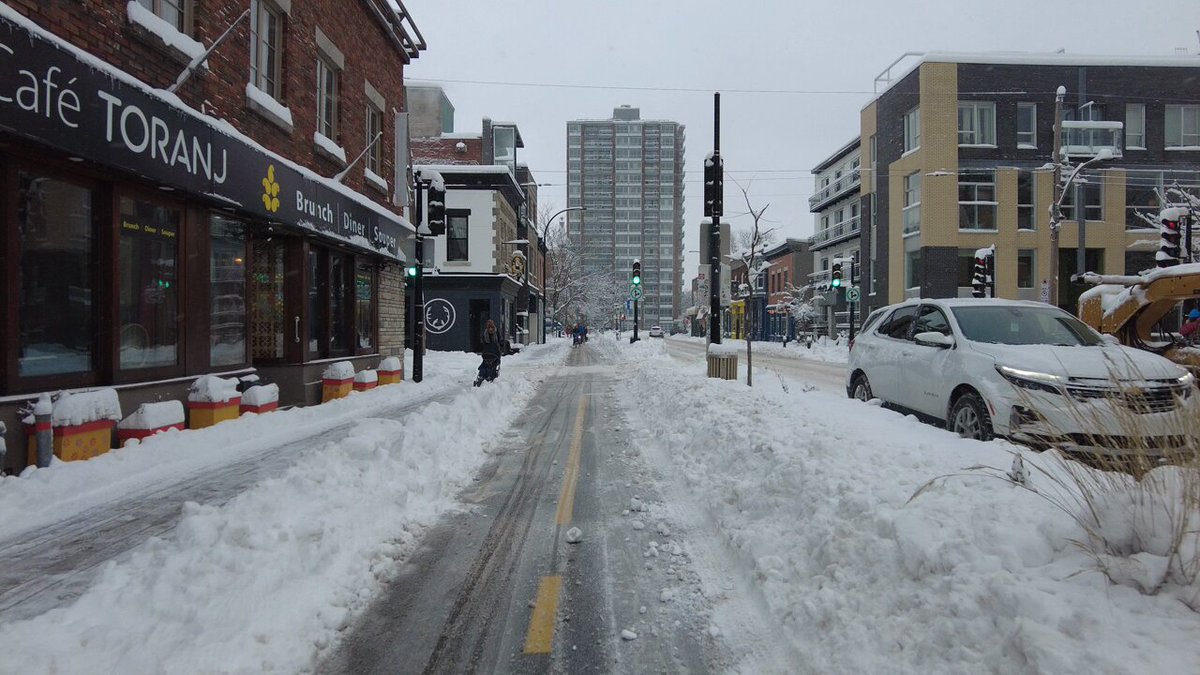
What's remarkable is the number of people who, at least from these tweets, continue to cycle in the winter. In fact, in the above video, there looks to be more bikes on the road than cars. Plowed lanes certainly help!
According to the city of Montréal, about 80% of the network is maintained for year-round use (717 km of its 900 km network). But I'm sure that there are a lot of people who still can't imagine anyone wanting to cycle in these conditions. So what is the actual winter usage?
Thankfully, Montréal has bike counters. 55 of them to be exact. And all of the data can be viewed, here. The busiest location is Saint Denis and Rue des Carrières. This falls within their Réseau Express Vélo (REV) network, which is a series of protected lanes intended to do what the name suggests.
The daily average for this counter is currently 4,403 riders, but the summer peak looks to be closer to 10,000. And this year, it has seen close to 1.5 million rides in total. This is a significant number. I mean, imagine 1.5 million more car trips on the road.
Looking at yesterday's data, the daily count was 1,292. If you very crudely divide this by my 10,000 summer peak estimate, you get to around 13%. And this happens to line up with what seems to be the city's generally accepted winter cycling retention ratio.

Not surprisingly, fewer people want to cycle in the winter. But the number is not nothing. If you multiple 1,292 cycling trips by 120 days (roughly December to March), that's still over 150,000 trips (I know, I didn't account for weekends). On top of this, the city's winter cycling retention rate appears to be increasing.
So just because you may not want to cycle to work in the winter, it doesn't necessarily mean that others feel the same way.