Daily insights for city builders, delivered every morning at 6 AM ET. I’m Brandon Donnelly — a Toronto-based real estate developer and founder of Globizen. I’ve been writing here since 2013.

Author: Brandon Donnelly

  • The State of Mobile 2020

    Analytics firm, App Annie, has just published its annual The State of Mobile report. As you might expect, our phones continue to consume more of our time, attention, and money. Last year, there were over 204 billion app downloads across the world. Global mobile advertising hit $190 billion and, by the end of this year, it is forecasted to reach $240 billion. By 2023, the mobile industry is expected to contribute some $4.8 trillion to global GDP.

    Compared to 2 years ago, the world is spending, on average, 35% more time on their phones. See above chart. Mobile-first countries such as Indonesia and Brazil spend even more time on mobile as they skipped over the PC era that was seen in more mature markets. But globally, all of us are doing more on our phones — everything from managing our investments to consuming media (TikTok had an explosive 2019).

    Financial app usage increased significantly last year. Above are the top “breakout finance apps” of the year. PC Financial (the financial services brand of Loblaw) saw the greatest year-over-year growth in downloads but, since it only launched last year, it was starting from a base of 0. Fintech apps, which grew even faster than traditional banking apps, demonstrate that the big banks probably need to step up their mobile game.

    Young people do, of course, spend more time on mobile. Generation Z (those born between 1997 to 2012) had 60% more sessions per user in top apps than older demographics. But as of the end of last year, Generation Z is believed to have surpassed Millennials as the largest generational cohort in the world at about 32% of the population. So this wave is going to continue to come.

    If you’d like to download a fully copy of App Annie’s mobile report, click here. You’ll need to enter your email address. But there’s a lot of interesting data in the report. You can almost ignore that it’s specifically about mobile and think of it as an overview of where the world is heading.

    Charts: App Annie

  • Maeklong Railway Market — plan view

    Many of you have probably visited or seen videos of the Maeklong Railway Market in Bangkok. (I’ve done the latter, not the former.) It is one of the largest seafood markets in Thailand and it is literally housed on the railway’s tracks. Every time a train passes through, the entire market needs to be pulled up and relocated. Even the awnings that cover the market need to be collapsed. The videos I’ve seen have all been taken from grade. But the below video (via Vala Afshar on Twitter), showing the market in plan view (from what was likely a drone), is arguably even more impactful. There isn’t a foot of wasted space.

  • Tacos, snowstorms, and laneway suites

    Few things go as well together as tacos and snowstorms. And so that’s exactly what I did for lunch today given the awesome — I love snow — storm that we’re having in Toronto this weekend. The garnish you’re seeing below is grilled cactus. Dave, the owner of Playa Cabana Taqueria, grows it on location and uses it for special dishes like this one here. If you haven’t been, I would highly recommend it. They’re located at 21 St. Clair Avenue East.

    In addition to tacos, I also spent the morning with Gabriel Fain Architects working on our upcoming laneway suite collaboration. Some of you may remember that our previous laneway project was refused at the Committee of Adjustment back in 2017. Well now that laneway suites are permissible as-of-right, it’s time to get going. We are not planning to seek any variances from what is currently allowed.

    But if you’re thinking about building your own laneway suite, there are still a number of issues that you might run into depending on your property. Servicing, proximity to a fire hydrant, access, and trees are maybe some of the most common. I know that the city is working to resolve / streamline some of these complications, as the objective is truly to build laneway suites across the city.

    As Gabriel and I work through our project this year, my plan is to write about it here on the blog. And hopefully when the project is complete, the posts will serve as a kind of guide for homeowners. These suites are really setup to be built by individual homeowners, as opposed to by developers. If you don’t already email subscribe to this blog and are interested in learning more, sign up here.

    In the meantime, if you have any questions about laneway suites, there are a number of experts in the city, including Gabriel Fain Architects and the folks over at Lanescape.

  • A fundamental reshaping of finance

    BlackRock CEO, Larry Fink, published his annual letter to CEOs this week and the title — which I am reusing here — should give you an indication of the tone. The focus is squarely on climate change. Larry argues that, sooner than perhaps most people think, climate change is going to cause a “significant reallocation of capital.”

    Below are a few excerpts from his letter. If you remember the first post that I published this year, you may remember that Larry is not alone in this prediction. Already 2020 is shaping up to be a year where more of us seem to be turning our attention to climate change. I would encourage you to read the full letter over here.

    Will cities, for example, be able to afford their infrastructure needs as climate risk reshapes the market for municipal bonds? What will happen to the 30-year mortgage – a key building block of finance – if lenders can’t estimate the impact of climate risk over such a long timeline, and if there is no viable market for flood or fire insurance in impacted areas? What happens to inflation, and in turn interest rates, if the cost of food climbs from drought and flooding? How can we model economic growth if emerging markets see their productivity decline due to extreme heat and other climate impacts?

    These questions are driving a profound reassessment of risk and asset values. And because capital markets pull future risk forward, we will see changes in capital allocation more quickly than we see changes to the climate itself. In the near future – and sooner than most anticipate – there will be a significant reallocation of capital.

    Over the 40 years of my career in finance, I have witnessed a number of financial crises and challenges – the inflation spikes of the 1970s and early 1980s, the Asian currency crisis in 1997, the dot-com bubble, and the global financial crisis. Even when these episodes lasted for many years, they were all, in the broad scheme of things, short-term in nature. Climate change is different. Even if only a fraction of the projected impacts is realized, this is a much more structural, long-term crisis. Companies, investors, and governments must prepare for a significant reallocation of capital.

    Photo by Chris Barbalis on Unsplash

  • One Thousand Museum, Miami

    Candace Taylor published an article today in the WSJ about the late Zaha Hadid’s One Thousand Museum tower in downtown Miami. The title: “Zaha Hadid’s Miami Tower Is an Architectural Feat. Is It Designed to Sell?”

    It’s an interesting case study, particularly for those of us in the industry. With only 84 units across 62 storeys, it is certainly “ultraluxury.” There’s also a helipad on the roof. Here is an excerpt from the article to give you a sense of the unit sizes:

    Louis Birdman, one of the project’s developers, said prices, which range from just under $5 million to $25 million, are negotiable. Each floor has only one or two units, ranging in size from about 4,600 square feet to 10,400 square feet and each has at least four bedrooms. “Given what’s going on in the market now, I think all of us developers are competing for a similar buyer, so there’s obviously flexibility on price,” he said.

    As you can probably glean from the above, the ultraluxury market has softened in Miami. But Candace is right: One Thousand Museum is an architectural masterpiece. If you’re in the market for a new four bedroom home in downtown Miami, now may be right time.

  • Toronto is on pace to have more skyscrapers than Chicago — so?

    I received a call from a reporter at the CBC today. She was working on a piece about the recent stat that Toronto is on pace to surpass Chicago for the most number of skyscrapers (150m or higher). The above chart is from Bloomberg.

    In particular, she wanted to know (1) what this means for Toronto and (2) if Toronto has been focusing enough on design and architecture during this period of expansion. Can and will it be as beautiful as Chicago?

    Here are the stats I was given (taken from the Council on Tall Buildings and Urban Habitat):

    Toronto skyscrapers (150m or more)

    67 done
    32 under construction
    59 proposed to be completed by 2023 latest

    = 158

    Chicago skyscrapers (150m or more)

    126 done
    8 under construction
    11 proposed to be completed by 2024 latest

    = 145

    And here is more or less what I said and what I was thinking:

    Toronto and Chicago are both important global cities. We (Slate) operate and have offices in both cities. The number of tall buildings is just one metric. Look at how few Los Angeles has. At the same time, I get what this signals. It’s noteworthy. Chicago invented the skyscraper.

    Chicago has a wonderful architectural history. (Raise your hand if you’ve been on that architectural boat cruise). But people often forget the fact that when most buildings are built there’s an economic imperative and a private client. This includes back in the day in Chicago.

    So the economic environment we have here in Toronto — where people do work to, you know, get paid and companies think about things like profit margin — isn’t necessarily all that different from the one that birthed architecture that is now widely admired (oftentimes from a boat).

    Toronto has some spectacular buildings and some shit ones. I’ll let you all decide which ones are which. But I do think that Toronto is seeing a greater commitment to design. We recognize the value. But here’s the thing: part of what makes this possible actually runs counter to what most cities want.

    Housing has become more expensive and that makes it possible to spend more money on architecture. It’s one of the great tensions of city building. We want developers to build more affordable housing, but we also want high quality building materials and “Capital A” architecture. Which is more important?

    Finally, I do think that architectural styles need time to settle in, sometimes before we can fully appreciate them. We are seeing that start to happen with Brutalist architecture. And let’s not forget about all of the Victorian homes that we tore down in Toronto. They weren’t fashionable at that time.

    It’s easy to romanticize about the way things used to be done. It’s harder, sometimes, to appreciate the now. But sometimes all it takes is a bit of time.

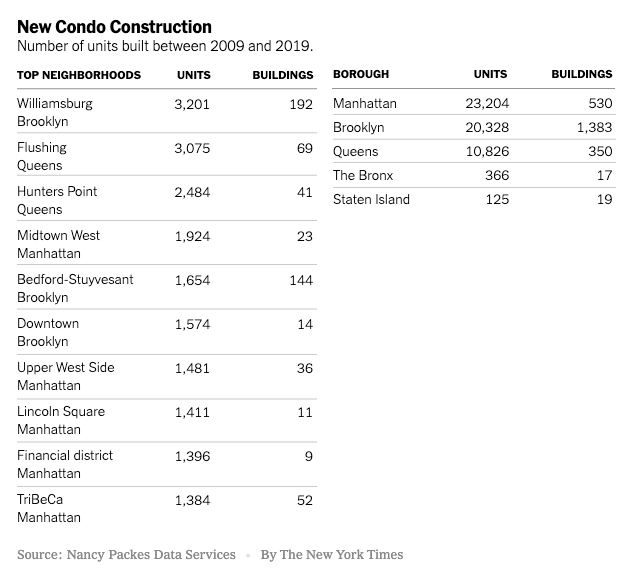
  • Number of condo units built in New York City between 2009 and 2019

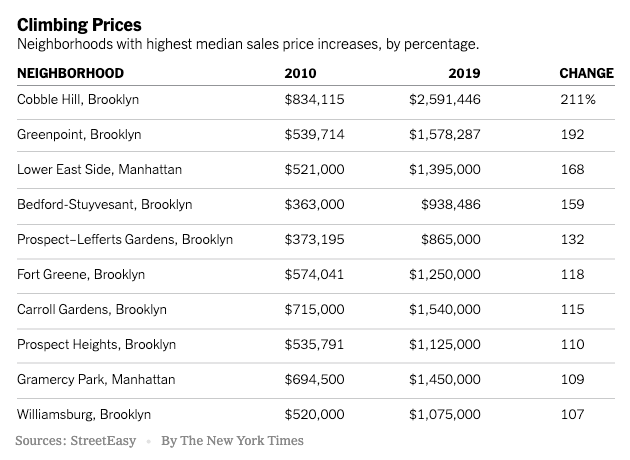
    A decade of ultra luxury condos. The New York Times published this story over the weekend talking about how the luxury condo boom of the 2010s transformed New York City, and in particular Brooklyn.

    Below are two tables from the article: (1) The number of units built between 2009 and 2019 across the five boroughs and the city’s top neighborhoods, and (2) the neighborhoods with the highest median sale price increase.

    The overarching theme is that New York built too many “super-high-end condos” geared toward global capital flows. According to one developer interviewed for the article (Gary Barnett of Extell Development), it was unprecedented.

    Apparently, the problem segment remains the $5 million to $10 million market. There’s simply too much inventory, and that has developers both delaying launches and going with much smaller (and hence more affordable) unit mixes.

    One stat that stood out for me was the new condo premium over resales. In 2011, the average sale price of a new condo in the city was about $1.15 million, which represented about a 9% premium over resale pricing.

    While it is typical to see a premium over resales (the same is true in Toronto), the average price of a new condo in 2019 rose to $3.77 million, representing a 118% premium over resales.

    For the rest of the article, click here.

  • The world’s first programmable city — Woven City

    Last week was CES in Las Vegas. Some or many of you were probably there. One of the things that was announced at the show was a project by Bjarke Ingels Group for Toyota called the Woven City. Situated at the base of Mount Fuji in Japan, the development sits on a 70 hectare site and will eventually house some 2,000 people.

    The objective is for it to act as a living laboratory for a number of new city building initiatives, ranging from autonomy and mobility as a service to multi-generational living and hydrogen-powered infrastructure. Woven City is intended to house not only residents, but also researchers who can test out and learn from these new ideas.

    Below is a short video from Dezeen. It’s entirely visual. No words. There’s also an official website, but not much is up there yet. Hopefully there will be more soon. Construction is set to start next year (2021) and it’ll be BIG’s first project in Japan.

  • Berlin apartment rent freeze has frozen capital expenditures

    Last year, the city of Berlin agreed to a five year rent freeze for some 1.5 million flats constructed before 2014. The way it was initially approved is that it would freeze rents at mid-2019 levels and allow for only 1.3% inflationary increases. All of this is being challenged in the courts, but the Financial Times is suggesting that it could still come into force by March 2020. Here is an excerpt from a recent article. (Guy Chazan isn’t holding back about the kind of people that he believes Berlin attracts.)

    The legislation, which should come into force by March this year, is City Hall’s response to a lingering housing crisis that shows no sign of easing. Packed out with Brexit refugees, international party people and wannabe tech entrepreneurs, Berlin is in expansion mode, its population growing by 40,000 a year. Yet affordable housing remains scarce. Rents have doubled over the past decade, as new residential construction fails to keep up with soaring demand.

    As I mentioned before on the blog, these policies are not intended to apply to new buildings. That would surely choke off new construction, which would only exacerbate the underlying supply issue that Berlin is facing. But not surprisingly, this move has also put a freeze on capital expenditures, according to the same FT article. Local trades are complaining that, “It’s as if someone’s just turned out the lights.”

    Photo by Gilly on Unsplash

  • Two-up, two-down

    Feargus O’Sullivan is doing a series in CityLab right now on the “home designs” that define four European cities: London, Berlin, Amsterdam, and Paris. The first one is on London’s classic “two-up, two-down” design, which refers to a two storey home with a living room and kitchen on the ground floor and two bedrooms on the second. It’s a simple design, but one that has supposedly endured.

    O’Sullivan argues that for many, or perhaps most in Britain, this is what a “home” feels like. It’s grade-related and there are two floors. Indeed, only 14% of British people live in an apartment, compared to 57% in Germany (a majority). This percentage is much higher in London, with about 43% of people living in an apartment. But about 25% of the population still lives in some sort of attached house.

    Home equals house. And for us North Americans, this is of course relatable. But the Germany example is a reminder that this is not necessarily universal. Attitudes toward housing are cultural. And cultures can and do change. I am seeing that happen right now in Toronto. Some of us are becoming less like the British and more like the Germans.