Daily insights for city builders, delivered every morning at 6 AM ET. I’m Brandon Donnelly — a Toronto-based real estate developer and founder of Globizen. I’ve been writing here since 2013.

Author: Brandon Donnelly

  • RioCan REIT announces new residential group

    On Monday, RioCan REIT announced its new residential brand: RioCan Living. This is the group that will now be responsible for redeveloping the 43 properties within their portfolio that they have identified as having intensification potential. Here’s how they are describing the new brand: “RioCan Living delivers best in class purpose-built rental units and condos along Canada’s most prominent public transit lines.”

    It has been interesting watching RioCan over the last 6 months. In the fall they announced that they would be selling off somewhere around $1.5 billion of their portfolio to rebalance toward Canada’s six largest markets, and in particular the Toronto market. And with this recent unveiling it is clear that they are doubling down on transit-oriented mixed-use communities as a way to future-proof their retail portfolio against disruption.

    Major markets. High-density. Transit-oriented. This shouldn’t surprise any of you. Here is a link to their latest investor presentation in case you’re curious.

  • Road pricing for whom?

    New York City is considering a congestion charge for drivers entering Manhattan below 60th street. It is part of Governor Cuomo’s Fix NYC plan. But we all know how difficult these things are to implement.

    Last month, Felix Salmon wrote a piece in Wired where he argued that our cities are dying of traffic congestion and that the cause is ride-hailing services like Uber and Lyft. The solution: A tax on ride-hailing services.

    The article elicited a few reactions, including this one by Charles Komanoff over at Streetblogs and this one by Joe Cortright over at City Observatory. Joe’s message: “The problem isn’t the ride-hailed vehicles, it’s the under-priced street.” 

    Precisely.

    Felix later followed-up with a post on his blog where he clarified that the reason he loves this idea – of taxing ride-hailing companies, not riders – is that it’s far more politically palatable than a blanket tax on all cars. I don’t disagree.

    Which is why I think my idea is something which is eminently politically possible, in contrast to congestion pricing, which has been implemented exactly nowhere in the USA.

    Americans love their cars, and they love the freedom that cars represent, and they hate the idea that they should be taxed for driving their cars. Tolls on roads and bridges are bad enough, but a fee just to drive in to a city?

    That said, I’m with Charles and Joe. 

    Last year, it was reported that roughly 25% of all Uber trips in New York City were UberPool trips. I’m not sure what the number is today, but these are people who are car pooling to get around. That’s generally considered to be a positive thing.

    Are these really the trips we want to be discouraging (and singling out) with a charge simply because we don’t have the moxie to do what is right and makes rational sense?

    Photo by Austin Scherbarth on Unsplash

  • Those wretched rear houses!

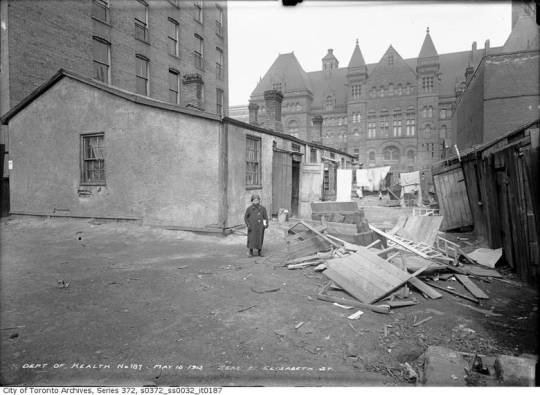
    Chris Bateman does some terrific sleuthing in the Globe and Mail this week to determine that the girl pictured in the below photo, dated May 15, 1913, is Dora (Dorothy) Cooperman – daughter of Morris Cooperman, a clothing presser.
    image

    Dora is standing in front of 3 wood-framed “rear houses” located behind 21 Elizabeth Street in an area known then as St. John’s Ward, or simply, The Ward. Behind her is City Hall, which we refer to today as Old City Hall. 

    If you’re familiar with Toronto, it shouldn’t take you long to figure out that she is standing in what is today the middle of Nathan Phillips Square in front of (new) City Hall. 

    The Ward no longer exists today, but as far as neighborhoods go its history is one of the most interesting. It was a high-density and mixed-use precinct that served as an important landing ground for successive waves of immigrants until it was deemed a slum and ultimately cleared. I wonder what it would look like today had it remained. Perhaps a bit like Kensington Market.

    It housed the Irish fleeing the Great Famine in the 19th century and was the center of Toronto’s Jewish community until the 1920s. The Cooperman family came from Kiev and identified as Jewish.

    There are so many interesting aspects to the above photograph. Everything from Dora’s pose to the juxtaposition between her surroundings and the grand (old) City Hall in the background. (Sidebar: I would like to try and recreate this same perspective. Would anyone like to model?)

    I also wonder why the city required a report to wake them up to the squalor that was living out in the Ward when they could have, presumably, just looked out their west facing windows.

    In 1911, Charles Hastings and Arthur Goss published what Batemen describes as a “landmark report that stunned civic officials, who had long ignored the poverty on their doorstep.” Hastings was the city’s medical officer of health, and Goss was the’s city first official photographer and author of Dora’s above portrait.

    One of the interesting things that Bateman explains about this report – and this is really the point of today’s post – is that it supposedly called out one particular housing typology as being highly problematic: rear houses. 

    These were houses that existed off the main street and could only be accessed via a laneway, like the one Dora is standing in. Today we would call them laneway houses. And so this report is evidence of over a century of anxiety around this particular housing type.

    It is obvious why overcrowding would have been deemed a serious problem at the start of the 20th century, but now one has to wonder how influential this report may have been in establishing the tone around these “rear houses.”

    Whatever the case may be, Dora’s story is an example of the role that this typology has played in housing people of modest means throughout this city’s history. It is also interesting, but perhaps not a coincidence, that affordability continues to be a part of the pitch around laneway housing and laneway suites. 

    Dora lived in a laneway house.

  • Hmm…architecture and basic income

    Albert Wenger recently published a post on his blog about architecture and basic income. Albert is a venture capitalist and is currently working on a book called World After Capital, which I have mentioned before on this blog. He is also an advocate of basic income as a solution to the growing inequality that the modern economy seems to be producing.

    In this latest post he wades into the world of architecture with two assertions that I would like to respond to today. The first is that with basic income the current trend of everyone piling up in large cities will end. We will decentralize in search of cheaper land on the outskirts of cities. And the second is that affordable housing could perhaps be produced with a more open source approach to architectural drawings and new construction.

    In terms of his first point, I’m not entirely clear why someone earning a basic income would suddenly decentralize. In the comments there is some discussion about how retirees, on a fixed income, often move outward in search of more affordable housing. I understand that phenomenon, but I am not convinced in this scenario. 

    There has been lots of talk about the demise of cities because of new technologies and other factors. But agglomeration economies have proved, again and again, to be a powerful centralizing force. Let’s also not forget about the environmental impacts of large scale decentralization, which would only be partially mitigated by the widespread adoption of electric vehicles. 

    Secondly, you can build a house without an architect. The issue isn’t that good bathroom details are hard to come by. Some of the bigger issues are likely the availability of land (decentralization, I guess, is supposed to solve this); construction costs (it’s a highly inefficient process that generates copious amounts of waste); and the immense regulatory burdens imposed on new construction (process, time, and costs).

    All of this stemmed from a visit that Albert did with a group of architecture students who are researching the relationship between architecture and basic income. I would be very curious to see what they produce.

    What are your thoughts?

    Photo by Mathyas Kurmann on Unsplash

  • The 2018 Henley Passport Index

    image

    I still have every passport that I have ever owned. The older ones are far more interesting because I was younger and always looking for creative ways to travel around the world. The older I get the less interesting my passports get. Now I find it difficult to travel away from my desk at lunch.

    Passports are highly symbolic to me. It equals a particular kind of freedom. But I suppose that’s because I have a pretty good passport. 

    According to the 2018 Henley Passport Index, the Canadian passport is tied for 5th – along with Switzerland, Ireland, and the United States – in terms of the number of countries you can access without a visa. 176 countries in total.

    The highest ranking countries this year are Japan and Singapore. With those passports you have visa-free access to 180 countries. The last place country, at 105th, is Afghanistan. You get 24 countries.

    Switching to design – because that matters – I think you would be hard-pressed to find better looking ones than the new Norwegian passport (pictured above and set to be put into circulation later this year) and the Swiss passport. The Swiss passport is allegedly the first to be professionally designed.

    How does your passport fare on the Passport Index?

    Image: Dezeen

  • Don’t touch the walls

    The Smith House by Richard Meier turned 50 years old last year. In celebration of that, photographer Mike Schwartz took these photographs. And just recently they were published in Surface Magazine along with an interview of both Meier and Chuck Smith. Smith’s mother commissioned the house (completed in 1967) and he was 8 years old when the family moved in.

    My favorite comment in the article is this one by Smith:

    “Don’t throw balls in the house, and don’t touch the walls.” I must have heard “don’t touch the walls” three or four times a day. That said, there’s a crack in one of the windows where I shot it with a BB gun. We got away with some things.

    Modern architecture was supposed to be a perfectly engineered machine for living. But I guess living didn’t include touching the walls or shooting BB guns in the house.

    My favorite photos – both from Mike Schwartz – are these two:

    imageimage

    They feel like inversions of each other. The first one (day shot) is all about the views outward. Meier also talks about how the white on white helps to enhance this experience. The second one (night shot) turns the house inward on itself. Smith talks about how at night the view disappears and all you’re left with is your own reflection.

    I also like how the paint is flaking on the fireplace, which by the way, is perfectly on axis with the home’s entry. It makes you work a little bit for the view. Apparently keeping the paint on was a problem since day one. But it gives the house – which is otherwise seemingly perfect – a bit of a patina. 

    However, I’m guessing that Meier would prefer the paint stay on.

  • InsurEye acquires the Dirt

    Back in 2013, my friend Mike Lerner and I designed, developed, and launched a condo review platform called the Dirt (thedirt.co). It’s hard to believe that it’s already been five years.

    Our mission was to empower real estate consumers through greater transparency in the marketplace. And we did this by crowdsourcing condo building reviews, as well as pricing comps.

    Today we are excited to announce that InsurEye Inc. has acquired the Dirt. InsurEye began as a moderated insurance review platform for home, auto, and life insurance, but it has since grown to include condo reviews.

    The team at InsurEye shares a very similar goal of creating greater transparency in the marketplace, and so we are thrilled that they will be picking up where we left off.

    Press release, here.

    P.S. The Dirt is the reason why I started the daily blog that you are reading right now. I started writing for the company and fell in love with it as a discipline and practice. Life is lived forwards, but understood backwards.

  • A sensible purchase price

    “Investing is an activity in which consumption today is foregone in an attempt to allow greater consumption at a later date. “Risk” is the possibility that this objective won’t be attained.” -Warren Buffet

    Warren Buffet published his annual letter to Berkshire Hathaway shareholders this past Saturday. I always enjoy reading his letters and I have been doing it for years. If only he wrote a daily blog.

    One of the things he talks about in this year’s letter is why Berkshire wasn’t very acquisitive in 2017:

    In our search for new stand-alone businesses, the key qualities we seek are durable competitive strengths; able and high-grade management; good returns on the net tangible assets required to operate the business; opportunities for internal growth at attractive returns; and, finally, a sensible purchase price.

    That last requirement proved a barrier to virtually all deals we reviewed in 2017, as prices for decent, but far from spectacular, businesses hit an all-time high. Indeed, price seemed almost irrelevant to an army of optimistic purchasers.

    Some of you in the real estate game might be feeling similarly. But he ends the section with these words of advice: 

    In the meantime, we will stick with our simple guideline: The less the prudence with which others conduct their affairs, the greater the prudence with which we must conduct our own.

    Buffet has a way of simplifying things. He also, clearly, has a way of remaining disciplined.

  • Are we entering a new era of tech-driven city building?

    Emily Badger of the New York Times published an interesting piece yesterday talking about the tech industry’s current obsession with trying to fix cities. And there are certainly many problems to fix.

    Staying true to tech and engineering parlance, there’s lots of talk of optimization. How do you technologically optimize a city, for things such as affordable housing?

    There’s no doubt that many of you will sympathize with this statement: 

    To planners and architects, all of this sounds like the naïveté of newcomers who are mistaking political problems for engineering puzzles.”

    But naïveté is not always a bad thing and with all of the money sloshing around in this industry, there’s also no doubt that this is likely a new era of city building.

    The article ends by quoting JD Ross, the 27-year old co-founder of Opendoor – a startup that we have discussed many times before on this blog and is now valued at over $1 billion.

    It is him saying that he wants to figure out how to put $100 million into this space as soon as he can figure out the right target to optimize for. “It’s better than buying a Bugatti.”

    Of course Sidewalk Toronto – which is mentioned a few times throughout the article – is already a perfect example of tech infiltration.

    But I think Dan Doctoroff gets it right when he posits that the real naïveté will come from disrespecting urbanist traditions.

    Photo by David Alacaraz on Unsplash

  • My Piece of the City

    A friend of mine just sent out a group city builder email about My Piece of the City, which is a new documentary that is screening all weekend here in Toronto at the TIFF Bell Lightbox.

    The film is a critique on the revitalization of Regent Park, told through local residents and their efforts to stage a community musical (which happened in real life).

    The Daniels Corporation, in partnership with Toronto Community Housing, is the developer and builder for the entire 69 acre community. The Daniels Foundation also funded the musical and this documentary.

    But, despite this backing, the Globe and Mail has said that it remains a “healthy critique” of this entire process. And the trailer certainly gives you that impression.

    I am sure that this documentary will be of interest to many of you, so if you would like to grab tickets for this weekend, you can do that here.