Daily insights for city builders, delivered every morning at 6 AM ET. I’m Brandon Donnelly — a Toronto-based real estate developer and founder of Globizen. I’ve been writing here since 2013.

  • Data centres will soon claim 15% of total US grid capacity

    Here are some recent data centre figures to help put things into perspective. By 2035, BloombergNEF now expects there to be 194 GW of data centres online in the US. This is an upward revision of 83%! The reason for this revision is that “the announced data center pipeline in the US has grown by a further 101 GW since December 2025.”

    But here’s another interesting thing. BNEF also estimates that the shipment of AI chips between 2023-2033 could total as much as 325 GW of data centre capacity in a theoretical world with no other constraints. Of this figure, they expect 207 GW to go to the US.

    However, they also identify a shortfall of 63 GW between this expected supply of AI chips and what is actually forecasted to get built due to grid constraints. So in other words, the chip market may be overshooting what can actually be physically deployed (though there are nuances to consider here).

    Regardless of what ultimately ends up happening, we’re talking about enormous numbers. The recent clean energy investment here in Canada is expected to generate an additional 14 GW of clean, renewable power. It goes to show just how many of these big announcements we are going to need for Canada to become a data centre superpower.

    At the end of 2025, the entire utility-scale electricity-generation capacity of the US was 1,280,799 MW, or about 1,280 GW. So when we’re talking about an install base of 194 GW by 2035, we’re talking about ~15% of the country’s current grid capacity.
  • Mapping 70,000 trains across Europe

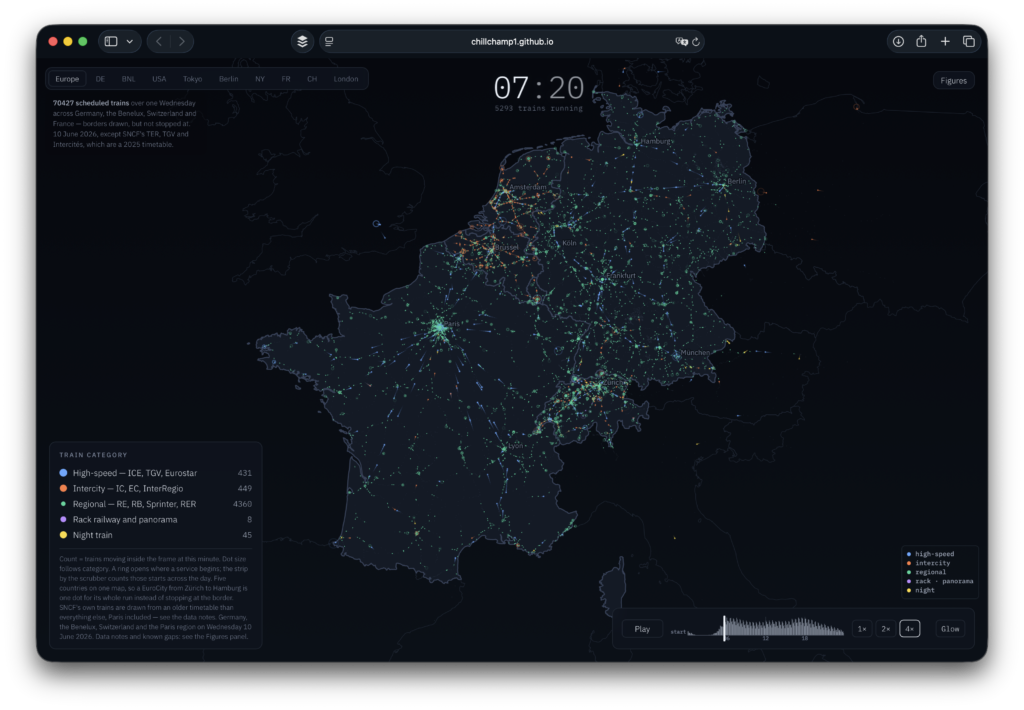
    I just came across a fascinating visualization of rail in Europe. You can also visualize other places like the US, but as you know, there isn’t much to see there in the way of trains. What is shown in the above screenshot is Germany, the Benelux, Switzerland, and France. I paused the visualization at 7:20 AM and there were 5,293 trains running, with the vast majority of them (4,360) being regional rail.

    Here’s what stood out:

    • France operates a monocentric hub-and-spoke network with Paris as the clear central hub. Trips almost always route through Paris, which reflects France’s historically centralized economy. In contrast, Germany operates a decentralized mesh network with more point-to-point travel and no single dominant city.
    • Regional rail is the workhorse. When I paused the visualization, over 82% of the trains in operation were regional rail. High-speed rail is sexy, but it clearly needs to be supported by a dense regional grid that brings people to and from major high-speed routes.
    • Smaller countries like Belgium, the Netherlands, and Switzerland have such a dense network of intercity rail that they almost read as continuous urban regions.

    If you love trains, as I do, you’ll want to take a look.

  • How Junction House built laneway towns for urban families

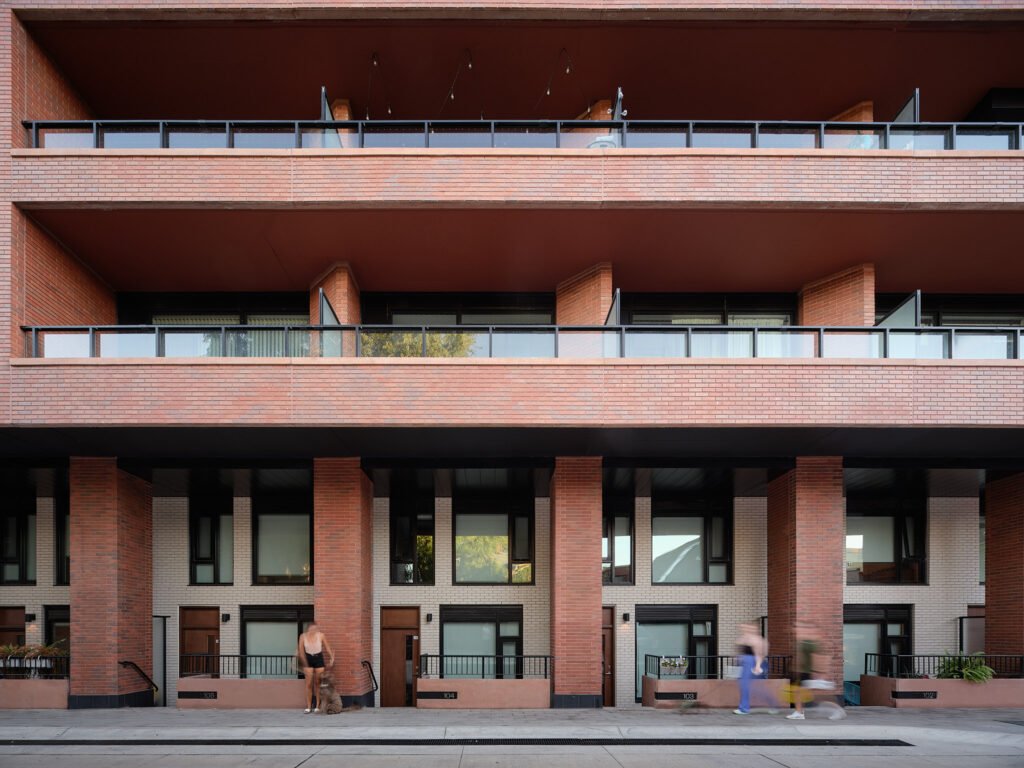
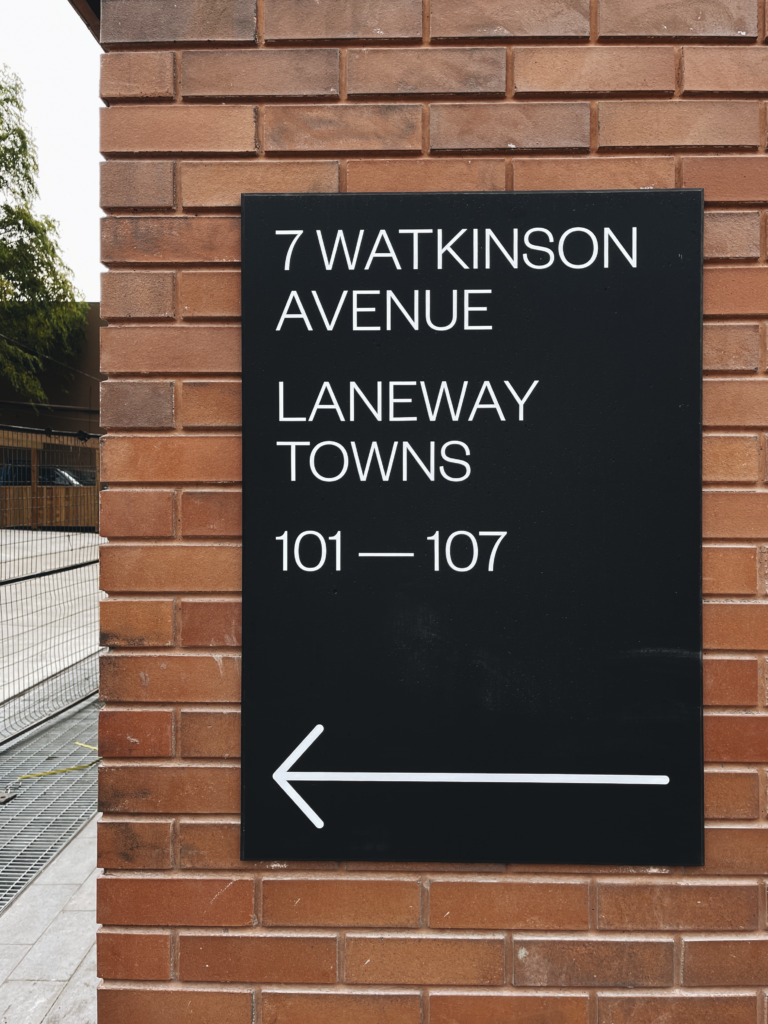
    Junction House was designed with 7 laneway towns on the north side of the building. The above photo is from 2023, right after we installed the wayfinding signage, which is why you can see the construction fencing sitting in the laneway. Alongside Superkul (architects), we made the design decision to incorporate ground-related towns for two reasons.

    First, we are supporters of laneway housing, and one of our city-building agendas is to find ways to revitalize and animate these spaces in Toronto. Incorporating laneway towns was a natural way to do this.

    Second, we were able to tuck these two-storey suites into the same height as our ground-floor retail on the south side. This meant that, even though our sales team was advising us that these would likely sell for a relatively low price per square foot compared to the rest of the building, it was the right business decision. It was still more accretive than additional single-level retail (or retail with a far less valuable mezzanine space) or some other unproductive back-of-house space.

    As a development aside, we originally designed these towns to be raised up from the laneway, accessible via a few steps. But during the rezoning process, the city asked us to shave down the overall height of the building to meet some symbolic height in metres that the local City Councillor demanded we achieve. It was frustrating, but we complied, and that’s why the towns are designed the way they are.

    Looking back on these suites a few years later, I continue to believe that we made the right big-picture decision, especially because of how they are now being lived in. These suites have a very high percentage of families with young children — children who often make use of and play in the quiet laneway.

    In hindsight, this makes perfect sense. These are larger, grade-related suites that offer some degree of relative affordability. In my view, it’s further evidence that not all families want to flee to the suburbs. We just have to find ways to deliver the right kind of urban housing for them.


    Second photo by Doublespace Photography

  • Canada keeps exporting its best builders, but the fix is right in front of us

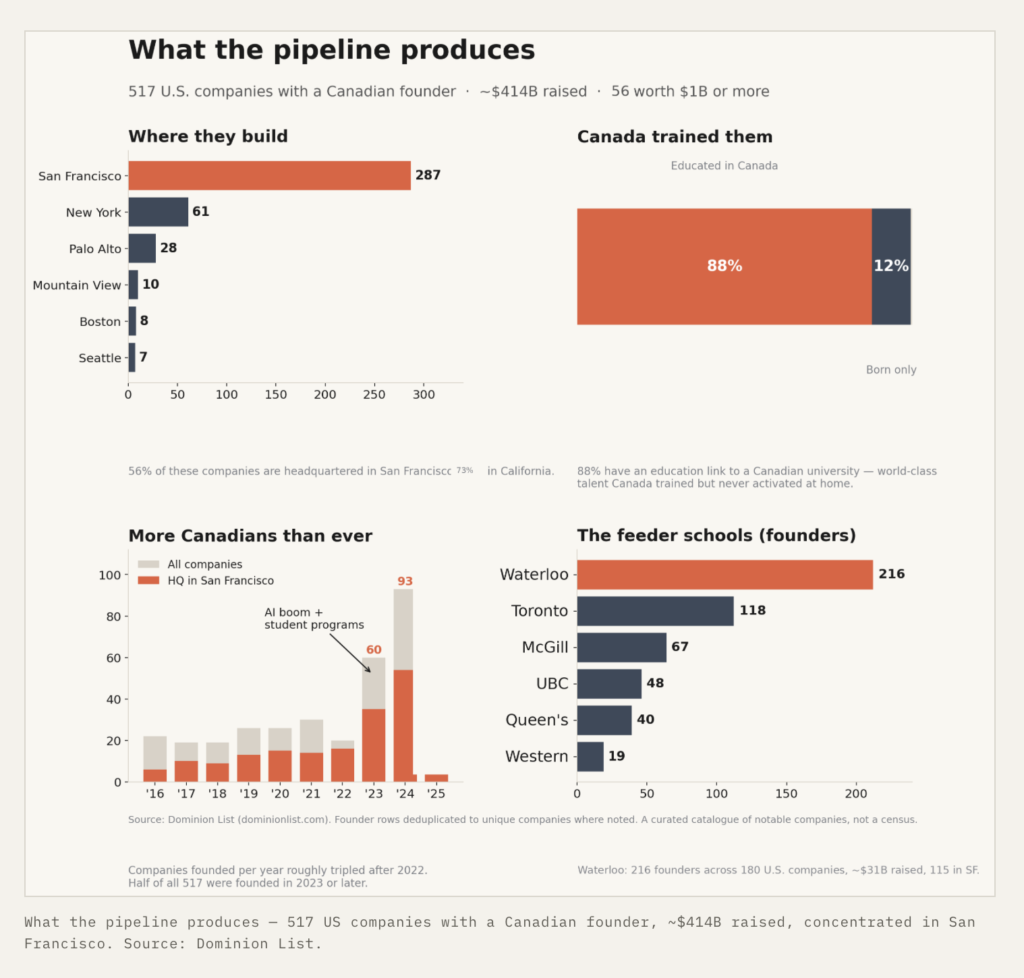
    Canada has a smart, highly educated, and entrepreneurial population base. The problem is that too many are leaving to build elsewhere. Here are some alarming stats from Barn Ventures, using data from Dominion List.

    The list shows 517 US-based companies with a Canadian founder. Of these founders, 88% were educated in Canada (12% were only born here), and the top feeder schools are the exact ones you’d expect: University of Waterloo, University of Toronto, and McGill University (in that order).

    Collectively, these companies have raised something like $414 billion of capital and 56 of these founders are now worth at least $1 billion. This is wealth being generated outside Canada, and then being reinvested into things, people and opportunities outside the country.

    The good news is we already have the raw ingredients. Excerpt from Jesse Rodgers at Barn Ventures:

    The thing Canada has is the one input none of these programs can manufacture: the builders. The Dominion data proves it — 88% of those founders are our graduates. Waterloo produces them on a schedule. The missing piece isn’t talent, or even capital — it’s the infrastructure to recognize and back people before someone in San Francisco does, and now “before” means before they’ve finished a degree.

    If we wait until a smart young person has graduated, started a company, and proven out their idea (which is often what Canadian capital wants), it’s too late! That founder is gone, living in the US, and raising capital for audacious, stupid-sounding ideas that have a small chance of 100x payoffs.

    As they should.

    This is one of the reasons why I think our current real estate downturn will be a net positive for the country in the medium and long term. Too much capital was getting allocated to real estate, starving other economic development opportunities (and I say this as a real estate developer).

    We need to be taking more bets on young Canadians with crazy ideas and accepting that failure is a normal part of the process. Because if we don’t, another country clearly will.

  • Why uploading Toronto’s highways to the province won’t fix traffic congestion

    In 2023, the City of Toronto announced a deal that would “upload” the Gardiner Expressway and Don Valley Parkway from the city to the province. This was a big deal because these highways were previously the city’s largest state-of-good-repair liabilities, and so, before this deal, the city was, you know, trying to figure out how to pay for them.

    One option was road pricing (or expressway tolls). And in 2016, this became a real possibility with City Council overwhelmingly endorsing the plan, before it got rejected by the province. It will come as no surprise to regular readers that I was in support of it and writing about it at the time.

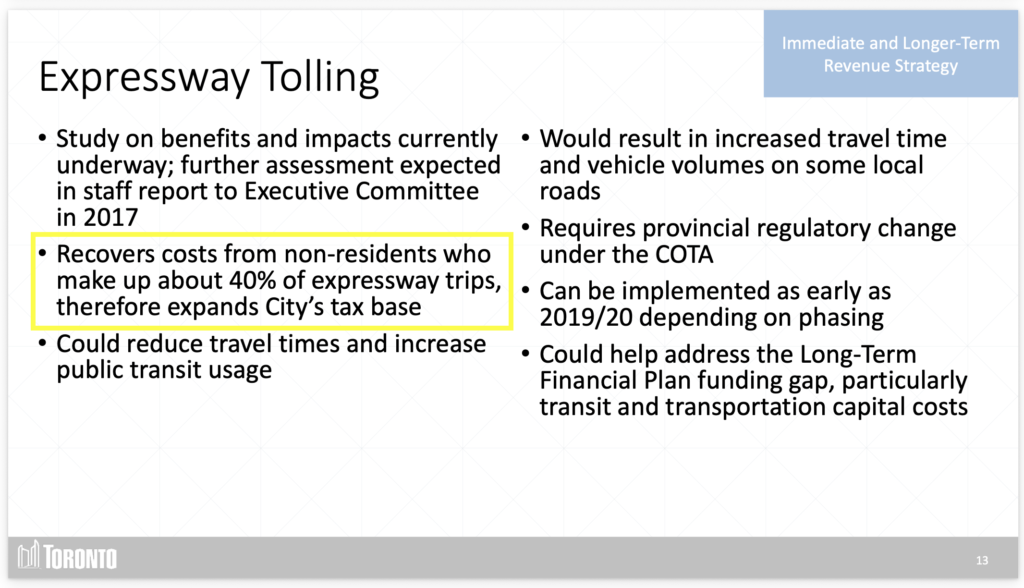
    In 2016, Toronto estimated that 40% of all trips on these two expressways were by non-residents, and yet they were being funded by Toronto taxpayers. When I said this on Twitter, many of you got upset and argued that people coming in from the suburbs are a boon for the city. No doubt. But the reality is that this was an inequitable funding structure.

    Let’s look at the 2022 Transportation Tomorrow Survey results, which I wrote about here.

    The mode share for all trips to downtown Toronto (from within the city) was 75% non-car, with transit making up the largest share at 40.4%. And the mode share for home-based work trips to downtown Toronto (people who leave home in Toronto to go to work downtown and then come home) was about 80% non-car! In this case, transit made up nearly 50% of the trips.

    The effective result is that the people who tended to drive the least to work were paying for the highways with their tax dollars, and the people driving into downtown were not. This is in no way intended to be an attack on the latter camp. The simple reality is that driving into downtown and buying a chicken souvlaki pita from Jimmy the Greek at lunch isn’t enough to offset the road usage costs.

    The uploading of the highways to the province (which is still advancing but has already relieved Toronto of its financial obligations) is a more equitable solution. It shifts the cost burden to Ontario taxpayers, reflecting that people from all over the region use these highways and that Toronto is part of a broader economic agglomeration.

    But this only solved the jurisdictional problem. We still have worsening congestion and an inefficient funding model. The problem with using broad-based taxation to obfuscate infrastructure costs is that direct usage then goes unpriced, and that leads to what is known as a “tragedy of the commons.”

    We all tend to act in our own short-term self-interest, and the result is that road demand constantly outstrips the available supply. There’s zero marginal cost to actual usage, whether you drive 100 kilometres each day or bike to work. The most effective way to manage traffic congestion is to remove the hidden subsidy for driving and price the costs and negative externalities.

  • Fast fashion is embracing luxury placemaking

    The future of physical retail continues to evolve.

    Recently, we spoke about LVMH’s approach of spending billions on some of the world’s most prime real estate. But the focus on human-centred destination experiences isn’t unique to the luxury segment. Case in point: Zara just opened a new flagship store in Shanghai designed by AIM Architecture (which appropriately stands for Authentic Immersive Matters).

    Located on a major commercial street, the store looks like this and can be generally described as follows:

    • Positioned on a prime open-air main street (versus an enclosed mall).
    • Large amphitheatre-style seating on the ground floor that connects the store to the street and encourages people to linger.
    • Beautiful interiors with not a lot of clothes on display — it has more of a gallery feel.

    It is a clear example of fast fashion adopting luxury placemaking and brand immersion. The point is not to bombard you with clothing options. The point is a human-centred space that gives you an opportunity to experience the Zara brand and then decide if its products might help you better define your sense of self. It’s a media channel, giving you something you can’t get online.

  • Traffic is agonizing, maybe we should try something new

    The other day I asked my dad how a function he attended went, and he responded by saying, “Traffic, BRUTAL. Traveling by car is an agonizing experience.” He’s not wrong, and I know most of us in Toronto like to complain about it. Traffic is one of the negative externalities of a big city.

    But here’s the thing: we know how to solve this problem. You price congestion, as has been done in New York, London, Singapore, and many other cities, and then direct the revenue it generates to a mode of transport that isn’t as agonizing in a big city: rail travel.

    I’ve written so much on this topic over the years that there’s very little I can add at this point. If you’d like to have a read, here are the search results for “congestion pricing.”

    While the policy has proven successful elsewhere, political inertia and valid concerns over equity keep Toronto stuck. But until we charge for valuable road space, gridlock remains our default. New York City has also shown us that once people see the benefits, they quickly change their minds.

  • Why do cities build skyscrapers?

    Very generally speaking, cities build skyscrapers because of some mix of natural market forces and symbolic prestige. In cities like New York and Hong Kong, where land is extremely scarce and valuable, the only option is to go up. Tall buildings are essential. And in cities like Dubai, I think it’s fair to say that symbolic prestige has been the greater motivator, at least at the outset of the city’s modern reinvention as a global city. Tall, over-the-top buildings helped put the city on the map, even when tall, over-the-top buildings weren’t necessary from a direct economic standpoint.

    Another way to encourage tall buildings is to simply restrict everything else. Ontario’s Places to Grow Act of 2005 was well-intentioned. It was designed to encourage intensification, support transit investment, and curb urban sprawl. I believe that all of these things are desirable planning outcomes. But one of the ways that intensification was sold, politically, was that growth would only be directed to specific areas and that the preeminence of single-family housing in the region would not be in any way threatened.

    The result is what has been pejoratively referred to as “tall and sprawl,” meaning tall buildings surrounded by vast swaths of low-density housing. It’s a built-form contrast that feels unnatural precisely because it is a market distortion created by policy. In a pure market without zoning constraints, the likely built-form outcome would be a smoother density gradient down from major urban nodes and transit stations (where land values tend to be higher). Of course, the Toronto region is filled with countless counterexamples of this.

    Now, to be fair, good work is being done to address this missing layer of medium density, but we’re not there yet. And we’re still working through the supply of the last cycle. Rachelle Younglai recently published an article in The Globe and Mail called “Condo developers outside Toronto feeling the biggest strain from market’s downturn.” This is not surprising. Peripheral markets generally get hit the hardest during real estate downturns and take the longest to bounce back. But on top of this, there are suburban towers that probably didn’t need to get built. The economic imperative was tenuous but for the planning restrictions and the pre-construction condo market.

    My suggestion would be to upzone the areas surrounding these towers and remove as many development constraints as possible, especially around transit nodes. This may seem paradoxical given we’re currently talking about excess supply, but the glut is likely a product mismatch problem. Allowing the surrounding areas to fill in invites the market to build what is most in demand, smooth out the density gradient, build amenities, and create destinations that could then lift the value of the entire node.

    This is not an immediate solution, but it’s a path toward a more natural market outcome. Need a case study to point to? Look to Tokyo. Flexible permissions, mixed-use zones by default, and an orientation around rail have allowed Tokyo to organically evolve into one of the most livable global cities on the planet.

  • What five global cities teach us about social mixing

    Here is an interesting study published in Nature Cities called “Hidden patterns of urban mixing across five global cities.” The study leverages individual-level travel data, covering over 200,000 residents in Boston, Chicago, Hong Kong, London, and São Paulo, to analyze the amount of social mixing that tends to occur across different socioeconomic groups within these cities. To be more precise, the study measures collocation among different segments — people within the same urban spaces at the same time.

    Two findings stood out to me.

    First, public transit is a key ingredient in increasing social mixing. It does this because it centralizes activity and delivers a broad cross-section of people to amenity-rich destinations, rather than encouraging decentralization. It is for this reason that “the gap in social mixing between low and high income is smaller in Hong Kong and London than in the other three cities.” Destination amenities explain 50-69% of individual social mixing levels, according to the study.

    Second, the study finds support for something known as the “second youth” hypothesis. This is a documented phenomenon where people, right after the typical retirement age (ages 65-74), exhibit an increase in social interaction and mixing. Another term for this is the Third Age, which is the active post-retirement period that people live after their Second Age (employment and family formation) and their First Age (childhood, education, and dependency). This makes sense given that retirement frees up time!

    Both of these findings (as well as the other ones in the report) offer lessons for city builders. Public transit and density are the great urban unifiers. They, quite literally, bring people together. At the same time, it’s a reminder that our challenge is to design our urban centres and public spaces for the full human lifecycle: young people, families, retirees living their best lives, and everyone else.

  • Why some of the world’s most valuable real estate is human-centred

    Yesterday we spoke about the growing divide between what I am calling machine-centred and human-centred real estate (feel free to suggest better titles in the comment section below). Machine-centred assets are introverted. By definition, they do not need to engage their environmental context. They are utilitarian spaces optimized for machine efficiency. Human-centred spaces, on the other hand, are extroverted spaces.

    A prime example of this is the approach taken by luxury conglomerate LVMH:

    • Trophy Real Estate: LVMH sees value in prime urban real estate in the world’s top global cities. In 2023, the company spent €2.45 billion on real estate in cities like Paris, London, and New York.
    • Mixed-Use Placemaking: Stores are no longer just stores. They are mixed-use places that blur the lines between retail, culture, food and beverage, hospitality, and whatever else strengthens the core brand.
    • High Street Bias: Between July 2024 and July 2025, JLL found that 59% of new luxury store openings across the US were in open-air, street-level locations. The three most active areas in the US were Madison Avenue, Fifth Avenue, and SoHo.

    A big part of this strategy is naturally about complete control. By owning standalone real estate assets in prime urban locations, brands can decide if they want to clad a 15-storey building in monogrammed Louis Vuitton trunks. But implicit in this desire is a recognition that the human experience is paramount when it comes to luxury. Emotional immersion, physical discovery, and a curated brand story are all part of the offering.

    Physical spaces also provide a platform for signaling identity and status, which is primarily why people buy luxury products in the first place. Machines can optimize for function, but human-centred spaces create the emotion that fuels some of the world’s most valuable real estate.