
Daily insights for city builders, delivered every morning at 6 AM ET. I’m Brandon Donnelly — a Toronto-based real estate developer and founder of Globizen. I’ve been writing here since 2013.

Month: August 2026

  • The Big Mac theory of housing costs

    Forty years ago, The Economist introduced its now-famous Big Mac Index. It was based on the simple idea that a Big Mac is a damn near perfect universal commodity, and so if you methodically compare its price across countries, it should give you an approximation of the purchasing power parity across a basket of currencies.

    For example, a Big Mac currently costs US$6.22 in the US (as of July 2026 and according to The Economist). But in Switzerland, it works out to US$9.04, and in Taiwan, it’s US$2.42. This suggests that the Swiss franc is overvalued and that the Taiwan dollar is undervalued because, in theory, their currencies should adjust over time to correct such a large variation.
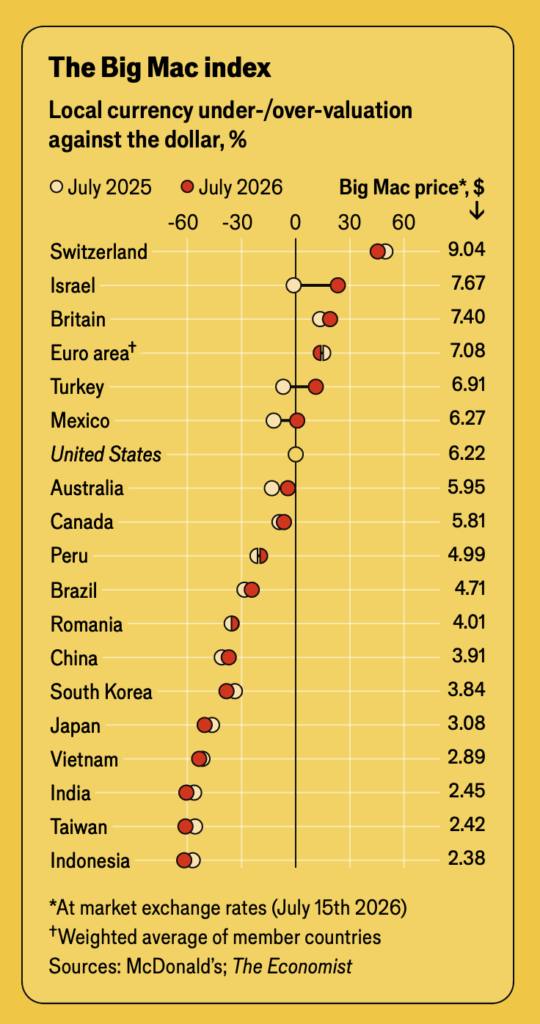
    Now, I’m not an economist, but supposedly there is some directional validity to this line of thinking. However, it’s not entirely accurate. If you look at the various inputs that make up the price of a Big Mac, there are over 60 ingredients, including local real estate prices, the cost of labour, and utility costs.

    Some countries may also have tariffs on certain ingredients, which would drive up the price for local consumers (yes, that’s how tariffs work), and some countries may have a higher willingness to pay for American fast food. If there’s a higher perceived value, McDonald’s can simply charge more.

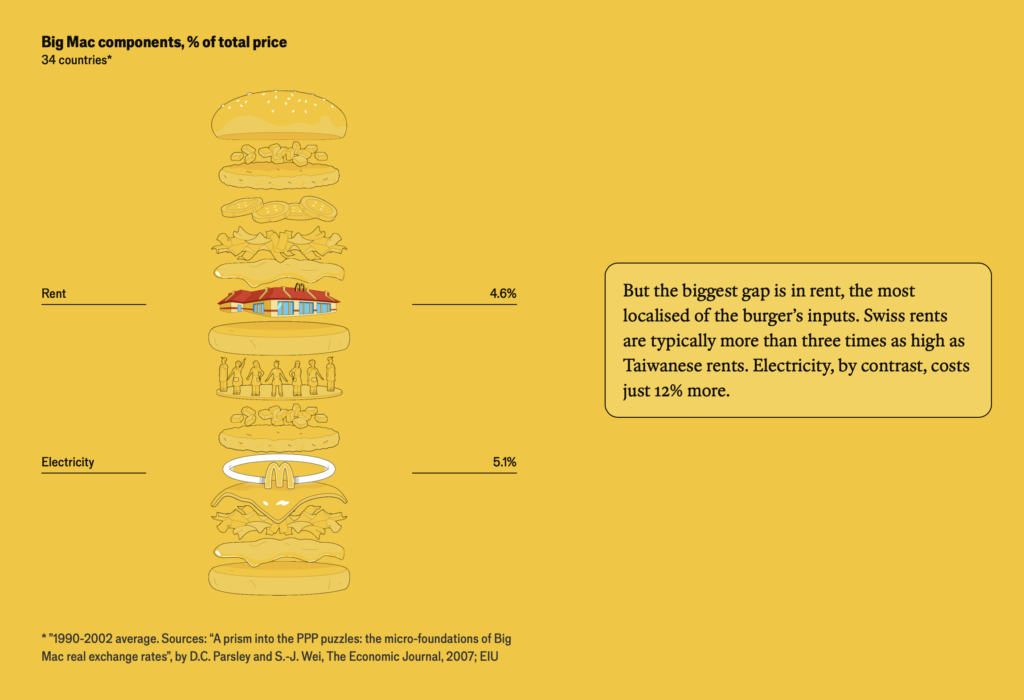
    So, the fact that a Big Mac costs significantly more in Switzerland does say something about the CHF, but it’s also an indicator that retail rents are somewhere around 3x what they are in Taiwan, among many other factors.

    Now let’s consider a product that, unlike the Big Mac, can vary a great deal across countries: housing. A new home requires far more than 60 ingredients, but it similarly reflects local cost structures, including material inputs, labour rates, and any tariffs and taxes that might be levied on the product.

    Every input, from time to development charges, gets factored into its end price, which is why, when a politician claims that something like inclusionary zoning represents a “no-cost affordable housing” solution, I wonder if they’re simply unclear on the economics or if they’re trying to deliberately misrepresent the situation.

    At McDonald’s, the equivalent policy would be to require that every time someone buys a Big Mac, the restaurant must simultaneously offer 20% of a new Big Mac to another customer, below the cost of production. It should be obvious that this practice would require the original customer to pay more for that same Big Mac.


    Images from The Economist

  • I’m going going, back back, to WordPress WordPress

    When I first started writing this blog in 2013, I started on Tumblr. Then about 6 years ago, I decided that Tumblr wasn’t the right platform for a written blog like mine, and so I moved to WordPress (specifically WordPress.com — not a self-hosted setup). About two years ago, I packed up and moved this blog once again, this time to Paragraph. I was trying to shift more of my online activity onchain, and I liked the idea of my posts being permanently stored on a blockchain like Arweave.

    But it turns out that Paragraph wasn’t the best fit for me. I’m still long crypto and I have it set up to syndicate my posts to the old site, but I found the platform more restrictive than my old WordPress setup, and its recent update also pivots the product to much more of an AI-focused media platform (with more credits to buy), and that’s not how I like to write. I just want to open a blank post editor, write my own words (sometimes post photos), and then hit publish.

    So, I’ve decided to return this blog to WordPress, but using a self-hosted setup (with Hostinger) and with my email newsletter being once again sent out by Mailchimp. To be honest, I really questioned this decision. Should I just use Substack like seemingly everyone else? Isn’t WordPress kind of old school? It’s certainly not the easiest to set up (I still have a bunch of housekeeping to do) and Mailchimp is going to again cost me hundreds of dollars per month given the size of my mailing list, but I decided it’s the best decision for me for two main reasons.

    One, I want a site that is as simple and timeless as possible. I’ve been writing basically every day for 13 years and in my mind I’m going to continue writing for at least the next decade. Two, I want to be able to customize my site and my email newsletter as I see fit. This blog is a personal blog, but it is also intended to be the top of the marketing funnel for everything that I’m working on with Globizen. The simple idea is that someone discovers me through my writing, maybe something resonates, and then that leads them to one of our projects or to book a stay at Parkview Mountain House.

    When you write every day, it’s easy to fall into a routine. Most days it’s a real commitment (okay, slog) to find the time to get something out into the world. But whenever I do a big reboot of the blog, I feel reinvigorated. It’s a time when I take the time to think about what I’m doing every day and then adjust as needed.

    Going forward, you can expect to find the same content focused on real estate, cities, and design. But I’d also like to write more personal posts, more travel posts, and get back into sharing my photography. AI muted my desire to take photos, and as much as I think AI is wonderful, I’m feeling a bit of fatigue around it. Part of this return to WordPress is about getting back to basics: a very simple landing page with authentic words, photos, and links.

    The only changes you should notice today are formatting ones, both at brandondonnelly.com and in your inbox. It’ll probably also take me another week or two to fully settle in with the new setup, but regardless, emails will continue to get sent out at 6 AM ET. Onward.

  • What are the actual employment effects of data centres?

    People used to get excited about data centre construction, and communities used to compete for them, frequently with incentives. They represented job creation and an investment in the new economy. But things feel quite different today.

    According to new research from Brookings, more than 100 local communities in the US have enacted moratoriums on data centres, and more than 300 state data centre bills were filed in the first six weeks of 2026 alone. Earlier this year, Sanders and AOC also introduced the AI Data Center Moratorium Act.

    The reasons for this are clear. Brookings reports that the PJM grid region in the US (which serves about 65 million people) saw its power supply costs increase from about $2.2 billion to $14.7 billion in a single year, and data centres are thought to account for nearly two-thirds of the increase.

    So, are the employment and economic gains worth it?

    The new research from Brookings shows that not all data centres are created equal. Hyperscale data centres (like those built by Google and Amazon) can quickly become the largest taxpayers in a county. They also appear to create higher employment benefits compared to colocation facilities (where a landlord builds a data centre and then leases it out to remote tenants).

    The largest employment effects were also seen when data centres cluster. This makes sense, and it’s the foundation of cities. When people and uses cluster together, they produce larger ecosystem effects. Conversely, standalone facilities were found to result in modest gains. A data centre is not a labour-intensive operation in and of itself.

    If you’d like to read the full Brookings brief, click here.