Daily insights for city builders, delivered every morning at 6 AM ET. I’m Brandon Donnelly — a Toronto-based real estate developer and founder of Globizen. I’ve been writing here since 2013.

Month: July 2026

  • From square to circle at One Delisle

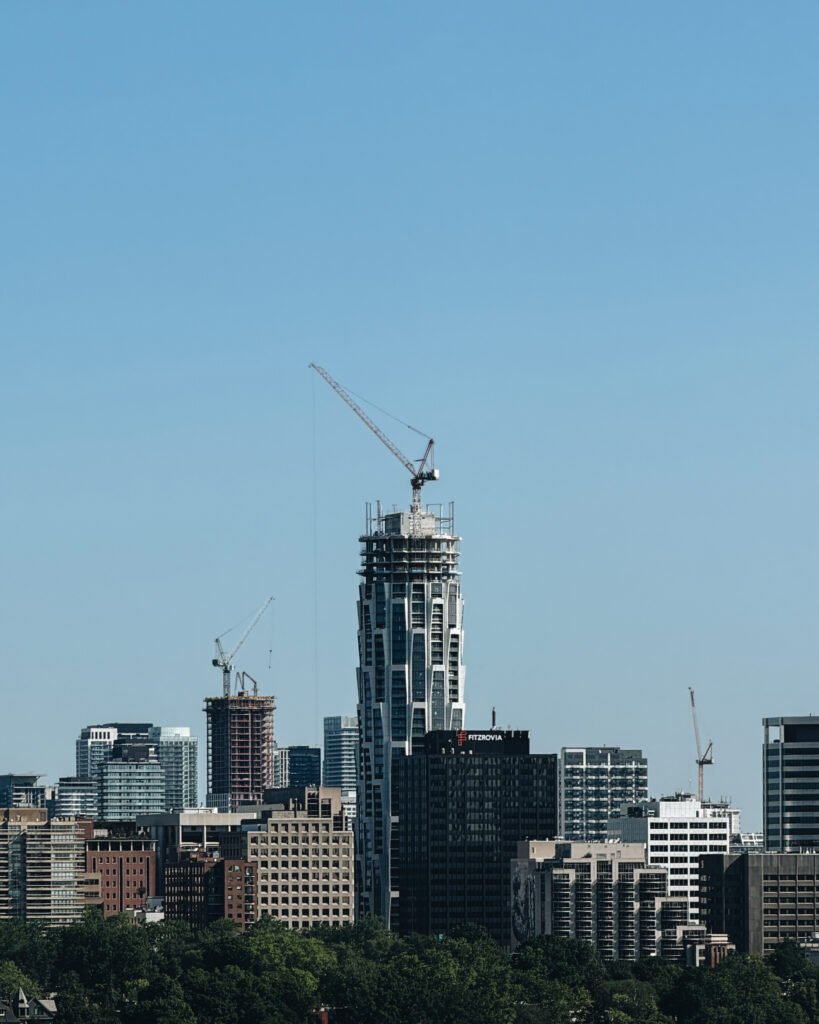
    One Delisle is really starting to make a mark on the Toronto skyline. So on a semi-regular basis, people now send me photos of the building or mention me on the socials. I love when people do that. Here’s a great photo from today from Dion on Twitter.

    One of the comments that I used to get was, “Yeah, I don’t know, Brandon, the floor plate is still looking pretty square.” And I would respond with, “Be patient.” For those of you who aren’t familiar with the design, the entire tower gradually transforms from a square floor plate to a 16-sided circular floor plate.

    Nobody makes this comment anymore.

    I also really like Dion’s photo because it shows the steel for the “crown” at the top of the building coming together. The height of the crown was something we fought for during rezoning. Studio Gang felt it was crucial for the proportions and slenderness ratio of the building. And we agreed.

    I can tell you that it had us measuring the exact height of nearby church windows to see if this crown would shadow them at certain times of the day and year. I’m sure glad we did that.

    Please keep the photos coming!

  • Out-of-office messages are for the unserious — or are they?

    There is a school of thought that out-of-office messages are only for the unserious. If you’re a top-performing executive, owner, or whatever, you need to be available and reachable at all times, and so an OOO message sends completely the wrong signal. It says that you’re just not that committed to what you do. Yeah, I always use an OOO message when I’m away.

    While I appreciate that school of thought and I know firsthand that when you have your own business you’re on 24/7 (because of some unhealthy combination of drive and obsession), I also believe that the following two things are true.

    One, we could all die tomorrow and it’s important to take some time when you can. In fact, I’d say greater freedom is the objective. As Charlie Munger famously stated: “I did not intend to get rich. I wanted to get independent, I just overshot.”

    Two, as connected as we all are today, there’s no way that when I’m crushing back bowls at high elevations I’m going to be able to respond as quickly as I do when I’m sitting at my desk for 15 hours a day. So I think it’s important to let people know, “Hey, if I don’t respond to you in 38 seconds, I have not died; you just need to wait a bit longer.”

    The signal is a recalibration of expectations, not of my level of commitment.


    Cover photo by Luca Bravo

  • Density is a feature of cities

    My sense is that density is a misunderstood characteristic of successful cities. I think most people see it as a bug. They see some of the negative externalities associated with cities, such as traffic congestion, and they assume that the culprit is too many people.

    But they are confusing population density with land-use inefficiencies. This, I can only assume, is why some people arrive at the selfish conclusion that their city is full.

    There are, of course, many counterexamples to this line of thinking. Paris, Seoul, Barcelona, Singapore, Tokyo, and many others have both high population density and are viewed as being highly livable and desirable cities.

    Not all high-density cities are livable, but that’s because other ingredients are missing. I will remind you that Tokyo once again placed first in Monocle’s annual quality-of-life survey this year.

    What I think gets missed are the following three key features of urban density.

    One, dense cities dramatically lower the cost of delivering infrastructure over the long term and reduce per capita energy consumption.

    Two, cities are wealth-generating machines and density drives “agglomeration economies.” Put smart and entrepreneurial people in close proximity to one another, and good things happen.

    Three, the only way to create an enormous, well-functioning city like Tokyo is on the backbone of transit. And the only way to make transit viable and convenient for most people is to build density all around it. Density is the unlock that makes it all possible.

    Ironically, then, density is what can make cities feel less congested and more livable.

  • What does Toronto want to be?

    So, what bold and uncomfortable 21st-century master plan should Toronto adopt? I don’t know exactly, but what I was getting at in my lead-up post is that it’s hard not to sometimes feel like Toronto is trying to run a 21st-century global city on a 19th-century Victorian street grid, surrounded by Houston.

    In the core of the city, we have narrow, generally 20-metre rights-of-way. Many of these east-west arteries are beautiful streets to walk on with fine-grained retail patterns, but the streets themselves have slow-moving streetcars in the middle two lanes and on-street parking on both sides. The result is streets that don’t move and are frustrating to navigate for all users: drivers, transit riders, and cyclists. It can take an hour to drive 10 km.

    Other major streets don’t have streetcars or much retail activity, but the land-use pattern reflects a bygone era. It doesn’t make sense to have only single-family housing on Toronto’s busiest arteries. It’s time for these streets to grow up. (To be fair, the City of Toronto is trying to achieve this with its new Major Streets policies, but the development economics do not make these changes feasible at scale.)

    As you move out of the core, Toronto’s major streets naturally widen along with the recency in which they were built. Now we have the opposite problem where we’re faced with “stroads” with little to no urbanity. Overall, it’s the result of a city that grew organically over time without the same kind of defined plan seen in cities like New York, Barcelona, and Paris (after it had already been built out).

    Here’s the thing: Toronto’s low-rise single-family era is over. Virtually the only single-family housing that gets built nowadays is when somebody demolishes an existing house and builds anew. The future is a uniformly higher-density city built on the backbone of robust transit, vehicular, and cycling networks; not a monocentric downtown that people commute to.

    So what might that mean exactly?

    To start, I believe it means getting our transit vehicles onto their own dedicated lanes, widening certain major streets (for the benefit of cars), shrinking and pedestrianizing others (for the benefit of human-scaled urbanism), carving through new major streets to fix connectivity gaps, and pricing congestion as a means of funding constant transit expansion. My fellow urbanists may not want to hear me advocate for the selective widening and creation of arterial roads, but we have to stop pretending that cars are going to disappear.

    Once the bones are in place, it’s then a matter of getting the land-use policies right and letting the private sector do what it does best — build for the future. Now, I don’t profess to know the exact combination of major street widths, one-way patterns, and whatever else should be done, but I do feel strongly that it’s time for a bold and uncomfortable 21st-century master plan for Toronto.

    What does Toronto want to be? We should host an international design competition and find out.


    Cover photo by Oles Borys

  • The entire city is your backyard

    I rarely watch any TV, but when I do, I enjoy browsing YouTube. One of my favourite channels, one that I have mentioned before on this blog, is Never Too Small. It’s a look at small urban spaces from around the world, with the architect or designer walking you through their intent and the various design details. Whenever I watch an episode, I usually get excited about the possibility of buying some piece-of-shit apartment in Paris and turning it into something cool. One day.

    Now NTS has a new series coming out, and it’s premiering this week on July 30. It’s called My City, My Backyard, and it’s a look at cities, specifically through the eyes of creatives. I already know that I’m going to like it, and I love the title. When you live in a city, the entire city is your backyard and amenity. The first city in this new series also happens to be one of my favourite cities: Marseille.

    Marseille is having a moment right now, and that’s not just my confirmation bias speaking. In 2024, the city saw 19.5 million overnight stays, which were a 20% increase compared to the year prior (they hosted 10 medal events during the Paris 2024 Olympics). But even if you strip out its Olympic boost, tourism is rising. Spring 2025 recorded a 7% year-over-year increase, which included a 19% increase in international visitors. Summer 2025 visitors were also 10% higher than in 2023.

    What’s driving this, beyond its vibrant culture, great restaurants, and breathtaking landscapes, is that Marseille has just the right amount of edge. It’s not always a hyper-polished Instagram moment; it’s an effortlessly cool place where finding an uncomfortable rock next to turquoise waters will give you everything you need.

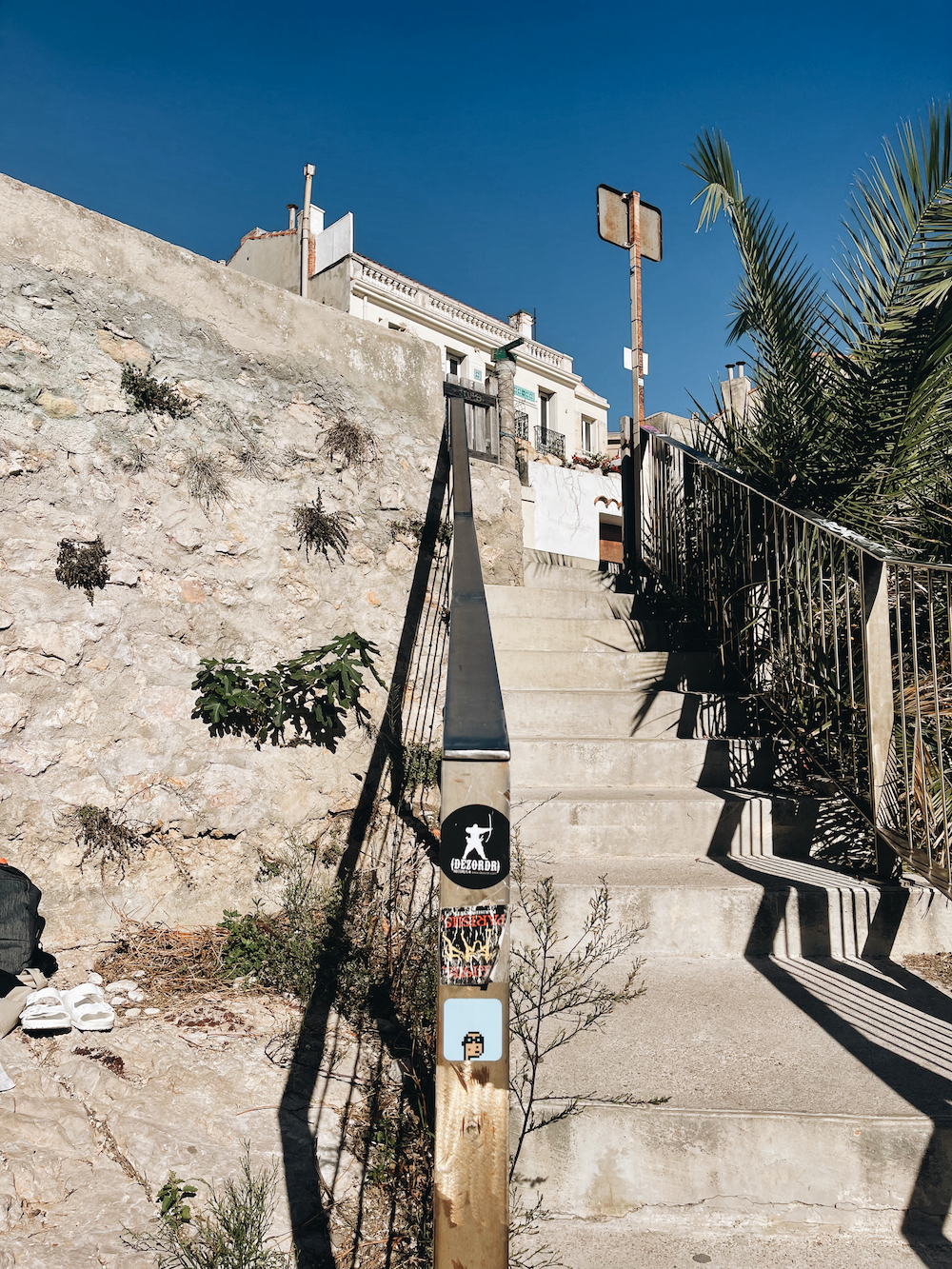
    In other words, it is a place that feels authentic. And in a world of global sameness and AI-generated simulacra, I think many of us are now seeking that authenticity — something that feels real and a little raw. Marseille has that in spades. Oh, and if any of you happen to visit la plage de Maldormé, let me know if my unauthorized sticker is still there.

    Here is NTS’s channel in case you want to check out Marseille this week.


    Cover photo by Jeet Sandhu

  • Customer-centricity reduces risk

    Real estate can be an abstract concept. If you’re a capital allocator, it might be a line item in one of your spreadsheets. Or, if you’re a developer primarily focused on zoning and entitlements, you might think in terms of gross floor area. How much density do I have, and what is it going to be worth?

    This is not to disparage any one component or participant within the development supply chain; it is simply to say that development is long and complicated, participants will naturally specialize, and everyone will have a lens through which they see things.

    But at the end of the day, these activities ultimately come back to fundamentals: the real estate needs to house people and things, and do something. Gross floor area has value on a spreadsheet because it can be turned into something. And it is ultimately that something that determines how much it is worth.

    If you’re a developer selling entitled land, your direct customer is the next developer, the one who will ultimately build out the site. Then, that developer’s customers are the people who will ultimately buy, rent, and occupy the space. And in some cases, those customers will also have their own customers, if, for instance, they choose to buy a space and then rent it out to somebody else.

    So there are layers to this. But regardless of where you might sit within the chain, I think it’s always helpful to focus on the customer, or customers. It’s harder to be wrong with your assumptions if you drill all the way down and consider the end use cases.


    Cover photo by Israel Andrade

  • A new study on missing middle building codes

    We talk a lot around here about the surprising difficulty of building small-scale apartment buildings. Here’s a post from earlier this year where I outlined a working list of policies, codes, and approaches that would need to change in order to unlock more of this housing type.

    But my list was just that — a list — and the reality is that each individual item can be shockingly complex. To that end, here’s a recent study, published by the Neptis Foundation, called “Ontario Building Code Missing Middle Study: Bridging the gap between houses and high-rises.”

    The authors are Conrad Speckert of Semibold Solutions (who has appeared on this blog in the past) and Jack Keays of Vortex Fire Consulting, and I encourage you to download a free copy. I haven’t gone through it yet, but I will, because we are actively working on projects at this exact scale.

    Enjoy the weekend.


    Cover photo by Danish Prakash

  • Standing inventory is clearing out, but a major condo supply crunch is coming

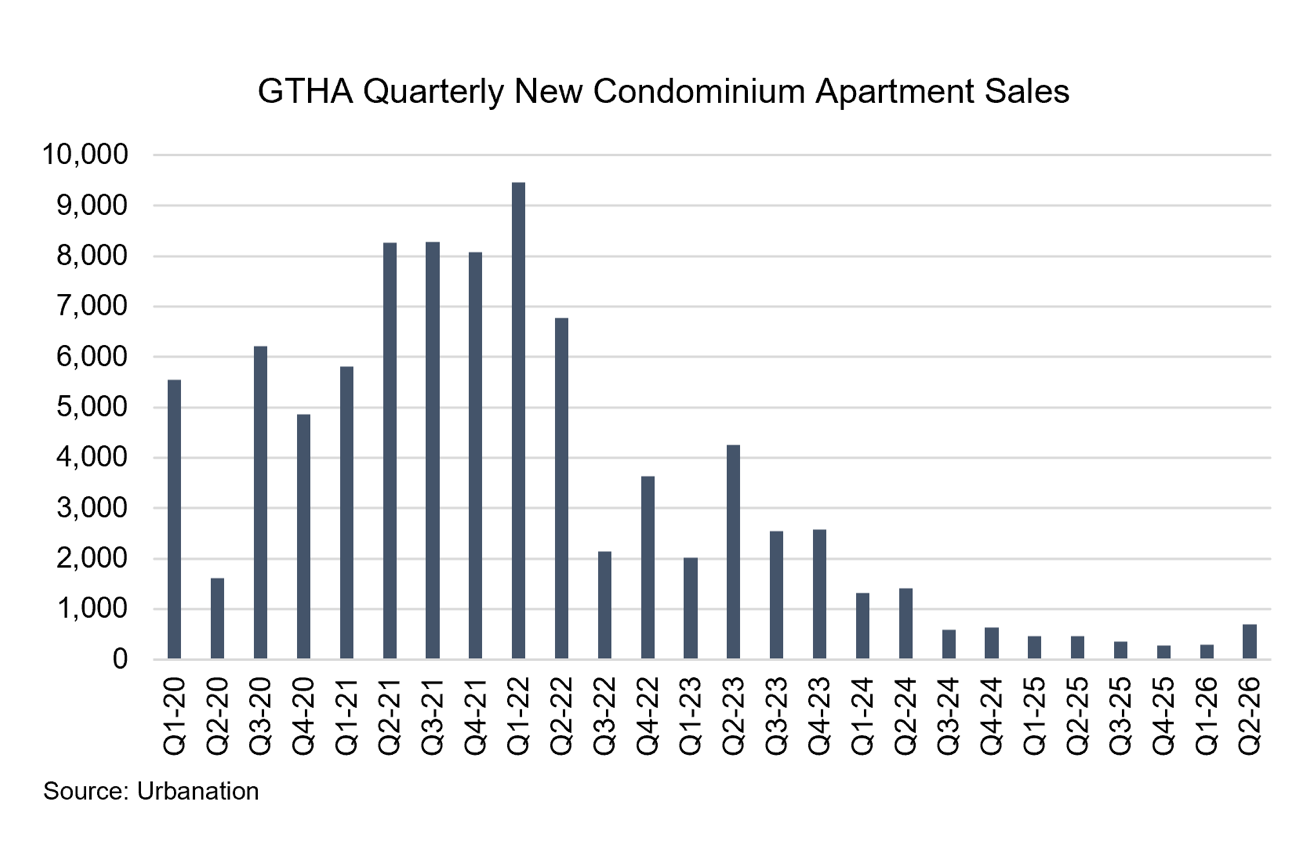
    Urbanation just released its Q2 2026 new condominium sales report for the GTHA (Greater Toronto and Hamilton Area). New condominium apartment sales posted their first year-over-year gain since 2023, with 702 home sales, representing a 52% annual increase. Anecdotally, I will also say that those of us in the industry can feel these winds changing.

    These figures are still well below the 10-year average, but the market is starting to do what it needs to do, and what the new (and cumbersome) HST rebate is intended to do. Standing inventory is getting sold, and I suspect the second half of this year will look even stronger as the industry figures out how to actually paper and administer this rebate.

    Importantly, the rebate is not helping pre-construction sales (though that’s just one factor). Q2 saw just 50 sales. Basically, nothing. This makes sense because the new rebate requires the purchase agreement to be signed before March 31, 2027. That’s not enough time for most pre-sale programs, but it does create a sense of urgency around standing inventory.

    So, what we are seeing today is a new condominium market that has refound price discovery and is starting to clear out already-built standing inventory, but one that is not producing a meaningful amount of new housing starts. As Urbanation says in its release, “condo supply is set to see its largest ever decline in the coming years.”


    Cover photo by Narciso Arellano

    Chart from Urbanation

  • Toronto needs a bold and uncomfortable 21st-century master plan

    Earlier this week, I tweeted that Toronto needs a Haussmann moment where we make some bold and uncomfortable changes in order to set ourselves up to be a dominant 21st-century global city. I mentioned Haussmann because his work is perhaps the most notable, but that is just one example.

    In addition to Haussmann’s renovation of Paris (1853-1870), I was also thinking about the Commissioners’ Plan for New York City (1811), and Ildefons Cerdà’s grid system of octagonal blocks for Barcelona (1859), as well as some more contemporary examples.

    In recent years, Barcelona has revisited its grid system and pioneered a new set of “superblocks” that focus traffic along the periphery and create pedestrian-focused spaces on their interior.

    The common thread among these examples is that they all represent a grand master plan. In the case of Barcelona and New York, it was a plan that served to guide development as the city grew. And in the case of Paris, it was a destructive plan that went back and redid what was deemed to have not been working. (In thinking about this now, it’s probably best that I used Haussmann as the example in my tweet).

    Toronto has never had such a plan. We flirted with the City Beautiful movement at the beginning of the 20th century — a movement intent on beautifying and introducing monumental grandeur to our cities — but, not surprisingly, we ultimately saw it as a superfluous and frivolous spending exercise.

    Instead, Toronto has grown incrementally, becoming what I see as an accidental global city. We are no longer the ultra-conservative, deeply Protestant city that we once were, but at the same time, it’s hard not to feel like we have a grid and public realm that doesn’t reflect the city we have become today.

    Toronto needs a bold master plan. And over the coming weeks, I’ll put some of my ideas to paper. In the meantime, if you have any of your own, please feel free to share them in the comment section below.

  • Uber and Waymo are breaking up

    The writing is always on the wall when aggressive lobbying starts. Here’s the situation. A proposed bill has been put forward that would allow autonomous vehicles to operate in Washington, D.C., updating a prior Autonomous Vehicle Act from 2012. Uber is opposing the bill, arguing that it would displace for-hire human drivers and hand Waymo a de facto monopoly in the District, according to TechCrunch.

    Instead, the company is lobbying for a system that would require robotaxis, like Waymo, to operate on a ride-hailing network that also uses human drivers. This would give consumers the ability to access both. Do I want to make small talk or not?

    Now, Uber’s position in the face of autonomous vehicles has always been that human drivers aren’t going anywhere because it’s simply too expensive to own and operate a fleet of AVs based on peak demand times. The only option is to top up the supply base with human drivers, and this is why the Uber marketplace will always remain essential.

    This narrative was initially supported by a series of announced partnerships, but now there seems to be a growing divide between the companies, and it’s not so clear that Waymo needs Uber as much as Uber would like. Because if Waymo were truly concerned about having human drivers, then the two companies wouldn’t be on opposite sides of the table with this bill. Uber knows this could be existential.

    At the end of the day, Uber disrupted traditional taxis and changed how our cities operate. Autonomous vehicles are set to do the same. Should we feel bad? Monopolies are, of course, bad. But creative destruction is not.


    Cover photo by Dan Gold