Daily insights for city builders, delivered every morning at 6 AM ET. I’m Brandon Donnelly — a Toronto-based real estate developer and founder of Globizen. I’ve been writing here since 2013.

Month: April 2026

  • Energy and AI

    April 30, 2026 · View original


    The International Energy Agency (IEA) has just published a comprehensive report on the nexus between AI and energy consumption. I would encourage you all to give it a read, or, you know, use AI to summarize it for you. It represents our reality today.

    The largest tech companies in the world spent over US$400 billion on data centres in 2025, and this number is expected to jump by 75% in 2026! The total capital expenditure of just five tech companies is right now larger than the entire global investment in oil and natural gas production.

    This is the new fuel for the world economy, and we’re going to need to figure out how to supply enough energy.

    According to the report, an individual server rack within an advanced data centre might only be the size of a refrigerator. But by 2027, it is not inconceivable that it could have a peak power demand equivalent to that of 65 households.

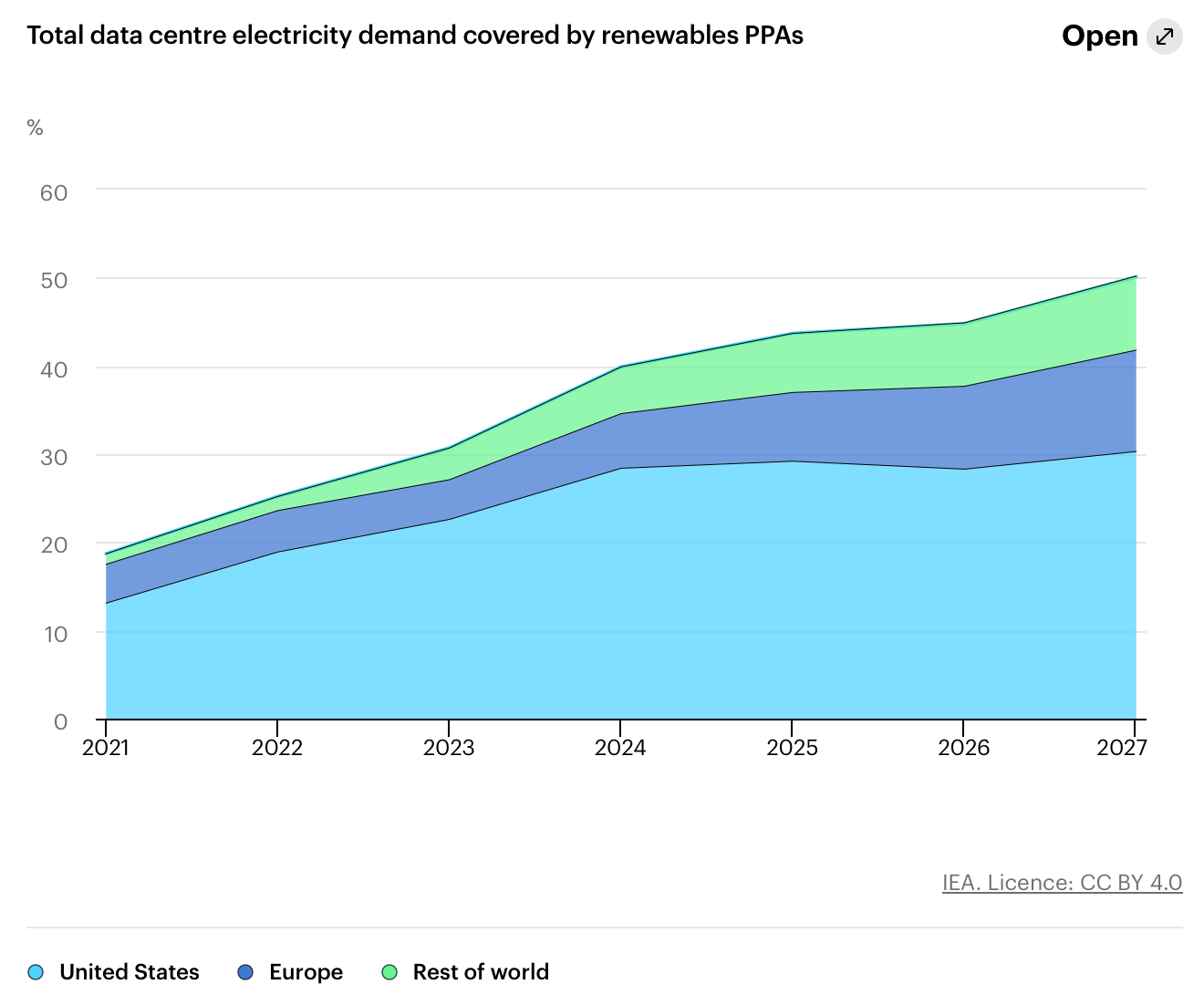
    The good news is that much of this demand is being met by renewables. Renewables are the fastest-growing source of electricity for data centres. The report estimates total generating capacity increasing at an average of 22% per year between 2024 and 2030, which will meet nearly 50% of the growth in data centre demand.

    If you’d like to download a copy of the full report, go here.


    Cover photo by Claudio Schwarz on Unsplash

  • The rules of the game are being rewritten

    Finding the silver linings in Toronto’s housing market reset

    April 29, 2026 · View original


    As a developer, or other market participant, it’s easy to be pessimistic about the current housing market in Toronto. It’s a challenge to make new projects work. That’s suboptimal from a business and city-building standpoint, and for Type A personalities who thrive on accomplishment. But today, let’s look at some of the positives and opportunities that are already here or are likely to happen going forward.

    – If you’re a developer who has been doing the same thing for decades, now is the opportunity to rethink your model and innovate. Why? Because the old model isn’t working, and who knows if it ever will again when the fun times return. – Already, we are seeing a renewed focus on end-user buyers and renters. This is healthy for the market. It signals a return to fundamentals and a deeper focus on our customers. What kind of homes do people actually want to live in? – At the same time, if you’re in need of a home, now is an excellent time to buy or rent. Similarly, for developers, now is an excellent time to buy sites, provided you’ve found a project that works or you have the balance sheet to be patient. – Modular construction and mass timber are getting a lot more airtime. They aren’t a silver bullet in this market, but these things take time and it’s positive that more developers and builders are exploring and testing out their options. – Crisis forces the hand of government. Already, we have seen a new HST rebate, cuts to development charges, and other helpful measures. I also think cities are more receptive to negotiation. If you have a wild and crazy idea that just might work, go talk to them! – As incumbents struggle with their legacy assets and deals, the market is creating more space for new entrants and fresh ideas. I have no doubt that we will see a new generation of developers and entrepreneurs emerge during the next cycle.

    Never let a good crisis go to waste, as they say.

    Would you add anything to this list?


    Cover photo by Lennon Kong on Unsplash

  • The structural reality of car dependency (including in European cities)

    April 28, 2026 · View original


    One generalized truism is that European cities are walkable and transit-supportive, and North American cities are not. This is not universally true, but it’s often thought to be directionally true. However, a recent paper called “Car Dependency in Urban Accessibility” reveals that this may not be as true as we think.

    The study introduces something called a Car Dependency Index (or CDI). What it effectively does is compare accessibility to jobs and services within a city by car versus public transit. They did this for 18 European and North American cities, and here’s what they found:

    A positive score (red on the map) means that a car can access more opportunities than public transportation, and a negative score (blue on the map) means the opposite. What’s not surprising is how car-dependent the outskirts of most cities are, including European cities. Car dependency was high in over 70% of the urban territories that they analyzed.

    What is more surprising to me is that most cities don’t have much, if any, blue. The best-case scenario seems to be a lot of white (which represents accessibility parity between cars and public transit). Hmm. Does Manhattan really not have any blue? The glaring exception is Paris and, to a lesser extent, Zurich, though keep in mind these are only city proper boundaries.

    Another finding is that car dependency remains a primary driver of car ownership, even when accounting for income. What this means is that if you took two people with the exact same income, one living in transit-rich Paris and the other living in the suburbs of Rome, the person in Rome is much more likely to own a car.

    Once again, this supports the obvious fact that if we design cities so that they’re inconvenient to navigate without a car, well, then more people will get cars. It’s not easy to build a transit network that can compete. Individual lines won’t do it. The key word is “network.” And you need the right land-use policies to support it.


    Cover photo by Alessio Ferretti on Unsplash

    Charts from “Car Dependency in Urban Accessibility.”

  • The movable icon of Paris

    April 27, 2026 · View original


    Movable chairs have been a feature of Parisian parks since the 18th century. Chairs are more comfortable than benches, and movable ones allow you to direct yourself toward the sun, cluster in groups, or just situate yourself so that you can prop your legs up and read a book.

    Now, here’s a brief story of how this came to be.

    At the outset of this innovation, park chairs weren’t free. If you wanted a bench upgrade, you had to pay. Private concessionaires would rent them out to visitors (like umbrellas at a beach), maintain them, and presumably ensure that things were kept generally tidy around the grounds.

    Then, around 1923, the iconic green Sénat chair was designed by the Ateliers de la Ville de Paris. If you’ve ever been to Paris, you know this chair (see cover photo). It comes in only three models: chair, armchair, and recliner, all of which are green. RAL 6013 green, to be exact.

    Eventually, the Sénat chair was imposed as the Parisian park chair. By 1955, it was the only possible option that could be rented out by concessionaires in places like the Jardin du Luxembourg. This set the stage for it to become one of the most recognizable symbols of the city.

    But due to the popularity of these chairs and the fact that people would rather not have to pay to sit in a park, it was decided in 1974 that the chairs should be free, and they were bought from the concessionaires.

    In 2002, Frédéric Sofia designed an offshoot of the chair called the “Luxembourg.” The Luxembourg is made of aluminum, as opposed to steel, and is therefore lighter. It’s also available for sale to the general public, whereas the Sénat chair is exclusively for city parks.

    The result of this centuries-long tradition is an iconic symbol for the city and an established culture of employing movable chairs in public spaces. A humble movable chair may not seem like a big deal, but in the world of public spaces, it is.

    Try to incorporate movable chairs into a park or public space today and, invariably, someone will tell you that it can’t or shouldn’t be done. They will say the chairs will be stolen, vandalized, and/or weaponized by hooligans. Perhaps not.

    Today, there are some 4,500 movable chairs in the Jardin du Luxembourg alone. Paris shows us that it can be done.


    Cover photo by Brigi Harkányi on Unsplash

  • How AI could strengthen our cities

    And the surprising link between railroad history and the AI era

    April 26, 2026 · View original


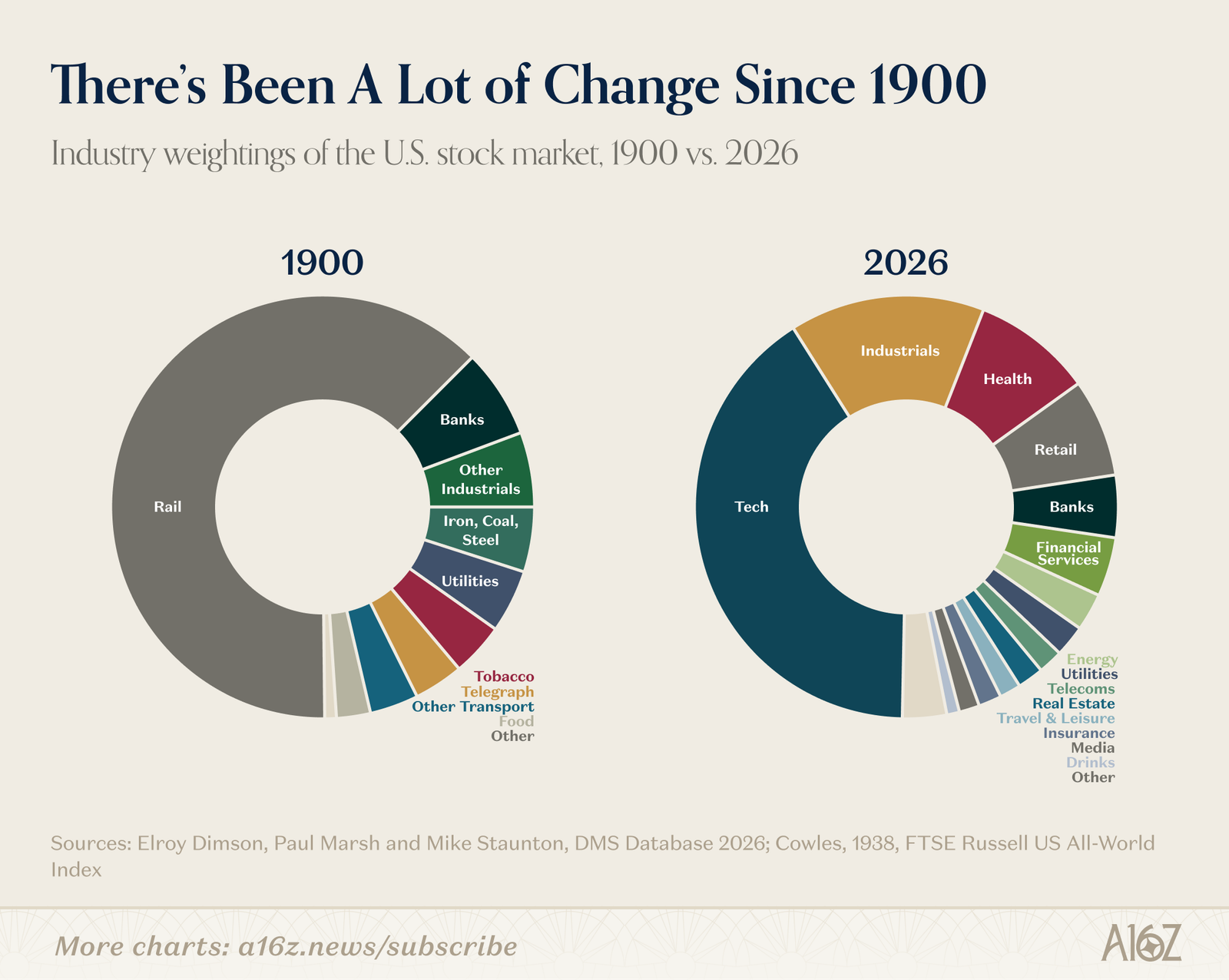
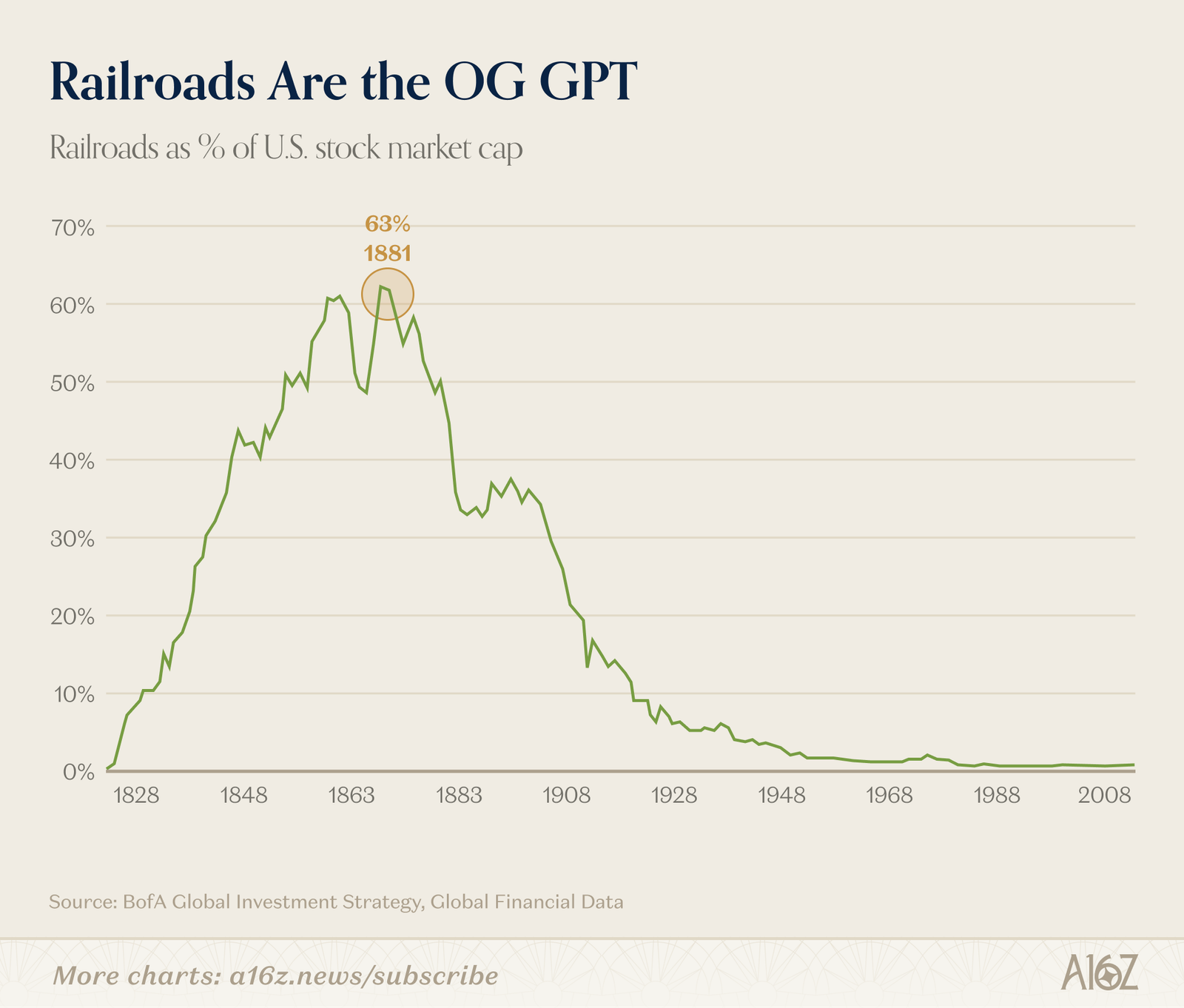
    Here are some interesting charts from a16z showing that, despite its dominance today, tech still represents a smaller percentage of the US stock market than railroads did at the turn of the 20th century. One parallel you could draw from this is that “tech” as we know it today, may not be so dominant a hundred years from now.

    But railroads continue to play a critical function in the modern economy. They are still the most cost-effective way to move heavy goods over long distances. A single freight train can carry the load of several hundred semi-trucks.

    The more interesting parallel might be the one that a16z raises in its post: railroads both led to further economic growth and rewired the way businesses and organizations were structured.

    Railroads were a new kind of business requiring massive scale and coordination, which led to new ways of thinking about “management.” Perhaps not surprisingly, it was around this time (1881) that the world’s first collegiate business school was formed at the University of Pennsylvania.

    The parallel to AI today, as argued by Jack Dorsey and maybe others, is that it’s going to similarly rewire how businesses are organized and what middle management does:

    > “Instead of absorb and route information, maintain alignment, pre-compute decisions, etc.—the kind of coordination that management typically is responsible for—in an AI business, humans move to the edges, to focus their judgment on customer contact and human interactions.”

    At least, this is the hypothesis.

    But if it does prove to be true, let’s consider what we often discuss on this blog, which is: what will it mean for our cities and built environment? Well, what I find interesting about the above quote is that it suggests AI will push humans further toward the things that we are uniquely suited to do: interacting with other humans and building meaningful relationships.

    And if that is, in fact, what happens, then there’s no more efficient place to be than in dense urban cities. Looking someone in the eyes, shaking their hand, and slurping ramen noodles together at a busy bar counter is not something that AI will be able to do for us.


    Cover photo by Mike Beaumont on Unsplash

    Charts from a16z

  • Default to yes

    April 25, 2026 · View original


    Fast, high-quality decisions and approvals are the lifeblood of organizations. And if you’ve ever worked in development or construction, you know that there are a lot of decisions and approvals — some small, some big — but all of which can delay and hurt a project. Ultimately, the objective is to achieve both high-quality and high-velocity decisions. But how?

    Very broadly speaking, you want a bias toward action and progress. How this plays out might depend on the specific situation at hand, but here’s one technique that we try to use whenever possible. I call it (as of 30 seconds ago) the “default-to-yes” principle. It works well for approvals and reviews, and it is very common in construction.

    All you need are two things: (1) a date by which something needs to be reviewed or approved and (2) a default yes. A default yes means that if I don’t hear from you by the deadline established by (1), I’m simply going to assume your answer is yes and move on. Consent is implied unless you object.

    The opposite of this is a “default-to-no” approach, which means things get stuck until someone gets around to reviewing or approving the thing. That’s far less optimal because there’s no outer limit to how long something might take. With the default-to-yes approach, I know progress will happen no later than X days from now.

    This is just one specific technique, and I’m not suggesting it will work for all decisions and approvals, but there’s significant value in high velocity. And to achieve that, you want a deeply ingrained cultural bias toward action.


    Cover photo by Rubén Bagüés on Unsplash

  • The return of hard assets

    April 24, 2026 · View original


    Back in 2011, Marc Andreessen wrote a widely cited blog post where he argued that “software is eating the world.” In some ways, it feels like just yesterday that I first read it. But it has been 15 years, and boy, has the world changed. Now, the worry is that AI is eating software.

    It has become significantly easier to write code, to the point that in the span of only two years, Google has gone from 0% of its new code being written by AI to now over 75% of it! But it’s not just big companies. I know lots of non-technical people who wanted software that could do “X,” and so they just vibe coded a solution. Done.

    In fact, I’ve been experimenting and doing the same for several months now. It has become so easy that I feel an obligation to do it. But as we know, if everyone can do it, then it means there is no longer any value. The value will necessarily need to be created in other ways.

    Earlier this week, we spoke about Uber and how being asset light — previously a hallmark of the gig economy — is potentially now a liability. Well, this is a broader theme. Josh Brown, CEO of Ritholtz Wealth Management, even coined a term for this: HALO. This stands for Heavy Assets, Low Obsolescence.

    The general idea is that you now want physical stuff with a big moat that is immune to being disrupted by someone in their parents’ basement using Claude Code. Hard assets are, arguably, where you want to be today. I guess that means real estate is back, baby!


    Cover photo by Tim Mossholder on Unsplash

  • Designing for the jobs to be done

    April 23, 2026 · View original


    I was on a panel this week, put on by BILD, called “Design That Sells.” The focus of the panel was on how innovative product design can help sell homes in the current market environment. When I was first asked to be on the panel, I thought to myself, “I’m not sure I’m qualified to talk about this right now. Market conditions, rather than design, are the challenge!”

    Of course, focusing on your customers’ needs, solving their problems, and innovating with great design is always going to be the way. I think we’ve consistently tried to do this with our projects, and so that’s what I talked about.

    But what the discussion also got me thinking about — though I didn’t mention this during the panel — is the late Clayton Christensen’s theory called “Jobs to Be Done.” I’ve written about this before on the blog, specifically about his milkshake case study.

    The key idea behind the theory is that customers “hire” products and services in order to complete specific “jobs” for them. The problem is, businesses sometimes don’t actually know the job that people are hiring for! In the case of the milkshake case study, this ended up being the job:

    > “Most of them, it turned out, bought [the milkshake] to do a similar job,” he writes. “They faced a long, boring commute and needed something to keep that extra hand busy and to make the commute more interesting. They weren’t yet hungry, but knew that they’d be hungry by 10 a.m.; they wanted to consume something now that would stave off hunger until noon. And they faced constraints: They were in a hurry, they were wearing work clothes, and they had (at most) one free hand.”

    This is why people were buying milkshakes in the morning, and why their efforts to sell more later in the day were not working. Now, let’s talk about a case study that is closer to home. If you visit the Christensen Institute’s site, you’ll find a case study of his theory from the condominium industry.

    The objective was for a Detroit-area developer to sell more homes targeted toward retirees and divorcees. They priced accordingly, had all the luxury finishes, and spent on elaborate marketing, and yet their inventory wasn’t moving. Was it a design problem? A pricing issue?

    Nope:

    > So, Moesta took a Jobs to Be Done approach: He set out to learn from the people who had bought units what job they were hiring the condominiums to do, and the conversations revealed an unusual clue: the dining room table. Prospective customers repeatedly told the company they didn’t need a formal dining room. And yet, in Moesta’s conversations with actual buyers, the dining room table came up repeatedly. “People kept saying, ‘As soon as I figured out what to do with my dining room table, then I was free to move,’” says Moesta. The table represented family.  > > What was stopping buyers from making the decision to move, he hypothesized, was not a feature that the construction company had failed to offer, but rather, the anxiety that came with giving up something that had profound meaning. “I went in thinking they were in the business of new-home construction,” Moesta recalls. “But I realized they were in the business of moving lives.”

    To solve this problem, the company offered moving services, two years of free storage, and a “sorting room” in the condominium where new owners could dump their stuff and then take their time deciding what to keep and what to discard. And it worked. Brilliant.

    Once you understand the actual barriers and “jobs to be done,” you can solve for them. Sometimes it might be a design problem, but it could be something totally unexpected. Regardless, the solution lies in caring about and understanding your customers. This is true in all market conditions.

  • When asset light becomes an asset liability

    April 22, 2026 · View original


    One of the great features of the so-called gig economy is that many of its businesses operate with an asset-light model. Uber, for instance, relies on drivers showing up with their own cars. This is the opposite of, say, the real estate industry, which, for a lot of business models, is both capital-intensive and asset-heavy.

    But there is one problem with the asset-light model, and it’s that it may not work forever. The Financial Times just reported that Uber has committed to spending $10 billion over the next few years on actual cars and on equity investments in various strategic companies.

    For instance, earlier this month, electric vehicle company Lucid announced that Uber will be investing $500 million in the company and buying at least 35,000 of its cars.

    This is gig-economy blasphemy, but it’s very obviously an existential concern for the company. Uber needs to be in the AV race, or else asset-light could be an asset-liability. The thing that helped Uber become successful in the past now seems to be what they need to overcome in this new mobility race.

    On a loosely related note, I find it somewhat amusing that cities are now starting to push back against robotaxis out of fear that they will displace Uber drivers. If you were following Uber in its early days, you’ll know that cities fought the company vehemently because of the taxi lobby. Now they’re trying to protect it.


    Cover photo by Erik Mclean on Unsplash

  • The market logic of Japanese rail

    April 21, 2026 · View original


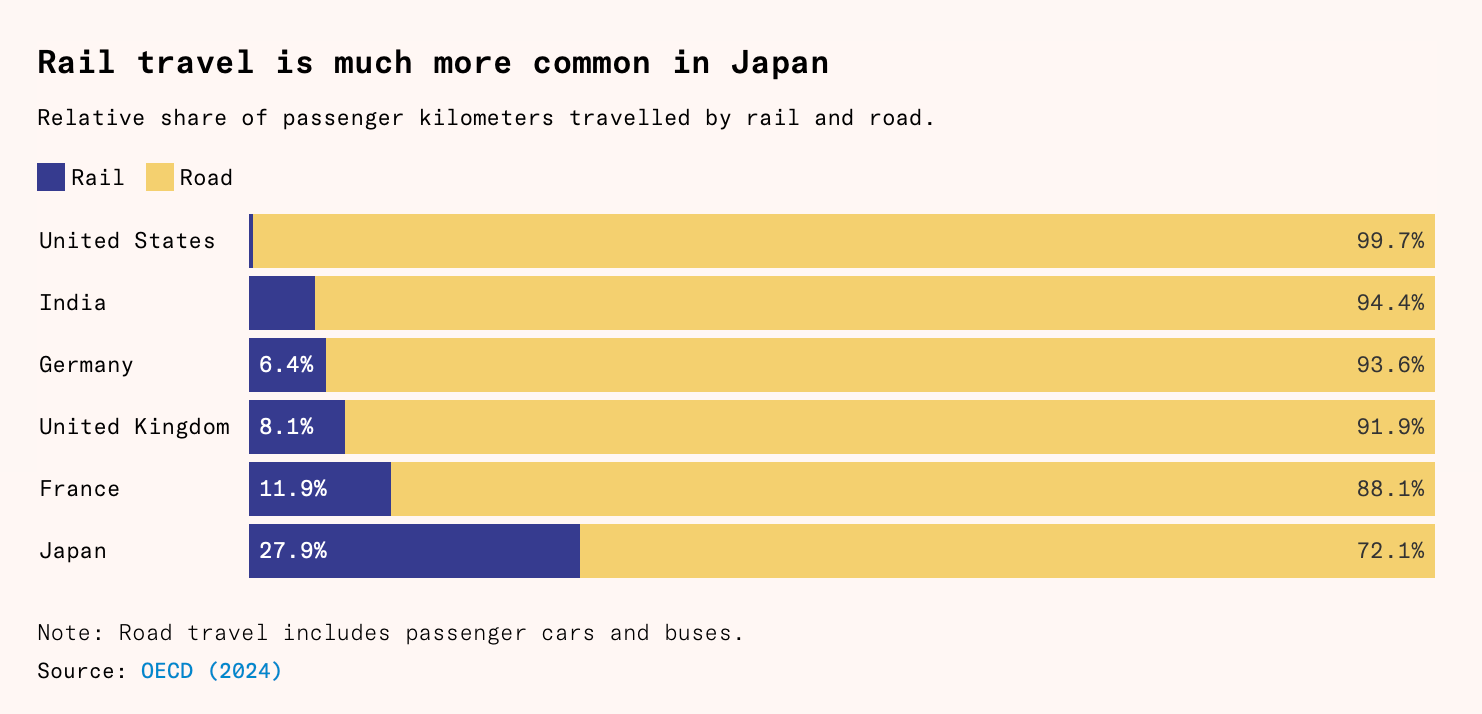
    We have spoken many times before about the fact that Japan is built around rail-oriented urbanism. But if you have the time right now, I’m going to suggest that you read this longish article by Matthew Bornholt & Benedict Springbett called “Why Japan has such good railways,” because nowhere else in the developed world uses rail for passenger kilometres more than Japan, and they explain why.

    One common hypothesis, which is mentioned in the article, is that it’s largely cultural. The Japanese are rule-abiding collectivists who are more willing to take public transit compared to us selfish and individualistic North Americans. But this doesn’t seem right. In fact, one could argue that the Japanese solution is actually more free-market oriented.

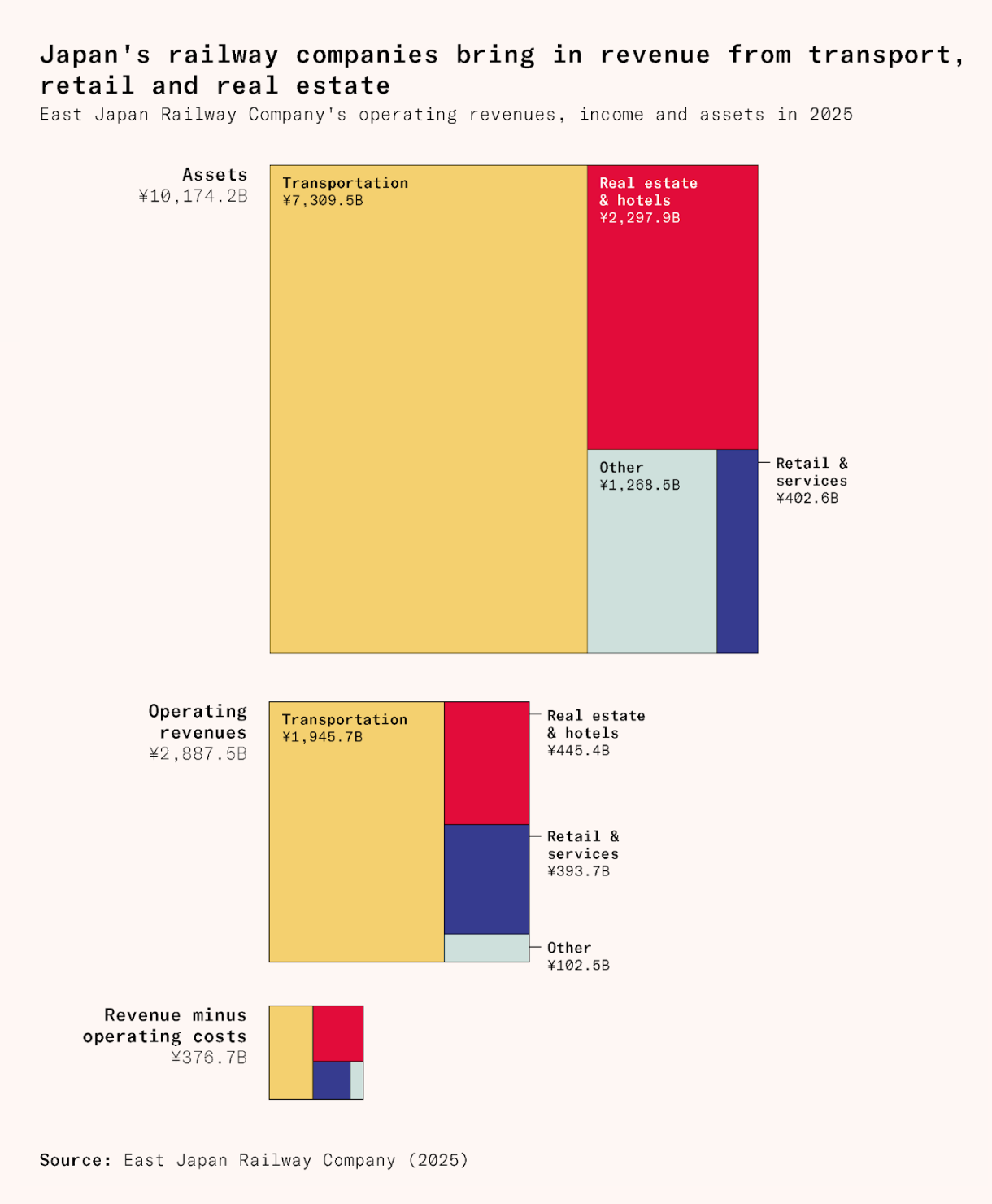
    The Japanese rail model seems to work so well because (1) most of the network is private, (2) liberal land-use policies have allowed Japan’s urban centres to develop enough density to properly support the use of rail, and (3) the rail operators make money in a bunch of other ways beyond rail. They’re typically also in the business of real estate.

    Here’s a quote from the article by the president of the Tokyu Group that I absolutely love:

    > I think that though we are a railway company, we consider ourselves a city-shaping company. In Europe for instance, railway companies simply connect cities through their terminals. That is a pretty normal way of operating in this industry, whereas what we do is completely different: we create cities and then, as a utility facility, we add the stations and the railways to connect them one with another.

    This is a fundamentally different model that allows rail companies to capture some of the value that they inherently create. To use the example of Toronto’s Eglinton Crosstown line, it’s the difference between saying, “I’m going to build a rail line and then, presumably, other stuff will happen,” and, “I’m going to develop this midtown corridor and then I’m going to run rail underneath it to maximize value creation.”

    If Japan can do it, so can we. Ironically, a big part of it means easing land-use controls and allowing transit-oriented development to simply be what it wants to be — dense and proximate to rail.


    Cover photo by Mylène Larnaud on Unsplash

    Charts from Work in Progress