Daily insights for city builders, delivered every morning at 6 AM ET. I’m Brandon Donnelly — a Toronto-based real estate developer and founder of Globizen. I’ve been writing here since 2013.

Month: June 2025

  • Building Canada with how, not why

    June 30, 2025 · View original


    The One Canadian Economy Act, which received Royal Assent on June 26, 2025, has two components to it: the Building Canada Act and the Free Trade and Labour Mobility in Canada Act. Today, I’d like to talk about the first one.

    The intent of the act is to expedite the delivery of “nation-building projects.” Projects that will strengthen Canada’s autonomy, resilience, and security, and turn the country into a global superpower (my words, not theirs).

    The government states that this might include things like highways, railways, ports, airports, oil pipelines, critical minerals, mines, nuclear facilities, and electricity transmission systems.

    At a high level, the streamlining is intended to work like this:

    – Projects first need to qualify as a nation-building project. – Then, the federal government approves the project right from the outset. – Following this a single conditions document will be issued by a new Federal Major Projects Office. This is intended to replace the current process of multiple sets of comments, conditions, and federal permits.

    Overall, the target is to reduce average approval timelines from ~5 years to ~2 years.

    What I particularly like about this sequence is that projects get “approved” right at the start. This is intended to immediately change the conversation from whether we should build to how do we build, which is an important distinction.

    As someone who manages projects for a living, I can tell you that decisive and clear direction is critical to moving projects forward. Uncertainty and indecision kill momentum and motivation within teams. You need to be able to say, “this project is going, and going fast, so focus on figuring it out and making it happen!”

    Ultimately, everything comes down to execution. But at least we’re taking positive steps toward becoming a country that once again builds — and builds big.
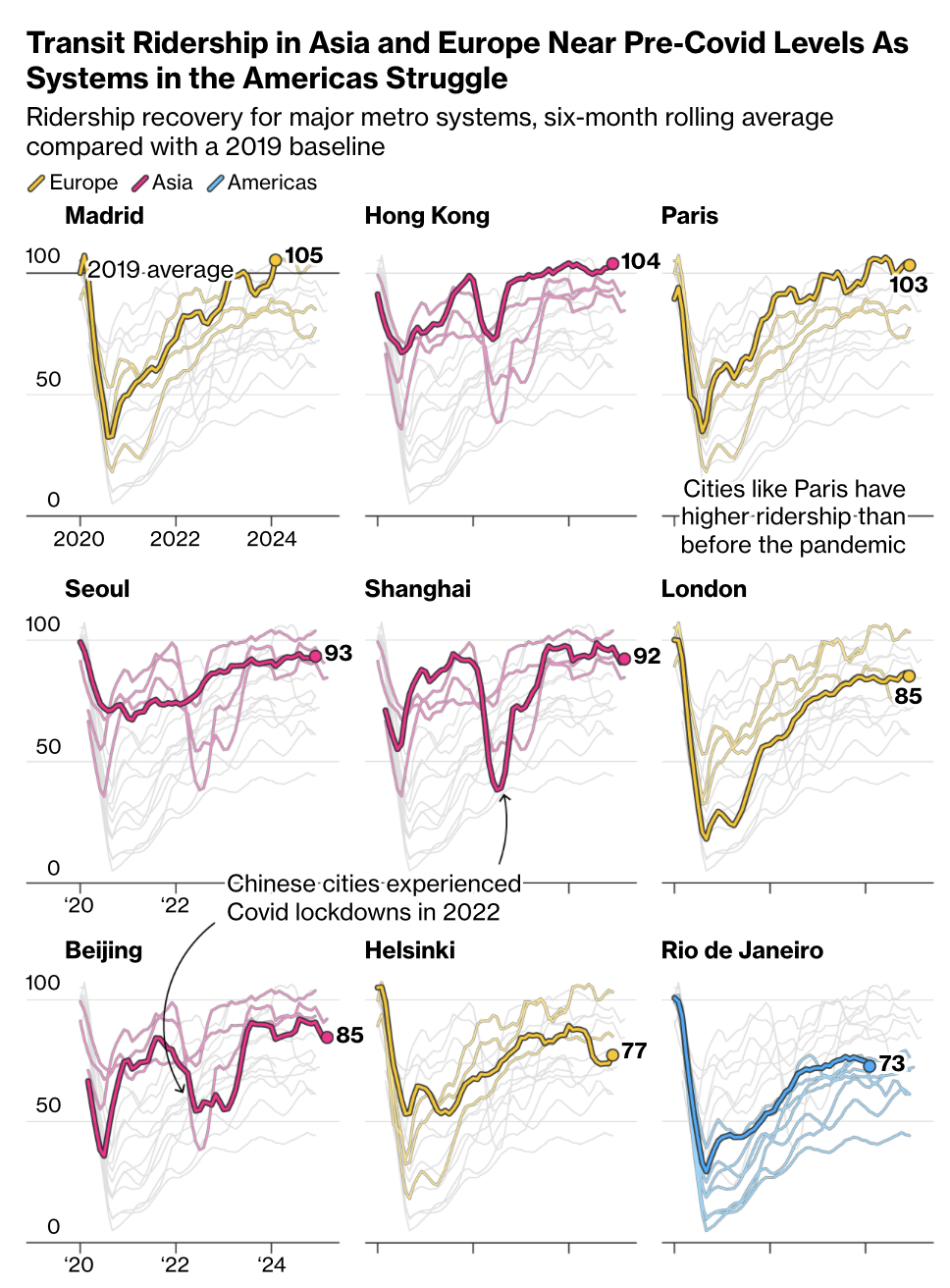
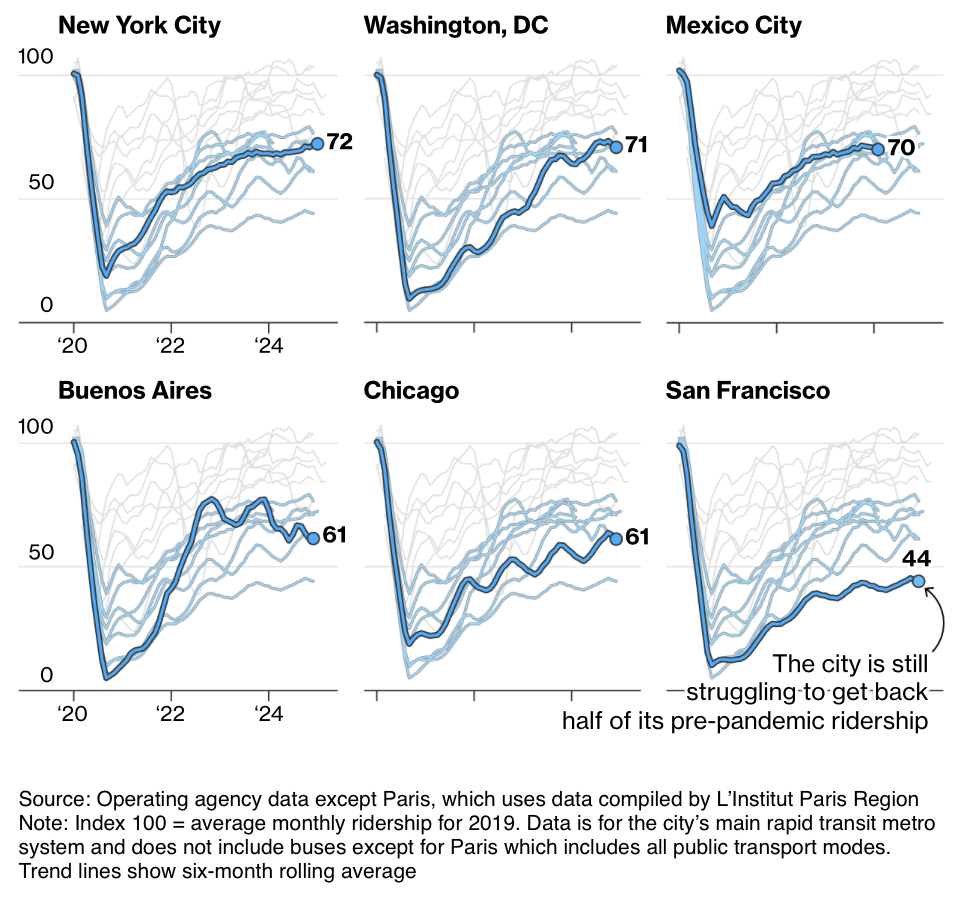
    Photo: Gordie Howe International Bridge

  • Do not freeze rents

    June 29, 2025 · View original


    > “Rent control is the second-best way to destroy a city, after bombing.” —Lawrence H. Summers

    Zohran Mamdani, the Democratic nominee for the mayor of New York City, clearly ran a good campaign. He used social media and short-form videos to find his audience and win with the message that the city has become unattainable to most.

    But it is also clear that the stock market really does not like his message. Shares of firms with exposure to New York City’s real estate market reacted immediately: Vornado Realty Trust, SL Green, Equity Residential, Empire State Realty Trust, LXP Industrial Trust, and others, were all down. At the same time, the wealthy vowed to leave New York for places like Florida, as they so often do these days.

    One of reasons for this negative reaction was Mamdani’s commitment to not just cap rent increases, but freeze rents in rent-stabilized units for the entire duration of his term. We’ve spoken a lot about rent control over the years (here, here, here, and other places) but, at a high level, the problem with rent controls is that they create a strong disincentive for landlords to invest and maintain their homes and for developers to build new homes. So what ultimately happens is that you get a more rapidly aging inventory of existing homes and a reduced amount of new supply.

    A full-out rent freeze takes this even further. A rent freeze does not mean that utility costs will also be frozen, that insurance and taxes will be frozen, that interest rates will be capped, and that all other landlord operating expenses will be restricted from inflating. (If this were the case, we really wouldn’t have market economy.) So what a rent freeze does is ensure that, in real dollars, a landlord is able to collect less money from tenants, while operating costs continue to increase under the line.

    The same is true in condominiums and other ownership structures. Whenever somebody talks about frozen maintenance or common element fees, I immediately remind them that this is a bad thing, not a feature. It means the condominium corporation is on an unsustainable path and will eventually run out of money. Something is being sacrificed in order to keep up with rising operating and capital expenses. At the very least, you need to keep up with inflation.

    I can appreciate that rents are too high. As a developer, I would love to be able to build to lower rents. It reduces absorption risk and it’s better for the city. But rather than just freeze rents, a more productive and sustainable approach would be to attack the underlying root causes for the problem. A rent freeze is a short-term political fix that will have second and third-order consequences. Problems for a different day and for a different mayor, perhaps. But problems nonetheless.

    Cover photo by Daryan Shamkhali on Unsplash

  • What is causing transit ridership to bounce back in some cities and not others?

    June 28, 2025 · View original


    Nationwide across the US, transit ridership is only at about 70% of where it was in 2019 before the pandemic. But this is not the case in all cities around the world. According to this recent Bloomberg article, Madrid, Hong Kong, and Paris are all above their 2019 ridership levels. Seoul and Shanghai are also close at just over 90%, and London is at 85%.

    So this problem of fewer people riding transit seems to be a North and South American phenomenon. Rio de Janeiro is at 73%, Mexico City is at 70%, and San Francisco is somewhere near or at the bottom at 44%. The obvious explanations for this are that Europe and Asia are generally denser and less car-oriented, their return-to-office patterns have been much stronger (less WFH), and their governments probably care more about transit (and spend more money on it).

    Broadly speaking, I think this is all true, but I’d love to know more precisely what’s driving these differences. Because it’s not exactly obvious. Consider, for example, Paris and London. Paris is at 103% of its 2019 levels, whereas London is only at 85%. Why is that? Both cities share a lot of similarities. They have a river that weaves through the middle, they’re dense, they have lots of trains, and both are alpha global cities.

    So why the delta? What exactly is Paris doing that is encouraging more transit usage?

    Charts via Bloomberg

  • Old Toronto, and then the rest

    June 27, 2025 · View original


    This week, Toronto once again demonstrated that there are two cities within our city: There’s Old Toronto and then there’s the rest of Toronto. The former generally corresponds to the boundaries of Toronto prior to amalgamation in 1998. It represents a city that was built around streetcars and subways and is therefore embedded with certain urban sensibilities. Then there’s the rest of Toronto. This part of the city ranges from being reluctantly urban to overly hostile toward it. And it shows up in many areas, from its modal split to its voting patterns.

    This week it showed up in a debate to permit multiplexes with up to six homes (sixplexes) in all residential neighborhoods city-wide. It is also important to note that adopting this zoning change is a prerequisite to the city accessing $471.1 million in funding from the federal government. But this is not how City Council voted this week. Instead, a “compromise motion” had to be put forward that isolated sixplexes to Toronto and East York District, and Ward 23 in Scarborough. In other words, we are not that far off from splitting Toronto between Old and the rest.

    I’m glad that something, instead of nothing, got done. But it’s disappointing that Mayor Olivia Chow did not stand up and show any leadership on this recommendation from planning staff.

  • Families do, in fact, want 3-bedroom homes

    June 26, 2025 · View original


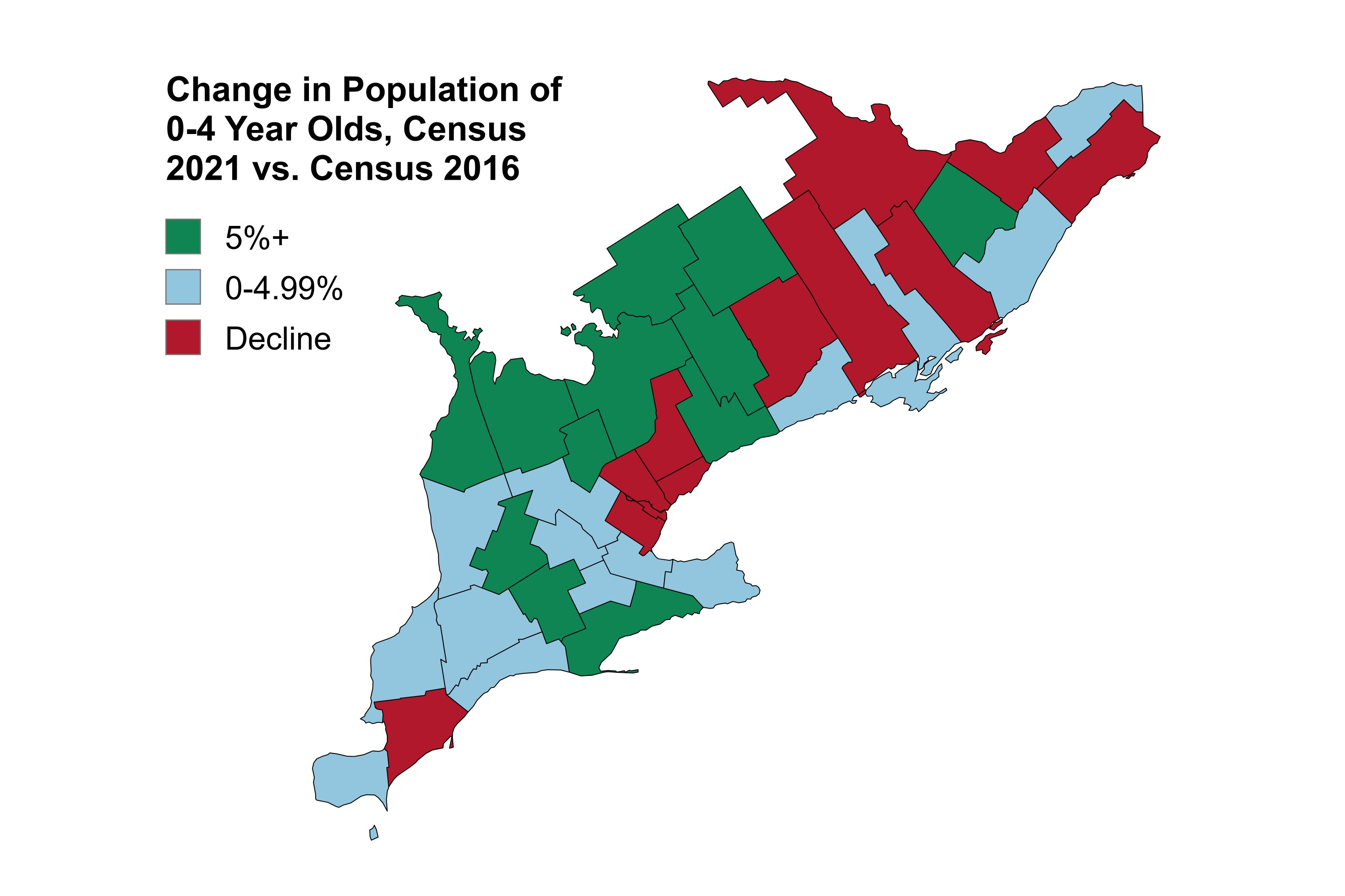
    Here’s an interesting figure from the Missing Middle Initiative showing the change in population of 0-4 year olds in Southern Ontario between 2016 and 2021:

    What this shows is that the population of young children declined in the Greater Toronto Area and in Ottawa, but increased dramatically in areas further out, such as in Lanark County (outside of Ottawa) and Oxford County (between London and Hamilton). If you know what home prices are like in Southern Ontario, then this probably makes intuitive sense to you. Families are, as the old saying goes, “driving until they qualify.”

    But let’s look at the data more closely. What the Missing Middle uncovered was that the metric most highly correlated with the population growth of children under the age of 5 was the increase in the supply of housing with three or more bedrooms. More specifically, though, it was highly correlated with an increase in the number of larger owner-occupied homes. Rental housing did not have the same correlation.

    They go on to remind us that correlation is not causation, which is true. But regardless, there’s a clear recipe here: If cities want to become more family-friendly, house more young children, and not lose them to exurban areas, then they need to figure out a way to unlock more 3-bedroom homes at price points that more families can afford.

    Note: As is typical on this blog, I am using the term home to include all housing types, not just single-family housing. A home is not a housing type. It is simply a place where people, families, and households live permanently. Associating the term home with only single-family housing creates a cultural bias that I believe is suboptimal for cities.

  • Cities are forcing short-term rentals to evolve

    June 25, 2025 · View original


    Most global cities now have restrictions, and in some cases an effective ban, on short-term rentals. Here are some examples, along with their annual nightly rental cap as I understand them (and by this, I mean what ChatGPT is telling me):

    – Berlin: Secondary residence rentals are limited to 90 days per year – London: Annual cap of 90 nights – Mexico City: Annual cap of 180 nights – New York City: Only host-present stays allowed – Paris: Annual cap of 120 nights – Rio de Janeiro: Annual cap of 90 nights – San Francisco: Annual cap of 90 nights – Singapore: Minimum stay of 3 months for private properties and 6 months for HDB properties (Singapore’s public housing authority) – Sydney: Annual cap of 180 nights – Toronto: Annual cap of 180 nights

    These rules and caps will have nuances to them. Like if you want to rent your place on the third Tuesday of a month and your property faces west and has a view of an outdoor terrace with no more than 6 brass bistro tables, you probably require a special license. Okay, this isn’t true. But broadly speaking, most cities now have strict caps in the range of 90-180 nights and differentiate between whole-home rentals and host-present stays.

    What this, of course, means is that most big cities don’t want people operating short-term rentals as a business. They’d like hosts to be people who maybe rent out their place while they’re away on vacation and/or offer up an extra room when some conference or event is taking place in town. In other words, cities do not want short-term rentals to negatively impact their supply of long-term rentals.

    It’s no wonder that Airbnb is investing heavily in both its “experiences” and “services.” It has to do this because its core “homes” business is facing significant regulatory headwinds. But what this also means is that the hospitality industry is now shifting toward other solutions — things like aparthotels/serviced apartments. These are purpose-built solutions that typically require commercial zoning.

    Globally, the aparthotel segment is expected to be the fastest-growing subset in commercial lodging for the remainder of this decade. And that makes sense. With STR regulations only becoming more stringent and with the continued rise of digital nomadism, the demand for this kind of apartment-like product is going to need to be satisfied in other ways.

    There’s clearly a market for kitchens, washing machines, and a bit more space.

    Cover photo by Aquilion Property on Unsplash

  • Do you even develop, bro?

    June 24, 2025 · View original


    In yesterday’s post I spoke about the practice of buying land, rezoning it for a higher-and-better use, and then selling it for a margin. It may not make economic sense to do this in the current market, but it remains an important step in the delivery of new homes and other forms of real assets. Before you can build, you need entitled land.

    But as I have mentioned before, there are people who look down upon this practice. They view it as a form of land speculation; one that just drives up land prices and doesn’t ultimately create anything of tangible value. They might even go so far as to say that, if this is what you do, then you aren’t actually a real estate developer!

    Of course, this would be false and it shows a lack of understanding of how development works. It’s also insulting to developers who work hard in this part of the business.

    Let’s consider Wikipedia’s definition of development:

    > Real estate development, or property development, is a business process, encompassing activities that range from the renovation and re-lease of existing buildings to the purchase of raw land and the sale of developed land or parcels to others. Real estate developers are the people and companies who coordinate all of these activities, converting ideas from paper to real property. Real estate development is different from construction or housebuilding, although many developers also manage the construction process or engage in housebuilding.

    The two most important points for this discussion are bolded. One, development includes a range of activities that might include the sale of land or parcels to others. And two, real estate development is distinct from construction or housebuilding. So the more accurate way to describe a developer who sells land and doesn’t build is to call them a developer who isn’t also a builder. It’s that simple.

    But more important than nomenclature is the fact that there’s nothing inherently wrong with securing development approvals and then passing off the land to a builder to complete the rest. Somebody has to do it.

    Entitling a site often takes years — sometimes even decades. It’s a process that creates value and serves as a prerequisite to building new homes. Whether it’s done by one company or two shouldn’t matter.

    Cover photo by Alexander Tsang on Unsplash

  • Land prices have been flat

    June 23, 2025 · View original


    At the end of last year, I wrote this post arguing that development value has shifted from land to the build. And in it, I argued that it’s no longer viable to be a high-density land developer in Toronto. The practice of buying land, rezoning it for a higher-and-better use, and then selling it for a margin, is over — at least for the time being.

    It’s also not easy to find value in the execution of new builds, but it’s a better place to be looking. Because today, as we underwrite new development sites, we are seeing land prices (on a per buildable square foot) that are similar to what they were back in 2017 when we were assembling the land for Junction House. Meaning that, in some cases, land prices have been nearly flat over this 8 year period. This is despite a total inflation rate of approximately 25% and an average annual decline in the value of money of 2.86%.

    This is not all that surprising, though. Land should, in theory, be the residual claimant in a development pro forma; so it should be one of the first things to reset during a market downturn. However, in the past, I have referred to land prices as being sticky in the face of changing cost structures, such as development charge increases and/or new inclusionary zoning policies. So which is it, Brandon?

    Well, one way I think about this is that land prices tend to be sticky in the short term. Nobody wants to immediately take a loss. And as long as prices/rents continue to exhibit strong growth, there’s a chance that these new costs will get absorbed into somebody’s pro forma and that land prices won’t need to adjust downward. But turn off demand and reverse price/rent growth, and now there’s no other option but for land prices to come down.

    This is what we’ve been seeing in Toronto since 2022.

    Cover photo by Adam Vradenburg on Unsplash

  • How Tokyo manages to be so clean without any public garbage bins

    June 22, 2025 · View original


    One city that we didn’t talk about from Monocle’s recent Quality of Life Survey, but that regularly appears on the list, is Tokyo. In this year’s ranking, it was bestowed with “best for cleanliness.”

    > All of this isn’t to say that there’s no rubbish in Tokyo but, overall, it’s much tidier than other cities of a comparable size. Tokyo spends a fortune on keeping things presentable. The Clean Authority of Tokyo’s waste management budget for the central wards is ¥105bn (€640m) this year, of which ¥83bn (€507m) is dedicated to cleaning. But the secret to the city’s sparkle is that it’s not simply the work of city employees: it’s a collective job.

    If any of you can remember my “Takeaways from Japan” post from this earlier this year, you might recall that cleanliness shows up in my first point. It is absolutely astounding that the largest city in the world — it almost has the entire population of Canada — manages to be so clean. On top of this, it manages to achieve this with almost no public garbage bins.

    If you’ve been to Tokyo, you’ll know this. There are very few places to throw out your garbage in a public space. This is perhaps the irony of Tokyo’s cleanliness. But it works because of the expectation that people will take their garbage home and then sort it according to the city’s strict separation rules. And of course, this is what people do.

    That said, there are some other reasons for the lack of public bins, namely the 1995 subway sarin attack. There remains a deep fear that garbage bins might be used to conceal a terrorist device, which is why if you do see a garbage bin, it’ll often be transparent in nature so that nothing nefarious can be concealed. But by and large, the Tokyo approach seems to work because everyone wants it to.

    This reminds me of an incident when our ski and snowboard group was there in February. We were walking around Harajuku and a few of us decided to indulge in a set of elaborate desserts involving crepes, various fruit-like mixtures, and an absolutely excessive amount of whipped cream. You know, the sort of thing you’d never order if you were at home.

    One of us ended up wearing their dessert. He had it on his face, his chest, his hands, and somehow all over this jacket sleeves. There was whipped cream everywhere. He needed to abandon ship immediately and rid himself of what remained of his dessert. Except, there were no garbage bins anywhere! This is despite being on one of the busiest tourist streets in the city (see cover photo).

    It became a mission to get himself cleaned up. But what he absolutely did not do is litter. That’s just not how one conducts oneself in Japan — with or without public garbage bins.

    Cover photo by Elton Sa on Unsplash

  • France just banned smoking in all public spaces

    June 21, 2025 · View original


    One of my least favorite things about Europe is the experience of sitting on a cafe terrace and having someone smoking beside you while you’re trying to enjoy a gelatinous pig foot from Au Pied de Cochon. (I kid; gelatinous pig foot isn’t my favorite.)

    So here’s some news: France has just announced that, starting July 1, smoking will be banned from nearly all public spaces, including parks, beaches, public gardens, and bus stops. That said, the ban does not yet include cafe terraces. So I can still expect my gelatinous pig foot experiences to be horribly ruined.

    Still, this is a giant step in the right direction, especially for a country with one of the highest smoking rates among OECD countries. As of 2023, the national average for daily smokers was estimated at 23% for adults aged 18 to 75. The region with the highest percentage of smokers was the southeast (~29.5%) and the region with the lowest percentage of smokers was Greater Paris (~21.9%).

    In addition to varying by region, smoking is also strongly correlated with socioeconomic status. INSEE, France’s national statistics agency, estimated the following daily smoking rates as of 2022:

    – 42.3% of unemployed adults – 33.6% of people in the lowest income tier – 30.8% of people without a degree (baccalauréat level) – 16.8% of people with higher education (above baccalauréat level)

    But even among high-income groups, the rates are significantly higher than what you’d find throughout the rest of Western Europe, and in places like Canada and the US. We’re in the 10-11% range. All of this is why the French health ministry is now aiming to create a generation “free of tobacco” by 2032.

    The majority of French people also seem to support this new public space ban; which maybe isn’t surprising, given that the majority don’t smoke.

    Cover photo by Marie-Sophie Tékian on Unsplash