Daily insights for city builders, delivered every morning at 6 AM ET. I’m Brandon Donnelly — a Toronto-based real estate developer and founder of Globizen. I’ve been writing here since 2013.

Month: December 2024

  • LVMH buys the Villa Bagatelle in Cannes for €46.5 million

    December 21, 2024 · View original


    One school of thought is that if you’re not in the real estate business, and you’re in some other business like fashion, then you probably shouldn’t own a lot of your real estate. The general idea is that the opportunity cost of doing so is too great; it ties up a lot of capital, taking it away from the core business.

    But then there’s LVMH.

    In 2023, the company spent €2.45 billion on real estate across the world, mostly for its retail stores. And then this week it was announced that, earlier this year, the company closed on the Villa Bagatelle in Cannes for €46.5 million. Supposedly this is one of the most expensive homes ever sold in the city.

    LVMH plans to use the 12-suite villa for brand activations during events like the Cannes Film Festival, and then rent it out when they don’t need it.

    So clearly they are of a different school of thought. They are blending experiential marketing and real estate investing, which is an interesting approach. It also makes me wonder if this has something to do with the fact that Bernard Arnault started his career in real estate.

    For more information on the Villa Bagatelle or to inquire about renting it for your next family vacation, go here.
  • Kind of like Europe, but not exactly

    December 20, 2024 · View original


    Our team has been spending a lot of time underwriting sites that would fit within the City of Toronto’s new Major Streets Study. The last time I checked these policies were still under appeal, but the expectation is that they will eventually come into force and start encouraging small-scale apartments up to 6-storeys on all “Major Streets” across the city. This is meaningful progress for our city, and we’re excited to be working on projects in this space.

    At face value, 6 storeys on all major streets sounds like every great European city you’ve ever been to. But after studying countless sites, what I will say is that these policies are not designed to recreate Paris or Barcelona or Berlin. Instead, they are intended to be deferential to single-family houses. You see this in the required setbacks and in the maximum building depth, among other things. We all know why this is the case, and it was probably needed as a first step, but I think it’s important to point out this subtlety.

    Because there are at least two effects to this: one, the end future state will not be a uniform urban street wall, like what you’d find in Europe. That is not the goal of the current policies. And two, it unnecessarily makes the smallest sites more challenging to develop. That’s a real shame, because more granularity is often a positive thing for cities. So we still have work to do. But I’m optimistic we’ll get there, eventually. City planning typically works in increments.

  • Value has shifted from land to the build

    December 19, 2024 · View original


    Before 2022, being a land developer was a perfectly reasonable business to be in. In fact, it was a lucrative business to be in. What this business entailed was buying development land, getting it rezoned for some higher-and-better use (which here in Toronto usually takes a few years), and then selling it to another developer who would then build the thing that you got approved (or something close to it).

    This kind of business practice is sometimes looked down upon by the general public, presumably because it feels like a speculative endeavor that doesn’t actually result in anything physical. But another way to look at it is that it’s just dividing up the same required work across multiple firms. Projects can take a long time and sometimes investors want their money back.

    It is also good practice to look at this option even if you aren’t a land developer, per se. One way you do this is by plugging in the market value of your land in your pro forma (not book cost). This way you can tell if your development margin is coming from your land uplift or from the build out. If most of your margin is coming from the former, then it may not be worth taking on the risk of construction.

    In any event, the problem with this business is that it no longer works. (At least not in Toronto.) Land prices are moving in the opposite direction. Without a clear understanding of potential revenues (such as condo sales), it’s very difficult to value development land. And if you can’t accurately value land, then it’s pretty challenging to run a business predicated on selling it.

    What this means is that the development margin, if any, has shifted away from land toward the full build out (or whatever else your strategy may be). It’s not enough to just entitle land. There’s lots of entitled land out there right now. That is not the constraint. The constraint is figuring out how to actually make sites feasible. And to do that, you have to roll up your sleeves and really work each project and each asset.

    Those who know how to do that will be the ones who come out ahead in the next cycle.

  • Curtain house

    December 18, 2024 · View original


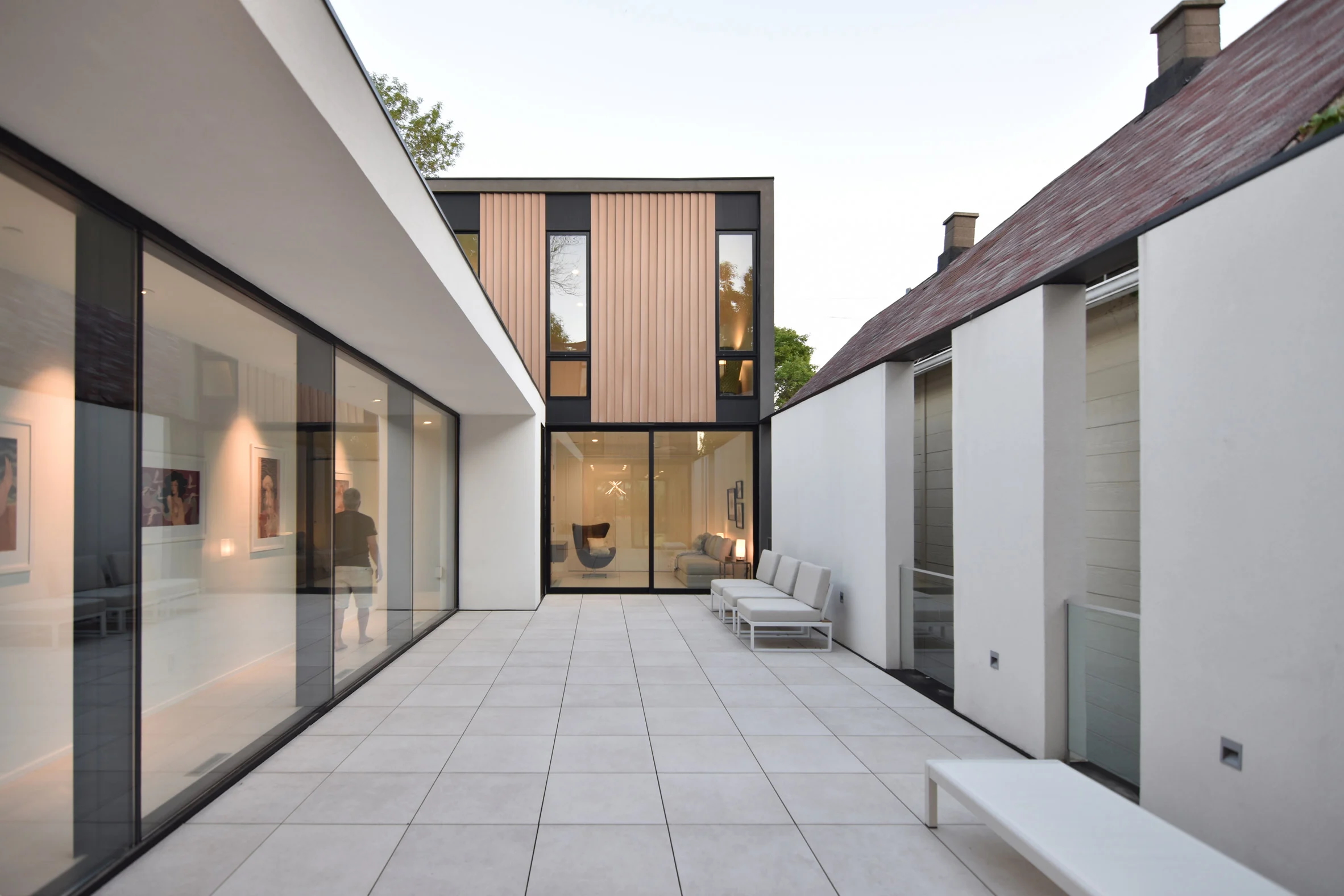
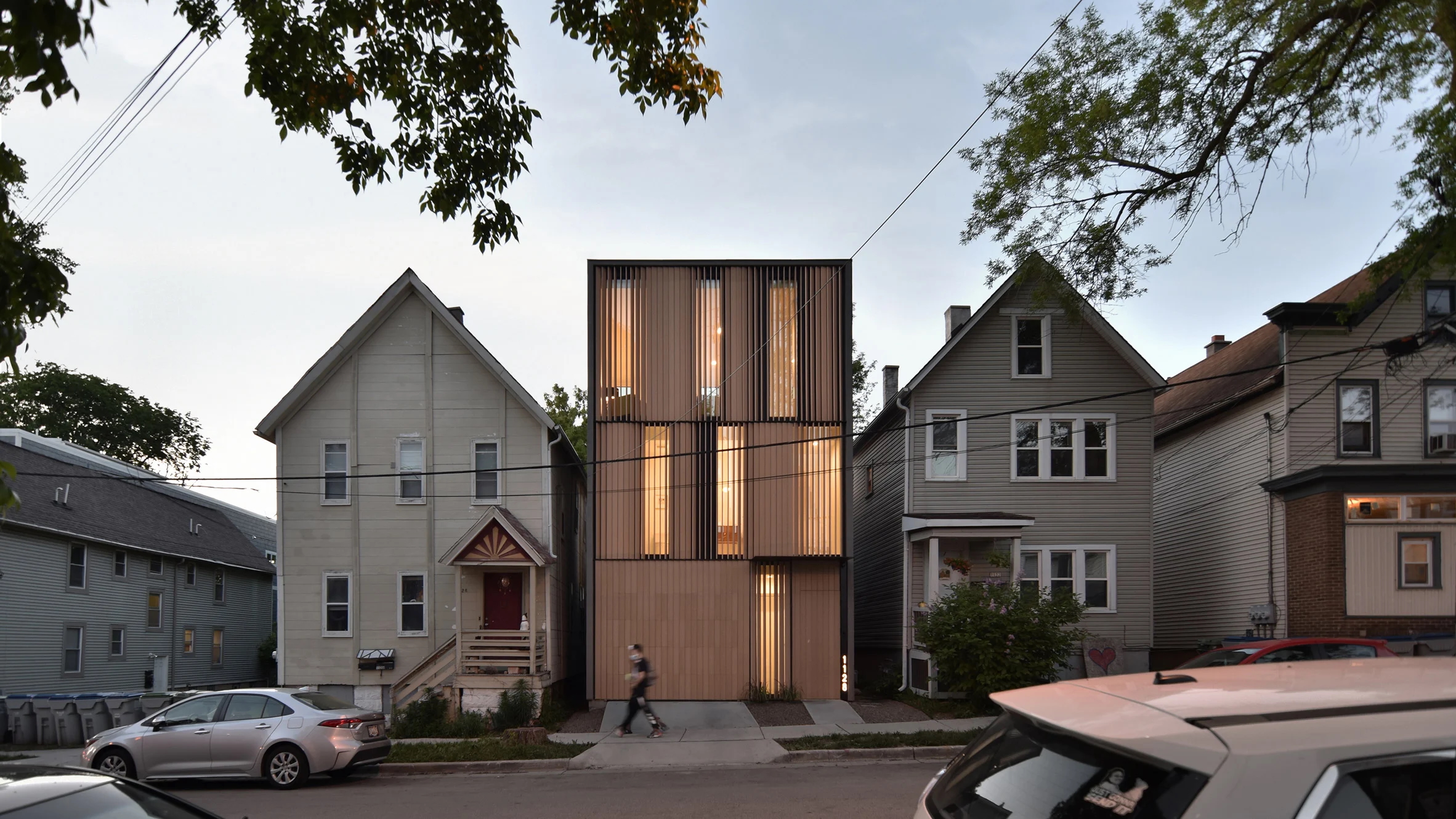
    This is a beautiful house:

    Designed by Johnsen Schmaling Architects and located in Milwaukee’s Lower East Side neighborhood, the home sits on a long 24-foot wide parcel that backs onto the Milwaukee River.

    When I first saw where it was located I immediately assumed that it was a coveted location. I mean, the backyard terraces down and has direct access to the water. But one of the things that’s interesting about this lot is that it had been sitting vacant for over two decades!

    According to the architect, the city had condemned and demolished the previous house, and so the current owners purchased the vacant lot directly from the Milwaukee Department of City Development. Every market is different.

    I don’t know Milwaukee, like at all. But I did spend a good 15 minutes street viewing the area. And I have come to the informed conclusion that this is the kind of first home you build for yourself when you’re a resolute urbanist.

    This is where you live when you don’t want to have to drive everywhere and when you want to be able to walk down to Brady Street for dinner. I respect this. So as much as I enjoy the architecture (I love a good courtyard), I think the context surrounding this build is equally interesting.

    Here is a forgotten urban lot, directly on the water, that was vacant and overlooked for over twenty years. Obviously, nobody saw any value in it. Then one day, some people came along and said “let’s create something incredible.” And that’s exactly what they did.

    This is one of the things that makes cities so wonderful. They are always evolving. And there are always opportunities that others are overlooking.

    Photos via Johnsen Schmaling Architects

  • Worried about the water

    December 17, 2024 · View original


    A friend recently asked me, “so, are you bullish on Miami yet, or are you still worried about the water?” And my response was that I love Miami, but that I do think about the risk of climate change.

    Then today, another friend sent me this study by scientists at the University of Miami showing that 35 buildings along the Miami Beach to Sunny Isles Beach coastline experienced some degree of subsidence between 2016 to 2023. In other words, they sunk into the ground a little.

    Here’s how they measured this:

    > The study published December 13, 2024, in the open-access journal Earth and Space Science, of the American Geophysical Union, employed a satellite-based technique known as Interferometric Synthetic Aperture Radar (InSAR). By combining 222 SAR images from the European Sentinel-1 satellites, the research team created a surface displacement time series. The technique utilizes “persistent radar scatterers” as reference points for measurement. These scatterers include fixed elements on a structure such as building balconies, rooftop air conditioning units, and boardwalks, which reflect the radar signal back to the satellite antenna. Satellites flying at 700 kilometers above Earth can measure millimeter-scale displacements.

    Now, some degree of subsidence is normal. But apparently, not this much:

    > “The discovery of the extent of subsidence hotspots along the South Florida coastline was unexpected,” said Farzaneh Aziz Zanjani, the study’s lead author, a former post-doctoral researcher and alumna of the Rosenstiel School. “The study underscores the need for ongoing monitoring and a deeper understanding of the long-term implications for these structures.”

    So yeah, I’m still worried about the water. It’s something I would need to get a lot smarter on in order to feel comfortable.

  • A buyer’s market in London

    December 16, 2024 · View original


    This year, 88 companies delisted or transferred their primary listing away from the London Stock Exchange. Only 18 new companies listed. This, according to FT, marks the biggest net outflow of companies since the financial crisis.

    A lot of these companies are, of course, moving their listings over to the US. The New York Stock Exchange and the Nasdaq are, by far, the two largest stock exchanges in the world by market cap. And so many companies believe that they’ll generally have a better time being listed over there — better access to capital, greater liquidity, etc.

    This is not a new trend. Last year, the FT also called out the London Stock Exchange as being the European stock exchange with the greatest risk of seeing companies depart for the US. Here’s what’s been happening since the financial crisis:

    Some people may not think that this is a big deal, but it certainly undermines London’s position as a pre-eminent global center. Most rankings of the world’s best or most global cities have London and New York out front. But from an economic prosperity standpoint, the US hegemony is real and feels even stronger right now.

    Naturally, this decline will also trickle through other parts of the economy. On the real estate side, prime central London is seeing the biggest buyer’s market since the financial crisis. (Presumably this is true of other submarkets as well.) On the new construction side, sales and starts are falling, and unsold homes sitting as developer inventory are increasing:

    It is tempting to say that London will always be London. But:

    > “The UK market does not have any god-given right to be a leading listing venue, [but] it requires nurturing and support to be successful in a market that is increasingly global,” said Hall, adding that “more companies will depart” unless action is taken.

    This is true of every city and every industry. There are no guarantees. Cities need to compete, just as companies compete. I am also of the opinion that Brexit has and will continue to be a drag on the UK economy. Disclaimer: I’m not an economist. But the UK is a relatively small country. So intuitively, I would think that the way to compete with the scale and dominance of the US is through a more unified Europe.

    Are you bullish or bearish on London right now?

  • Is it true that the majority of Americans prefer to live in spread-out communities?

    December 15, 2024 · View original


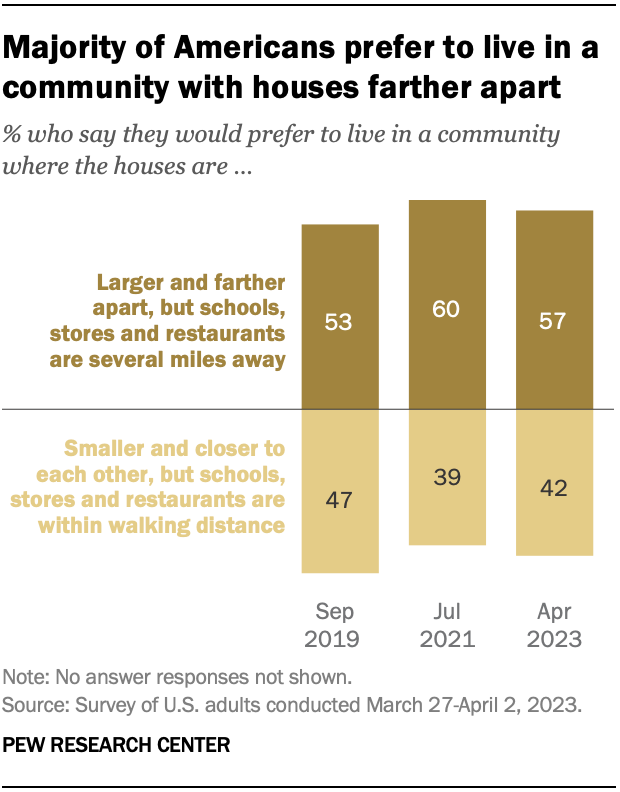
    Last year, Pew Research Center asked over 5,000 adult Americans whether they would rather (1) live in a community with smaller houses that are within walking distance of schools, stores, and restaurants, or (2) live in a community with larger houses, but where schools, stores, and restaurants are several miles away. The result:

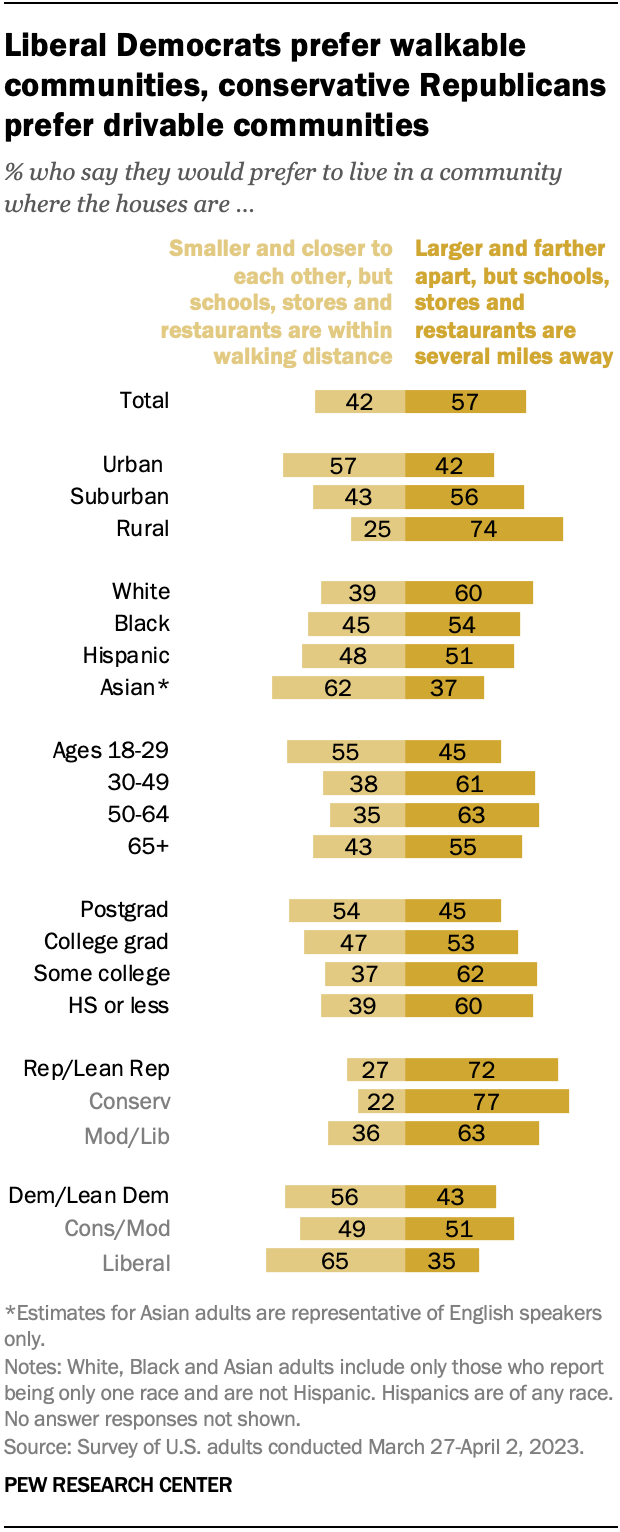
    On average, most respondents preferred the latter option — the larger home. However, there are some demographic groups that feel differently. If you’re young (under 29), highly-educated, Democratic-leaning, and/or Asian, this survey suggests that you have a preference for smaller houses in more walkable communities.

    More specifically, in this chart, it’s interesting to note that 62% of Asians (survey only counted English speakers), 55% of those aged 18-29, 54% of those with a post-graduate degree, and 65% of liberal Democrats prefer denser places that allow you to walk to more places.

    A lot of this isn’t surprising, but I don’t think I’ve seen data supporting such a strong leaning from Asian adults before. What makes this even more interesting is that White and Asian households are by far the two richest ethnic groups in America%20was%20much%20less.). And here, when it comes to built form preferences, they’re on opposite ends of the spectrum.

    Another important consideration is the cost of living in walkable versus car-oriented communities. Generally speaking, the latter is less expensive on a cost per square foot basis for homeowners; though, this obviously doesn’t include the indirect costs of transportation and the additional time it to takes to commute places.

    It is also more expensive to service and bring infrastructure to more spread-out communities. There are real economies to density. Despite this, higher-density living tends to be more expensive. Part of this has to do with higher build costs and more restrictive zoning, but it could also be a scarcity of supply (most of the US is car-oriented).

    Indeed, there is a well-established premium to living in walkable communities, which creates an interesting dynamic. The thing that the majority of people reportedly don’t want or don’t prefer is actually more expensive. This always makes me wonder: What if this wasn’t the case? What would happen if we didn’t have this cost-of-living differential?

    Charts from Pew Research Center; cover photo by Dmitry Tomashek on Unsplash

  • What a beautiful corner

    December 14, 2024 · View original


    I was out on College Street this week for our team Christmas dinner, and on my way to the restaurant I passed the southeast corner of College and Euclid. Specifically, 533 College Street, pictured above. And as I was passing by, I immediately thought to myself, “my god, this is a really beautiful corner and building.”

    Now, I know the building. I’ve been in it before. It’s about 3,500 m2. And in 2022, WZMH Architects (who is also the Architect of Record for One Delisle) completed a renovation of it for Akelius. But it was looking particularly beautiful the other night.

    Liu Loqum Atelier (a Turkish bakery) is now in the ground floor retail space and they did a wonderful job with their fit out. The entire space was glowing and the ground floor felt grand.

    The building itself is also just a bit taller than what you typically find on Toronto’s main streets, and that gives the entire street a more urban feel. I’d argue that it’s not tall enough, but still, it gives you the feeling of an urban fabric with a bit more grandeur.

    So in the end, I came away thinking about how much better Toronto will be once we have more buildings akin to this one, all across the city. Add in some more floors (with no stepbacks, of course) and you have a tried-and-true urban formula that is hard to beat.

    Photos via WZMH

  • Health is the ultimate luxury

    December 13, 2024 · View original


    > “Modern luxury is the ability to think clearly, sleep deeply, move slowly, and live quietly in a world designed to prevent all four.” -Justin Welsh

    Here’s a question for you: Would you rather have the car of your dreams or would you rather live longer? (Maybe you don’t care at all about cars and so this is an easy question, but bear with me, I’m sure you get the point.) This is a question that was posed to the audience at Elevate earlier this week and the entire room responded by saying that they would choose the latter. This is perhaps obvious. What good are material possessions if you don’t have your health? But it’s still an important frame of reference. And it’s why Brazil-based developer AG7, who was at the conference, has centered their entire practice around “building wellness.” Forget the fancy brands. Their buildings are focused on one thing: to help you live better and longer. This, to me, is a compelling value proposition. Because I think there’s an easy argument to be made that there’s no greater luxury than our own health and wellness.

    Cover photo by Alex Perri on Unsplash

  • Bookings are now open for Parkview Mountain House

    December 12, 2024 · View original


    For the last 16 years, I have been going on an annual ski and snowboard trip with some of my closest friends from Penn and from Toronto. Two years ago we went to Park City. Last year we went to Les 3 Vallées. And this winter we’ll be going to Hokkaido, which has been on my bucket list for a very long time. I enjoy doing a lot of different sports, but nothing comes close to snowboarding for me. It’s my first love. There’s just something about being in the mountains. So I look forward to our “annual” all year.

    Because of this, I have long had the goal of building a house and short-term rental in the mountains. Firstly, I felt that there weren’t a lot of design-focused options in many mountain towns. You know, something clean and minimal. And secondly, I wanted a place that could embody and share our love of the mountains with others. As many of you know, this resulted in Parkview Mountain House. Globizen partnered with two regulars on the trip and we created what we refer to as a “creative retreat.”

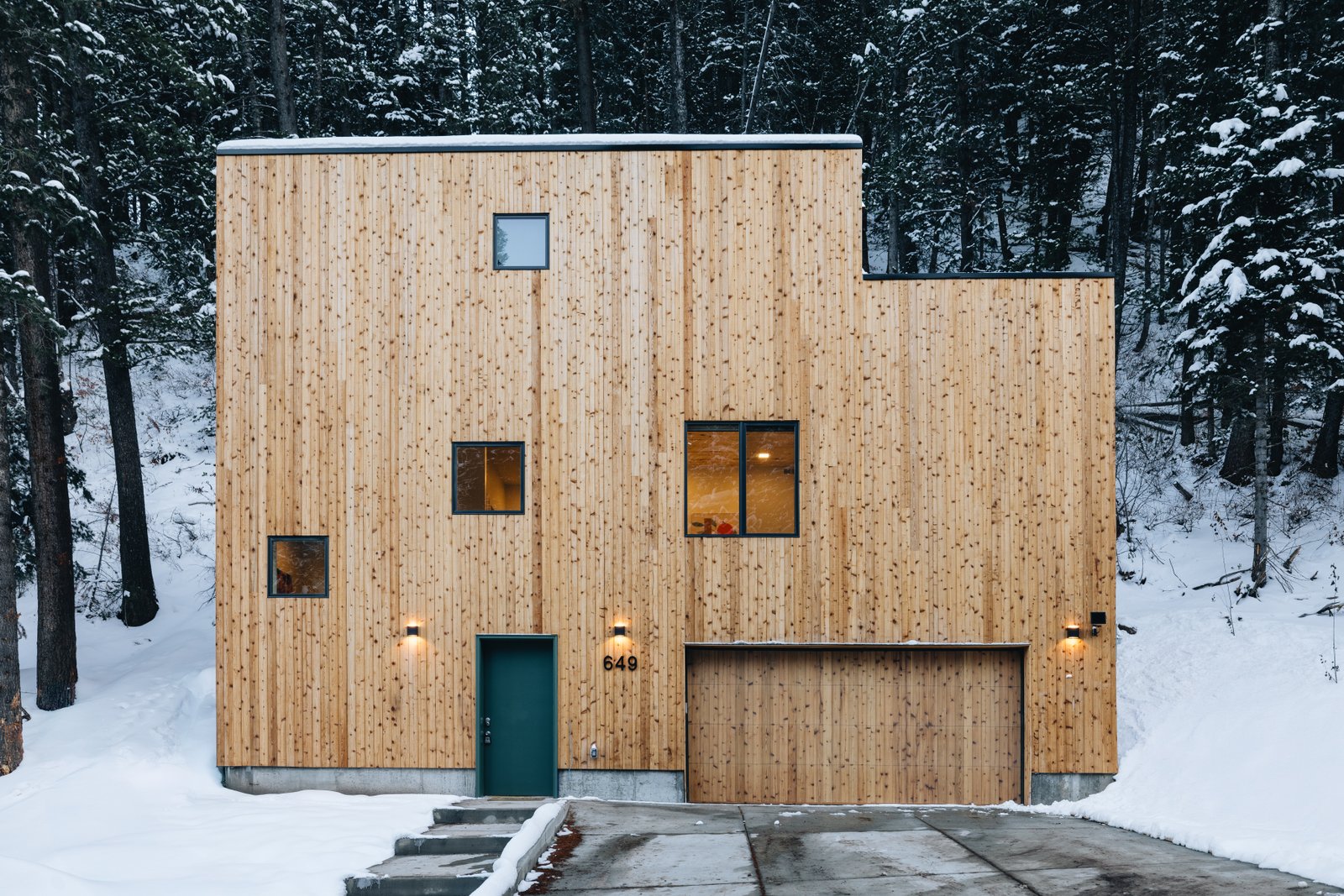
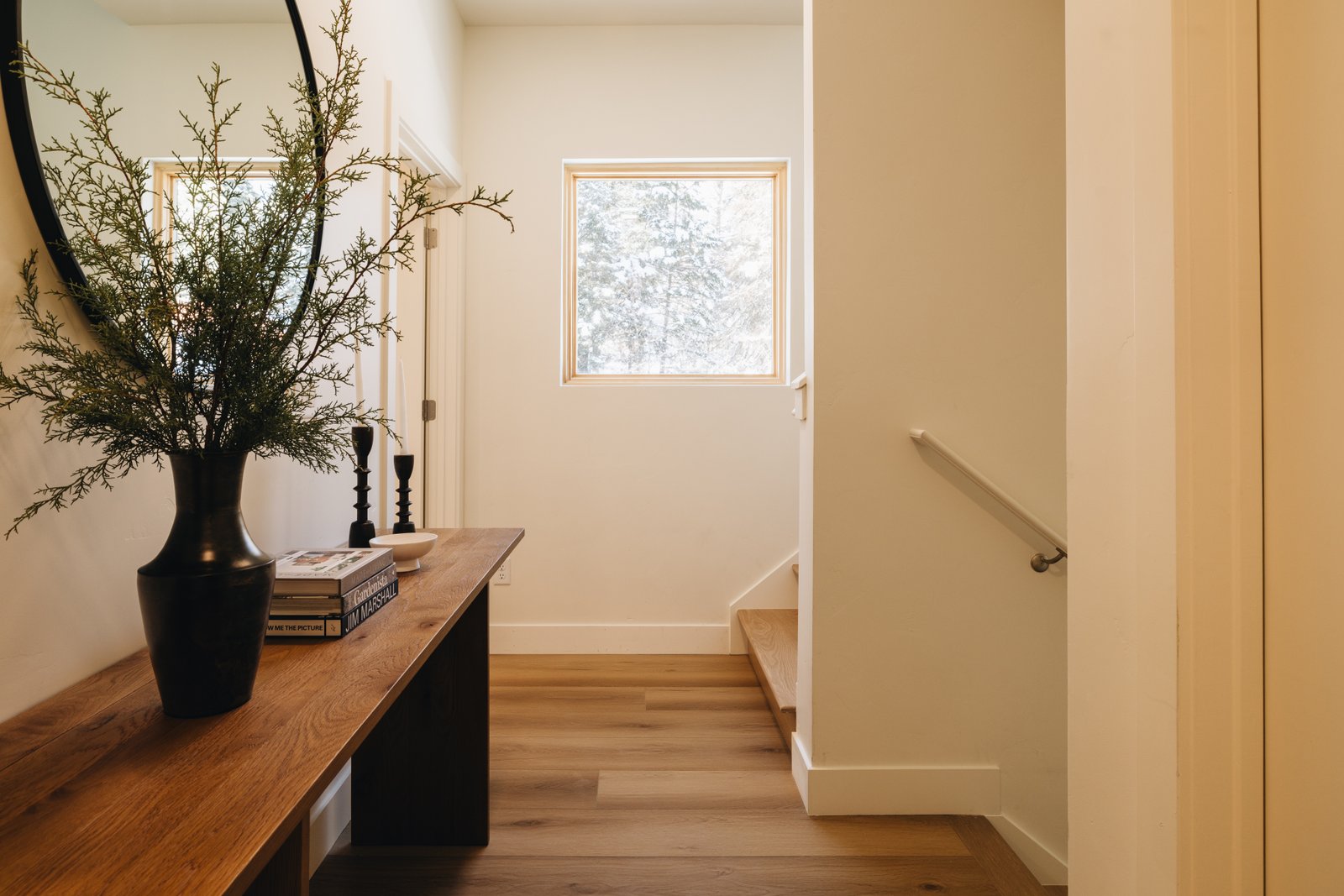
    Here are a few photos of the house:

    Today, I’m super excited to announce that bookings are now open at PMH! If you’d like to book a stay, you can visit AvantStay’s website (who is our hospitality manager) or you can book through Airbnb, if you prefer that. Because we’ve just gone live, all of the rates are at an introductory level while we build up our initial review base. So now is a good time to get something in the calendar this winter (or next summer which is also a really beautiful time). Neat B and I, and a few friends, will be there later this month and we can’t wait.

    Cover photo by Alex Moliski on Unsplash